The Cudahy School Board has voted to close one of its elementary schools and send those students to another elementary school while three other merger proposals have failed.
At its Dec. 13 meeting, the board voted unanimously to close Park View Elementary at the end of the 2021-22 school year and send Park View students and staff to General Mitchell Elementary and reduce overall staffing within the district.
A proposal that would have closed Kosciuszko Elementary at the end of the 2021-22 school year and sent students and staff from that school to J.E. Jones Elementary and Lincoln Elementary, as well as to reduce staff, failed by a 4-3 margin. Board members Linda Kutka, Dennis Carney, Joan Haske and Michael Johnson voted against the proposal while board members Laurie Ozbolt, Chris Galewski and Rhonda Riccio voted for it.
A similar motion that would have closed Kosciuszko Elementary, in this case at the end of the 2022-23 school year, merged the school’s students and staff with J.E. Jones Elementary and Lincoln Elementary School, and accepted district administration recommendations for budget reductions throughout the district also failed 4-3. Carney, Haske, Johnson and Kutka voted no while Galewski, Ozbolt and Riccio voted yes.
A third proposal that would have sent sixth grade students back to elementary school buildings starting in the 2022-23 school year, as well as closed Cudahy Middle School and sent seventh and eighth students to Cudahy High School starting in the 2023-24 school year to create a seventh through 12th grade secondary school, also failed 4-3. Galewski, Haske, Kutka and Riccio voted no while Carney, Ozbolt and Johnson voted yes.
The decision to close Park View Elementary comes after a similar decision was considered in May but failed by a 4-3 vote. The board at that time had considered, along with closing Park View, starting a Montessori program. During that same May meeting, it voted to consider a virtually identical plan later and have an independent firm perform a land valuation on the elementary and middle school buildings and the land they sit on.
In a Nov. 8 email, Cudahy superintendent Tina Owen-Moore said any discussions about what to do with the buildings would wait until decisions were made on the mergers.
The district considered the mergers as it tries to resolve budget issues it says are caused by declining enrollment and state aid, as well as rising costs.
In May, Owen-Moore said that the district was anticipating more declining enrollment and wanted to be proactive. She said at that time the district reviewed its budget in January to determine changes it needed to make before the district’s current $11.75 million operating referendum ends in 2025 to avoid the possibility that continued declining enrollment could put the district in a similar position again.
Yalonda Chandler homeschools her children, Madison and Matthew. She co-founded Black Homeschoolers of Birmingham, in Alabama, and has seen the organization grow since the pandemic began.
Kyra Miles/WBHM
hide caption
toggle caption
Kyra Miles/WBHM
Yalonda Chandler homeschools her children, Madison and Matthew. She co-founded Black Homeschoolers of Birmingham, in Alabama, and has seen the organization grow since the pandemic began.
Kyra Miles/WBHM
It’s a common perception that white, evangelical families are the most likely to homeschool their children. But a growing number of Black families have started teaching their kids at home — especially during the pandemic. The Census Bureau’s Household Pulse Survey found that in April 2020, 3{e4f787673fbda589a16c4acddca5ba6fa1cbf0bc0eb53f36e5f8309f6ee846cf} of Black households homeschooled their children, and by October 2020 it was up to 16{e4f787673fbda589a16c4acddca5ba6fa1cbf0bc0eb53f36e5f8309f6ee846cf}.
Those numbers may not be completely accurate, the Bureau noted, because a lot of children were learning at home in 2020. So part way through the survey period, the homeschooling question was expdanded to clarify that homeschoolers did not include children enrolled in public or private school. Even so, the numbers signal a significant increase.
Joyce Burges, founder of National Black Home Educators, said that since 2020, thousands of families have joined her organization.
“I think you’re going to see more and more parents, Black parents, homeschooling their children like never before,” Burges said.
“COVID was the catalyst”
Didakeje Griffin in Birmingham, Ala., is one of them. When she and her husband realized their kids wouldn’t be going back to public school in March 2020, they knew they had to make a change.
“It was like a light bulb moment,” Griffin said. “Ultimately, what I realized is that the pandemic just gave us an opportunity to do what we needed to do anyway, which is homeschooling.”
The mother of two said she’d always coached her kids at home to keep them on track. But three things made her decide to officially start homeschooling. First, she wanted her children to be safe from bullies. She also wanted them to understand their cultural history. The third factor was freedom.
“I want to have time to cultivate my children’s African-American, their Nigerian history and culture in them first, before anybody tries to tell them who they are,” Griffin said. COVID was the catalyst, “but it has not been the reason that we kept going.”
The Griffins celebrate Juneteenth more than July Fourth. They have discussions about the Black Lives Matter movement and talk about critical race theory with their children, ages 11 and 8. Griffin sees homeschooling as a way to protect her children.
“I don’t want my kids to be subjected to racism in certain ways so early,” she said.
Homeschooling as activism
In Black households, homeschooling can be its own unique form of activism and resistance.
“The history that’s taught is that we’ve tried through Brown v. Board of Ed to get access to schools, and schools are integrated,” said Cheryl Fields-Smith, a professor at the University of Georgia who studies Black homeschooling and its cultural significance.
“And that’s true,” she added. “But we’ve also always been self-taught.”
Fields-Smith said homeschooling is a way to combat educational racism, which comes in many forms.
“We all know that there are structures and policies and practices within our traditional schools that can be damaging to students of color, Black students in particular,” she said.
School discipline is one of them. Data from a 2014 study by the U.S. Department of Education Office for Civil Rights showed that Black students were suspended at three times the rate of white students, and were more likely to be reprimanded. A 2015 study from the Association for Psychological Science found that Black students are more likely to be labeled “troublemakers” by teachers.
These statistics can make parents and caretakers of Black children distrust the education system. In the last couple years a number of states have moved to add more Black history into their lesson plans. Still, earlier this year, Alabama and a handful of other states banned critical race theory in K-12 classrooms, even though it’s an academic theory of structural racism that is largely taught at the university level.
“This idea of white supremacy and the inferiority of Black people lingers today,” Fields-Smith said. “We are overcoming racism through homeschooling. I don’t think white people can say that.”
A growing community
Some families are also creating community through homeschooling.
In Alabama, Alfrea Moore said homeschooling her children for the last three years has given them the freedom to ask questions and learn without a strict curriculum. It’s also allowed them to connect with their culture.
“The thing about homeschooling in the South as a Black family that I’m finding is that there are a lot more of us than we actually know of,” Moore said.
“When we moved to get my kids to interact with other kids, there are networks of homeschoolers and Black homeschoolers in not just this part of Alabama where we live, but all over.”
Carleigh and Alexander Duckworth get some play time as part of their homeschooling day. Their mother, Jennifer Duckworth, is a co-founder of Black Homeschoolers of Birmingham.
Kyra Miles/WBHM
hide caption
toggle caption
Kyra Miles/WBHM
Carleigh and Alexander Duckworth get some play time as part of their homeschooling day. Their mother, Jennifer Duckworth, is a co-founder of Black Homeschoolers of Birmingham.
Kyra Miles/WBHM
Jennifer Duckworth and Yalonda Chandler co-founded the Black Homeschoolers of Birmingham three years ago so more homeschooling families of color could find and support each other.
Duckworth said she started homeschooling because she was concerned that if her son were in public school, he would start to withdraw.
“My son, being a young Black boy with positive self-esteem about himself, can sometimes be threatening, for lack of a better word, to some teachers,” Duckworth said. “They’ll create an identity for the Black and brown children that they don’t even realize they’re doing.”
Duckworth said the Black Homeschoolers of Birmingham has created a community where children don’t feel different because of their race.
Her 10-year-old son, Alexander, agrees. “It just feels great to be around kids like me so you don’t always have to be alone, like the odd person out,” he said.
Duckworth has been homeschooling her three children for several years. They participate in a lot of the Black homeschooling group’s activities, like the debate club and field trips.
Last month the group held its first homeschooling summit. The founders said in just three years, the Black Homeschoolers of Birmingham has grown from two families to 70.
“Black families, they understand now that they don’t have to be trapped in a system that overpolices them, that marginalizes them, that makes their children feel criminalized for just being who they are,” said Chandler.
For a long time, the U.S. had barriers that made it hard for Black people to get an education, so learning and knowledge were always shared within the community.
“The African-American and African culture, we are the culture that has been homeschooling our children since the beginning,” Duckworth said. “And so I feel like it’s just in our DNA.”
When the pandemic hit in 2020, production work in the taconite mines in northeastern Minnesota slowed way down. Yet mining companies still needed to provide health and safety training to their employees. With lockdowns in place, how were they going to do that?
Since the 1970s, this training had been provided by the miner safety and health training program through Minnesota State’s five northeastern Minnesota colleges. The federal Mining Safety and Health Administration (MSHA) mandates that all such training must be done in person. That requirement was rescinded temporarily in the spring of 2020, and courses shifted to 100 percent online. As Hibbing Community College safety and health instructor Eric Lund notes, “We’re still in that status as we speak.”
During the pandemic, about 4,200 students have been trained. Minnesota State’s training program also has extended its reach, providing its health and safety courses to students in other states—and in Iceland and New Zealand. The program has had international trainees before, but they had to fly in for a couple of days of face-to-face sessions. Now, Lund says, “they can do that training virtually from their home countries.”
Online education wasn’t invented in response to the pandemic. Minnesota’s colleges and universities had been offering virtual courses and degrees for several years before the coronavirus reared its ugly, spiky head. But in March 2020, Minnesota’s colleges and universities were forced to move their courses online. Nearly two years after the onset of the pandemic, schools, employers, and students have learned a lot about digital education.
Institutions of higher learning have made changes to what educators call “modalities”—the different ways education is delivered. They’re redesigning classrooms in ways that accommodate both online and in-person learning. They’re tapping new digital tools that go beyond Zoom. They’re creating more courses that are completely digital, or a blend of virtual and in person.
That’s because students, faculty, and the schools themselves have gotten used to online education and experienced its advantages and flexibility. Even after many students—mostly undergraduates—have returned to campus, it’s unlikely that higher education will return to a pre-pandemic normal.
Staying flexible
Like other colleges and universities, Saint Mary’s University of Minnesota shifted to completely online learning formats beginning in March 2020. Saint Mary’s traditional undergraduate campus was mostly back to class and the face-to-face format by the fall of 2021, says Andrea Carroll-Glover, vice provost for online strategy and programs. The university still offers fully online courses “to provide that flexibility to our students, and to ensure that our traditional undergraduate students are able to graduate with the technology skills that employers are looking for.”
On the bachelor completion and graduate side, the university is continuing to explore new opportunities online. Beyond fully online programs, Saint Mary’s also is offering more hybrid undergraduate programs, which combine online and in-person time. “It has really changed quite a bit in terms of how we think about our portfolio, how we think about delivery modalities, and how we’re able to serve our students in living our mission by leveraging flexible learning models with opportunities for practical application,” Carroll-Glover says.
Online education programs rely on platforms called learning management systems (LMS). In the fall of 2020, Saint Mary’s shifted to an LMS called Canvas. “This elevated the student experience,” Carroll-Glover says. Thanks to Canvas, the online teaching and learning experience became “mobile friendly, much more intuitive, and enhanced the faculty’s teaching experience,” she adds. For instance, faculty can use new mobile features to see when students are posting assignments or discussions.
Building on Canvas, Saint Mary’s integrated an online recording and streaming platform called Panopto to ensure it had strong video capabilities. The university also incorporated a tool into its Canvas LMS called Ally, which helps instructors provide alternative formats to make their courses more accessible for people with disabilities. For instance, Ally can help teachers accommodate students with color blindness through the use of more visible text colors and image captioning.
Carroll-Glover says that Saint Mary’s strong online experience has attracted many transfer students from other colleges. It also has allowed the university to extend its geographical market: More of Saint Mary’s new students live and study outside of Minnesota, some as far away as California.
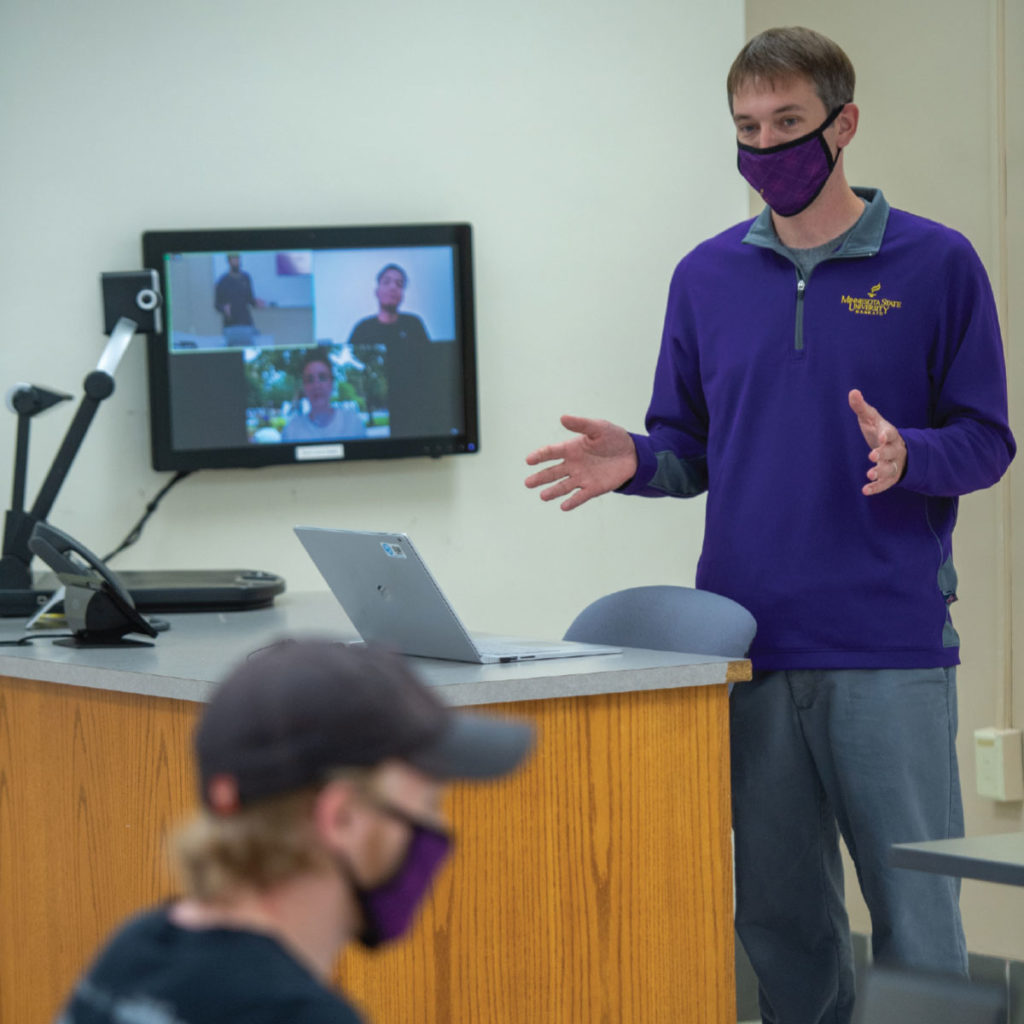
At Minnesota State University, Mankato, classrooms equipped with monitors, microphones, and speakers allow students to participate both in person and remotely.
Upgrading virtual business courses
Graduate-level business education programs also have adjusted their modalities for MS and MBA students. Again, many of these programs have been offered online for some time, but university business schools are incorporating what they’ve learned during the pandemic into new approaches to delivering education.
Case in point: Deploying Zoom, the platform that became the short-hand term for pandemic communication. “We all had to learn how to use [Zoom’s] breakout rooms and the annotation tools,” says Patricia Hedberg, associate dean of the University of St. Thomas’ Opus College of Business. “We expanded our understanding of the technology and are using it deeper than we had before.”
Hedberg says that St. Thomas invested a great deal in remote learning during the pandemic, and university faculty learned how to effectively present instruction online. “We’re seeing that pay off now—that we can offer that flexibility,” she says.
“We want that online experience to be similar to the learning experience you’d get in person,” Hedberg says. The St. Thomas online instructional group combines pedagogy with technology, and it works with faculty to “have the right tools to accomplish the same learning outcome [virtually] and a similar type of engagement with students.”
For instance, the group added more screens in university classrooms to allow online and in-person students to be together and interact. For such mixed classrooms, St. Thomas has added several tech enhancements. These include using a stylus “to scribble on the screen,” which shows up on the PowerPoints projected both online and in person.
Read more from this issue
For faculty, Hedberg says, this means more choices. “You have more opportunities to think about what you want the outcome to be for students,” she says. “What’s the best way to share information? What’s the best way to have some kind of interaction and discussion about the information?” In other words, St. Thomas believes that online education tools and platforms can actually enhance education. Opus is now looking at technologies that would allow its students to do projects with businesses across the world.
Phil Miller, assistant dean of MBA and MS programs at the University of Minnesota’s Carlson School of Management, notes that Carlson had been building its online capacity before the pandemic hit. “Our capabilities and our facilities have evolved to meet that changing landscape,” he says. During the pandemic, Carlson School Dean Sri Zaheer “made a commitment to make sure that students could participate whatever way they chose, as could faculty.” In the summer of 2020, Carlson made “a massive push” to make sure every classroom had a rear-mounted HD camera and ceiling mics. “At a minimum, every class can stream,” Miller says.
When it comes to how a hybrid course runs, Miller says “there’s a whole stack of tools that are embedded in Canvas,” an LMS that Carlson began using about five years ago. Now instructors are adding more technology to that toolbox.
Miller, for instance, teaches a problem-solving class at the MBA level that includes collaborative projects. To enable the professor and students to interact virtually, he began using a platform called FeedbackFruits, which allows participants to “cross-comment” on projects online. “It very easily allows me to structure that whole engagement so that you can post your deliverable and I can comment,” Miller says. Tools like FeedbackFruits have become an important part of delivering virtual education, he says.
The lessons of the pandemic also have influenced the way the Carlson School offers its non-degree leadership programs for business executives. Nora Anderson, executive director for executive education, introduced completely online leadership courses with the arrival of the coronavirus.
Carlson has created a new kind of online program. Instead of participants meeting on Zoom for four days straight, it extended the program across six months with regular two-hour online sessions. “We had leaders from Europe, Asia, and the U.S. all going through this learning experience together,” she adds. The Carlson School is now launching a second cohort of this program.
“I’d venture to say that we would not have designed the program this way before the pandemic,” Anderson says.
‘Hyflex’ higher education
This past summer, the Carlson School introduced what Miller characterizes as “the next evolution,” called hybrid flexible, or “hyflex.” Eight Carlson classrooms were fitted with “a higher degree of technology and integration,” including tracking cameras and large, prominent monitors. The result, Miller says, is “an immersive room that allows virtual and in-person participants to fully integrate in a class [at the same time]. We see a lot of our working professional programs evolving in that direction.”
Minnesota State senior vice chancellor Ron Anderson believes that hyflex has the potential to significantly impact the way his system delivers education. He distinguishes hyflex from hybrid, where a class meets in person once or twice a week, then online at other times.
Anderson also says that students will “move seamlessly between delivery modes depending on their needs.” Minnesota State is “seeing a lot of interest in this increasing flexibility for scheduling and juggling other commitments.”
“I would estimate about half of our non-credit offerings this current semester are being offered in an online modality,” he says. There are limitations—some courses still need to be hands on, such as those in which students handle industrial equipment. But even some of those courses “are now being coupled with some components being delivered online or via Zoom.”
Larry Lundblad, Minnesota State’s executive director of workforce and economic development, notes that “what we were doing on campus was paralleled by business and industry. They were getting used to Zoom and other distance formats. Everyone had to learn at once.”
With the persistent labor shortage and companies needing every hour of labor they can get from their current workforce, “many employers are reluctant to let employees participate in training,” Lundblad says. “These alternative ways of delivery are meeting a need where workers can stay in place for at least a portion of the training.”
Like nearly all educators, Lundblad doesn’t see a full return to the old normal. “This is a permanent shift,” he says. “The employers, the students, and the instructors are all saying that the flexibility can be a good thing. Now the emphasis is on, ‘How can we make this work better?’ ’’
Mining safety instructor Lund has seen a “generation gap” in terms of preferences for online and in-person instruction. Younger workers, he says, are quite comfortable with digital learning. And like many higher-education faculty members, he believes that the demand for online courses will continue to be strong, particularly because companies and students have gotten accustomed to it. It’s not yet known whether MSHA will allow some form of virtual learning to continue. “If they do,” Lund says, “it’s probably here to stay.”
JJ Neiman-Brown, of Iowa City, died on Feb. 2, 2020, in his sleep. He was almost 3 years old. Doctors after his death determined he was positive for influenza A. His mom, a University of Iowa biology professor, is behind a new educational game teaching kids about how flu spreads and how vaccines work. (Maurine Neiman)
IOWA CITY — On a Sunday in early February 2020 — a day before the country would declare COVID-19 a public health emergency and just weeks before it would join much of the world in moving toward widespread lockdown — 2-year-old JJ Neiman-Brown started acting more tired and worn out than usual.
The Iowa City toddler with a broad smile and curly brown hair — and love for animals, dancing, baking, berries, and music, especially Prince — told his mom his mouth hurt. By 4:30 p.m., JJ had a temperature of 101.5, which his parents treated with Tylenol.
“It was nothing serious or scary,” his mom, University of Iowa biology professor Maurine Neiman, told The Gazette.
JJ had been sick before, and he perked up on the medication. His temperature returned to normal, and he fell asleep that evening in his mom’s arms as they watched Moana. His parents put him to bed but kept an eye on him via the baby monitor. He appeared to be sleeping peacefully.
“I actually went to check on him because he was so quiet,” Neiman said.
And she discovered he wasn’t breathing. They called 911, and JJ was rushed to the emergency room, where doctors were unable to save him. After JJ’s death, officials determined he was positive for influenza A, H1N1 — even though he’d gotten his flu vaccine months earlier.
An autopsy revealed JJ had several invisible vulnerabilities — like asymptomatic and undiagnosed asthma, putting him at higher risk for flu complications.
“As a parent, we sort of have a sense of control,” Neiman said. “I really was paying attention to when flu outbreaks were emerging, when the best time to vaccinate would be — in terms of maximizing protection.
“Of course, it turns out that when only half the community is vaccinated, it doesn’t really matter,” she said. “We’re far below where we need to be with influenza for herd immunity.”
‘Flu’s Clues’
For JJ, nothing more could have been done. Neiman and her husband took all the precautions. They vaccinated him. Watched his symptoms. Gave him rest and nourishment and cuddles.
“I certainly don’t believe that everything happens for a reason,” Neiman told The Gazette. “This is just horrible.”
But it did happen. And with the 2020-21 flu vaccination rate among children 6 months to 17 years at 59 percent — a 5 percentage point drop from the year prior — Neiman said more can be done for many kids.
“It’s making meaning out of something that feels really senseless,” she said.
So nearly a year ago — in collaboration with the national nonprofit Families Fighting Flu and with support from local entities like Integrated DNA Technologies — Neiman and her students began creating an online interactive kids game tasking players to identify and tamp down flu outbreaks globally.
Flu’s Clues game screenshot
“Flu’s Clues” — in a “Where in the World is Carmen San Diego” mission-centered style — takes kids into laboratories and communities from California to Nigeria to Taiwan and the United Kingdom to track influenza spread and create effective vaccines to halt it.
“Congratulations,” one of the game’s researchers tells players after they complete their mission. “Because we made an effective vaccine, we were able to save the lives of 1.8 million people. We were able to decrease hospitalizations by 8 million people.”
The game, which officially launched last month, is meant to be educational and accessible in the midst of a non-flu-related pandemic that’s heightened children’s awareness of viruses, how they spread, and how vaccines can help prevent them.
It incorporates facts — like how to identify symptoms and determine differences between the flu and other viruses. It imparts information on how vaccines are made — through “actors” clad in lab coats and glasses.
“These are all my students,” Neiman said. “These are undergraduates and graduate students, for the most part, donating their time. And it’s substantial.
“I think some of them are fantastic actors.”
Acknowledging COVID has pushed the discussion of viruses into the homes of many children, Neiman said the flu — statistically speaking — is more of a threat to them.
“We don’t want to scare kids, but influenza is more dangerous to them than COVID, from the perspective of yearly mortality,” she said. “And the influenza season this year looks like it might be bad.”
The game is debuting in time for National Influenza Vaccination week, a U.S. Centers for Disease Control and Prevention initiative.
“We were really interested in thinking about something that would help teach young kids about the importance of infectious disease, vaccination, and then we wanted to do something that was connected to JJ,” Neiman said.
Vanessa Miller covers higher education for The Gazette.
DANDRIDGE, Tenn. (WVLT) – Dandridge Elementary School closed early on Monday due to a bathroom fire set by a student.
According to a release, the incident occurred at 7:50 a.m. in a restroom on the second-grade hallway in which a student allegedly used a device to set toilet paper on fire in a stall.
Students were reportedly entering the building to prepare for the day when a staff member noticed the smell of smoke. Upon entering the restroom, the staff member observed the smoke and found the fire which had spread to the plastic molding that holds the paper onto the walls, a release stated.
“Fire evacuation procedures were immediately implemented by sounding the fire alarm, evacuating the building, and notifying emergency officials,” a release said. “Additionally, one staff member used a portable fire extinguisher to try to contain the fire.”
Since the school is located close to the Jefferson Co. Justice Center, Jefferson Co. Sheriff Jeff Coffey and his staff opened space to place the children while they waited for their parents.
Parents were notified shortly after the incident. The student who set the fire was identified, disciplined and will not be on campus for the remainder of the first semester.
A decision on resuming school will be made during early evening hours after cleanup crews provide an estimated timeframe for the work to be completed, officials announced.
The principal made a statement regarding the incident.
The director of schools said he was grateful no one was injured in the fire.
The fire was contained, and no injuries have been reported.
You may know Longwood Gardens for our spectacular horticulture, our dancing fountains, our invigorating performances and our ever-present beauty … but we’re much more than meets the eye.
From K-12 programs that bring our Gardens into the classroom, to experiential onsite programs for those pursuing a career in horticulture, we are also a place of learning and growth.
Learning has been integral to our mission — to the soul of Longwood — since day one, reflective of our founder Pierre S. du Pont’s desire to establish a school where students and others may receive instruction in horticulture and floriculture. But our commitment to learning goes much farther, with a much deeper impact than you may know.
Today, here at Longwood, we continue our commitment to learning, proudly offering a vibrant, broad and ever-evolving selection of educational programs that deliver on Mr. du Pont’s wishes that we continue as an institution committed to both education and instruction. All of these programs are supported by our earned and contributed revenue (admission and membership revenue, gift shop sales, special events like our Fireworks and Fountains Shows, donations and our endowment.)
Here are just a few:
In 1957, we began offering paid summer residency internships for college and university students — a program that continues today and has impacted more than 2,300 students from more than 80 institutions.
Our K-12 programs expand learning beyond the classroom walls with free, curriculum-based virtual and hands-on offerings including our Virtual Field Trips, which bring our Gardens directly into K-12 classrooms around the world via live interactive video.
This program began in 2009, so when the pandemic reared its head, we had the infrastructure and the expertise to ease the transition to virtual learning across all of our educational programs. In 2020-21 alone, our Virtual Field Trip program reached 23,000 K-12 students worldwide through 462 programs. Again, this program is free to all K-12 participating institutions.
Our Longwood Fellows Program — an immersive, 13-month, paid residential living and working experience borne from the Longwood Graduate Program — focuses on building leadership capacity in public horticulture. Our Fellows come to Longwood to refine their skills, gain pragmatic experience, and learn from other regional and global public horticulture leaders. To date, more than 200 graduates have gone on to leadership positions that are impacting global plant conservation and horticulture around the globe.
Designed for recent high school graduates to those looking to change careers, the two-year, tuition-free Professional Horticulture Program offers the opportunity to engage in hands-on learning alongside our expert staff; our graduates enjoy successful careers in public, private and commercial horticulture, joining a network of Longwood alumni in horticulture positions around the world (more on that later!).
Finally, our Continuing Education program welcomes adult learners to work with experts in the fields of horticulture, floral and landscape design, botanical arts, garden photography, and much more, to simply have fun or to enrich their professional skills.
When I think back on how we’ve been able to keep the learning going for more than 50 years, one very special occasion — that’s actually been in the works since 1970 —comes to mind.
In 1970, Longwood founded the two-year, tuition-free Professional Gardener Training Program (now the Professional Horticulture Program) to help fulfill Mr. du Pont’s wish for a practical school of horticulture and floriculture at Longwood. And, now more than 50 years later, it continues to do just that … and so much more.
On October 16, 2021, we were thrilled to welcome 120 Professional Horticulture Program alumni — including a student from the very first class — back to our Gardens for our Professional Gardener Alumni Association 50th Anniversary Celebration at Longwood.
During that very special occasion, our alumni —a network of 327 graduates making a real difference in horticulture — shared their stories and successes since their time here at Longwood, as part of this legacy, immersive program that combines hands-on learning and high-level coursework.
Of these 327 graduates, 26 worked, or continue to work, here at Longwood. Many work at other public gardens as leaders in horticulture. Others have become entrepreneurs as landscape designers, landscape architects and consultants, as well as leaders in commercial greenhouse and nursery production or other commercial horticultural industries. Some have become educators themselves. Our graduates, however, are much more than a professional network.
They’re friends. They’re leaders. They’re family. They’re changing the future.
Paul B. Redman is President and CEO of Longwood Gardens.





/cloudfront-us-east-1.images.arcpublishing.com/gray/K4SCAJBISREHZETHHCTSK7FCA4.png "Dandridge Elementary School dismissed early after student sets fire")