WATAUGA — If you build it they will come, and the Children’s Playhouse accomplished just that with a jam-packed celebration of childhood fun and learning at BuildFest 2022.
Free to all families, BuildFest welcomed children ages 2-12 to the Watauga High School campus for a Saturday filled with wall-to-wall, hands-on science, technology, engineering, art and math activities. Sponsors from community organizations and members such as the Children’s Council of Watauga County, local elementary schools and Appalachian State students gathered to create seemingly unlimited numbers of activities for children to join throughout the day.
In the gymnasium, robots circled around a mat in one corner while an ever-growing labyrinth of cardboard boxes consumed the other end. In the cafeteria, children engaged in painting activities, built a brain-cap to wear or played in other sensory-engaging activities.
Many parents reported their children had yet to attend a BuildFest due to the pandemic, and the sheer volume of activities meant there was no shortage of learning and play throughout the day.
Children of all ages took advantage of the variety of activities, sunny weather and opportunity to play together at BuildFest.
Children use their imaginations to build a kingdom out of cardboard boxes in the gymnasium of Watauga High School.
Photo by Marisa Mecke
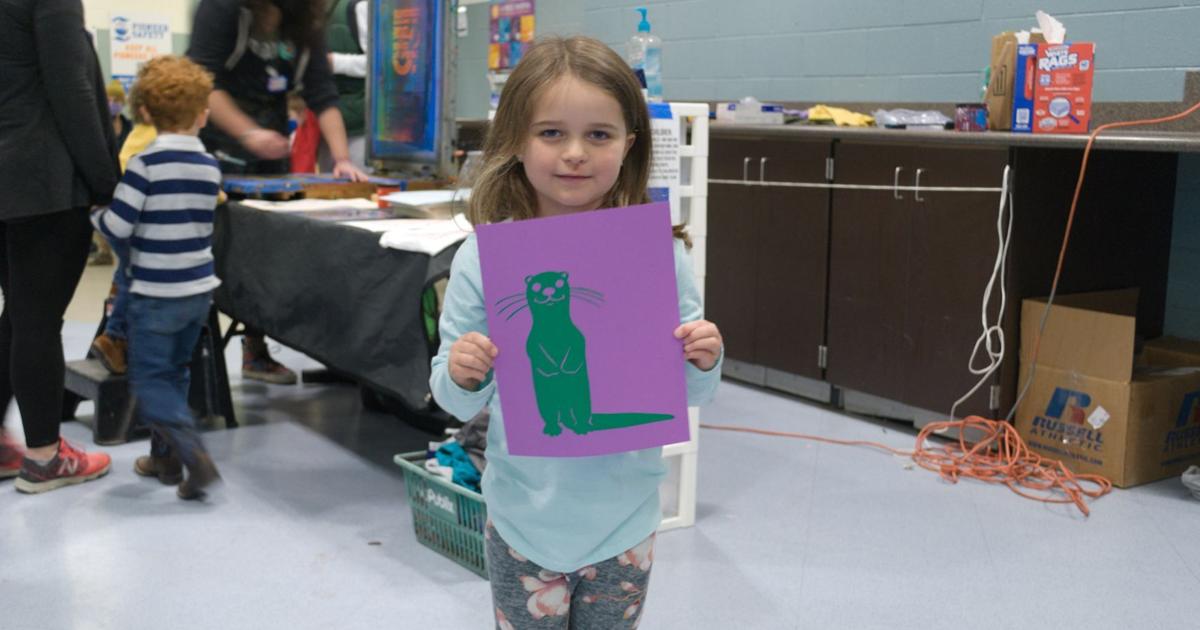
Representing Two Rivers Community School, April Flanders, professor of studio art at App State, and App State art senior Will Christ help April Flanders use green paint to print a picture.
Photo by Marisa Mecke
Outside Watauga High School, multiple stations are set up one after another for kids to take place in a variety of hands-on activities.
Photo by Marisa Mecke
Allison, Lacey and Lachlan Saine enjoy the kids’ first BuildFest with some hands-on games.
Photo by Marisa Mecke
Sunny and Ocean Morgan practice engineering structures out of pasta and marshmallows.
Photo by Marisa Mecke
The Boone Fire Department paid a visit to BuildFest to answer questions from kids and show the community around the fire truck
Photo by Marisa Mecke
From above, the cafeteria of Watauga High School is filled to the brim with kids, activities and adventures.
Photo by Marisa Mecke
Danny Proctor and his child Ace Proctor fight against gravity building a skyscraper out of blocks.
Photo by Marisa Mecke
In the middle of a sea of cardboard boxes, kids find the perfect building materials to create a cardboard maze throughout the gym.
Photo by Marisa Mecke
Students from the AGElabs at App State’s Psychology Department volunteered their time to share a bit about their brain development research and knowledge via festive brain caps for attendees to wear. Pictured are Tianna Martinez, Peyton Teer and Adam Peterlin.
Photo by Marisa Mecke
Finn Hoffman races a car down a track with the help of volunteer Milene Trejo.
Photo by Marisa Mecke
Finley Garner gets hands-deep in some “floam” at BuildFest 2022.
Photo by Marisa Mecke
Parents and kids mill around to check out the fire truck courtesy of Boone Fire Department.
Photo by Marisa Mecke
Throughout the day, the maze of cardboard boxes grew as kids added on more extensions to the labyrinth.
Photo by Marisa Mecke
Finn Krause and Sophie Zimmer husk corn outside of BuildFest.
Photo by Marisa Mecke
Using a cranking device, Sophie Zimmer takes the kernels off a dried cob of corn.
Liu C-H, Hsu L-L, Hsiao C-T, Hsieh S-I, Chang C-W, Huang ES, et al. Core neurological examination items for neurology clerks: a modified Delphi study with a grass-roots approach. PLoS One. 2018;13(5):e0197463.
Flanagan E, Walsh C, Tubridy N. ‘Neurophobia’–attitudes of medical students and doctors in Ireland to neurological teaching. Eur J Neurol. 2007;14(10):1109–12.
Pakpoor J, Handel AE, Disanto G, Davenport RJ, Giovannoni G, Ramagopalan SV, et al. National survey of UK medical students on the perception of neurology. BMC Med Educ. 2014;14:225.
Freeman S, Eddy SL, McDonough M, Smith MK, Okoroafor N, Jordt H, et al. Active learning increases student performance in science, engineering, and mathematics. Proc Natl Acad Sci U S A. 2014;111(23):8410–5.
Taylor DCM, Hamdy H. Adult learning theories: implications for learning and teaching in medical education: AMEE guide no. 83. Med Teach. 2013;35(11):e1561–72.
Sandrone S, Berthaud JV, Carlson C, Cios J, Dixit N, Farheen A, et al. Strategic considerations for applying the flipped classroom to neurology education. Ann Neurol. 2020;87(1):4–9.
Gorbanev I, Agudelo-Londoño S, González RA, Cortes A, Pomares A, Delgadillo V, et al. A systematic review of serious games in medical education: quality of evidence and pedagogical strategy. Med Educ Online. 2018;23(1):1438718.
van Gaalen AEJ, Brouwer J, Schönrock-Adema J, Bouwkamp-Timmer T, Jaarsma ADC, Georgiadis JR. Gamification of health professions education: a systematic review. Adv Health Sci Educ Theory Pract. 2021;26(2):683-711.
Raskurazhev A, Kuznetsova P, Khizhnikova AE, Klochkov A, Bakulin I, Annushkin V, et al. Neuropoly: an educational board game to facilitate neurology learning. Front Syst Neurosci. 2021;15:688210.
Garcin B, Mariani LL, Méneret A, Mongin M, Delorme C, Cormier F, et al. The “neurological hat game”: a fun way to learn the neurological semiology. Rev Neurol (Paris). 2019;175(9):528–33.
Huber J, Witti M, Schunk M, Fischer MR, Tolks D. The use of the online inverted classroom model for digital teaching with gamification in medical studies. GMS. J Med Educ. 2021;38(1):Doc3.
Sandrone S, Albert DV, Dunham SR, Kraker J, Noviawaty I, Palm M, et al. Training in neurology: how lessons learned on teaching, well-being and telemedicine during the COVID-19 pandemic can shape the future of neurology education. Neurology. 2021. https://doi.org/10.1212/WNL.0000000000012010.
Clément A, Delage R, Chollier M, Josse L, Gaudry S, Zahar J-R, et al. Prospective study on a fast-track training in psychiatry for medical students: the psychiatric hat game. BMC Med Educ. 2020;20(1):373.
Samarakoon L, Fernando T, Rodrigo C. Learning styles and approaches to learning among medical undergraduates and postgraduates. BMC Med Educ. 2013;13:42.
Urval RP, Kamath A, Ullal S, Shenoy AK, Shenoy N, Udupa LA. Assessment of learning styles of undergraduate medical students using the VARK questionnaire and the influence of sex and academic performance. Adv Physiol Educ. 2014;38(3):216–20.
Ricker TJ, Nieuwenstein MR, Bayliss DM, Barrouillet P. Working memory consolidation: insights from studies on attention and working memory. Ann N Y Acad Sci. 2018;1424(1):8–18.
Friedlander MJ, Andrews L, Armstrong EG, Aschenbrenner C, Kass JS, Ogden P, et al. What can medical education learn from the neurobiology of learning? Acad Med. 2011;86(4):415–20.
Shigemune Y, Abe N, Suzuki M, Ueno A, Mori E, Tashiro M, et al. Effects of emotion and reward motivation on neural correlates of episodic memory encoding: a PET study. Neurosci Res. 2010;67(1):72–9.
Young JQ, Van Merrienboer J, Durning S, Ten Cate O. Cognitive load theory: implications for medical education: AMEE guide no. 86. Med Teach. 2014;36(5):371–84.
Sandrone S, Carlson C. Gamification and game-based education in neurology and neuroscience: applications, challenges, and opportunities. Brain Disorders. 2021;1:100008.
Akl EA, Pretorius RW, Sackett K, Erdley WS, Bhoopathi PS, Alfarah Z, et al. The effect of educational games on medical students’ learning outcomes: a systematic review: BEME guide no 14. Med Teach. 2010;32(1):16–27.
Roze E, Worbe Y, Louapre C, Méneret A, Delorme C, McGovern E, et al. Miming neurological syndromes improves medical student’s long-term retention and delayed recall of neurology. J Neurol Sci. 2018;391:143–8.
Roze E, Flamand-Roze C, Méneret A, Ruiz M, Le Liepvre H, Duguet A, et al. “The move”, an innovative simulation-based medical education program using roleplay to teach neurological semiology: students’ and teachers’ perceptions. Rev Neurol (Paris). 2016;172(4–5):289–94.
Matthias AT, Nagasingha P, Ranasinghe P, Gunatilake SB. Neurophobia among medical students and non-specialist doctors in Sri Lanka. BMC Med Educ. 2013;13:164.
When a child reaches age 5 they often enter a sweet spot for understanding competition. Simple board games can give them an opportunity to explore strategic play while enjoying a little friendly rivalry (emphasis on friendly). It’s also a great time to start talking about being a good loser. And with these board games for 5-year-olds, they can have fun while developing an appreciation for winning and losing.
These games come from the minds of companies that have studied child development and understand a need to put an emphasis on education. Some of these games will help improve math and STEAM skills, others are more focused on word play or agility and helping kids build up their fine motor skills. But all of them also have a heavy helping of silliness as well. Plus, there are some tried and true board games you’ll remember from your own childhood that still hold up today (Candyland, anyone?).
And these board games for kids aren’t exclusively for preschoolers and kindergarteners either. You might be surprised by how much you enjoy playing these games too. Take it from this mom of a 6-year-old who has played nearly all of these games, they’re a surprisingly good time for all generations. So gather up the whole family, grandma and grandpa can get involved too, and have a little indoor entertainment with these board games for 5-year-olds.
We only include products that have been independently selected by Romper’s editorial team. However, we may receive a portion of sales if you purchase a product through a link in this article.
1
Camp
Kindergarteners may not be ready for overnight camp, but with the board game Camp they can get a taste of the fun to come. This educational game features a colorful board game that’s a forest scene with a winding path amidst it. This is what kids will follow as they work to win by getting to the campfire first. Along the way, campers — cute forest critters like a Bruce the Moose and Sassy Squirrel — may land on a “Clubhouse Position” where they get to read a Fun Fact card (example: “Some fish can climb trees”). Or they might land on a Footprint space where the player has to answer a Camp Question card. Each card has four levels of questions so the game grows with the child. Fun times.
2
Bugs in the Kitchen
For sheer giggles, Bugs in the Kitchen scores big points. Basically, two to four players each man a corner of the tall game board and tries to protect their corner from the dreaded bug, a HEXBUG nano that scuttles through a maze made up of adjustable spoon, fork, and knife walls. Players roll a die covered in these silverware pictures. Land on a fork and you can spin a fork to open a wall to get the bug away from your corner of the board. Work fast enough and you could even direct the critter to someone else’s corner. It’s a fast paced silly operation that kids will love.
3
Battleship
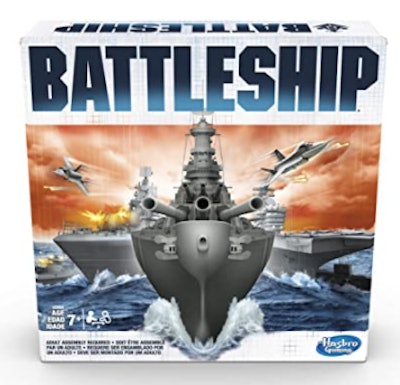
Take it from a mom who knows, the box Battleship says it’s for ages 7 and up, but 5-year-olds will love this game just as much, and it’s no wonder why. It’s a classic. And you don’t need to get the digital version either to let your kids have fun with this classic naval warfare game. Basically, two players each get a foldable board that looks a bit like a Light Brite. They set up their boats on their bottom board and going back and forth calling numbers and letters, each player tries to sink the other’s boats. This is a great way to work on recognizing the alphabet and numbers while trying to win.
4
Candyland
Children 3 and up can play Candyland which is great for big brothers or sisters dying to play a board game. In Candyland little kids don’t need to be excluded. As you may recall, players start on down a colorful road, through scenes like a Lollipop Palace, to get to King Kandy’s Castle first. It’s an incredibly simple concept, but that’s what makes it one of the great board games for 5-year-olds. Think of Candyland as the perfect introduction to board game play. Once they master this sweet contest, they can graduate to more advanced board game options.
5
Operation
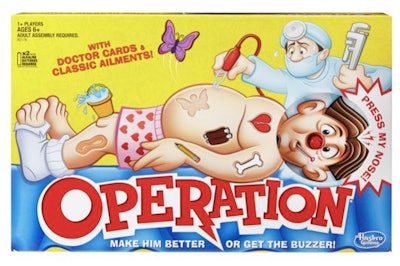
Remember Operation? A cartoon man lays on an exam table and the players get to carefully remove organs without setting off the alarm, aka surgery. So it’s not exactly a pre-med class nor HIPAA approved, but it is a super fun and silly game that any 5-year-old can play. Plus, you could use it as an introduction to teaching your kids about parts of the body. Fun fact: the patient actually has a name — Cavity Sam. Operation comes with 13 ailments kids have to remove. The player that removes the most ailments wins. Better yet? This game doesn’t actually need a competitor. Children can play alone too.
6
Dinosaur Escape
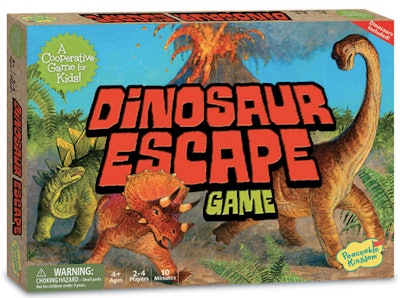
Have a budding paleontologist on your hands? Then you must order Dinosaur Escape. This game is made for kids 4 and up and is a colorful trip to the Jurassic era that centers around getting dinosaur pieces to safety on the island before a volcano erupts. But on top of that, this game comes with a matching element that’s great for developing children’s memory. By uncovering matching dinos under fern pieces, they can help the dinosaurs escape. This game also has a gentle approach in that all of the players work together to save the dinos. It’s a team effort which is another important lesson to teach kids about competition.
7
Pretty Pretty Princess
You might remember this bejeweled board game from your own childhood. It’s called Pretty Pretty Princess and the concept is simple: each player is vying to gather a full collection of jewels. If they can do that as they navigate the board, they win. You read that right, this is a board game all about accessorizing. A product of the early ‘90s, it continues to mesmerize kids and remains one of the terrific board games for 5-year-olds. Pink, blue, green, and purple rings, necklaces, clip on earrings, bracelets, and the coveted crown make up the jewels players compete for. Warning: not for tiny princesses, the small parts are a chocking hazard.
8
Hungry Hungry Hippos
You loved it as a kid, your kid will love it too. Hungry Hungry Hippos is loud and physical and a great way to burn some energy when play is limited to the indoors. But one big warning: if you have little children younger than 5 also in the house, keep this game away. The small pieces are not safe for little ones. If that’s not an issue, get your snacking hand ready as four players or less snap their hippos in order to eat up all of the marbles. Then work on counting skills as kiddos tally up how many marbles their little hippo inhaled.
9
The Floor is Lava
Want to find some physical board games for 5-year-olds? Your child might already be playing their own imaginary The Floor is Lava game, likely on your couches and cupboards. If you want them to take their indoor parkour set to a safe space, grab The Floor is Lava board game. Using bright large shapes, you get to layout the obstacle course for this family friendly competition for 2 to 6 players who are ages 5 and up. A player spins a foam spinner and whatever color it lands on is where every player has to jump to. The last one to land on the color has their original tile removed. Anyone who falls into the lava (a.k.a. floor) is out.
10
Dragon’s Breath
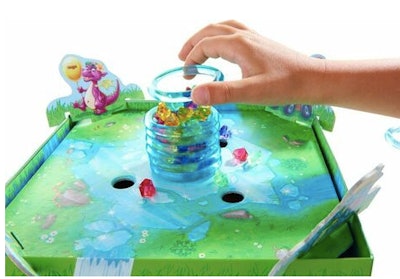
Any game that brings in a little fantasy is worth considering when it comes to 5-year-olds. Dragon’s Breath does just that. The game is played by one young dragon and four young dragons, who try to get the most gems out of an ice column filled with them. Sounds simple enough, but this is a 3-D board game where gems can slip through holes on top, adding an additional element of risk. As the game goes on, the dad gets to remove another ring on the ice column releasing more gems for players to collect. Super colorful, this game will capture kids’ attention the minute they open the box.
11
Outfoxed!
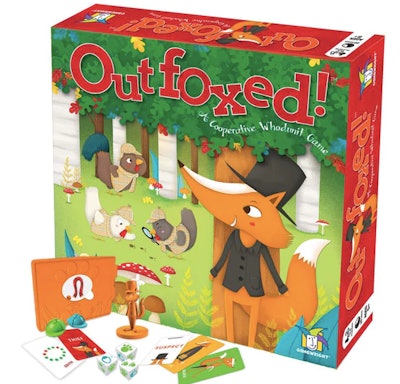
Want a precursor to Clue for your young board gamer? Consider Outfoxed! This is a colorful whodunit designed for the littlest private eyes that will take whole bunch of critical thinking to solve. The problem? Mrs. Plumpert’s prized pot pie has gone missing, gasp! Now players have to work together to reveal suspects and find clues to discover who stole the pie. To add an extra element of fun, this game comes with a Clue Decoder tool to eliminate suspects. Find the guilty fox and you win. If you want to develop a child’s deductive logic, this might just be the board game of choice for 5-year-olds.
12
Treasure Hunt Game
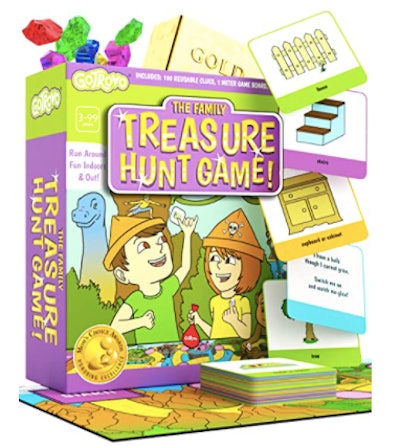
Thanks to Easter egg hunts and children’s books about pirates, the concept of finding treasure is something kids get a good understanding of at a young age. The idea of coming upon a box filled with gold and gems has captured people’s imaginations for centuries. So translate that same idea into a board game and you have a winning afternoon. Treasure Hunt Game is for children 4 and up and won the Mom’s Choice Award. Basically parents lay out a trail, then kids solve clues to make their way through the trail to uncover the treasure. Easier than building your own indoor treasure hunt, you can reset the trail over and over for a fun afternoon indoors.
13
Connect Four
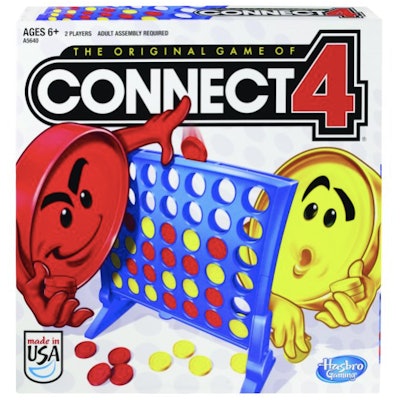
Ok, so it’s a vertical game board, but a game board at that. Connect Four is a fantastic game for developing logic, counting, and color identification skills. As any child of the ‘90s will recall, each player gets either yellow or red circular game pieces. Using their pieces they slide them into the standing board in the hopes of getting four in a row vertically, horizontally, or diagonally. Get four in a row and you win. The tactile nature of this game adds a noisy, fun element when the winner pulls the release to send the game pieces crashing down in victory that kids will want to hear over and over again.
Ready to play? Grab one of these board games for 5-year-olds and you can start your child on a long love affair with strategy and healthy competition.
(This is the final post in a two-part series. You can see Part One here.)
The new question-of-the-week is:
What are your favorite classroom games?
In Part One, Shannon Jones, Jennifer Bay-Williams, Molly Ness, and Sheniqua Johnson shared their favorites.
Today, Jenny Vo, Donna L. Shrum, David Seelow, Kathleen Rose McGovern, Melisa “Misha” Cahnmann-Taylor, and Ciera Walker provide their recommendations.
‘Students Are More Focused’
Jenny Vo has worked with English-learners during all of her 26 years in education and is currently the Houston area EL coordinator for International Leadership of Texas. Follow her on Twitter at @JennyVo15:
Games are great tools to engage students in their learning. There are many educational benefits to playing games in the classroom. One, games make learning fun. Two, they encourage the students to pay attention. As a result, the students are more focused when playing games. Three, students learn to collaborate and cooperate with their team members when playing on a team. They learn the social skills of communication, listening, and compromising, just to name a few. The best benefit that occurs from playing games in the classroom is that students are learning content in a fun, engaging way!
Games can be used anytime during your lesson. You can use them to assess students’ background knowledge about a certain topic before you begin a unit. You can also use games to build background knowledge before you actually introduce your lesson/topic. There are some great games to practice and review vocabulary. Other games are perfect for whole-group or individual reviews before an assessment. Below are some of my favorite classroom-learning games.
Charades, Pictionary, and Pyramid are great games to use for vocabulary review. Charades is a word guessing game. Students can be paired with partners or in teams. One member will act out a word or phrase without talking or making noises. Along the same vein, Pictionary requires a team member to draw pictures, and the rest of the team guesses what the word or phrase is based on the pictures. Pyramid is a two-person game and relies on words only. The objective is to guess the mystery word using only words or phrases given by the teammate. I love using these three games because they require the students to pay attention to each other, collaborate with each other, and study/learn the vocabulary beforehand so their team can do well.
Another game that my students love to play is Kahoot!, a game-based learning platform. It is made up of quizzes that the students can play in class and at home. Teachers can access a database of ready-made games or create the games themselves. I used Kahoot! in a variety of ways—to build background knowledge, as vocabulary practice, and to review before an assessment. Students are not only competing against each other but also a time limit (adjustable by the teacher). With online learning during the pandemic, I relied on Kahoot! a lot for both in-person and virtual classes. The students loved the competitive aspect of the game and worked hard to see their names on the Kahoot! virtual podiums at the end.
The third kind of game that my students love to play in class is the old-fashioned board game. This may be surprising considering the technology-advanced world we live in, but my students LOVE rolling the dice and moving the game pieces around the game board! One year, when I was given extra money by my department, I bought a bunch of board games that focused on reviewing reading-comprehension skills such as main idea, details, inference, context clues, etc. Each year after that, whenever I would be given extra money, I would add to my collection with games from other subjects—math, science, and social studies. We had so much fun playing them, and the students asked to play them so much that we designated Friday as our game day. I chose the Friday game based on the skill we were working on that week. I think the students knew we were doing schoolwork, but they didn’t mind because we were also having fun, not sitting at our desks and doing worksheets.
Adding ‘Snap, Crackle, and Pop’
After teaching English for over 20 years, Donna L. Shrum is now teaching ancient history to freshmen in the Shenandoah Valley of Virginia. She remains active in the Shenandoah Valley Writing Project and freelance writing for education and history magazines:
When students play a game, their brains reward them with dopamine. Incredibly, your curriculum alone doesn’t always provide that same brain rush for your students, so mixing games into your curriculum can add some snap, crackle, and pop. In fact, some teachers are completely gamifying their courses, structuring their curriculum as an ongoing game. But that is a discussion for another day.
While teaching with Zoom, I struggled to find ways to adapt the active games I’d used in my physical classroom. One success was playing tag: Someone in Zoomland was “it” and tagged someone of whom I asked a question. Answer the question wrong, and you’re “it”; get it right, and the tagger had to try again with another student.
This year, while teaching 8th grade civics, I used some of the review games I’d used for years to introduce material. I discovered that creating a Kahoot about current events was a fun way for the students to see if they could predict the correct answer and then I’d briefly fill in the details of the event once they saw the answer. I used Kahoot as an anticipation guide in the same way, creating brief “What Do You Already Know?” Kahoots before teaching a topic. At the end of the lesson, students could play again to see what they had learned.
I sometimes use Quizizz for variety, but this year, I have fallen in love with Quizizz Lessons. Instead of introducing material on Google Slides, I could put it into a Quizizz slide, then follow with a formative-assessment slide as a poll, open-ended answer, or multiple-choice question. Video slides are part of the paid package. Lessons still gave a score at the end, and I was surprised students viewed Lessons as a competitive game. It was a wonderful tool for Zoom, because providing the code allowed them to see the game on their computers (a feature Kahoot also introduced this year) without relying on a possibly unsteady Zoom screen share.
I’ve had the paid version of Gimkit for three years now, and in that time, an increasing number of other teachers have found out about this treasure, which offers a high level of competition as well as multiple game modes. As the school year drew to a close, I used the Drawing mode for short curriculum breaks. Drawing didn’t work well with my existing Kits, so I created ones just for drawing in which I entered words and phrases and then simply put a period as all the answers. In the future, I plan to create drawing Kits related to the classes I teach.
I comb online sites to find new game ideas, and these are the most popular with my students and links explaining how to play:
The Unfair Game While I sometimes played whole class, I usually let them partner up and keep their own scores while they played on one computer between them.
Grudgeball For some reason, honors classes play Grudgeball the most intensely.
Motor Mouth. Use Google Draw to create playing cards. On each, put 4-6 terms you’d like students to learn. Print on card stock and laminate. Create enough sets for students to play in pairs. The game is like Password: The students split the cards, then take turns trying to get the other person to correctly guess the term. The partners who finish first win.
I have several favorite games for different grades levels. For the elementary grades, Dragon Box Algebra 5+ is wonderful. It introduces algebra through fun, engaging activities that transition seamlessly into algebra without students even realizing they are solving mathematical equations. Minecraftremains a favorite. Students can build entire worlds and work either individually or as part of a team.
Pokémon Gotakes the class out of the school building into the world where students can explore famous geographical and historical landmarks by visiting pokestops. In keeping with a geography theme, the board game Trekking: The National Parks allows students to experience an outdoor adventure indoors, learn valuable information about the country’s national parks, and cultivate the value of conservation, while enjoying magnificent photography of our natural wonders. KidCitizen uses primary documents in an interactive experience pertaining to democracy. The KidCitizen Editor gives teachers the tool to create their own episodes tailored to their class. Castle Panic provides children with a rich fantasy world to capture their imagination while also requiring cooperation to be successful in the game. Learning how to work in teams at an early age will be indispensable throughout a child’s education.
For the middle school age group, Biome Builder-Card Game has students build food chains in a race to help one of four biomes (the American Prairie, Pacific Ocean, Amazon Rain Forest, Sahara Desert) survive. Before leaving the middle grades, I want to recommend the online game Kind Words; students learn the value of being kind and helping others by responding anonymously to requests for help. The game promotes the best in social and emotional learning and can have a transformative impact on students’ approach to life.
Kind Words also reminds me to point out that many games can be played across grades levels. Biome Builder, mentioned above, has curricular alignment with elementary, middle, and high school students. Portal 1 and 2 can be applied to learning missions ranging fromr using statistics in 6th grade all the way up to AP Physics. iCivics has a suite of 30-minute games exploring all aspects of the U.S.’s three branches of government. Every student will benefit from playing these games in class.
Finally, for the high school age, making ethical decisions should be an essential skill, and no game teaches this better than Papers, Please. In the game, you play an immigration officer making life-changing decisions about who can or cannot cross the border of a totalitarian country. The board game Pandemic has immediate relevance for students living through COVID-19. Importantly, this game requires cooperative learning to win. The game effectively simulates the need to cure, cope with, and prevent a pandemic in 60 minutes play time.
Language arts/English are well served by two narrative-based games: Gone Home and What Remains of Edith Finch. In both games, players explore a family home in the Pacific Northwest. In the former, as protagonist Kate, you learn about family secrets including a nuanced depiction of an LFBTQ+ relationship. In the latter game, you explore a haunted ancestral house in a brilliantly executed story reminiscent of Edgar Allan Poe and perfect for teaching literary elements. Finally, encouraging students to slow down and appreciate both the wonders of the natural world and the marvels of language will prove invaluable to their future lives. Students need to step outside their screen-dependent world to reflect on their surroundings and their own life, and, paradoxically, Walden, a Game helps them do just that.
Oh, before I go, Jeopardy! is still a great game for the classroom; just have students design the answers.
Building a ‘Trusting Community’
Kathleen Rose McGovern is a TESOL specialist with the U.S. Department of State and a lecturer in applied linguistics at the University of Massachusetts Boston. She’s authored several publications at the intersections of drama, language teaching, and immigration theories, including Enlivening Instruction with Drama and Improv:
One of my favorite games to play with intermediate learners involves an extension of the popular language-teaching (and party) game: 2 Truths & 1 Lie.
Basically, it involves inviting students to share three personal stories (not statements, but stories with a beginning, middle, and end). Then, after each person has told their stories, and classmates have guessed the lie, I divide students into groups and guide them through an improvisational process in which they perform one another’s stories.
I find that students are typically very engaged because they are sharing stories that are important to them with their classmates and negotiating the language involved in putting together a scene (e.g., “come in from the right and stand by that table”). This also offers opportunities for literacy practice as students can write out their stories or even draft scripts from their improvisations. This activity was the backbone for my work devising plays with my intermediate ESOL students at a nonprofit language school for immigrant learners in Massachusetts. But I have used it in nonperformative contexts as well. It’s a wonderful way to collaboratively explore language relevant to the students’ interests and build a trusting community at the same time.
Improv Games
Melisa “Misha” Cahnmann-Taylor, a professor of language and literacy education at the University of Georgia, is the author of five books addressing intersections between language education and the literary, visual, and performing arts including her newest co-authored book, Enlivening Instruction with Drama and Improv: A Guide for Second and World Language Teachers (Routledge, 2021):
“Getting to know you” games can be terrific for any time you want a group to learn more information about each “player” in the class, including and going beyond learning one another’s names.
By using it at the beginning of any class or semester, teachers gather a great deal of information about who is in the room, including how comfortable and familiar each student is with performance as well as information about any limitations or concerns students may bring to these embodied practices. The information garnered from these games, including students’ individual needs, strengths, and limitations, will assure greater trust and success in play and language learning throughout your group’s time together.
One of my favorites that I use with any group is the Poetry in Names Game. Even if a group already knows one another, it can be a fun and lyrical challenge to create a class poem for which each student uses alliteration and/or rhyme to describe themselves in their person. First, show students how to play by saying your name and something you like in the following formula: [Name], he/she likes _______. E.g.: “Misha, she likes marshmallows.” While you say this, make an exaggerated movement (e.g., mime eating lots of marshmallows). Advanced learners may consider things that have the same first-letter sound (alliteration), consonance sounds, assonance (vowel) sounds, or rhyme (exact or slant). Here’s a video of a group of TESOL educators playing this game.
Many theater and improv games can and should be played repeatedly. By changing the prompt, teachers can change the target language of the game—from vocabulary acquisition to specific grammatical forms or pronunciation features such as intonation and stress. Just as the same game can be played differently, the same words can be communicated differently depending on how they are said, where, to whom, by whom, and for what ends. These games introduce or review target language words and phrases that help students understand an important communicative lesson: It’s both what you say, and how you say it!
A wonderful example of this is the game, “The house is on fire, let’s…”. One person in the pair begins, saying, “The house is on fire, let’s_____,” filling in the end of the sentence with ANY suggestion not connected to the actual scenario of a house on fire. (For example, “Let’s buy a canoe”; “Let’s eat some candy”; “Let’s study math”; “Let’s braid our hair.”) This game exercises students’ fluency, creativity, sense of humor, and ability to laugh in light of making L2 (second language) errors. See this video to watch how hilarity ensues and fluency is developed!
‘Running Dictation’
Ciera Walker is a seventh-year systemwide elementary school ELL teacher in east Tennessee:
At the beginning of the school year, my students set academic goals based on their WIDA Access scores from the previous year. While goals always vary, this year, many students had a goal to improve their speaking scores. I set out to intentionally create differentiated lessons for my students that involved multiple opportunities to speak. Each week, students use Flipgrid with rubrics and personalized feedback to practice and improve speaking. Additionally, I utilized a learning game I read about in 39 No-Prep/Low-Prep ESL Speaking Activities for Kids written by Jackie Bolen and Jennifer Booker Smith called Running Dictation. This game was a favorite among my students this year. Below is a list of materials needed for the game, a description of my interpretation of the game and how I used it in my classroom, some benefits of the game, and suggested improvements to the game to fit my students’ needs in the future.
Materials:
Printed phrases, sentences, or paragraphs from a text that students are reading (I typed out sentences from passages or novels that we were reading in class.)
Paper
Pencil
Description/How to Play:
Benefits:
Students are constantly communicating very specific information.
Students are engaged in using punctuation and spelling patterns.
Students must be able to verbalize when they need more information or are confused.
Students are actively engaged in grammar while writing.
Students are practicing speaking, listening, reading, and writing all in one game.
Cross-curricular connections can be made in various subjects such as language arts, science, or social studies.
Implications for the Future:
I hope to use Flipgrid captions in combination with the running-dictation game to show students that what they say isn’t always interpreted or heard correctly. This will help emphasize the importance of speaking clearly.
For higher English-proficient students, I might use a paragraph, and once the paragraph is written, have students put it in order (as suggested by Bolen and Booker Smith).
Have students use the original text to answer questions about what they wrote during the running-dictation game.
Have students interpret and discuss the paragraph.
Use a paragraph that students haven’t read yet to introduce a new unit/topic/vocabulary.
The game is a wonderful and fun way to get students reading, writing, listening, and speaking. Additionally, I would recommend the book 39 No-Prep/Low-Prep ESL Speaking Activities for Kids for anyone looking to enhance engagement in the ESL classroom.
Thanks to Jenny, Donna, David, Kathleen, Melisa, and Ciera for contributing their thoughts!
Consider contributing a question to be answered in a future post. You can send one to me at lferlazzo@epe.org. When you send it in, let me know if I can use your real name if it’s selected or if you’d prefer remaining anonymous and have a pseudonym in mind.
Education Week has published a collection of posts from this blog, along with new material, in an e-book form. It’s titled Classroom Management Q&As: Expert Strategies for Teaching.
Just a reminder; you can subscribe and receive updates from this blog via email (The RSS feed for this blog, and for all Ed Week articles, has been changed by the new redesign—new ones are not yet available). And if you missed any of the highlights from the first 10 years of this blog, you can see a categorized list below.
For another year, Eurohoops Academy is hosting your favorite Christmas Camp, giving all kids an opportunity to enjoy basketball under the best possible circumstances, regardless of their level. The Christmas atmosphere is combined with learning, knowledge, new friends, special guests and lots of fun at the Eurohoops Dome!
The schedule of this year’s Christmas Camp includes two seasons – 27 to 30 of December 2021 and 3 to 5 of January 2022, along with three training programs – Fundamentals, Improve Your Skills and Shooting Days, each of them carrying its own different focus. The Christmas Camp is aimed at all athletes and not only members of Eurohoops Academy. Every athlete can choose one of the three programs but also make a combination out of them, depending on his/her desires and his/her needs.
Sign up for the Christmas Camp here!
Fundamentals
Endless game and basketball development go hand in hand in the Fundamentals program! The Euroohops Academy coaching team under Head Coach Konstantinos Stamatis has designed a coaching schedule that is tailored to the modern needs of young athletes. Boys and girls of six years of age and older will enjoy a lot of basketball, make new friends and experience the festive atmosphere on the basketball floor. The program runs from 10:00 to 14:00. It includes exercises, games and activities that aim towards one goal: the improvement of technical skills, the development of the cooperation between two and three players and the strengthening of their physical condition. The daily schedule includes a nutritious snack per day for each participant. Furthermore, parents can extend their children’s stay in the Eurohoops Dome facilities for some extra hours during the morning (08:00-10:00) and noon after the completion of the practices (14:00-17:00).
Improve Your Skills
Improve Your Skills is a specialized training program with the goal of teaching and improving basic basketball techniques. It aims at all athletes of 13 years of age or older and is an excellent opportunity for those who want to develop their technique. It’s a carefully designed training program with a rich and customized list of exercises, curated by Eurohoops Academy Head Coach Konstantinos Stamatis. The program lasts for 90 minutes, from 12:30 to 14:00 or 15:30 to 17:00.
Shooting Days
The secrets behind the… art of shooting are revealed during the Shooting Days of the Christmas Camp. In this innovative training program of Eurohoops Academy, athletes can learn to shoot well and properly through a series of special exercises that are adapted to different game circumstances. The list of exercises emphasizes on practicing the ability to receive the ball, the rhythm and mechanics of execution as well as the combination of moves for the ideal use of shooting in match circumstances. The program is suitable for all athletes from 10 to 18 years of age and will last from 14:15 until 15:15 during all days of the Christmas Camp.
The program of this year’s Christmas Camp has been adjusted to the mandatory health rules and regulations that are in effect by authorities. Every athletes who wants to participate in the Christmas Camp must submit a doctor certificate or an athlete’s health card, along with a vaccination certificate, sickness certificate, or a certificate of a negative result in a COVID-19 self-test. Furthermore, a paramedic will watch over the entire event, with the support of BIOIATRIKI, the Official Sponsor for Nutrition and Ergometrics.
Program:
Period A’ | 27/12/2021 – 30/12/2021
Period B’ | 3/1/2022 – 5/1/2022
Time schedule:
10:00 – 14:00 with the possibility of aftercare (08:00 – 10:00 & 14:00 – 17:00)
Participation Cost:
Fundamentals 27-30/12: 160€ 3-5/1: 120€
Improve Your Skill 27-30/12: 120€ 3-5/1: 90€
Shooting Days
27-30/12: 50€ (40€ if combined with one of the other two programs) 3-5/1: 35€ (25€ if combined with one of the two other programs)
2021-2022 Eurohoops Academy members have a 10{e4f787673fbda589a16c4acddca5ba6fa1cbf0bc0eb53f36e5f8309f6ee846cf} percent discount on the original price
Game titles can be a subtle way for mom and dad or individuals who care for young children to aid make on and develop their techniques for later on everyday living. It is encouraged to play educational enjoyable online games with little ones from early ages as it can give youngsters the foundations they will need to have all over schooling.
Most importantly, academic video games are pleasurable! Most young ones really do not even recognize they are discovering or developing these crucial abilities as they are enjoying. A research found that academic games, specially these that stimulate the mind, can 23{e4f787673fbda589a16c4acddca5ba6fa1cbf0bc0eb53f36e5f8309f6ee846cf} get above common understanding.
An educational match does not have to be centered all around finding out topic matter, but fairly lets kids to use and construct on memory, cooperation, teamwork, and difficulty-resolving skills. The competitiveness element of schooling game titles lets for small children to be much far more enthusiastic compared to other methods of finding out.
Educational games have numerous regarded benefits to your children’s learning course of action these kinds of as:
For early finding out, encouraging your young kids get to grips with the names of colors and quantities as a result of the medium of game titles is a exciting and entertaining way to keep little ones engaged and having exciting even though discovering
Entertaining at all ages! As a parent, we know how challenging it can be to hold young adults entertained, but academic online games add a perception of competitiveness to an exercise that will hold every person concentrated and having fun.
Video games can support motivate children to strengthen their language expertise without having them even figuring out it!
Committing to a activity can also assist small children to sharpen your child’s focus techniques and assistance them to target on the sought after purpose –important now as kid’s attention span because of to the introduction of several varieties of know-how and social media have arguably develop into shorter in accordance to a study by the University of Denmark
Instructing teamwork values- This might change depending on the style of recreation played but no matter of if you are playing an specific board game it can nonetheless have the added advantage of exposing your little one to working with people today.
They can instruct little ones how to observe being a ‘good loser’ or also a ‘gracious winner’
It is vital to remember also that board video games can be a way to rest and soothe kids in particular if they are nervous or endure from understanding troubles.
Last of all, board games are pleasurable and can generate a medium over which to bond with relatives, good friends, and friends.
Just about every dad or mum is familiar with the issues of seeking to entertain their small children especially on the likes of school holiday seasons, well… with academic online games you can blend recreation time into unconscious learning, become a instructor without having the training and assistance support your child’s discovering expertise at household.
Educational video games can contain various diverse types of video games from board & card game titles, trouble-resolving puzzles, large ‘outdoor’ variations of all your favorite common online games this kind of as dominoes, Yahtzee, Jenga, or the out of doors yardzee recreation. No make any difference the match becoming performed, all academic games will aid produce some type of simple skills significant to your child’s advancement.
To attain a enjoyable ‘board game’ practical experience that combines the outside then is ideal, you can obtain all the instructional positive aspects of a board sport with no being cooped up in the household.
Unique online games will workout distinct elements of your child’s mind, it’s possible your baby is great at spelling or memory so hence you may well want to select a game that will follow your child’s numerical techniques, game titles involving dice can be terrific for this!
Really don’t permit an iPad or game titles console consume all of your kids’ time, blend it up with some pleasurable, novelty instructional game titles!