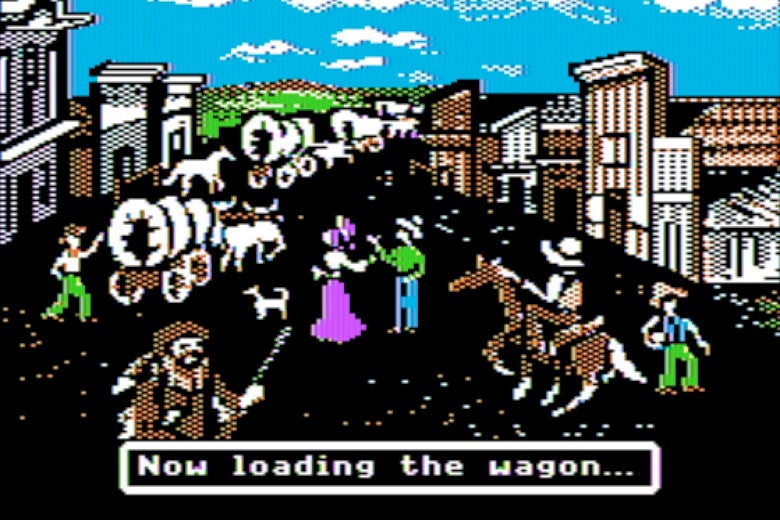
An interview with the inventor, Don Rawitsch.

An interview with the inventor, Don Rawitsch.

Fifty years ago this winter, a young student teacher by the name of Don Rawitsch introduced his eighth grade American history class to a computer game on westward expansion that he had developed along with his colleagues Bill Heinemann and Paul Dillenberger. The game, called The Oregon Trail, would go on to sell over 65 million copies, many of them to educational institutions, making it one of the bestselling games of all time, right up there with Super Mario Bros. and Tetris. But when I talked to Rawitsch recently, he said that when he first came up with the idea, making money was the furthest thing from his mind.

“Back in 1971, there was a lot of activity going on in the world of schools to upgrade curriculum and come up with innovative methods of teaching,” Rawitsch said. Inspired by his teachers at Carleton College in Northfield, Minnesota, Rawitsch decided to pursue new types of pedagogy for his student teacher classes at Jordan Junior High School in Minneapolis. “I was excited and maybe a little naïve,” Rawitsch recalled. “I really wanted to do some things in the classroom that the students were not necessarily used to.” Before developing The Oregon Trail, Rawitsch had attended class with another instructor dressed like Lewis and Clark and attempted to speak and answer questions as the famous explorers. For classes on the Civil War, he tried to recount battles for students through songs that he wrote and performed in class with his guitar. Rawitsch also worked with a track coach at Jordan Junior High on a mock trial assignment for students that began with someone being shot with a starter pistol—the type of innovative pedagogy that most definitely would get you fired today.

For his classes on westward expansion, Rawitsch decided to try something a little safer: a board game with a big map and some toy covered wagons. “In my college work,” Rawitsch said, “I had seen some examples of educational games that were in a box game format … [and] I was kind of fascinated by the idea that this would be something you do in a classroom that would probably be much more interesting to students than just reading about history.” Rawitsch began work on this board game in the apartment he shared with fellow Carleton College student teachers, Paul Dillenberger and Bill Heinemann, who both taught math and dabbled in computer programming. They suggested Rawitsch ditch the paper-and-pencil approach; they would help him convert this game into a computer program that could run on his school’s teletype, a monitorless machine connected via the phone line to a mainframe computer in downtown Minneapolis. The two math teachers sometimes used the machine in their own classrooms; when they weren’t using it, the teletype lived in the school’s janitorial closet.

Rawitsch introduced the resulting game, which he called Oregon at the time, to his class on Friday, Dec. 3, 1971. “We spent a week on Oregon Trail,” Rawitsch remembers, “and so [the students] had four or five days to try it out. And they were … compared to the usual nonexcitement of reading about history … extremely excited to do this and fascinated by the computer.” For many of Rawitsch’s students, this moment not only represented their first time playing a digital game, but also their first time using a computer. Rawitsch believes that, out of the students he taught, “probably 90 percent of them had never had a chance to take a turn on the one computer” at the school.
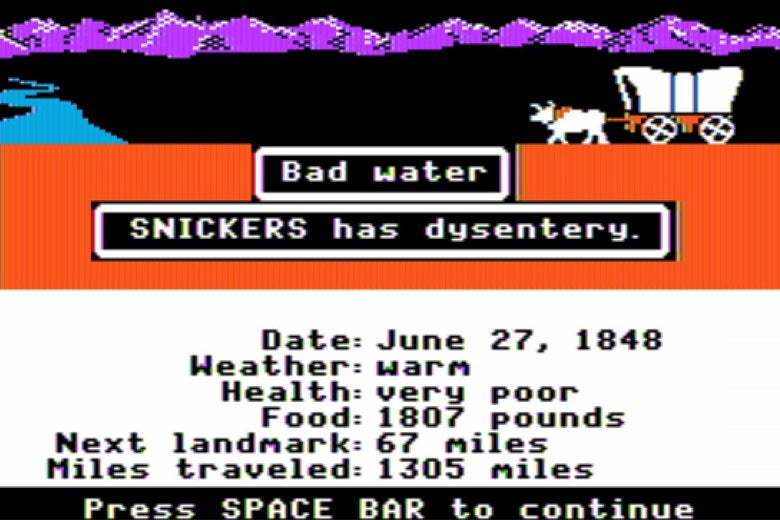
Oregon Trail game screenshot of a covered wagon with the notice "Bad water. Snickers has dysentery" and details on weather, health, and distance traveled.
The Strong National Museum of Play, Rochester, New York

Because of this fact, Rawitsch collected his class into groups of five to play the game together. This setup gave everyone an opportunity with the computer, allowed the students to troubleshoot the machine collectively, and mimicked the family dynamic of traveling along the historic Oregon Trail. “The kids took their turns,” Rawitsch said, “each small group … gathered around the teletype terminal. And, of course, they were all anxious to read the output that was being printed by [the machine].”

This initial version of The Oregon Trail was designed to supplement student knowledge of westward expansion, but it also tested their abilities with resource management, teamwork, and typing. For example, in order to hunt for food, students had to accurately and quickly type either “BANG” or “POW” into the machine, or risk missing their target. “All five kids wanted to type [at the same time], and they wanted to get that done very quickly,” Rawitsch said, “and they soon discovered that that wasn’t the most efficient way to go about this because, invariably, they would get typos.” During their week on The Oregon Trail, each student group got at least one full playthrough finished, with some successfully reaching Oregon. But their enthusiasm for the game didn’t stop there. “There were times when certain groups finished their trip before the bell rang,” Rawitsch remembers, “and so kids … started over for as long as they could. … Once I started using this [game] in my classes, I got students coming in after school and lunch period and so forth, just because they wanted to try it many times over.”

This is the moment in the biopic when the creators realize they are sitting on a gold mine, and they convert The Oregon Trail into a commercial product. But instead, at the end of that fall semester, Rawitsch, Heinemann, and Dillenberger—those humble and respectful student teachers—printed out the game’s source code from the teletype machine and deleted The Oregon Trail from the school district’s mainframe. The game that would go on to sell 65 million copies would spend the next three years in a folder in Rawitsch’s bedroom desk. It was, after all, a one-off classroom exercise for an eighth grade history class, taught by a student teacher.

How, then, did this game go from Rawitsch’s desk to millions of classroom computers around the country? “I was hired by MECC [Minnesota Educational Computing Consortium] in October 1974,” Rawitsch said, “and we had a share library where people could submit programs they had written, and then the staff would decide if they were worthwhile putting in the library [for students across the state]. … So over Thanksgiving weekend I had a cold and I had nothing else to do. … I decided to bring a portable [teletype] terminal back to the house. And from the kitchen phone, I connected to the MECC computer and typed in line by line the code on the [Oregon Trail] printout.” After Thanksgiving, Rawitsch “started showing it to the staff and they were enthusiastic. So, then [Oregon Trail] became available to Minnesota schools that were using that mainframe computer, and over the next couple of years it became extremely popular.”
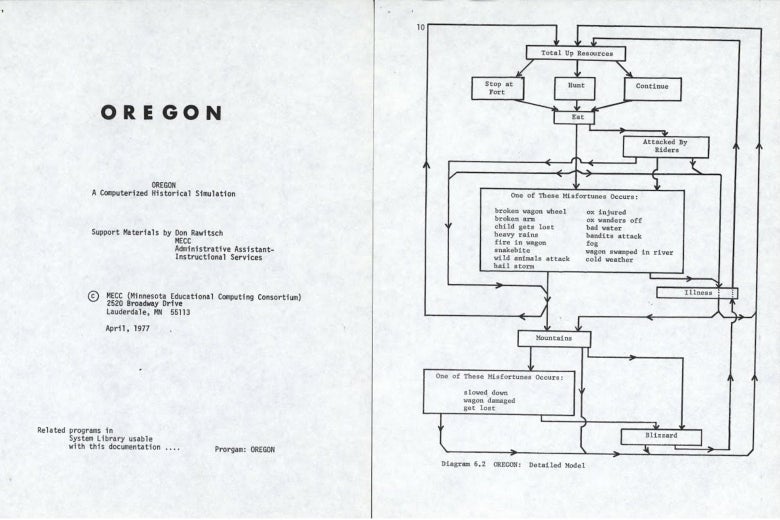
Printout for Oregon: A Computerized Historical Simulation with a decision tree outlining gameplay
Page from the 1977 Oregon Trail users manual.
The Strong National Museum of Play, Rochester, New York

So this is the moment when the financial windfall comes, right? Overtime pay for working on Thanksgiving, at least? “No,” Rawitsch said, laughing, “there was just no cognizance of that. I considered myself to be an educator.” As The Oregon Trail grew in popularity in Minnesota, Rawitsch the educator decided to share the source code for the game in an article for the national magazine Creative Computing in 1978. “I think the fact that was in 1978,” Rawitsch argues, “indicates that as late as then there was still no understanding that there was soon to be a software market. A big one. … So should [I] write an article about The Oregon Trail … and then give you all the code so that you can type it into something else? Yeah, why not!” Rawitsch continued: “When you’re an educator, you’re encouraged to write and publish. … Paul and Bill and I, when you get right down to it, we were teachers. We have the teacher mentality. And so, [to get] rich off this would have been nice, but not as important as having donated something to the world of education.”

History-themed digital games, of course, are now big business, with titles such as Assassin’s Creed Valhalla, Call of Duty: Black Ops Cold War, and Red Dead Redemption 2 representing some of the most profitable games in recent years. But in that mix of ahistorical action and bombast, there is still space for educators to get involved. Assassin’s Creed Discovery Tour: Viking Age features the work of dozens of scholars from around the world. Charles Games’ adventures Attentat 1942 and Svoboda 1945 rely on instructor advice and public funding. The first-person narrative game Blackhaven was developed by a history Ph.D. This year, the academic journal of record, the American Historical Review, started to include video game articles and reviews. And the latest version of Oregon Trail includes input from three Indigenous historians, to consider westward expansion from a Native perspective.

For Don Rawitsch, who would go on to work for MECC for almost 20 years, this latest iteration of Oregon Trail is most welcome. For an educator who gave away his greatest lesson plan, the goal wasn’t to be authoritative, but to create a platform that could be used by others and iterated on—with better technology but also better history.


North Carolina General Assembly Week in Review – November 2021 #2 | McGuireWoods Consulting

North Carolina General Assembly Week in Review – November 2021 #2 | McGuireWoods Consulting

While there were no legislative sessions or committee meetings this week, we learned that some familiar faces would likely be staying in town for a few more years. House Speaker Tim Moore (R-Cleveland), who was first elected to the state House in 2002, announced he would not run for Congress and would seek another term as Speaker. There had been speculation that he might run for Congress in the newly drawn open Congressional district in the foothills. His announcement came after conservative firebrand Congressman Madison Cawthorn (R-Henderson) declared he would switch districts and run in the same newly drawn district.

There is positive news out of Raleigh this week as COVID-19 cases and hospitalizations have declined. As of this morning, in the state of North Carolina, there were 2,156 confirmed cases of the coronavirus, 1,095 individuals hospitalized, and sadly, 18,371 confirmed deaths. There have been 11,692,513 doses of the vaccine distributed in NC, which is about 72{e4f787673fbda589a16c4acddca5ba6fa1cbf0bc0eb53f36e5f8309f6ee846cf} of the total adult population.

As we all continue to feel the effects of the global pandemic and adjust to a new normal, we want to highlight a few ways our clients across North Carolina have worked to support residents and make this time a little easier for those throughout the state. Read more about what our clients are doing to help by clicking here.

For more information on COVID-19 in North Carolina, click here to visit the Department of Health and Human Services website, and be sure to stay up to date on the latest federal guidelines issued by the Centers for Disease Control and Prevention (CDC) by clicking here.


Budget Update

For the first time in his second term, Governor Roy Cooper (D) faces the prospect of a legitimate veto-override over the state budget. On Wednesday, Cooper’s office released a statement on Twitter saying that Republican leaders in the legislature will release a budget next Monday, adding that it will “have a number of the Governor’s priorities…including increased education funding” According to the statement, Medicaid expansion will not be in the bill.

Wednesday evening, Senate leader Phil Berger’s office and top budget writer Rep. Jason Saine (R-Lincoln) confirmed that votes will be taken next week on the budget proposal. According to an interview with Saine, the Senate will release the budget conference report on Monday, which was worked on by a conference committee consisting of both Republicans and Democrats in both chambers. The Senate will then hold votes on the budget bill on Tuesday and Wednesday, then the House will vote Wednesday night and Thursday.

Legislators are optimistic that the Governor will sign the budget into law. “No one has left mad, no one has left upset…no one has gotten everything they wanted,” Saine told reporters, but “it looks to me that because of that [Governor Cooper] is going to seriously consider signing the budget.”


Leandro Ruling

A State Superior Court took a rare step Wednesday when Judge David Lee ordered the state budget director, state treasurer and state controller to transfer around $1.7 billion from state reserves to fund two years of a seven-year plan to increase state spending on public education. The plan, often called the Leandro plan, resulted from a 1994 court case where low-wealth school districts argued that the state was not adhering to the state Constitutional standard to guarantee every child “an opportunity to receive a sound basic education.” During Democrat Roy Cooper’s first term as Governor, his administration funded a comprehensive review by education consultants who recommended the $5.6 billion Leandro plan, which calls for a 5{e4f787673fbda589a16c4acddca5ba6fa1cbf0bc0eb53f36e5f8309f6ee846cf} pay raise for teachers, increased funding for low-wealth school districts, and expansion of the NC Pre-K program.

Earlier this year, Judge Lee signed an order to implement the Leandro plan. He said he was choosing the Leandro plan as the remedy to the state not fulfilling its guarantee because the legislature had not developed its own plan. Not everyone agrees that Lee had the power to order the plan into effect. Retired Superior Court Judge Howard Manning, who presided over the Leandro case for nearly two decades, argued in a letter to Cooper and legislators that the courts don’t have the authority to order that the money be provided to the “educational establishment” that he blames for the state’s lack of educational progress.

To accommodate the potential for an appeal, Lee’s order will not go into effect for 30 days. It is almost certain that the General Assembly will challenge the ruling. House Speaker Tim Moore (R-Cleveland) and Senate leader Phil Berger (R-Rockingham) released a joint statement after the hearing, saying that a judge “does not have the legal or constitutional authority to order a withdrawal from the state’s general fund.” Moore and Berger called the case “an attempt by politically allied lawyers and the governor to enact the governor’s preferred budget plan via court order, cutting out the legislature from its proper and constitutional role.”


Legislative Meetings

Monday, November 15

11:00AM: Senate Session

Note to policymakers: Home-schooling is here to stay | Lifestyle

Note to policymakers: Home-schooling is here to stay | Lifestyle

Homeschooling is here to stay and the time has come for policymakers to acknowledge that fact. After years of increasing at a rate of about 3 percent a year, the number of parents choosing to homeschool their children has spiked, triggered by the COVID-19 pandemic.

According to the U.S. Census Bureau, the portion of children being homeschooled doubled from 5.4 percent during the 2019-20 school year to 11 percent in 2020-21. Among Black families, homeschooling jumped nearly five-fold during that time, from 3.3 percent to 16.1 percent.

Even in Massachusetts, where only 1.5 percent of students were homeschooled before the pandemic, the number was up to 12.1 percent by the fall of 2020.

And it’s no longer just for religious conservatives. There has been a big jump in “second choice” homeschoolers, who choose the option for more pragmatic reasons. With more parents working from home when the pandemic began, they had a bird’s-eye view of K-12 education in the age of COVID. Many didn’t like what they saw.

It didn’t take an education degree for them to see that overall student progress was slowing – a fact that has since been borne out in state tests. It was equally clear to parents that online learning wasn’t working for one or more of their children.

Many thought about homeschooling for the first time. Others who had previously considered it concluded that this was the time to give it a shot. Lest we forget, homeschooling IS “in-person” learning – one of the factors that public school authorities have insisted that parents were demanding.

Another indication that homeschooling has grown beyond its fundamentalist roots is that about half of parents with more than one child in school don’t homeschool all of them. This not only suggests that parents can tell when online education is working and when it isn’t, but that their motivation is educational, not ideological.

While the belief that learning at home is a safer environment than going to school was a motivator, especially for urban parents, having more say over their child’s education was the dominant reason for the increase in homeschooling.

As for the idea that attending school is critical to a child’s socialization, homeschooling parents would counter that their choice doesn’t prohibit their children from participating in sports, cultural and other group activities, or even just hanging out with the neighborhood kids.

Still, homeschooling will undoubtedly be a temporary solution for some. But the upward trend in families choosing to do it is sure to continue and likely to accelerate. Many parents had options for educational choices during the pandemic. But the increase in families opting for homeschooling was far more significant than that experienced by other options such as private/parochial, charter, vocational and virtual schools.

Many in the educational establishment vehemently oppose homeschooling, but the fact is that it results in massive savings for traditional schools. If it were banned and the five million American students the Census Bureau estimates are being homeschooled is correct, it would cost $50 million-to-$75 million a year, or nearly $1 trillion over a student’s 13-year K-12 career.

In addition, schools across the country would need 80,000 more teachers at an annual cost of $13 billion, and between 4,000 and 10,000 school buildings would have to be built.

Homeschooling is legal in all 50 states, but each has its own regulations. Some are encouraging, but others make the homeschooling choice unduly difficult for families.

Opposition from traditional education interest groups is one reason why homeschooling often gets the cold shoulder from government. But the time has come for policymakers to acknowledge it as a viable educational choice and do more to support those who are considering non-traditional options for their children’s education.

That means school districts should provide information to parents seeking information about those options and include links on their websites to the homeschooling support groups that exist in every state.

We are only beginning to appreciate the long-term impacts the pandemic has had on our way of life. In education, one of those impacts is accelerating the rise of homeschooling. It’s time for policymakers to catch up with the times.

Physical education classes can help schoolkids in other areas, analysis finds

Physical education classes can help schoolkids in other areas, analysis finds


Physical education classes may boost intellectual and academic performance in schoolchildren, a new study has found. Photo by Michael Schwarzenberger/Pixabay

June 29 (UPI) — Enhanced physical education classes in school boost children’s brainpower and academic performance, particularly in math, according to an analysis published Tuesday by the British Journal of Sports Medicine.

Students at schools in which physical education classes were taught by dedicated teachers and included intellectually challenging activities had evidence of improved cognitive and academic performance based on standardized test scores and grades, among other measures, the data showed.

However, the analysis also revealed that students ages 5 to 18 gained little benefit from more frequent or longer-duration physical education classes, the researchers said.

“Physical education seems to promote improvements in several future health-related outcomes,” study co-author Dr. Antonio García-Hermoso told UPI in an email.

“Although physical education alone may not provide young people with all the exercise they need to fight childhood obesity, [it can] provide young people with tools to lead a healthy and physically active lifestyle,” said García-Hermoso, an investigator at the Public University of Navarra in Spain.

The findings are based on analysis of data from 19 studies that collectively enrolled nearly 8,700 children and teens in 11 countries, including the United States, the researchers said.

The included studies evaluated the effects of physical education on intellectual and academic performance using standardized test scores and students’ grades.

Amid increasingly limited budgets, many schools worldwide, and nationally, have made cuts to physical education programs — a trend that prompted García-Hermoso and his colleagues to conduct their analysis.

This is despite several studies that have linked physical activity with improved learning and academic performance, the researchers said.

The new analysis of the study data revealed that interventions focused on boosting the quality of physical education programs boosted students’ brainpower, particularly at the primary school level.

Adding “cognitively challenging” activities such as dance or martial arts, having lessons led by a physical education specialist and including high-intensity fitness activities, sports and team games had the most impact, the data showed.

But boosting the number or length of physical education classes had a “marginal and insignificant” effect on academic performance.

Still, increasing the length of physical education class time does not negatively affect academic performance, the researchers said.

“The beneficial effects of regular physical activity on young people’s cognition are more than well known,” García-Hermoso said.

“Overall, physical activity may enhance cognition by modifying white matter integrity and activating key regions of the brain responsible for cognitive processes,” he said.

India to become a $313 billion online education market soon: Report

India to become a 3 billion online education market soon: Report

Summary

Report by non-profit Aspire Circle elaborates on 10 disruptive investment ideas that can transform the way Indians receive education

It shows the way forward in building human capital, keeping in mind the needs of the 21st century education and job market

India is poised to become a $313 billion online education market soon, thanks to the pandemic-induced shift to online classes as the chief mode of education, a new report has found.

The report, titled “Investing for Impact: Education, Skills and EdTech”, has been released by Gurugram-based Aspire Circle, a not-for-profit forum promoting enlightened social leadership in India through fellowships and research.

The report elaborates on 10 disruptive investment ideas that can transform the way Indians receive education, including skilling and training catalysed by new-age educational technologies. It shows the way forward in building human capital, keeping in mind the needs of the 21st century education and job market.

The 10 ideas that may steer the online education boom in India are:

  • Technology-enabled K-12 education
  • Online test preparation platforms-led inclusion and affordability
  • Supplemental and extra-curricular education
  • Teacher training and development
  • Affordable education loan platforms
  • Gig economy and unbundled microtasking
  • Affordable student housing
  • Innovative finance in education and skilling
  • Micro and alternative credentials for employability skills
  • Social and emotional learning

According to Amit Bhatia, founder of Aspire Circle, India’s education and skills market will grow almost double in this decade — from $180 billion in 2020 to $313 billion in 2030 — while creating five million incremental jobs and impacting 429 million learners.

Investors, entrepreneurs and policy makers will engage with Aspire Circle research based recommendations to help India truly realise its demographic dividend, Bhatia added.

The Covid-19 situation had led to mass school closures, affecting 150 million girls, 90 million among them being left without any learning opportunity whatsoever, informed Safeena Husain, founder of NGO Educate Girls which works to provide education to girls in rural and educationally backward belts in the country.

Husain added that if these girls are given the opportunity to access technology-driven quality education that is also affordable — including the supplementary social and emotional learning, and loan platforms envisioned in the report — that would go a long way in maximising the impact on education.

Aspire Circle’s three foundational initiatives include Aspire Young Achievers, a scholarship programme launched in 2008. The Rs 1 lakh scholarship is awarded annually to three young achievers from humble backgrounds under age 30 in the field of sports, art, culture, academics or civil society.

The Aspire Circle Fellowship is a one-year curriculum for CSR heads, foundation heads, impact investors, impact entrepreneurs and NGO heads to inspire enlightened leadership.

In 2020, Aspire Circle launched RISE Interns, which prepares youth as new cadre of impact professionals for an imminent impact revolution with the aim to enhance India’s chances of global leadership.

Last updated on 20 Nov 2021

5 Ways To Break Into The Video Game Industry

5 Ways To Break Into The Video Game Industry
video game developer working on a computer with 3d videogame design

Video games are part of a multibillion-dollar industry in which lucrative employment opportunities abound.


Getty Images


When you break out the game console to play a video game like NBA2K, chances are the biggest decision you’ll have to make is which player or team you want to be. But have you ever considered becoming one of the people who actually designs a game like NBA2K?

Worth an estimated US$336 billion, the video game industry is bigger than TV, movies and music combined. And since the industry is growing at a rapid pace, there are plenty of opportunities to work in this field. From game designers and software engineers who program the games to graphic artists or electrical engineers who design the game consoles, careers in the video game industry abound.

These jobs pay from about $55,000 to $100,000 or more annually. But somewhat like the NBA itself, the path into the video game industry is filled with tough competition.

As former head of graphics for a large video game company – and as head of the Learning Interactive Visualization Experience – or LIVE Lab – at Texas A&M University, I know firsthand what it takes to land a job in the video game industry. Here are 5 tips on how to do just that.

1. Design Your Own Games

When it comes time to apply for a job or even an internship at a video game company, it helps to show the games you’ve created or modified.

Fortunately, game engines, which are the underlying technology for games, are available free of charge and allow you to create your own game. Unreal and Unity are two you may want to try out.

You can also use free software, such as Houdini and Blender, to create video game assets such as buildings, characters, vehicles and animations.

If it’s too daunting to create a game from scratch, you can always “mod” – short for “modifying” – an existing game like Portal 2Civilization or Minecraft. This is a great start to learning the basics of game design and asset creation.

2. Participate In Game Jams

A game jam is a contest in which participants create a new video game within a set time frame. Game jams are a great way to meet and work with others on a game project and just learn how to design games. Many jams feature video game company representatives. These company reps serve as mentors, judges and coaches. They can give you tips and tricks on how to break into the industry. They can also give you leads on jobs.

Game jams are usually short, like a day or two, but some last a week or more. You can enter a game jam as an individual or as a small team. Some game jams are focused on specific themes such as health, conservation or science and provide resources for teachers and students to participate, such as the Games for Change Student Challenge. Other game jams are open to anyone including professionals, like the Global Game Jam. Some game jams are in-person, allowing you to meet face to face with other game designers, artists, developers, industry mentors and game companies, like Chillennium.

players at a gaming convention

Video game conventions are a great way to advance a player’s career.


Joe Buglewicz/Getty Images

3. Attend Game Conventions

One of the biggest conferences in the U.S. is the annual Game Developers Conference in San Francisco, which historically has attracted over 29,000 attendees. In Europe, the annual Gamescom conference in Cologne, Germany, has drawn over 370,000 attendees. Several PAX conferences happen throughout the year in different locations in the U.S. PAX started out as Penny Arcade Expo before developing into a full conference and exhibition. These conferences enable attendees to find out about new games, meet professionals from the games industry, play games and attend seminars and workshops on topics related to designing and developing games.

A conference like PAX East also provides opportunities for indie developers to showcase their games and get feedback from the public. Most of the conferences will be back in person in 2022 and require a fee to attend or exhibit. The price for tickets can range from $50 to several hundred dollars.

4. Take Classes In Game Design

Many high schools, community colleges and universities now offer game design classes.

In addition to these classes, it helps to take classes in math, physics, art and technology, starting in high school if you can. Almost all careers in the video games industry benefit from all of these fields. A game designer trying to create a balanced game requires a solid foundation in math and statistics. Balancing a game requires the designer to use math and statistics to ensure that no particular game element – such as a particular character or strategy – overpowers any other element.

Even if you don’t think you will be using math or doing any art, having a basic understanding of both and being able to talk about those subjects with colleagues goes a long way.

5. Play Away

In order to create great games, you need to be well versed in the games that are currently being played and have been successful in the past. This means that you should also play games that you normally would not play and even games that you don’t like. Not all people like all games. There are many different types of games from entertainment games to educational games, games for health, games for science and many more. Being able to critically look at games and identify which elements work well, which elements could be improved and which elements you might use for your own games will help you become a great game designer.

Breaking into the games industry is possible with a little bit of work. It can also be hugely rewarding. Just imagine the game you helped create is teaching players new knowledge, or helping players heal faster, supporting scientists in the discovery of new proteins or entertaining players for hours.