INFLUENCER OF THE WEEK: Michelle Lucas-Lawhorne, of Whispering Oak Elementary School | West Orange Times & Observer

Michelle Lucas-Lawhorne is a Voluntary Pre-K teacher at Whispering Oak Elementary School. Her day is divided into a morning and an afternoon program, with two separate groups of children ages 4 and 5. She teaches her students school-readiness skills, such as letters, sounds and numbers; as well as classroom routines and responsibilities that help them transition successfully to kindergarten and elementary school in general. She was named Teacher of the Year in 2017-18 and was named an A+ teacher for Spectrum News 13 this year.


What brought you to your school?

When Whispering Oak Elementary was first built, I lived within the community and thought it would be a great opportunity to work with children in my community. It was also a bonus that it was so close to home and I could attend many after school functions.


What do you love most about your school?

I love the strong sense of community that has always been here. The students, the families and my colleagues here have always been great and promoted a positive atmosphere.


What is your motivation?

My motivation has always been to help students reach their full potential and to enjoy learning. To not only learn the ABC’s and 123’s but to also learn to be good communicators, be helpful to those around them and to spread kindness.


What is the most rewarding part of your job?

Watching the students grow and flourish. It is so rewarding to see where students start out and how much they grow in a single school year.


What do you like to do in your spare time?

In my spare time I like to play and snuggle with my two dogs, watch Hallmark Christmas movies, take naps, and spend time with my husband and family.


Who was your favorite teacher when you were in school? Why?

It is very difficult for me to pick just one. I had amazing teachers throughout my schooling. I attended many OCPS schools growing up. The one that I think made a such a difference in my life was my fourth-grade teacher, Mr. Police. His classroom was amazing. He not only taught us what we needed to know for school, but he taught us life skills, like being organized.


When you were a child, what did you want to be when you grew up?

Since I was a little girl, I always wanted to be a teacher. When I was younger, I had a lot of great teachers who were there for me, supported me, mentored me and inspired me to want to do the same thing one day when I was older. Teaching is truly a calling.


What is your favorite children’s book and why?

My favorite children’s book is “The Gingerbread Girl” because she is strong and determined.


What are your hobbies?

I would say a hobby of mine is creating new games for my students to learn important concepts in a creative way. I also love spending time with my family.


If you could have any superpower, what would it be and why?

If I could have one superpower, it would be time travel so that I could go back and spend time with family and friends who are no longer with me.


If you could only listen to three bands or artists for the rest of your life, what would they be and why?

Journey, Garth Brooks and Taylor Swift. I have always loved Journey’s music, especially the song “Don’t Stop Believing.” I have seen Garth Brooks three times in concert, and I love country music in general, but his songs are so fun and energetic and great to sing along to. I love Taylor Swift ever since she showed up to the scene. Her songs are fun. I believe she is very down to earth, as well as a good person.


What was your go-to lunch as an elementary student? Any favorite snacks or special treats you remember?

PBJ! Extra-crunchy Jiff peanut butter and strawberry jam. To this day, I love PBJ sandwiches, and if I do not feel like making them, my husband will make them for me.


What is your favorite holiday and why?

Christmas! I love the music, decorations, the meaning of Christmas — and hanging out with my family has always been important to me. It’s a special time of the year for me.


Who was your best friend when you were in school and why? Are you still in touch?

My best friend was my sister Jennifer. We always encouraged and uplifted each other.


What were your extracurricular activities as a student? Did you win any accolades or honors?

I was a member of the National Honor Society.


How long have you been at your school and with OCPS? 

I have worked for OCPS for 22 years, the last 15 at my current school, Whispering Oak Elementary. 

The Observer has invested in new technology, so you can enjoy a more personalized online experience. By creating a user profile on OrangeObserver.com, you can manage settings, customize content, enter contests and more, all while continuing to enjoy all the local news you care about — .


What Glenn Youngkin Owes Virginia Parents

It’s no secret that parents are fed up.

Governor-elect Glenn Youngkin was able to claim victory in Virginia—a state that went for Joe Biden by 10 points just a year prior—by echoing parents’ frustrations with school closures and radical, divisive classroom content.

In a WFXR News/Emerson College poll, education claimed the top issue spot among likely voters, beating out jobs and COVID-19, along with more perennial concerns like health care and taxes. And Youngkin won parents’ support (polling at 56 percent to McAuliffe’s 42) by a greater margin than the general electorate.

Simply put, the governor-elect owes his seat to parents in the commonwealth, and soon it will be time to deliver on his campaign promises.

Radical curriculum content, from critical race theory to gender-bending ideology and even soft pornography in school libraries, did not spring forth overnight. The politicization of the education system was decades in the making, as teachers, administrators, and contractors all marinated in the underlying ideology. It will not be easy to steer schools away from their chosen path on these topics. Making election promises into a reality will require a multi-faceted, sustained policy effort.

These efforts should focus on three strategies: offering immediate leverage and options to parents through a broad school-choice program; ensuring total transparency so that parents can continue to monitor lessons; and supporting a state law forbidding racial essentialism and radical gender ideology in public school curricula.

Education choice can serve both as leverage in battles with districts, and as an exit strategy for parents frustrated that their voices are being ignored. During the campaign, Youngkin promised voters, “A student’s zip code cannot determine his or her destiny. Parents must be free to make the decision best for their children.” Real education choice would look like an extension for Education Savings Accounts—flexible accounts that follow the child to any educational opportunity—to all commonwealth families.

Youngkin should encourage the General Assembly to expand and reconfigure the state’s tax credit scholarship program, and immediately create Learning Loss Education Savings Accounts for students who failed the spring 2021 state assessment. Virginia can use federal funds provided to state and local governments through the American Recovery Plan to fund these education accounts.

Glenn Youngkin
Virginia Governor elect, Glenn Youngkin (L), and his wife Suzanne Youngkin, attend the Christmas parade in Middleburg, Virginia on December 4, 2021.
ANDREW CABALLERO-REYNOLDS/AFP/Getty Images

Importantly, while Virginia’s charter school law is among the worst in the nation and requires an overhaul, most charter schools provide no escape from the woke ideology engulfing their traditional public counterparts. Nor are they an immediate solution, as any charter law update would take years to result in new schools. That’s too long for Virginia parents and students.

Virginia only has seven charter schools—a comically low number compared to other states. A “down payment” on parental choice in the form of adding 20 schools will barely impact districts, which desperately need the competition, or parents, who deserve true educational options.

Other non-negotiables for a Youngkin education agenda should include introducing a ban on CRT and gender ideology in the state legislature and demanding total transparency from districts about what children are learning.

On the campaign trail, Youngkin told parents, “We have abhorrent chapters in our history, we have great chapters in our history, we must know it all but let me be clear: I will ban Critical Race Theory at our schools.” Virginia parents expect him to follow through on this promise, and to evaluate the impact of the activist-drafted, state-mandated transgender policy as well.

The governor-elect also committed himself to transparency: “Our parents have been kept in the dark long enough. When I’m governor, schools will make teaching materials, textbooks, lesson plans all available to parents who request them.” Parents should not have to commit long hours to FOIA requests, and pay districts prohibitively high fees, to see what a day in the classroom will bring their children.

In addition, with the new Omicron variant causing uncertainty, Youngkin must remain a bulwark against what will undoubtedly be another fear-fueled effort by teachers’ unions to shut down in-person schooling again. Although mandated by state law to offer in-person education this year, Virginia school districts have been announcing last-minute closures throughout the fall. Without school choice or clear policy direction from the state, parents are powerless to stop this accelerating trend.

Some of these policy solutions might seem overly grand in a moderate state like Virginia. But the reality is that education savings accounts are overwhelmingly popular, including with independents and moderate Democrats. And cultural topics long considered “divisive” by Beltway consultants and insiders—like removing critical race theory from the classroom—are actually areas of broad agreement between moderate and conservative voters.

Leaning into these fights is what brought Glenn Youngkin his victory. Now he needs to commit to an education agenda that matches the rhetoric voters of all political backgrounds enthusiastically supported.

Inez Stepman is a senior policy analyst for the Independent Women’s Forum. Virginia Gentles is a senior fellow at the Independent Women’s Forum.

The views expressed in this article are the writers’ own.

CCISD sees increase in enrollment and attendance rates

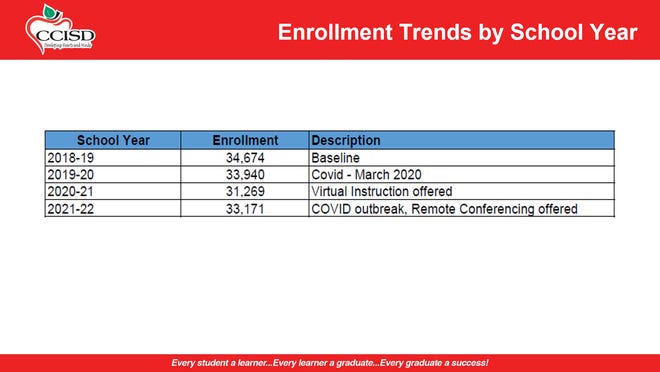
Corpus Christi ISD saw an increase in enrollment compared to last year by 1,902 students.

But the school district has about 1,500 fewer students than in the 2018-19 school year, and staff is working to continue the trend of growing enrollment, said Delma Bernal, director of admissions, attendance and student support service.

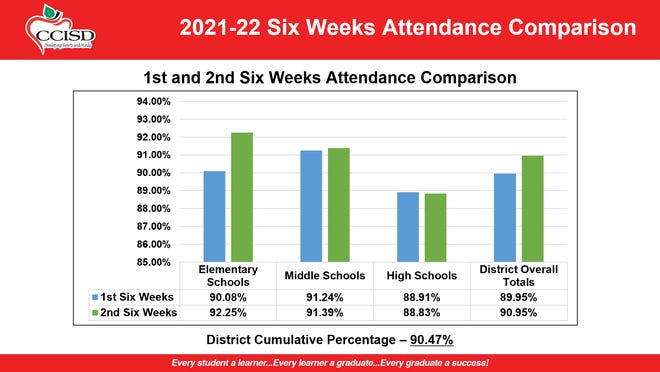
During the board of trustees meeting Monday, Bernal shared a report on the district’s current enrollment and attendance for the first and second six-week periods of the 2021-22 school year.

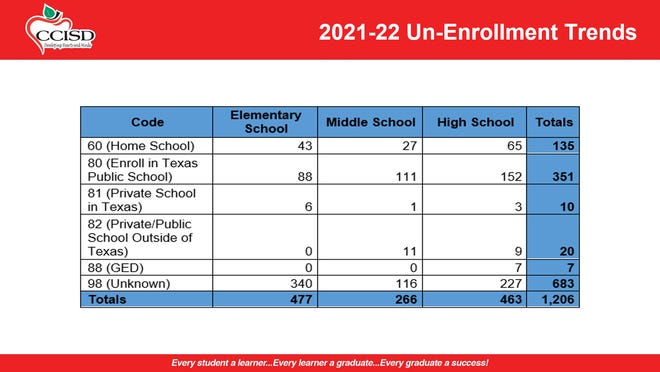
Texas schools receive state funding based in part on student attendance. Districts lose funding if students are absent or withdraw. 

Students arrive at Jones Elementary School on the first day of in-person classes for Corpus Christi Independent School District schools on Tuesday, Sept. 8, 2020.

Enrollment trends and goals

The district is aiming to return to the 2018-19 enrollment of 34,674. The current enrollment is 33,171.

For the past three school years, CCISD has experienced a decrease in enrollment. Bernal said contributing factors include  parents seeking other in-person or virtual school options at private or charter schools or through home schooling, children staying home due to COVID illness or contact, and refinery jobs that have left the area.

The case for combining synchronous and asynchronous online learning

There has been much debate in recent years on whether educators, trainers or L&D managers should focus on delivering synchronous or asynchronous online learning experiences.


What is the difference between synchronous and asynchronous learning?

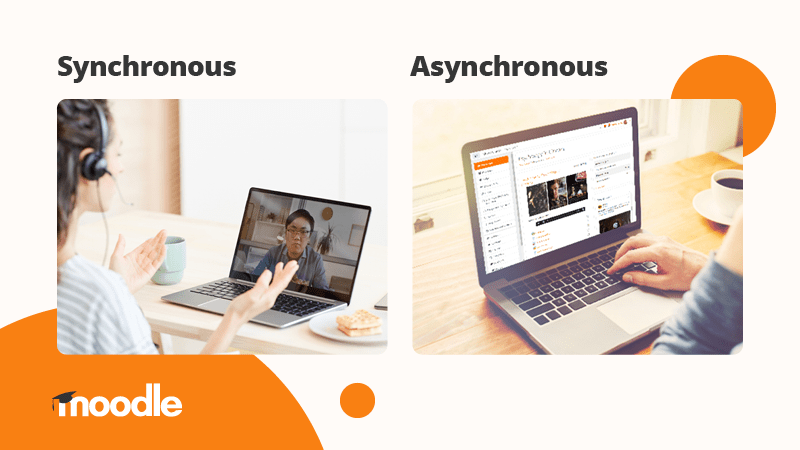
In the context of online education, synchronous learning experiences are those delivered live with an educator or trainer facilitating a learning session. There are a variety of tools that can be used in synchronous learning such as live meetings or virtual classrooms where educators and learners meet virtually in real-time (by means of a device over a network) and communicate and collaborate through video, chat, whiteboard and other synchronous tools. In contrast, while also requiring a device, asynchronous learning is a student-centred method usually delivered via a learning management system (LMS) that allows learning to occur in different times and spaces particular to each learner. In asynchronous learning, educators set up a learning program or course that students engage with at their own pace.


Social constructionism – learning as a social context

As many readers will be aware, Moodle is based on social constructionism, which is the understanding that people develop knowledge in a social context. Moodle advocates for, and supports, the importance of creating a collaborative community of learners where learners learn “by doing” and by observing their peers. A community where educators and trainers understand the context of learners so that they can customise the language and expression of concepts in ways that are best suited to the audience. And, where teachers or trainers recognise themselves as learners and are willing to collaborate, listen and share ideas in order to improve their own understanding and ultimately inform improvements to the learning program.


So, synchronous is better, right? Wrong.

This grounding in social constructionism could lead readers of this blog to think that Moodle would advocate for synchronous over asynchronous delivery. But to presume so would be wrong because asynchronous delivery also supports the theory of social constructionism. In order to create truly engaging learning experiences, it is equally important that asynchronous activities provide opportunities for learners to learn by doing and through relationships with each other and their teachers.

This does not mean that asynchronous instruction should replace the opportunity for educators, trainers and their learners to meet in real-time through virtual classrooms with live video and messaging functionality. Indeed, this modality of online synchronous delivery mirrors good traditional classroom instruction where a teacher or instructor supports students to become actively involved in their learning through interaction with each other and their teacher as they complete tasks or activities. 


Together is better

The issue is not whether asynchronous or synchronous delivery is better, but how both can be used to support the theory of social constructionism, accommodate different learning preferences and ultimately the engagement of learners through interaction with each other and their teacher.

Some face to face interaction is an essential component of good quality online instruction. That is why BigBlueButton, the open source web conferencing solution providing real-time sharing of audio, video, slides, whiteboard, chat and screen, will be incorporated into Moodle 4.0 as a standard feature. Currently available as a Moodle plugin, BigBlueButton, allows educators trainers to use breakout rooms, polls, multi-user whiteboard, and shared notes to engage learners in real-time. However, it is worth recognising that streaming video and connecting to online meetings use a lot of data and require fast internet connections, which not all learners may have at the same time. Even where connectivity is not an issue, technical issues can affect the quality of live interaction. These issues can be mitigated by using a combination of synchronous and asynchronous delivery methods.

More importantly, learners differ in the way that they perceive and comprehend information that is presented to them. For instance, some learners will understand content more quickly through visual or auditory means rather than printed text. Other learners with sensory disabilities or learning difficulties will have specific needs. To accommodate all learners’ preferences, it is important that educators create asynchronous Activities and Resources in a variety of modalities that learners can interact and engage with.

Online collaboration and group work can also be done well asynchronously. As an example, educators and trainers can use Moodle’s many standard features to encourage learner interaction and experimentation. For instance, they can invite personal response through Moodle Forum, create learner Groups, set Assignments, encourage collaboration through peer assessment with Workshops and allow students to create collaborative project plans and documents through Wiki. Asynchronous courses also accommodate more introverted students who may struggle to interact with other learners and their teacher or instructor in a live setting.

Both synchronous and asynchronous delivery has benefits for educators, trainers and learners:


Moodle was designed for ultimate flexibility, a toolbox that accommodates both synchronous and asynchronous delivery to empower educators and trainers to build their own education platform that is appropriate to their learners.

Find out more about our online learning platforms Moodle LMS or Moodle Workplace. Or, contact a Moodle Certified Service Provider who can help you with learning design, custom development, hosting, onboarding, installation and integrations.


References:

https://elearningindustry.com/blending-asynchronous-and-synchronous-digital-learning-modalities-part-5
https://www.brynmawr.edu/blendedlearning/asynchronous-vs-synchronous-learning-quick-overview
https://elearningindustry.com/right-learning-modalities-asynchronous-and-synchronous-interactions
https://elearningindustry.com/asynchronous-and-synchronous-modalities-deliver-digital-learning
https://educationrickshaw.com/2020/03/30/the-unproductive-debate-of-synchronous-vs-asynchronous-learning/

Code Ninjas to Debut in Hacienda Heights, Will Teach Kids to Code in a Cool New Way

Code Ninjas Center to Focus on Interactive Learning through Game-Building, Robotics and More

HACIENDA HEIGHTS, Calif., Dec. 7, 2021 /PRNewswire/ — Code Ninjas, one of the fastest-growing kids coding franchises, is set to open their newest location at 17142 Colima Rd. Unit D on Dec. 8. Code Ninjas will serve the local area by offering computer coding courses for kids. The courses will allow kids to problem-solve while they build video games and collaborate with other children their age. This new learning center will establish an environment where kids and teens can learn about technology while having fun.

Code Ninjas Logo (PRNewsfoto/Code Ninjas)

Code Ninjas Logo (PRNewsfoto/Code Ninjas)

The Hacienda Heights location is owned and operated by local entrepreneurs David and Irene Yu. David has 25 years of experience in IT networking while Irene spent 15 years in the pharmaceutical industry before becoming a stay-at-home mom. David and Irene tried several methods when it came to teaching their kids how to code, including online programs and coding tutors. It wasn’t until Code Ninjas that they found the right fit; fun, engaging courses teaching essential skills. It was due to their positive personal experience that the Yus decided to bring Code Ninjas to Hacienda Heights.

“Coding is an invaluable language for kids to learn and Code Ninjas allows for kids to hone their abilities in an interactive and social environment,” says David Yu. “Technology has made its way into almost every job and we want to give kids the skills they need to succeed. The best part about the Code Ninjas curriculum is that kids have so much fun while they learn new subjects.”

Hacienda Heights children (ages 5-14) can look forward to the new Code Ninjas center where they can learn how to code in a fun, safe, and social environment. At Code Ninjas, gaming is celebrated, and STEM is cool. Everything about their centers – or Dojos – are built around fun, which keeps kids coming back. The center also provides the results that parents are looking for, as their children gain coding and problem-solving skills they’ll need in the evolving job market.

“At Code Ninjas, kids are developing social skills in addition to learning how to problem solve,” says Irene Yu. “Code Ninjas combines screen time and social interaction in a way that is productive and beneficial for kids. Making education engaging and enjoyable for them is what will truly help them succeed in school and in their future career.”

Code Ninjas offers a robust, game-based curriculum made up of nine belts, just like martial arts. The courses are self-paced, but not self-taught; kids get immediate help and encouragement from Code Senseis (teachers) and fellow students as they advance from white to black belt. The program keeps kids motivated with little wins along the way, and “Belt-Up” celebrations where they receive color-coded wristbands to mark their graduation to the next level. By the time a child finishes the program, they will publish their own app, available to the public in an app store.

Code Ninjas also offers a variety of opportunities for children to get involved, including a flexible weeknight drop-in program, camps and Parents Night Out events on weekends.

For more information about the Hacienda Heights Code Ninjas location, please visit www.codeninjas.com/ca-hacienda-heights or call 626-910-2020.

About Code Ninjas
Founded in 2016, Code Ninjas® is the world’s largest and fastest-growing kids coding franchise. In hundreds of Code Ninjas centers, kids ages 7-14 have fun building video games while gaining life-changing skills in coding, robotics, and problem solving. Kids have fun, parents see results®. For more information, visit www.codeninjas.com.

Media Contact: Allie Bertrand, Fishman PR, [email protected] or 847-945-1300

Cision

Cision

View original content to download multimedia:https://www.prnewswire.com/news-releases/stem-learning-with-video-games-code-ninjas-to-debut-in-hacienda-heights-will-teach-kids-to-code-in-a-cool-new-way-301439337.html

SOURCE Code Ninjas

Physical fitness is a powerful predictor of health outcomes — ScienceDaily

In the largest study performed to date to understand the relationship between habitual physical activity and physical fitness, researchers from Boston University School of Medicine (BUSM) have found that higher amount of time spent performing exercise (moderate-vigorous physical activity) and low-moderate level activity (steps) and less time spent sedentary, translated to greater physical fitness.

“By establishing the relationship between different forms of habitual physical activity and detailed fitness measures, we hope that our study will provide important information that can ultimately be used to improve physical fitness and overall health across the life course,” explained corresponding author Matthew Nayor, MD, MPH, assistant professor of medicine at BUSM.

He and his team studied approximately 2,000 participants from the community-based Framingham Heart Study who underwent comprehensive cardiopulmonary exercise tests (CPET) for the “gold standard” measurement of physical fitness. Physical fitness measurements were associated with physical activity data obtained through accelerometers (device that measures frequency and intensity of human movement) that were worn for one week around the time of CPET and approximately eight years earlier.

They found dedicated exercise (moderate-vigorous physical activity) was the most efficient at improving fitness. Specifically, exercise was three times more efficient than walking alone and more than 14 times more efficient than reducing the time spent sedentary. Additionally, they found that the greater time spent exercising and higher steps/day could partially offset the negative effects of being sedentary in terms of physical fitness.

According to the researchers, while the study was focused on the relationship of physical activity and fitness specifically (rather than any health-related outcomes), fitness has a powerful influence on health and is associated with lower risk of cardiovascular disease, diabetes, cancer and premature death. “Therefore, improved understanding of methods to improve fitness would be expected to have broad implications for improved health,” said Nayor, a cardiologist at Boston Medical Center.

These findings appear online in the European Heart Journal.

Story Source:

Materials provided by Boston University School of Medicine. Note: Content may be edited for style and length.