When students and educators were sent home in March 2020, they quickly had to figure out what to do without being in person. Our ways of teaching and learning were disrupted by the coronavirus (COVID-19) pandemic and so we had to make do with what we had: online learning.
Around a year and a half later, online learning has turned the way we think about education on its head. Even today, as we are still slowly making our way out of the pandemic, virtual education is still implemented. Whether it be the virtual days due to inclement weather or the asynchronous classes that students are still taking this year, online learning is the way that we dealt with COVID-19 interrupting our education.
Students at Montclair State University have a lot to say about their experience with learning via Zoom. Although experiences differed in some ways, they left a lasting impression on most. Cam Martin, a junior sports media and journalism major, described how he handled the initial transition to learning online.
“Using Zoom for the first time was definitely unique to me partially because I’d never experienced an online school,” Martin said. “I can sleep in a little bit, but this is still kind of new to me. I’m good with technology, so I could find a way to successfully complete this, but it’s just really a matter of, ‘Can I really do this at the moment?’”
Cam Martin is one of many students who had to make the transition to online learning. Photo courtesy of Cam Martin
Mari Zuniga, a senior communication and media arts major, had a more difficult transition into what became the new normal for education.
“I find it hard to concentrate on the computer,” Zuniga said. “It’s really difficult for me because I’m looking at this and looking at that. I’m hearing them, but I’m not listening. I’m not paying attention.”
Mari Zuniga had her mental health affected by online learning. Sal DiMaggio | The Montclarion
Dr. Erik Jacobson, an associate professor in the teaching and learning department, noted how different students reacted in different ways to the initial switch over to virtual learning.
“[For students who prepared for online learning], it might’ve been slightly different than they were expecting, but I think classes still worked for them,” Jacobson said. “I think they got maybe not 100{e4f787673fbda589a16c4acddca5ba6fa1cbf0bc0eb53f36e5f8309f6ee846cf} of what they would have gotten normally, but I think they got a good chunk of it. And the students who were not prepared for it, I think really suffered.”
Dr. Erik Jacobson had much to say about how online learning impacted our way of education. Sal DiMaggio | The Montclarion
Students weren’t the only ones impacted by the move to Zoom. Professors had to deal with this change as well. Dr. Michael Koch, an adjunct professor for the School of Communication and Media, was one of many.
“[Online teaching is] not my preferable way to teach, but I wasn’t completely against it either,” Koch said. “I wanted to be safe, and I wanted everybody to be safe, too. So it was challenging, but I made the best of it that I could and I tried to be as accommodating as [I] possibly could be.”
Dr. Michael Koch says online learning made it difficult for him to engage properly with his students. Sal DiMaggio | The Montclarion
Mental health was also something that online learning affected. Going to classes has a social aspect to it as well as an educational one, and being forced to learn from home took that away.
In addition to being a professor at Montclair State, Koch is also a therapist, and he saw students struggling with their mental health. But he also noted that sometimes it’s hard to know what students are going through.
“I think that it’s a bit of a cliché to say everybody is struggling, but there is a lot of cumulative impact of this,” Koch said. “Maybe six months ago, some people [would say], ‘Yeah, I’m fine. I’m doing alright.’ But as it drags on and on, it just gets tiring. I think there’s a lot of mental exhaustion. [Even] myself and [other educators] are not immune to that at all.”
Zuniga went on to discuss her struggles with mental health while learning over Zoom.
“Before COVID-19, [my mental health] was already on the rocks,” Zuniga said. “So when online learning happened, it slightly got worse. [I thought] ‘How am I going to get through this? Are we always going to be on Zoom?’”
According to Jacobson, the decline in mental health wasn’t quite invisible to professors, but it was hard for them to tell exactly what was going on.
“I had students who would straight up tell me how they were doing and how they were feeling and others who fell off the radar,” Jacobson said. “So I [would] email them, ‘How are you doing? Is everything okay?’ But then there were students who showed up, did their work, were engaged and their personality wouldn’t lend themselves to saying, ‘Actually I’m struggling right now.’”
Despite this, online learning may have its advantages going forward if used correctly, especially here at Montclair State where traffic and parking seem to always be cause for concern for students, according to Jacobson.
“It certainly provides flexibility, right?” Jacobson said. “In terms of time, schedule and physical location. Montclair State has a lot of students who work outside of school. We have a lot of students who are commuters, [and] we’ve got terrible traffic and parking problems on campus. So certainly Zoom and using online learning platforms may be a way to address some of those things.”
As the future unfolds, the COVID-19 pandemic will continue to shape our education systems. No one can predict the future and tell what it has in store for us, but at the end of the day, one thing is clear: online learning has changed the way we think about education forever.
The global serious games market was valued at USD 6.29 billion in 2020, and it is expected to reach a value of USD 25.54 billion by 2026, registering a CAGR of 26.37{e4f787673fbda589a16c4acddca5ba6fa1cbf0bc0eb53f36e5f8309f6ee846cf} over the forecast period 2021 – 2026.
Companies Mentioned
Designing Digitally Inc.
Diginext (CS Group)
CCS Digital Education Ltd
Applied Research Associate Inc.
Grendel Games
Cisco Systems
Revelian
MPS Interactive Systems
Can Studios Ltd
L.I.B. Businessgames BV
Tygron BV
Triseum LLC
Key Market Trends
Learning and Education Application to Witness Significant Growth
In the recent past, digital games and simulations have gained popularity for being the most powerful and highly engaging learning environment. The production of these serious games requires complex and dynamic constructs with appropriate designs of multimodal context and engaging interactions and productive pedagogical strategies to preserve learning efficacy.
Moreover, in the education and learning ecosystem, the need for game concepts, such as challenges, rules, scores, competition, and levels, is encouraging vendors to develop solutions to address and accommodate the principal pedagogical functional variables, such as instructional support, feedback, guidance, self-regulation, attention, cognitive flow, and assessment.
Further, Grandel Games developed a serious game that achieves behavioral change. For instance, one of the games, ‘Garfield’s Count Me In,’ is designed for students in primary education and helps them do repetitive math exercises. It is based on the learning methodology ‘Het Rekenmuurtje’ (‘Math Wall’) and specially designed by educational advisers.
In April 2020, the Indiana Department of Education in the United States announced the Rose-Hulman’s PRISM program to provide school teachers across Indiana with valuable e-learning resources and summer professional development workshops. The program aims to create an online library with more than 6,000 free online teaching resources, which will enable teachers to share lesson plans with other school districts with the help of digital tools, such as serious gaming, among others.
Further, in May 2021, the National Cyber Security Centre (NCSC) launched a new educational game known as CyberSprinters for teaching cyber security at primary schools, clubs, and youth organizations. The CyberSprinters is an interactive game aimed at 7 to 11-year-olds learners.
Asia Pacific to Hold Significant Market Share
The growing awareness regarding serious games or Game-based Learning (GBL) concept, increasing investment by big players into the segment, and growing demand for mobile-based serious gaming are some of the major factors driving the growth of serious games in the Asia-Pacific region. The recent COVID-19 pandemic and nationwide lockdowns, along with governments boosting educational gaming in the country, are some of the opportunities that are expected to boost the adoption of serious games in the region over the forecast period.
Serious games are emerging as a powerful learning tool and are experiencing increasing popularity in recent times, owing to the cost-effective alternative to classroom-based learning for knowledge acquisition, as well as perceptual, behavioral, cognitive, affective, motivational, physiological, and social learning outcomes.
The healthcare industry had been one of the targeted industries for the increased usage of serious games. With the aid of simulation and visualization technologies, serious games now have the capability to teach multidisciplinary healthcare professionals key procedural and cognitive skills in an engaging manner.
To enable the development and implementation of serious games in healthcare, SIMS (SingHealth Institute of Medical Simulation) collaborated with the Serious Games Association (SGA), a non-profit serious games and game technology society in Singapore, to provide healthcare professionals with the ability to apply gamification in healthcare.
The previous collaborations with SGA include the SIMS Games Challenge 2019, a serious healthcare simulation game competition, which observed healthcare professionals submitting concepts and developing prototypes of simulation games. SIMS and SGA had also announced a collaboration to organize RICH Games 2022, a conference for the Southeast Asian region, which offers emerging solutions and innovations to advance healthcare education.
Key Topics Covered:
1 INTRODUCTION
2 RESEARCH METHODOLOGY
3 EXECUTIVE SUMMARY
4 MARKET INSIGHTS
4.1 Market Overview
4.2 Industry Attractiveness – Porter’s Five Forces Analysis
4.3 Technology Snapshot
5 MARKET DYNAMICS
5.1 Market Drivers
5.1.1 Growing Usage of Mobile-based Educational Games
5.1.2 Improved Learning Outcomes are Expected to Increase the Adoption of Serious Game Among End Users
5.2 Market Restraints
5.2.1 Lack of Assessment Tools to Measure Serious Game Effectiveness
5.3 Assessment of Impact of COVID-19 on the Industry
It’s almost time for gym class, and my fifth grader can’t find her tennis ball.
“Adrienne, did you take it?” she demands of her younger sister, who swears she didn’t (though she probably did).
“How about a soccer ball?” I ask. They’re practicing dribbling skills.
“No, Mom,” she says firmly. “We’re indoors.” It has to be a tennis ball. She searches under the coffee table and behind the couch; scours her sister’s cluttered room. No tennis ball.
This is what remote phys ed looks like in our house.
And this is what it sounds like: Thundering footfalls from the bedroom above my office, as my third grader jumps over virtual dinner plates, dodges pixels of pumpkin pie and karate-chops cartoon carrots in a Thanksgiving-themed online fitness game that her PE teacher is using as a warmup.
The coronavirus pandemic and the resulting widespread shift to remote learning have brought major changes to phys ed in the United States. Gone are the team sports played in wide-open fields behind the school. In their place are Turkey Ninja Warrior and water-bottle bowling, solitary pursuits conducted couch-side, in spaces as small as a studio apartment. Rolled up socks and laundry baskets have replaced balls and nets, as schools seek everyday alternatives to stranded sports equipment.
The author’s daughter, Emma, 11, practices water-bottle bowling in her living room. Credit: Kelly Field for the Hechinger Report
The PE instructors I spoke with said the students seem to be having fun — the ones they can see on video, at least. Privacy policies in many districts bar teachers from requiring students to keep their cameras on, and some students don’t.
But it’s hard to gauge if they’re getting the same benefits from online PE as they did from in-person classes. Some students lack the equipment, space or parental support to participate fully. Instructors say it’s tough to teach and assess motor skills, like catching and kicking, online.
Meanwhile, public health experts say kids need exercise more than ever.
“PE is so important, because our kids are sitting from 8 to 3,” said Michelle Huff, a high school PE teacher in New Jersey.
In a majority of districts, students are spending some or all of their school days online. They’re missing out on recess and extracurricular sports, many of which have been cancelled for safety reasons. And they’re eating more junk food, according to research from Ireland and Italy. Public health experts here are worried about unhealthy eating too. Compounding these issues, many students around the country live in crowded apartments or in neighborhoods where it’s not safe to exercise outside. In some cities, parks are closed due to the pandemic.
If school closures continued through the end of this year, childhood obesity rates would climb by more than 2 percent.
If school closures continue through the end of this year, childhood obesity rates will climb by more than 2 percent, according to estimates in a recent study by a researcher at Washington University in St. Louis.
And though there’s little hard data on how much exercise kids are getting right now, the anecdotal evidence is that they are not moving as much as they should. In surveys Huff conducted this fall with 200 students at Metuchen High School, students said they had headaches from staring at the screen, that their backs hurt from sitting, and that they weren’t retaining anything.
Related:How a growing number of states are hoping to improve kids’ brains: exercise
School-age children should get an hour or more of moderate-to-vigorous physical activity daily, according to the Centers for Disease Control and Prevention. Students in elementary school should spend 150 minutes a week in PE while students in middle and high school should receive 225 minutes a week of PE instruction, according to recommendations from the Society of Health and Physical Educators (SHAPE), which represents PE and health instructors.
The benefits of exercise for children are well-established. Children who are aerobically fit are not only physically healthier than their sedentary peers — their brains are more developed, too, said Charles Hillman, a psychology professor at Northeastern University. His research indicates that fit children appear to have more mature prefrontal cortices and hippocampi — the parts of the brain associated with attention, memory and self-regulation, and by extension, academic achievement.
Exercise can also alleviate depression and anxiety — conditions that have intensified in many students during the pandemic. And it’s critical to combatting childhood obesity, which affects one in seven kids between the ages of 10 and 17 nationally, with even higher rates among low-income children and children of color.
“You have to keep them moving, because if they aren’t focused, if they have too much energy, they aren’t going to learn anything.”
Leslie Monterrosa, a second-grade teacher in Concord, California
Yet, even before COVID-19 shut down schools, fewer than half the states set any minimum amount of time that students must participate in PE, according to SHAPE.
With much of PE now online, some kids are getting even less time in class than before. In March, California’s governor waived the state’s time requirement, prompting some districts to eliminate PE as a stand-alone class or make it an elective. At least two Massachusetts districts have eliminated elementary PE altogether this year, according to the president of the state’s SHAPE chapter.
Portland, Oregon nearly laid off all its elementary adaptive PE instructors, who work with children with disabilities, before teachers defeated the move. Neighboring Hillsboro, a diverse city, was less lucky: The district reassigned all but one of its 15 elementary PE instructors to classroom positions to meet Oregon’s pandemic class size guidelines. That left the lone remaining gym teacher to teach 11,000 students asynchronously by creating Google slides for them to use.
Advocates for phys ed fear more cuts could be coming, as districts grapple with looming budget cuts stemming from the current economic downturn. And if the Great Recession is any guide, those cuts could fall hardest on high-poverty districts, where students already have less access to afterschool sports than in wealthier ones.
“Not all students have the privilege of taking ballet classes or sports clubs,” said Julia Stevens, the president of Oregon’s SHAPE chapter.
Related: Immigrants find hope in soccer, but some states won’t let them play
For now, though, PE instructors are focused on finding creative ways to keep their kids engaged. They’re sending kindergarteners on scavenger hunts that have them running around their homes to collect items. They’re challenging high schoolers to “beat the teacher” by performing more push-ups in a minute than their instructor.
“We’re disguising fitness,” said Brett Fuller, the president of SHAPE’s national board of directors, and a curriculum specialist for health and physical ed within Milwaukee Public Schools. “You can’t just do a fitness class, because kids will say it’s no fun.”
Back in New Jersey, Huff is working hard to make her classes fun. She’s created Tik Tok dance and exercise challenges, some of them with her sister, a PE teacher in another school. (And she’s not the only gym teacher embracing Tik Tok.) She’s also teaching students movement and mindfulness exercises they can perform, even during Zoom classes.
Since most kids don’t have a whole lot of gym gear in their homes, SHAPE’s reopening guidance recommends that teachers ask students what they do have on hand and provide a checklist of common household items that could be repurposed as sports equipment.
Some substitutions are simple — cut plastic gallon milk cartons for catching, or unopened canned soup for weights. Others are trickier. Kyle Bragg, an elementary school PE instructor in Scottsdale, Arizona, said he’s yet to find an acceptable alternative to a jump rope; nothing rotates at the same speed. He’s told kids to ask their parents to buy one, but he can’t force them. So for now, he’s stuck with some students jumping over pillows.
“It’s kind of like taking a pencil away from a classroom teacher,” he said. “It’s nearly impossible to meet a jump rope standard without a jump rope.”
Some districts are purchasing take-home kits containing jump ropes, balls and bean bags. But the kits can be pricey, and not all districts can afford them. In normal times, the median budget for PE equipment and supplies is just $764 a year per school, according to a 2016 report by SHAPE.
So some teachers are soliciting supplies online, through sites like DonorsChoose.org. Between July 1 and Dec. 1, teachers submitted 860 requests (out of 181,000 total) that referenced virtual PE, according to Christopher Pearsall, the website’s vice president for brand and communications. The most sought-after items, by far, were jump ropes.
“It’s kind of like taking a pencil away from a classroom teacher. It’s nearly impossible to meet a jump rope standard without a jump rope.”
Kyle Bragg, an elementary school PE instructor in Scottsdale, Arizona
One of the requests came from Leslie Monterrosa, a second grade teacher in Concord, California. She knows her low-income, English language learners tend to live in small apartments and have busy working parents, so she asked for equipment they could use on their own, in small spaces — jump ropes and bean bags. A donor stepped up within days.
“You have to keep them moving, because if they aren’t focused, if they have too much energy, they aren’t going to learn anything,” she said.
Some instructors are offering students choices: If they don’t have the equipment they need for one activity — say soccer — they can try another, like running. The alternative might not target the same skills, but at least it gets them moving.
And in the midst of a pandemic that has upended nearly every aspect of education, some standards may simply need to be set aside for a bit, instructors say.
“You gotta be OK with OK,” David Daum, an assistant professor of kinesiology at San Jose State University in California, said he tells teachers. “If you are trying hard, your students will see it. Just do your best.”
The hardest things to teach and evaluate online, instructors say, are the skills, strategies and collaboration involved in team sports. There’s just no way to play soccer alone in your living room.
Related: Ed tech can transform physical education classes, too
That’s why online PE courses — which have existed at the high school and college levels since at least the late 1990s — have historically favored fitness-based instruction, like interval training and biking, over the development of gross motor skills like jumping and throwing. Covid-era classes seem to be following the same trend, said Daum, who researches online PE.
This neglect of motor skills in online PE courses has been one of the chief criticisms of the delivery of classes via the internet. In its guidelines for online PE, SHAPE argues that the development of motor skills competence is “the highest priority of physical education,” and should be a “central component of any online physical education course.”
During the pandemic, some teachers have been asking students to send short video clips of themselves performing individual skills, like jumping rope. (Cooperative skills, like passing a ball, are harder to measure, since not everyone has a partner.) But there are limitations and drawbacks to that approach: Some parents aren’t comfortable with their children sharing videos of themselves and some students send clips that are far too long. With dozens of students per grade, reviewing the submissions can take an instructor hours.
The alternative is to conduct assessments in livestream classes, but that can open students up to ridicule and cyber-bullying. Some districts have policies stating that students can’t be required to keep their cameras on.
In such districts, it can be hard to tell if students are participating at all. They might be doing jumping jacks, or they might be watching YouTube.
To gauge participation, many instructors are asking students to answer a question in a chat box or complete an exit ticket with questions about the lesson and their own performance. Some schools with fully asynchronous PE are relying on the honor system, with students using logs to report how much exercise they get each day.
It’s unclear how many students are actually doing the portions of PE that aren’t livestreamed. Are busy working parents enforcing it? Given the hassle involved — one lesson in our house required my daughter to collect no fewer than seven household items — should parents just send their kids out to play instead?
No, said Stephanie Morris, the CEO of SHAPE America. Outdoor play is great. But PE is about more than just being active, she said. It’s about “learning skills to be healthy.”
Related: Schedules for distance learning are all over the place (and it’s making parents crazy)
Despite the challenges involved in remote learning, Fuller, SHAPE’s president, sees the pandemic as an opportunity to show that PE is not only about team sports. Teachers are learning technological skills that “none of us ever dreamt they’d have,” he said. And students are discovering that fitness can be fun, even without group games.
“Sitting on a couch in front of a computer may be some people’s dream job, but it drives me crazy.”
Andrew VanDorick, an elementary PE teacher in Maryland
“I see this as an opportunity to do things differently, to really showcase what we should be about,” he said, “and that is developing physical literacy: the skills, knowledge and attitudes to be physically active for a lifetime.”
Still, many PE instructors said they’re eager to return to the gym and sports fields.
“I became a PE teacher because I needed to keep moving,” said Andrew VanDorick, an elementary PE teacher in Maryland. “Sitting on a couch in front of a computer may be some people’s dream job, but it drives me crazy. I can’t wait to be back in front of the kids.”
Oh, and that missing tennis ball? Turns out it isn’t essential after all. When it vanishes again, just in time for water-bottle bowling, my 11-year-old substitutes a lacrosse ball — and rolls a spare.
This story about phys ed was produced by The Hechinger Report, a nonprofit, independent news organization focused on inequality and innovation in education. Sign up for the Hechinger newsletter.
The Hechinger Report provides in-depth, fact-based, unbiased reporting on education that is free to all readers. But that doesn’t mean it’s free to produce. Our work keeps educators and the public informed about pressing issues at schools and on campuses throughout the country. We tell the whole story, even when the details are inconvenient. Help us keep doing that.
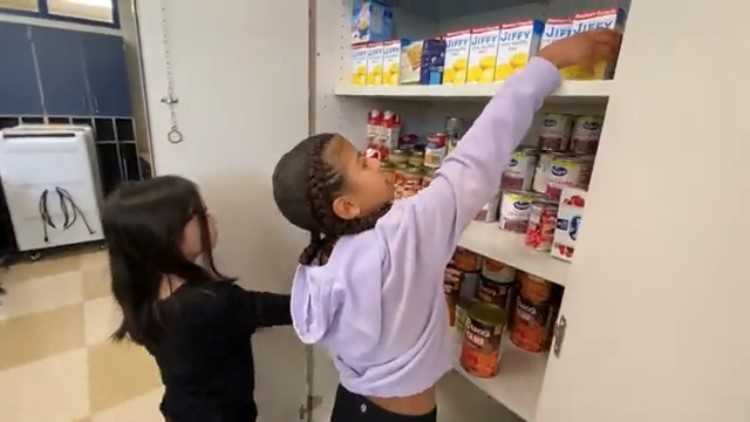
Keilani Lopez and Adele White spent this Giving Tuesday organizing food at Middletown’s Creekview Elementary School. Keilani and Adele are fourth graders who are helping to make a difference in their community.They know with each box of food that was donated and every can placed on a shelf, a Middletown family’s life gets a little easier.”I did not think that there’s going to be that much,” Keilani said as she looked at the donations.Adele said, “I didn’t know all that food was in there.” Even after handing out dozens of meals fr Thanksgiving, there was a lot left over from the school’s food drive, which was a little different this year.”We just wanted to not make anybody feel pressured to extend themselves in a way that would have been maybe hard,” said Brea Greer, an art teacher at Creekview. So, rather than asking families to donate, as they did in years past, teachers asked students to write letters to local businesses and churches.”We wrote letters saying what they can give to us and what we need, basically,” Keilani said. The response was overwhelming.”It was super exciting. It filled our office, our front office into the conference room, down the hallway,” said Allison Drake, a fourth-grade teacher. “I think it kind of helped lift our spirits during a crazy time of the holidays.””It just became clear that people in the community wanted to be connected and wanted to help out with the schools but didn’t know how,” Greer said. “We had so many donations, we were able to open it up to anybody in our school.” A counseling office has now turned into a mini food pantry that will help to feed families and souls.”It makes me feel happy,” Keilani said.Creekview is still accepting donations of food, hygiene items and gif cards. Anyone wishing to make a donation is asked to call the school directly.
MIDDLETOWN, Ohio —
Keilani Lopez and Adele White spent this Giving Tuesday organizing food at Middletown’s Creekview Elementary School. Keilani and Adele are fourth graders who are helping to make a difference in their community.
They know with each box of food that was donated and every can placed on a shelf, a Middletown family’s life gets a little easier.
“I did not think that there’s going to be that much,” Keilani said as she looked at the donations.
Adele said, “I didn’t know all that food was in there.”
Even after handing out dozens of meals fr Thanksgiving, there was a lot left over from the school’s food drive, which was a little different this year.
“We just wanted to not make anybody feel pressured to extend themselves in a way that would have been maybe hard,” said Brea Greer, an art teacher at Creekview.
So, rather than asking families to donate, as they did in years past, teachers asked students to write letters to local businesses and churches.
“We wrote letters saying what they can give to us and what we need, basically,” Keilani said.
The response was overwhelming.
“It was super exciting. It filled our office, our front office into the conference room, down the hallway,” said Allison Drake, a fourth-grade teacher. “I think it kind of helped lift our spirits during a crazy time of the holidays.”
“It just became clear that people in the community wanted to be connected and wanted to help out with the schools but didn’t know how,” Greer said. “We had so many donations, we were able to open it up to anybody in our school.”
A counseling office has now turned into a mini food pantry that will help to feed families and souls.
“It makes me feel happy,” Keilani said.
Creekview is still accepting donations of food, hygiene items and gif cards. Anyone wishing to make a donation is asked to call the school directly.