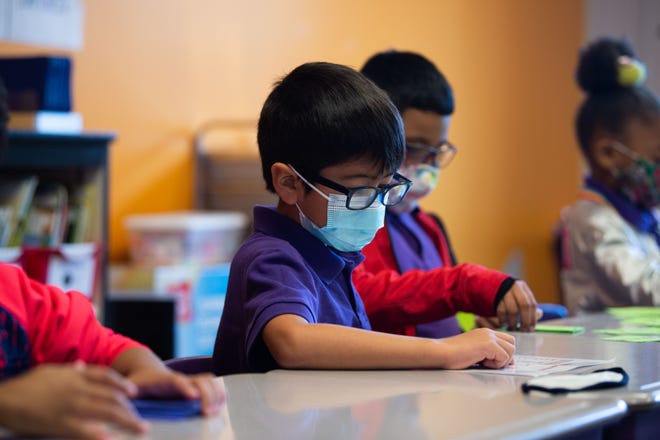
Keilani Lopez and Adele White spent this Giving Tuesday organizing food at Middletown’s Creekview Elementary School. Keilani and Adele are fourth graders who are helping to make a difference in their community.They know with each box of food that was donated and every can placed on a shelf, a Middletown family’s life gets a little easier.”I did not think that there’s going to be that much,” Keilani said as she looked at the donations.Adele said, “I didn’t know all that food was in there.” Even after handing out dozens of meals fr Thanksgiving, there was a lot left over from the school’s food drive, which was a little different this year.”We just wanted to not make anybody feel pressured to extend themselves in a way that would have been maybe hard,” said Brea Greer, an art teacher at Creekview. So, rather than asking families to donate, as they did in years past, teachers asked students to write letters to local businesses and churches.”We wrote letters saying what they can give to us and what we need, basically,” Keilani said. The response was overwhelming.”It was super exciting. It filled our office, our front office into the conference room, down the hallway,” said Allison Drake, a fourth-grade teacher. “I think it kind of helped lift our spirits during a crazy time of the holidays.””It just became clear that people in the community wanted to be connected and wanted to help out with the schools but didn’t know how,” Greer said. “We had so many donations, we were able to open it up to anybody in our school.” A counseling office has now turned into a mini food pantry that will help to feed families and souls.”It makes me feel happy,” Keilani said.Creekview is still accepting donations of food, hygiene items and gif cards. Anyone wishing to make a donation is asked to call the school directly.
MIDDLETOWN, Ohio —
Keilani Lopez and Adele White spent this Giving Tuesday organizing food at Middletown’s Creekview Elementary School. Keilani and Adele are fourth graders who are helping to make a difference in their community.
They know with each box of food that was donated and every can placed on a shelf, a Middletown family’s life gets a little easier.
“I did not think that there’s going to be that much,” Keilani said as she looked at the donations.
Adele said, “I didn’t know all that food was in there.”
Even after handing out dozens of meals fr Thanksgiving, there was a lot left over from the school’s food drive, which was a little different this year.
“We just wanted to not make anybody feel pressured to extend themselves in a way that would have been maybe hard,” said Brea Greer, an art teacher at Creekview.
So, rather than asking families to donate, as they did in years past, teachers asked students to write letters to local businesses and churches.
“We wrote letters saying what they can give to us and what we need, basically,” Keilani said.
The response was overwhelming.
“It was super exciting. It filled our office, our front office into the conference room, down the hallway,” said Allison Drake, a fourth-grade teacher. “I think it kind of helped lift our spirits during a crazy time of the holidays.”
“It just became clear that people in the community wanted to be connected and wanted to help out with the schools but didn’t know how,” Greer said. “We had so many donations, we were able to open it up to anybody in our school.”
A counseling office has now turned into a mini food pantry that will help to feed families and souls.
“It makes me feel happy,” Keilani said.
Creekview is still accepting donations of food, hygiene items and gif cards. Anyone wishing to make a donation is asked to call the school directly.
Students at Stafford Elementary School (SES) recently completed a two-week, kindness-focused fundraising campaign named Raise Craze. During the fundraiser, students showed their appreciation to donors by completing Acts of Kindness for others. At the end of the campaign, the students completed more than 630 acts of kindness and raised more than $16,000.
“Students completed a variety of kindness acts, from picking up trash in their community to writing special letters to teachers at Stafford Elementary School. Some students even made blessing bags for the homeless,” said SES Principal Stefanie Sanders. “In addition to individual acts of kindness, the school hosted a community Chalk the Walk at the school to spread kindness messages and art.”
During the campaign, students signed their name on various sea life and applied it to the Dolphin Kindness Wall after completing an act of kindness. “Kindness is an important part of good citizenship, and we all can learn a lesson from these students about supporting one another with kindness,” said Dr. Stanley B. Jones, SCPS Interim Superintendent. “Every small act leaves a ripple of joy in the community. I encourage all of us to go out and do something nice for someone today. You never know how large an impact one small act, such as a letter of support to a child’s teacher, will make.”
As the culmination of the campaign, school administrators, with the support of the SES PTA, created a surprise Magical Celebration day on Friday, November 19. With support from the SES PTA, each grade level hallway was immersed in a different Disney movie theme. Teachers, administrators, counselors, and staff dressed as characters from the movie, enhancing the magic. “We wanted a fundraiser that meant something. The kids were so excited to complete their acts of kindness and see how being kind can make a BIG difference,” said Kathleen Meade, Stafford Elementary PTA President.
The students also were surprised with two kindness assemblies. The Stafford County Sheriff’s Department provided several displays from the special operations unit which included the SWAT Team, the K9 Unit, and the Unmanned Aircraft Systems Team. Guest speaker Lieutenant Diggs delivered an inspiring message addressing the importance of kindness. Stafford County Fire House 4 conducted the second assembly, providing a 100-foot fire truck. The students watched as Mrs. Sanders and Mrs. Hardman, the school administrators, were raised into the air above them to read “Be Kind” by Pat Zietlow Miller.
“These two organizations are a large part of our community,” said Sanders. “They have always done kind things for us, so having them deliver a message about kindness was very powerful for our students. We hope our students remember how everything begins with just one small act, and that the message of kindness resonates with them all year.”
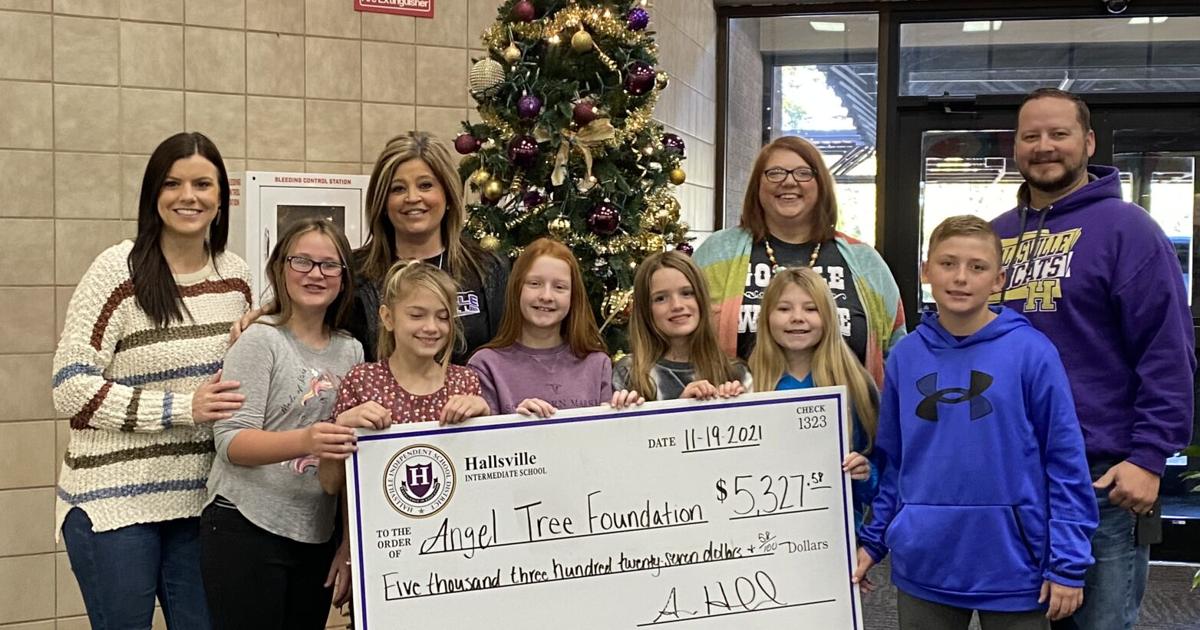
HALLSVILLE — A Hallsville ISD elementary school has raised more than $5,000 this year to contribute to the district’s Angel Tree fund, which provides Christmas presents for families in need.
Each November, Hallsville Intermediate School raises money throughout a two-week period known as the “Penny Wars,” to donate to the Angel Tree Foundation, which provides Christmas presents to area children in need.
The friendly competition sees jugs for teachers set out front of the school’s front office during the two-week period. The teachers who collect the most points from pennies wins.
“Here’s how the game works: each family of teachers has their own plastic jug outside of the front office. Students gain points for the class by adding pennies to their jug. Students can lower their opponents’ points by adding silver change to the opponents’ jug,” Hallsville Intermediate School Counselor Victoria Downs said. “The points are tallied each day and announced over the intercom. The next morning, the students are ready to sabotage whoever is winning and also add more to their own jug.”
In addition to knowing they bested other classes at the game, the winning team at each grade level wins a pizza.
“We also set a campus goal to raise $3,000, and if we reached that goal, the students would be able to pie our principal, Aaron Hoecherl, and our campus officer, Justin Clark, in the face,” Downs said.
The students raised so much, more than $5,300, resulting in both Hoecherl and Clark getting a face full of pie this year.
“This competition is such a fun way to raise money towards a good cause while also integrating math,” Downs said. “The Penny Wars has always been very successful, but this year we were shocked at how well it went.”
Downs and other staff presented the $5,327 check to Hallsville ISD Special Programs Director Amy Whittle recently.
“We sent emails thanking parents for letting their children raid their couch cushions and cup holders, but parents were calling the school and letting us know that their children were using their own allowance for this fundraiser,” Downs said. “I hope our students know how much of an impact they have made on children’s lives and how many children will actually be able to enjoy Christmas this year because of them.”
In celebration of the above and beyond giving, the winning classes received their pizza and the whole school received popsicles and extra recess time, making a win-win for everyone this holiday season.
This story was originally published by Chalkbeat, a nonprofit news organization covering public education. Sign up for their newsletters here: ckbe.at/newsletters.
Originally published Nov 19, 2021, 6:00am EST
There was no warning, just a knock on the door of Melissa Keaton’s Flatbush, Brooklyn, apartment. She opened it to find a caseworker with the Administration for Children’s Services, or ACS, the New York City agency tasked with investigating suspected child neglect and abuse.
Still shaken by the sudden death of her father to COVID-19, Keaton hadn’t sent her 9-year-old daughter to school since classes started mid-September. It was now the end of October, and the caseworker explained to Keaton, a former PTA president at her daughter’s school, that someone had reported the family for educational neglect.
When New York City opened its schools this fall for in-person learning, with no option for virtual instruction, families across the five boroughs opted to keep their children home. They worried about the health of their children and vulnerable loved ones, and remained unconvinced it was safe to return to full buildings.
“The only time ACS will intervene is if there is a clear intent to keep a child from being educated, period,” schools Chancellor Meisha Porter said at a press conference shortly before the new school year began. “We want to work with our families because we recognize what families have been through.”
Now, more than two months into the school year, some parents say they have been reported for neglect. The impact of child welfare investigations on already traumatized families can be severe: charges may stay on records for decades, future job prospects can be affected, and, most alarmingly, parents could be separated from children.
Education department staff made 207 reports of educational neglect through Oct. 31, according to ACS data. The numbers tripled in the last two weeks of October, compared to the total reported during the first month of school.
Still, the overall number of reports dropped from last year, when there were 346 cases in the same time period. But some parents and advocates say this year’s numbers are cause for concern since some of the parents getting wrapped up in the child welfare system are making efforts to educate their children as they hold out for a remote option.
Options for wary families, who are disproportionately families of color, are limited. Parents can apply for medically necessary instruction, which offers few teaching hours at home or virtually — but only for children who meet certain medical conditions. They can home-school, but that removes the student from their public school and puts the onus on families to educate their children at home, without help. In New York, homeschooling also involves completing and filing a plan and quarterly reports.
Experts have stressed that children learn best in school. The American Academy of Pediatrics has warned about the dire consequences of keeping students home.
“Remote learning — which exacerbated existing educational inequities — was detrimental to the educational attainment of students of all ages and worsened the growing mental health crisis among children and adolescents,” the academy wrote.
City leaders have worked to reassure families that steps are being taken to make buildings safe. Staff must be vaccinated, masks are required for everyone, and officials said they’ve upgraded ventilation across the city’s 1,600 schools. Weekly on-campus COVID testing for unvaccinated students (the only group who is swabbed) has revealed a positivity rate of .39{e4f787673fbda589a16c4acddca5ba6fa1cbf0bc0eb53f36e5f8309f6ee846cf} over a seven-day average, according to city data through Nov. 17.
“Our priority is the safety of our students, and the first two months of this school year showed that our schools are the safest place for them to be during this pandemic,” said education department spokesperson Nathaniel Styer.
For Keaton, whose father died alone at a hospital soon after developing a cough in April 2020, that isn’t enough. After attending virtual town halls and talking to school and district leaders, she remained unconvinced that it was safe to send her daughter back to a school building.
“Families who are grieving and traumatized should not have to go through this,” she said.
‘Caught in the crosshairs’
It’s unclear how many families are refusing to send their children to school buildings this year. But attendance has lagged in some places, and last month the chancellor recorded a round of robocalls to families urging them to send their children to class.
Tajh Sutton is a mom in Brooklyn who, through the advocacy group PRESS, Parents for Responsive Equitable Safe Schools, has been providing resources and support to families boycotting classrooms because of health concerns.
The group has been advocating for a remote option as well as legislation that would require parents to be informed of their rights if they’re ever reported to ACS. Group members have also asked for an attendance code to track families who are staying home because of safety concerns.
After receiving roughly 20 calls from parents who recently received visits from ACS caseworkers, PRESS members created toolkits to help families understand their rights when it comes to child welfare and is partnering with the advocacy group JMacForFamilies and others on a Nov. 26 workshop on the topic.
The education department last week sent new guidance to principals with specific suggestions for how to engage with families who aren’t sending their children to school because of health concerns.
The guidance calls for offering families a virtual tour of the school to see the safety measures in place, making adjustments to respond to parents’ concerns, and offering application information for the city’s medically necessary instruction program. It also notes that schools should not report families for educational neglect if there is a pending application for medically necessary instruction or homeschooling.
“A report of suspected educational neglect is not a remedy for excessive absences, and is an option of last resort,” the guidance says.
Styer, the education department spokesman, said that educators “exhaust all options to support families in making sure every student attends school safely every day,” but also that, “our staff take their responsibility as mandated reporters for child welfare very seriously.”
“One of the striking things to me about placing teachers in the role of mandated reporters is just the extreme damage and lack of trust that creates in the relationship between parents and teachers,” said Anna Arons, an acting assistant professor at New York University.”
Despite the detailed guidance, many schools appear to be responding in their own ways, according to Amy Leipziger, a senior staff attorney who deals with education issues for Queens Legal Services. The move to call ACS on families, who are “trying to do the best they can,” ends up feeling very “retaliatory” by their schools, she said.
Now you’ve got parents — and more importantly, you’ve got kids — getting caught in the crosshairs,” she said.
A spokesperson for ACS, Nicholas Aguilar, said that the agency’s top priority is the safety and well-being of the city’s children. “Our work is focused on ensuring families have the services and supports that they need for their children to thrive, including educational services,” he said.
Educators are considered “mandated reporters,” which means they’re obligated to report suspected abuse or neglect. Prior to COVID, educators made about a quarter of ACS reports, said Anna Arons, an acting assistant professor at the New York University law school who has studied the city’s child welfare agency.
Arons pointed out research nationwide shows reports from educators are the least likely to be substantiated.
“One of the striking things to me about placing teachers in the role of mandated reporters is just the extreme damage and lack of trust that creates in the relationship between parents and teachers,” she said.
In terms of who is being reported, Black and Latino children tend to be overrepresented. While about 60{e4f787673fbda589a16c4acddca5ba6fa1cbf0bc0eb53f36e5f8309f6ee846cf} of the city’s children are Black and Latino, they are 90{e4f787673fbda589a16c4acddca5ba6fa1cbf0bc0eb53f36e5f8309f6ee846cf} of those involved in investigations or placed in foster care, Arons said.
In response to the harshness of how long ACS charges stay on one’s record, a new state rule will take effect in January reducing the number of years to eight. Until then, any ACS charges could remain on someone’s record until the child turns 28.
‘Concerned for our children’s safety’
After spending last year fully remote, Viviana Echavarria’s two teenagers were excited to return to Riverdale Kingsbridge Academy and even went back-to-school shopping. But then the Bronx mom and her husband decided to keep their two high schoolers home until their 11-year-old could get vaccinated.
Still, Echavarria was stunned when her husband called late last month while she was at work, as a director of operations for a nursing home, letting her know that an ACS caseworker was at their door. He hasn’t returned to work yet to stay home with their three school-aged children and 6-month-old baby. The caseworker was investigating allegations of educational neglect and checked the children for bruises on their bodies. Because the family includes an infant, the caseworker said she would be visiting weekly, Echavarria said.
Before the school year started, Echavarria had contacted the school to let them know her children would be home and asked for support. The principal told her that the only option was to sign up to home-school her children. The principal, in a Sept. 8 email, wrote that the education department was not providing curriculum, materials, or support.
The full-time working mom of four didn’t feel equipped to home-school and asked the city’s home-school office for help, but got no response. Though she’s been taking her children to the library on occasion, they’ve had no formal schooling yet this year.
“They’re putting you in a position where you have to choose between your kids’ health and their education,” Echavarria said. “If they think they’re helping the children, they’re making it worse. Now they’re adding fear.”
Her two older children’s geometry teachers had reached out to find out why they were missing class, and ended up giving them access to assignments in Google classroom. But when the children asked the other teachers if they could do the same, the principal clamped down, Echavarria said.
In a Sept. 24 email the principal said: “The children must come to school. We have programs and are expecting them.”
The principal declined to comment, referring questions to the education department, which didn’t address specific cases.
After getting her 11-year-old son vaccinated this week, Echavarria now plans to send all three children back to school on Thursday, hoping that will put an end to the ACS investigation. The agency, however, would not tell her whether that would close the case, she said.
“We feel like we can’t wait for the second dose. We feel like we don’t have a choice,” she said. “It still leaves us: Where do we go from here? We’re sending them to school, but we’re still being investigated.”
Home schooling wasn’t an option for Keaton either. She felt she could manage online learning after having done so for more than a year. She wasn’t prepared, however, to be her daughter’s teacher. Like Echavarria, Keaton also sent emails to school leaders asking them to provide virtual work for her daughter to complete.
“I was told no, there wasn’t any work. That was only for students who are quarantining, and there is no remote option,” she said.
With the help of the nonprofit organization Brooklyn Defenders, Keaton is now navigating the application for medically necessary home-based instruction while the ACS case looms. She has found support through a local group called Parents Supporting Parents NY. She has worried about whether the investigation will affect her ability to work in schools, as she has in the past, and wondered how long it would take to get her daughter back if they were ever separated.
“It’s rough to fathom the thought that I could end up in front of a judge who could remove my child because I want to maintain her safety and our health,” Keaton said. “I can provide a safe environment for her at home. There is no exposure.”
‘It’s policing’
Another member of PRESS, Paullette Healy has been keeping both of her children home because of health concerns while providing resources and support to families who are also boycotting schools because of health concerns. Healy knew that getting a visit from ACS was a real threat — she had been working on the toolkits for parents in that situation.
Still, the Brooklyn mom was shocked when she received a knock on her door from an ACS caseworker while in the middle of an online training session last week for her role on her local Community Education Council, which is essentially a school board for her district.
She was shaken by the visit, especially since both of her children’s schools unofficially supported her choice by allowing them access to work on Google classroom.
Healy refused to let the caseworker inside, nor did she provide the requested pictures of her children’s asthma medications, her husband’s medications, and their smoke alarms.
Healy had applied on Sept. 1 for medically necessary instruction for her children, citing asthma and anxiety as reasons to keep them home. She never heard back, and just last week learned from one of her children’s schools that school officials could not find her application.
“They’re putting you in a position where you have to choose between your kids’ health and their education,” Echavarria said. “If they think they’re helping the children, they’re making it worse. Now they’re adding fear.”
Some parents and legal advocates told Chalkbeat that applications for medically necessary instruction are taking about four weeks to process. Roughly 500 children are enrolled in medically necessary instruction, with about 750 having submitted applications this year so far, according to education department data as of Nov. 9.
Healy worries she’ll likely have to spend the next year working to get the ACS investigation off her record for background checks.
Even though Healy understands how to navigate the system, the visit has her family on edge.
“It’s harassment. It’s surveillance. It’s policing… It’s so stressful,” said Healy. “My child has been having trouble sleeping since the ACS visit: nightmares about being taken away from her home.
Arons, the NYU researcher, said that during the shutdown and its aftermath in New York City, sharp drops in the number of reports made, cases heard, and families separated has not led to increased risk to children as measured in a variety of ways, from youth fatalities to emergency room usage. Her findings are detailed in a forth-coming paper.
She hopes the fallout from these neglect complaints can be an open conversation about the role of agencies like ACS moving forward.
“I think there’s much more appetite and willingness to engage around the idea of do we need this level of surveillance? And do we need teachers to be in this role,” she said.
Chalkbeat is a nonprofit news site covering educational change in public schools.
FARGO, N.D. (Valley News Live) – Gooseberry Falls is a popular Minnesota state park. But it’s also dangerous. A quick google search brings up article after article of hikers falling to their death.
Beau Lofgren is one of those people who fell off over the waters edge while trying to save a child– and today he lives to tell the tale.
Six months ago while on a school field trip — the Hawley Elementary teacher’s life changed forever.
“The next thing I knew is we, we both made a 30 foot ball down the set of waterfalls,” Lofgren said.
He broke 4 vertebrae and his tailbone, while trying to help a young student who had waded to close to the edge. Lofgren spent 4 days in the hospital, months in a brace, and even longer relearning how to walk. He still isn’t 100{e4f787673fbda589a16c4acddca5ba6fa1cbf0bc0eb53f36e5f8309f6ee846cf}. The physical part of recovery was hard. But, he says, being back at school has helped him recover, mentally.
”It was like instant adrenaline knowing that okay, these are the kids I get to work with. And that really helped me here to get better here so I could be here today,” he told his students before dismissing them for lunch.
Lofgren teaches his 6th graders all kinds of serious life lessons, from student’s losing their little brothers– to his accident.
He stands at the front of the room, brace in hand, showing it off to his students, “And this was my brace honest and my brace that I thought you know, and it’s so funny because this was such a part of my life for you know, three months.”
He says his students are like medicine him– and says that talking to his students is not only helping him recover, but it’s helping his students be vulnerable about their struggles, too.
The accident has given him a new outlook on life. This Thanksgiving, he says he’s more grateful than ever.
“And I’m just thankful to to experience all that life has to offer everyday living and Hawley. I just I can’t say that enough,” Lofgren said.
But most of all, he’s just glad he’s still here for his family.
“I’m thankful for the opportunities I have to teach, to coach, to be a husband, to be a father,” he explained.
And they’re grateful he’s still here, too.
“I love when he drives us to school in the morning — spending that time before school. Coming home after school just seeing him really makes me happy,” his son, Jonathan said.
Lofgren wanted to made sure I told you just how thankful he is for his church, the medical staff at his hospital, and everyone who’s played a part in his recovery.
An effort on Tuesday to add fifth grade at three charter schools, in alignment with Metro Nashville Public Schools’ own initiative, devolved into chaos and a heated debate about the role of school board members.
Metro Nashville school board members eventually voted to allow three charter schools — Rocketship Nashville Northeast, Purpose Prep Academy and Smithson Craighead Academy — to add fifth grade to their current K-4 elementary schools in alignment with the district’s own initiative to move fifth grade from middle schools back to the elementary level.
But the vote came only after heated debate as board members drew pro- and anti-charter lines and a yelling match with some of the many parents who showed up in support of the charter schools.
An initial motion by board member John Little, a charter school advocate, failed and he slammed his colleagues for not supporting the desires of parents. His colleague, board member Sharon Gentry, called his remarks a “tongue lashing.”
“We’re sending the wrong message to our families to say we’re going to change how we do elementary and middle school, but we’re not going to allow charter schools,” Little said.
Board member Freda Player-Peters had earlier said charter schools could have made the move to add fifth grade before Metro Schools introduced the ReimaginED initiative to do the same, saying the process is dependent on the school board’s decision.
But Little reminded Player-Peters that charter schools still have to propose amendments to their initial agreements with the district to change the grade levels along with the number of students they serve.
Parents applauded Little’s comments before the tone quickly shifted.
“It’s worth noting that these are charter school students, not necessarily our students,” said board vice-chair Rachael Anne Elrod, who attended the meeting virtually.
Several parents voiced their disappointment with Elrod’s comments, prompting Little to interrupt Elrod before stepping away from the dais. One parent stood in the middle of the board room, pointing and shouting at Elrod on the screen while chair Christiane Buggs gaveled for silence.
A motion by Elrod to deny Rocketship’s proposal also failed.
On top of that, there was confusion about the Rocketship vote totals, with some members not voting but not officially abstaining, either. As a result, the board had to reconsider Rocketship’s application.
When it was made clear that Rocketship was not requesting an enrollment increase to add two fifth grade classes, board members eventually approved the matter with a 6-2 vote.
The board then approved Purpose Prep and Smithson Craighead’s request to add fifth grade but did not approve enrollment increases for the two schools Tuesday night.
Should fifth graders stay in elementary schools?
For years, most elementary school students have transitioned to middle schools for fifth grade in Nashville. An earlier effort to move fifth grade back to elementary school — the most common practice for school districts — in 2017, under then-superintendent Shawn Joseph, failed after district officials determined the $300 million price tag was too high.
Starting in 2018, three elementary schools that feed into Antioch Middle School began adding fifth grade and now as part of the district’s multi-year Metro Schools ReimaginEd initiative, schools in specific clusters are making the change.
And district leaders acknowledge that most parents prefer their fifth-grade children stay in elementary school.
Academically, fifth-graders learning in an elementary school environment outperform their peers attending fifth grade in middle schools, said Elisa Norris, executive officer of strategy and performance management and leader of Metro Schools’ ReimaginED initiative.
State standards and most curriculums also group grades together, typically as K-3 or K-5, 6-8 and 9-12, making it easier for fifth-grade teachers to plan and collaborate with other elementary school teachers, said David Williams, the district’s executive director of curriculum and instruction.
This school year, elementary schools in the Pearl-Cohn, Maplewood and Whites Creek clusters, have transitioned fifth grade back into their buildings
Bobby Miles, principal of Rocketship Nashville Northeast, told The Tennessean Tuesday morning that his school hoped to add two fifth grade classes for the 2022-23 school year because many current parents have been hopeful the school board will approve the effort.
Amending charter school agreements
Charter schools have to propose amendments to change the grade levels along with the number of students they serve. Both Purpose Prep and Smithson Craighead asked to increase enrollment in addition to adding fifth grade. But Rocketship Nashville Northeast is only requested to add two fifth grade classes, which the board granted.
Rocketship’s second Nashville elementary school, United Academy, did not seek to add fifth grade because the school does not have the space, said James Robinson, executive director for the Rocketship charter school network in Tennessee.
The district’s Office of Charter Schools recommended the board approve the grade additions for all three schools but found that Purpose prep and Smithson Craighead’s enrollment increase requests “fall outside of the maximum enrollment threshold” at both schools per their charter agreement.
Smithson Craighead for instance has never met its current enrollment cap and does not have a weight list, according to Shereka Roby-Grant, director of charter schools for the district.
Board member Emily Masters, who typically sides with the anti-charter school board members, voted in favor of adding fifth grade at all three schools and even spoke in favor of Smithson Craighead, which is located in her district.
“I had a great visit at Smithson Craighead and I was really straightforward that I’m very appreciative of everything that they’re doing in that school and that I would be glad to vote for them to add fifth grade …because that is a pedagogical decision that doesn’t require the addition of seats. I can be understanding of that,” Masters said.
The role of school board members
After the board finished its votes — and the room nearly cleared out — Gentry questioned Little’s motives
“I would be remiss if I didn’t say a couple things. I will be honest with you Mr. Little, I’m talking about you sir, with some of these comments you made sitting at this board,” she said. “It just concerns me that I would be chastised for serving as a school board member and making decisions that are in the best interest of MNPS. I’m concerned when the tongue lashing comes.”
Gentry also reiterated Elrod’s earlier point that charter schools are not MNPS schools.
“They’re public schools, but they’re not MNPS schools,” she said.
Little said many families have children in a variety of schools, whether a charter school, a traditional zoned public school or a magnet school, and therefore parents and students should be treated equitably no matter the “brand” of their school.
Gentry argued the board is capable of making decisions in the best interest of students, using Tuesday’s votes to add fifth grade as an example, but members are charged with making decisions in the best interest of the district.
Charter school proponents often argue that parents choose charter schools when their zone or neighborhood school doesn’t serve them well or when their only options appear to be underperforming public schools. But those who are against charter schools argue they have little oversight and pull money out of local schools, making it harder for them to improve.
The majority of the present board members eventually voted in favor of the three charter schools’ amendments. Elrod voted against all three. Board member Abigail Tylor voted against the proposals for Rocketship and Purpose Prep but in favor of Smithson Craighead’s application.
The board also voted to renew its contract with LEAD Prep Southeast but deferred Knowledge Middle School’s renewal at the request of the school.
Want to read more stories like this? A subscription to one of our Tennessee publications gets you unlimited access to all the latest news throughout the entire USA TODAY Network.
Meghan Mangrum covers education for the USA TODAY Network — Tennessee. Contact her at mmangrum@tennessean.com. Follow her on Twitter @memangrum.





/cloudfront-us-east-1.images.arcpublishing.com/gray/KS2YK2P3Q5GVXHODGT6DXY7T3M.PNG "Hawley Elementary School teacher grateful to be alive after tragic field trip accident")