
Selectboard, superintendent mull capital projects as Sunderland Elementary School repairs mount

Selectboard, superintendent mull capital projects as Sunderland Elementary School repairs mount

SUNDERLAND — As the list of repairs and maintenance for Sunderland Elementary School increases, Superintendent Darius Modestow met with the Select Board last week to begin discussions about how to address them.

The group came away from the discussion determining that the Union 38 School District and the town will need to cooperate to evaluate their methods of funding.

“We’re not solving this problem with the current setup and that’s my message tonight,” Modestow said. “The system in which we need to address these capital needs is broken right now. We’re not going to be able to address these needs in the current way we do things.”

Currently, the Union 38 School District’s budget does not include capital improvements. Meanwhile, Sunderland’s capital budget covers the entire town, but does not set aside any money specifically for the school. The discussion led to Select Board Chairman Tom Fydenkevez proposing that the district determine an annual maintenance cost so a designated capital fund can be created.

“To do it right, you have to identify how much you need per year to maintain the school,” Fydenkevez said to Modestow. “I like that idea. … It has to be used for capital expenditures. You’re designating money and it’s going to be used for that reason.”

Another option Modestow proposed was possibly taking out a joint loan with Sunderland if the town already has capital improvement ideas.

“I wanted to bring it to your attention because I’m wondering if the town has other facility projects … that it wants to group together and possibly do a loan,” Modestow said. “I wanted to put it on your radar because it’s getting to a scope that’s a little bit bigger than the School Committee alone can handle and we’re going to have to work together.”

Modestow highlighted the need to replace glycol in the sprinklers, a non-functioning intercom and a dishwasher that constantly breaks down as the immediate needs for the school, but said much larger projects such as window replacements and the installation of air conditioning in the gym are on the horizon. Modestow said he anticipates the list “will keep getting longer.”

Fydenkevez said a loan is not out of the question because Sunderland doesn’t “have a lot of debt in town right now.” He said residents could be persuaded to take on a loan or designate money if the school can clearly identify what projects need to be addressed.

“We’ve retired a lot of our debt over the past few years. We have the capacity to talk to the citizens of our town and say, ‘Hey look, this is gonna set the school up for another 15, 20 years,’” Fydenkevez said. He added that compiling a list of repairs would be more persuasive than “coming back every year and asking for another $50,000 for this or $30,000 for this” because “it’s much harder than trying to do this stuff all together.”

Modestow said in an interview later that the meeting was productive in laying out the particular challenges Sunderland Elementary School is facing.

“It was the first step to start the conversation to make them aware of what the elementary school’s needs are,” Modestow said by phone. “As the building ages, we start to get more and more higher-priced repairs.”

He said Sunderland Elementary is at the age where a full renovation isn’t necessary, but significant repairs are starting to add up. He noted the three other elementary schools in the Union 38 School District are not seeing a growing list of repairs “to the same degree” because they are made of brick.

“Their buildings are made of brick and this is made of wood,” Modestow said. “That’s the honest truth.”

He clarified his statements from Monday’s meeting about the “broken” system for addressing capital improvements and said the system is “broken for the amount of repairs we have at this time.”

“We don’t have capital as part of the elementary budget. … We’ve been going to the town and that list is getting big enough,” Modestow said, “that we’re not going to get things done at an appropriate pace.”

The Recorder – Selectboard, supt. mull capital projects as Sunderland Elementary School repairs mount

The Recorder – Selectboard, supt. mull capital projects as Sunderland Elementary School repairs mount

SUNDERLAND — As the list of repairs and maintenance for Sunderland Elementary School increases, Superintendent Darius Modestow met with the Selectboard this week to begin discussions about how to address them.

The group came away from the discussion determining that the Union 38 School District and the town will need to cooperate to evaluate their methods of funding.

“We’re not solving this problem with the current setup and that’s my message tonight,” Modestow said. “The system in which we need to address these capital needs is broken right now. We’re not going to be able to address these needs in the current way we do things.”

Currently, the Union 38 School District’s budget does not include capital improvements. Meanwhile, Sunderland’s capital budget covers the entire town, but does not set aside any money specifically for the school. The discussion led to Selectboard Chair Tom Fydenkevez proposing that the district determine an annual maintenance cost so a designated capital fund can be created.

“To do it right, you have to identify how much you need per year to maintain the school,” Fydenkevez said to Modestow. “I like that idea. … It has to be used for capital expenditures. You’re designating money and it’s going to be used for that reason.”

Another option Modestow proposed was possibly taking out a joint loan with Sunderland if the town already has capital improvement ideas.

“I wanted to bring it to your attention because I’m wondering if the town has other facility projects … that it wants to group together and possibly do a loan,” Modestow said. “I wanted to put it on your radar because it’s getting to a scope that’s a little bit bigger than the School Committee alone can handle and we’re going to have to work together.”

Modestow highlighted the need to replace glycol in the sprinklers, a non-functioning intercom and a dishwasher that constantly breaks down as the immediate needs for the school, but said much larger projects such as window replacements and the installation of air conditioning in the gym are on the horizon. Modestow anticipates the list “will keep getting longer.”

Fydenkevez said a loan is not out of the question because Sunderland doesn’t “have a lot of debt in town right now.” He said residents could be persuaded to take on a loan or designate money if the school can clearly identify what projects need to be addressed.

“We’ve retired a lot of our debt over the past few years. We have the capacity to talk to the citizens of our town and say, ‘Hey look, this is gonna set the school up for another 15, 20 years,’” Fydenkevez said. He added that compiling a list of repairs would be more persuasive than “coming back every year and asking for another $50,000 for this or $30,000 for this” because “it’s much harder than trying to do this stuff all together.”

Modestow later told the Greenfield Recorder the meeting was productive in laying out the particular challenges Sunderland Elementary School is facing.

“It was the first step to start the conversation to make them aware of what the elementary school’s needs are,” Modestow said by phone. “As the building ages, we start to get more and more higher-priced repairs.”

He said Sunderland Elementary is at the age where a full renovation isn’t necessary, but significant repairs are starting to add up. He noted the three other elementary schools in the Union 38 School District are not seeing a growing list of repairs “to the same degree” because they are made of brick.

“Their buildings are made of brick and this is made of wood,” Modestow said. “That’s the honest truth.”

He clarified his statements from Monday’s meeting about the “broken” system for addressing capital improvements and said the system is “broken for the amount of repairs we have at this time.”

“We don’t have capital as part of the elementary budget. … We’ve been going to the town and that list is getting big enough,” Modestow said, “that we’re not going to get things done at an appropriate pace.”
Chris Larabee can be reached at [email protected] or 413-930-4081.

Summerlake Elementary School raises over $11,000 for local non-profit | West Orange Times & Observer

Summerlake Elementary School raises over ,000 for local non-profit | West Orange Times & Observer

One Orange County Public School is going above and beyond its goals to help those in need. 

Summerlake Elementary School recently raised over $11,000 for the Second Harvest Food Bank of Central Florida through its virtual food drive.

Second Harvest is a a private, non-profit organization that collects, stores and distributes donated food to more than 550 feeding partners in six Central Florida counties. 

Summerlake Elementary School PTO Vice President Veronica Solarz said the virtual food drive began last year due to COVID-19 restrictions where volunteers could not be on campus. 

“We didn’t want a food collection falling on the teachers and staff that were already going above and beyond the call of duty during the first few months of school,” Solarz said. “Especially being a brand new school last year. So I started looking for different options and found that Second Harvest offered a virtual option and I loved it.”

Solarz said even with so many of the students being virtual last year, the event was a hit. 

This year, the food drive ran for a total of six days. 

The original goal of $2,500 was met in less than one day. The school quickly expanded its efforts, setting a new goal of $10,000 which was still surpassed. 

The school helped to provide over 43,508 meals for those in need. 

Solarz said she had the opportunity to speak with the students during lunch about the drive. She let them know why they were taking part in the drive, how $1 provided 4 meals and why it’s important to be a good neighbor to those in need.  

“The older students were even figuring out how many meals we had provided when I told them the amount we had raised so far,” Solarz said. “They were so excited knowing they were making such a huge impact on our community.” 

Mrs. Crispell’s 1st grade class won the prize for the most donations during the food drive. The PTO Vice President said they are planning to do a pizza picnic with the school’s mascot for the kids as well as supplying them with hand-made Great Neighbor Gator certificate’s to show appreciation. 

“These kids….they are simply amazing,” Solarz said. “But to be honest, the kids at this school always do amazing things. I collect items to be recycled through TerraCycle every month and we’ve collected over 9000 items already. They donated leftover Halloween candy to the troops and I brought 241 pounds home to be packaged up. They donated costumes to Give Kids the World. And we have so much more planned this year.”


The Observer has invested in new technology, so you can enjoy a more personalized online experience. By creating a user profile on OrangeObserver.com, you can manage settings, customize content, enter contests and more, all while continuing to enjoy all the local news you care about — .

Reader grateful for home school education

Reader grateful for home school education

To the editor:

Harvard Law School’s Professor Elizabeth Bartholet has been a major opponent of homeschool education lately. In an interview with the Harvard Gazette last year, Bartholet outlandishly claimed that homeschoolers are “socially awkward” and “in danger of maltreatment.”

Bartholet gives absolutely no statistical evidence to support her conclusions. Surely someone as highly educated as an Ivy League university professor has the ability to cite studies to reinforce their claims. In my opinion, Bartholet’s lack thereof is suggestive of her failure to find any such evidence.

Bartholet also makes allegations that are simply untrue. For instance, she said in an article for the Arizona Law Review that we have zero evidence that homeschoolers are successful. A study released this year by two of Bartholet’s colleagues at Harvard, Brendan Case and Ying Chen present very different findings. The scholars’ results showed not only that homeschooled students are on a higher level as other students academically, but that they actually have thirty-percent advantage over their peers in terms of social and financial success. With more than 12,000 students participating in this 11-year study, Case and Chen present much more statistical evidence than Bartholet. According to the Business Insider, sixty-nine percent of homeschooling graduates finish high school, meanwhile only fifty-nine percent of other students do so.

The stereotypes Professor Bartholet pushes on homeschooled students like me are false and grossly unfair. We are not socially awkward or ignorant in any way. The skills needed for our non-traditional learning actually enhance our social aptitude and entrepreneurial spirit. For these reasons, it is not surprising that studies are putting us at the top of our generation in terms of achievement. Recently, institutions of higher education have come this realization. At this point, many colleges and universities across the nation (including Harvard) have begun strategic enrollment practices of homeschooling graduates.

Unjust allegations have been, and will continue to be brought against homeschoolers, but these unfounded claims will never speak as loud as the overwhelming evidence in our favor. I will always be proud of my education, and forever thankful to my family for making it possible.

Essex Elementary School Students Break the Code

Essex Elementary School Students Break the Code


By
Elizabeth Reinhart/Zip06.com


12/01/2021 09:34 a.m. EST

When a child first starts learning to read, decodable texts can be an important tool. These texts provide them more practice in decoding, or sounding out, certain phonics patterns, or words, in the context of a story that they find interesting.

To supplement the Essex Elementary School (EES) collection of these types of texts, the Essex Elementary School Foundation (EESF) provided an $8,600 grant for the 2021–’22 school year for the purchase of new Geodes Decodable Texts that are now being used as part of K-2 instruction.

“Just yesterday I had the pleasure of observing a group of students reading one of the books,” said EES Principal Jennifer Tousignant in a phone interview. “They were actively engaged and genuinely excited to enjoy their new books.”

Tousignant said the books feature a variety of genres and are a mix of fiction and non-fiction.

“The illustrations in these particular books are bright and the story lines are far more interesting than decodables of the past,” said Tousignant. “Decodable readers have certainly come a long way.”

The texts are aligned with and complement the school’s reading curriculum, which is called the Wilson Fundations foundational reading program.

Tousignant said that the phonics and decoding skills taught through the school’s reading program are reinforced with decodable readers.

“Students can use and practice the skills that they were taught and that they learned,” with the decodable readers, said Tousignant.

Decodable texts are often used along with leveled readers.

“Leveled readers are characterized and categorized by level of difficulty,” said Tousignant. “They are more focused on meaning…and contain many sight words.

“So, there are benefits to both and both serve a valuable purpose. Teachers use multiple tools to support and differentiate literacy instruction to meet the needs of our students,” she continued.

Funding for the decodable readers was allocated to the school by EESF prior to the start of the current school year.

“The EESF is really neat, and I feel so fortunate to work with them,” said Tousignant.

She noted that Early Literacy Teacher Colleen Artymiak and Kindergarten Teacher Kelli Grace submitted the formal grant proposal to the foundation.

“Colleen and Kelly were interested in these books, and they came to me,” said Tousignant. “I feel like we could never have too many books and kids get very excited about new books…I fully supported it.”

The Geodes decodable texts were chosen based on their “systematic scope and sequence, which will allow our students to practice the phonics skills that have been explicitly taught in our phonics lessons,” said Artymiak in an email. “Geodes will scaffold children’s mastery and application of the alphabetic code in reading.”

According to a press release, EESF provided $50,000 in grants and program support to EES this school year.

In addition to the decodable texts, the funds support a collaboration with the Essex Historical Society for a Historian in Residence Program, a Summer Math Passport Program, and a Scientist in Residence Program offered by the Connecticut Audubon Society’s Roger Tory Peterson Estuary Center.

Other continued grants and programs include Bloom Art instruction, Lego Engineering and 3D Printing Makerspace afterschool programs. Another new program for the 2021–’22 school year is a collaboration with the Connecticut River Museum “to increase students’ knowledge of their town and connection to the Connecticut River,” according to the press release.

The foundation is also working to develop a science, technology, engineering, and mathematics (STEM) lab for students and teachers, for the 2022–’23 school year.

“We are thrilled to bring back some favorite learning opportunities in addition to some new collaborations with our local community organizations,” EESF President Bill Jacaruso stated in the press release. “We are grateful for the generous support from our local parents and community members to make these programs possible.”

Bowser Administration Releases Preliminary DC Enrollment Numbers for the 2021-22 School Year

Bowser Administration Releases Preliminary DC Enrollment Numbers for the 2021-22 School Year

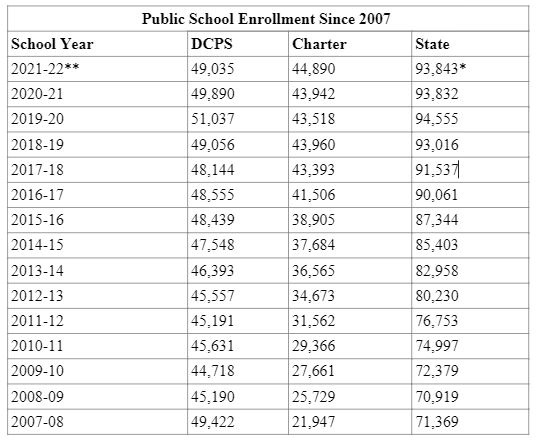
(WASHINGTON, DC) – Today, the Bowser Administration announced that the number of students enrolled in public schools in Washington, DC in the 2021-22 school year increased slightly compared to 2020-21 enrollment, with 93,843 students enrolled in District public and public charter schools according to preliminary data released by the Office of the State Superintendent of Education (OSSE). These unaudited numbers show a less than 1{e4f787673fbda589a16c4acddca5ba6fa1cbf0bc0eb53f36e5f8309f6ee846cf} increase overall across DC – or 11 more students – compared to last school year’s count. 


Enrollment at DC Public Schools (DCPS) saw a second year of enrollment declines from 49,890 students in the 2020-21 school year to 49,035 students in the 2021-22 school year, a 1.71{e4f787673fbda589a16c4acddca5ba6fa1cbf0bc0eb53f36e5f8309f6ee846cf} decrease compared to final, audited numbers released in early 2021. Enrollment at DC’s public charter schools saw a second year of increases, from 43,942 students in the 2020-21 school year to 44,890 students in the 2021-22 school year, a 2.16{e4f787673fbda589a16c4acddca5ba6fa1cbf0bc0eb53f36e5f8309f6ee846cf} increase over final, audited numbers for last school year released in early 2021. 


While early childhood education programs saw decreases, the number of students in homeschooling programs approved by OSSE increased in the 2021-22 school year, compared to 2020-21. OSSE reports a preliminary number of 959 students registered for home schooling in 2021-22, compared to 602 in the previous year. All families of compulsory aged students who wish to home school must register with OSSE and meet certain standards by submitting an application, which OSSE reviews and approves. OSSE will report final home school numbers along with the final enrollment audit numbers in early 2022. 
 
Bowser Administration Releases Preliminary DC Enrollment Numbers for the 2021-22 School Year


As the District’s state education agency, OSSE conducts an annual enrollment audit of public schools. The preliminary numbers above are based on a snapshot of data certified by local education agencies in October. This marks the beginning of an enrollment audit and certification process that takes several months and is conducted in collaboration with an independent auditor. The chart below tracks enrollment trends since 2007 with preliminary unaudited numbers for the 2020-21 school year. Final, audited enrollment figures will be published by OSSE in early 2022. 


*Note: State-level enrollment subtotal does not equal DCPS + Charter totals due to student duplications. Duplications have been removed from the state level numbers but may still exist at the sector level in these preliminary, unaudited figures. 


**These figures represent preliminary data. Final audited enrollment figures will be published by OSSE in early 2022.