Over the years, the workplace has changed in many ways. For example, we now see people choosing instant communication and cloud collaboration tools over email. There is far more awareness about diversity and inclusivity. A job is no longer just about the salary; career progress and continued learning are considerations. However, the most significant shift post pandemic is the move to purpose driven businesses, unleashing purpose to transform productivity and profitability.
The future workplace will be digital – whether it’s retail, agriculture or financial services. There will be faster adoption of automation and AI, meaning that workers will do well to pick up skills needed to harness these. This is backed by the World Economic Forum’s Future of Jobs Report 2020 which states that due to the adoption of technology, in-demand skills will change, and the skills gaps will be high.
We will also see the rise of several different kinds of occupations, including jobs as diverse as autonomous transport specialist, augmented reality journey builder, human-machine teaming manager and more.
What sort of skills must young professionals possess to be successful in the workplace of the future?
There is an interesting mix of skills that young professionals will need to possess to be successful in the workplace of the future. The most obvious are the tech skills needed to keep up with digital transformation.
There will be a continuous drive towards highly skilled occupations. Many of the new positions in the modern workforce favour those with science, technology, engineering, and math (STEM) skills. Jobs in science, research, engineering and technology fields have been predicted to grow twice as fast as other careers (6 per cent versus 3 per cent), driven by the factors we heard earlier – the pace of infrastructure investment and digital innovation.
Next are soft skills such as critical thinking and problem-solving that have always been much sought after and will continue to be so. However, some other skills such as resilience, stress tolerance, good communication skills and flexibility will grow in importance in the future and will play a large role in determining worker success.
Finally, we will see an increase in awareness around reskilling and lifelong learning, with professionals seeking training and opportunities internally, through online learning platforms and via external consultants or workshops.
This is important as recent research by the World Economic Forum that suggests that every five years, our skills are about half as valuable as they were before. The study further goes on to say that it is crucial for professionals to assess existing skills and build new ones to get ahead of that decline in value.
How can educational institutes ensure that their students are prepared for jobs which may not even exist today?
Educational establishments, through their research and innovation activities, are at the forefront of disruptive technologies and ideally placed to anticipate the skills of the future.
They are adapting content to be flexible and aligned to the needs of non-traditional students as well as conventional graduates. Many are focusing on the creation of opportunities for lifelong learning.
Education should no longer be seen as something that stops when a person graduates from college; rather it is a lifelong process where people are constantly being educated and retooled to stay relevant in their jobs, so they are prepared for whatever the job market looks like.
Finally, educational institutions are partnering with industry to co-create offers that consider trends in the job market, skills that employers are looking for, with a focus on work-based learning such as apprenticeships and internships. For example, we launched the Engineering Doctorate (EngD) in Construction as an alternative to the traditional PhD in response to professionals wanting to continue learning through industry-led research and involving their employer as an industrial sponsor.
Also, what kind of a role do research and innovation play in shaping the world of work?
Research and innovation play a huge role influencing industry and framing the jobs of tomorrow. They also contribute to and drive forward solutions to global challenges. One example of Heriot-Watt research doing this is the Industrial Decarbonisation Research and Innovation Centre (IDRIC), which aims to help companies transition away from traditional carbon fuels into low carbon infrastructures. Another is the Centre of Excellence in Smart Construction (CESC) which brings together researchers, industry and the government to revolutionise the way we develop, manage and operate smarter cities. Research and innovation are important drivers of economic growth as they spur innovation, invention and progress. They create the industries, sectors and jobs of the future.
From a Heriot-Watt perspective, what are the steps you are taking to ensure you support this transition to the future?
At Heriot-Watt, there are several steps we are taking to prepare our students for the workplace and the jobs of the future.
We will continue to introduce programmes in line with the changing demands of the marketplace. We will also continue to look for ways to make education more flexible to suit the changing profile of the average university student. For example, the university student of today may not necessarily be an 18-year-old, but a working adult who attends college part time, or may even be juggling childcare.
We are looking at new work-based learning, including apprenticeships and engineering doctorates.
Finally, our work in the research area includes significant international industry collaborations that can shape the future, transform lives and overcome industry challenges. We are already seeing evidence of the impact this can have and will work to drive this ahead.
Our Future Skills Conference at Expo 2020 at the UK Pavilion on December 8 will also bring the industry together to explore how the university’s research is shaping education, catalysing industries and framing jobs of tomorrow in response to the changing workplace – through sustainability, mobility and opportunity.
Social and emotional learning is the latest trend at your child’s school. It sounds beneficial, but that’s a disguise. In truth, social and emotional learning indoctrinates kids with extremist ideas many parents don’t condone.
On Nov. 22, the Hartford Courant reported that West Hartford, Connecticut, elementary school parents are in an uproar. They’re complaining that teachers are putting words such as “nonbinary” on the chalkboard and telling kids, including kindergarteners, they can live life as a gender different from what they were assigned at birth. Parents were told by school authorities that they can’t opt their children out.
Most Americans think parents should have the final say on what children are taught. From Treasure Valley, Idaho, to Greenwich, Connecticut, school board candidates made social and emotional learning an issue in elections earlier this month.
Indiana Attorney General Todd Rokita encouraged parents to speak up and cautioned that social and emotional learning programs shift “the role of teachers from educators to therapists.”
Fighting social and emotional learning is an uphill battle because it’s not only favored by the left-leaning educational bureaucracy, it’s also big business. “The SEL ecosystem today is flush with dollars,” reports Tyton Partners, social and emotional learning industry consultants.
Billions in federal COVID-19 relief money for schools are being used to buy social and emotional learning programs and fund instructors of it. Advocates and companies that produce the materials lobby Congress and the federal Department of Education to ensure legislative language precisely matches what they’re selling.
Nationwide, sales of social and emotional learning materials shot up 45{e4f787673fbda589a16c4acddca5ba6fa1cbf0bc0eb53f36e5f8309f6ee846cf} in a year and a half to $765 million in 2021, reports Education Week.
But parental opposition is also surging. Attorney General Merrick Garland asked the FBI to look into parents protesting issues like social and emotional learning at school board meetings. His son-in-law is a co-founder of Panorama Education, a company raking in millions selling social and emotional learning materials to school districts. Conflict of interest?
And what about the billions of dollars the Democrats’ Build Back Better legislation allocates to child care and pre-K? Will that money pay to indoctrinate even younger minds? Likely, “yes.” At least a dozen states, including New York, have already adopted social and emotional learning standards for preschool.
As for elementary schools, gender dysphoric kids make up less than 1{e4f787673fbda589a16c4acddca5ba6fa1cbf0bc0eb53f36e5f8309f6ee846cf} of the school population. Protect them, of course, from bullying and discrimination. They need to feel safe. But don’t brainwash the rest with one-sided, repeated lessons about gender issues.
West Hartford is reported to hammer away grade after grade, starting with a kindergarten-level book about a teddy bear who knows in his heart he is a girl teddy, not a boy teddy. Then, a book about Aiden, who knows the sex he was assigned at birth is “wrong.” Then, a book about choosing pronouns. And another about a girl named Jazz who changes her gender identity. Are kids reading that many books about the U.S. Constitution?
One Arkansas father objected that his fifth grader’s teacher showed a video of a transgender activist’s speech. Then, the teacher, wearing a “Protect Trans Lives” T-shirt, invited the class to a pride celebration: “I’ll be at Pride from 1-6! I hope to see you there!”
Social and emotional learning was originally sold as training children to control their emotions, manage their time, and make good personal decisions. Teachers have always tried to instill these life skills. They’re the same American values Benjamin Franklin proselytized in his autobiography 200 years ago.
But recently, social and emotional learning purveyors, including the Collaborative for Academic, Social, and Emotional Learning, have openly revised their goals. The collaborative advocates for “transformative SEL” to promote “justice-oriented civic engagement.” Translation: Make your kids into activists.
A South Bend, Indiana, school district adopted social and emotional learning two years ago to curb substance abuse and bullying. Now, parents, recognizing the radical messaging, are demanding more oversight.
Who’s in charge of what your child learns? Parents need to take control. It’s not an easy fight against the combined forces of educational profiteers and left-wing activists. But the stakes are too high to accept defeat.
COPYRIGHT 2021 CREATORS.COM
The Daily Signal publishes a variety of perspectives. Nothing written here is to be construed as representing the views of The Heritage Foundation.
Have an opinion about this article? To sound off, please email [email protected] and we’ll consider publishing your edited remarks in our regular “We Hear You” feature. Remember to include the URL or headline of the article plus your name and town and/or state.
Fayette County Public Schools in fall 2020 moved its Central Office from 701 East Main Street to 450 Park Place in Lexington.
Fayette County Public Schools
From academics to organization, Fayette County Public Schools have multiple weaknesses, a management review released Thursday found.
School district officials will address the findings through a new strategic plan developed by a community advisory group and a staff working group.
The district is paying $87,200 for a follow up review of organizational alignment, communications, human resources, equity office, financial services, operations, teaching and learning and family and community engagement. An initial review from the same consultants occurred in 2016.
Scott Joftus, president of the Maryland-based educational consulting firm Four Point Education Partners, gave school board members several findings at a Thursday meeting that included:
▪ School improvements are not implemented evenly or as effectively as possible.
▪ The Central Office’s organizational structure is not optimized to meet the needs of schools. Data should be more accessible and usable.
▪ Job responsibilities and authorities are frequently not understood.
▪ Several barriers are preventing schools from implementing the curriculum effectively and ensuring educational excellence and equity for all students.
▪ Greater attention needs to be paid to students who are struggling academically, with tutoring, smaller classes and other support.
▪ Professional development is not a strength of the district, with only four days officially set aside.
▪ The need for equity work is great. Achievement rates among Black and Hispanic students attending schools with high concentrations of minority students are lower than those attending schools with lower concentrations of minority students.
▪ The district is “not getting it quite right” in the Department of Equity, which has been in flux for a number of years. The department should be restructured and data used to hold Central Office accountable for lowering the achievement gap of minority and disabled students, the review found.
▪ Family and community engagement is not well coordinated.
▪ Communication has not been prioritized by district leadership.
▪ The district struggles to hire staff of color.
▪ The Department of Human Resources is not set up correctly and is likely understaffed.
▪ There should be more standard operating procedures in areas such as maintenance.
▪ Student enrollment and staffing projections are not handled effectively.
▪ A comprehensive review of the district’s informational and instructional technology is needed. That is especially important because adequate staff was not added after students were assigned laptops to help with virtual learning.
On a positive note, the review found the school district is in sound financial condition.
Also, the review found the school district had introduced several systems — including preschool — to improve teaching and learning and educational equity. And the review found the district has a strong student behavior management system.
Central Office staff will be asked to improve support for schools, improve communication, promote equity and use data to improve performance.
Staff writer Valarie Honeycutt Spears covers K-12 education, social issues and other topics. She is a Lexington native with southeastern Kentucky roots.
First-year college students often are expected or required to live in residence halls or dormitories. In subsequent years, it’s usually up to those students to decide whether to reside on or off campus.
(Getty Images)
“We believe that living on campus for your entire time here during your college career really helps to complement your educational career,” says George Stroud, vice president and dean of student life at Dickinson. “It connects you more with the campus, with the facilities, with your peers and with the faculty. It allows students to easily access programs and labs and things of that nature. And so we really believe that having students here on campus for the four years really helps to build a better community.”
There are exceptions, however. At OWU, a student is exempt from the requirement if he or she is a commuter, fifth-year senior, at least 23 years of age, married, a parent to a dependent child, has medical or psychological needs that cannot be met by the institution or lives with parents or a legal guardian.
Living on campus has been shown to increase graduation and retention rates as well as improve academic performance, especially among first-year students, says Dwayne K. Todd, vice president of student engagement and success and dean of students at OWU.
“A number of indicators around success are quite clear in decades of research,” he adds, “so that’s why schools like ours do have a living requirement to create the best environment for student success.”
Residential housing is not limited to shared dorm rooms and communal bathrooms. Other alternatives include suites, apartments, Greek houses or living-learning communities for students with shared interests.
On-campus students have access to services and resources such as residence life staff who can provide assistance if a housing issue arises.
“The social experience of living with so many fellow new students is a unique opportunity to make lifelong friendships,” Brendon Dybdahl, spokesperson for university housing at the University of Wisconsin-Madison, wrote in an email. “Our staff can help students navigate roommate issues or move to another room if necessary, while students who live off-campus are locked into a lease with few options to manage roommate conflicts. We also have academic resources in our residence halls for tutoring, advising and class sections.”
It can also be a safer environment, especially during the coronavirus pandemic as residential students were regularly monitored, quarantined and tested, says Rose Pascarell, vice president for university life at George Mason University in Virginia.
“We have a vaccine clinic on campus,” she adds. “There’s also a health clinic on campus staffed by physicians, nurse practitioners and physician assistants that residential students have access to. … I can tell you on any given week how many students on campus had tested positive. We had a way to quarantine those students in a residence hall that was off limits to everyone except those that were exposed.”
On the other hand, off-campus living provides a student with more independence, as he or she is not constrained to school housing policies. It can also be better for students with severe food allergies or dietary restrictions, according to Cyndy McDonald, a career coach in California and member of the Independent Educational Consultants Association.
Cost Comparison
At first glance, off-campus housing can appear as the less-expensive option. But the additional expenses outside of rent like utilities, groceries, internet access, cable and furniture are often overlooked.
“I would encourage students to really read their contracts,” says Lisa Ortiz, interim director of housing and residence life at Ferris State University in Michigan. “That is something that I’ve heard from students that they don’t realize those hidden fees and the different aspects of what the contracts are truly telling them in terms of cleaning and other things as they move out of the apartment. So we definitely want our students to fully understand what they’re committing to.”
To reduce off-campus costs, some students choose to overpack houses or apartments, sometimes with four or five people in a two-bedroom house, experts say.
But unlike off-campus housing, the total cost of living on campus is typically all-inclusive – covering rent, utilities, furniture, Wi-Fi and a meal plan.
At GMU, where students are encouraged to live on campus for at least the first year, the average cost of a traditional double room with an “Independence Plan” – the mandatory meal plan for residential freshman and sophomores with unlimited access to dining halls – is $12,630 for the 2021-2022 school year. The school estimates off-campus housing – outside of living with parents – to be $13,268, but prices can be higher or lower based on number of residents.
Another factor that plays into cost is the length of a lease. Residence halls follow an academic schedule while landlords at off-campus properties often require a full year. In such cases, students not taking summer classes must either pay for an additional three months or, if permitted, sublet to a replacement tenant.
Some experts say it’s a toss-up between the price differences of living on or off campus because costs can vary based on many components, including location and convenience. Therefore, when making a decision about housing, students should consider more than just the price tag.
“Take a look at your grades, see how you’re doing,” says Russell Mast, vice president for student affairs at Morehead State University in Kentucky. “If you’re struggling then I would say try to stay on campus because those support units are there for you. But if you know how to balance life, if you’re good at time management and budgeting, then take a look at living off campus.”
Financial Aid Options
Though prices are comparable, schools like Ferris State offer financial incentives to students who choose to live on campus. Admitted students can earn up to $2,000, for example, through the school’s Bulldog Housing Bonus program. To qualify, a student must attend a virtual housing information session and submit a housing contract.
Financial aid is also available for off-campus living.
When filling the Free Application for Federal Student Aid, also known as the FAFSA, a student indicates whether he or she plans to live on campus, off campus or with a parent. A set budget is allocated to each student by a college that can be used for rent, utilities, groceries and other housing-related expenses. If the aid does not cover the full cost of rent for the year, students can file an appeal, and documentation is required, according to McDonald.
She adds that student loans are most commonly used to help pay room and board fees.
“Don’t hesitate to ask the financial aid office,” McDonald says. “There’s nothing wrong with being the squeaky wheel. If you don’t know, keep asking. And there’s nothing wrong with writing an appeal. If you are not getting enough money and you need a little bit more then don’t be afraid to ask for more. All they can do is say no. But they can’t say yes if you don’t ask.”
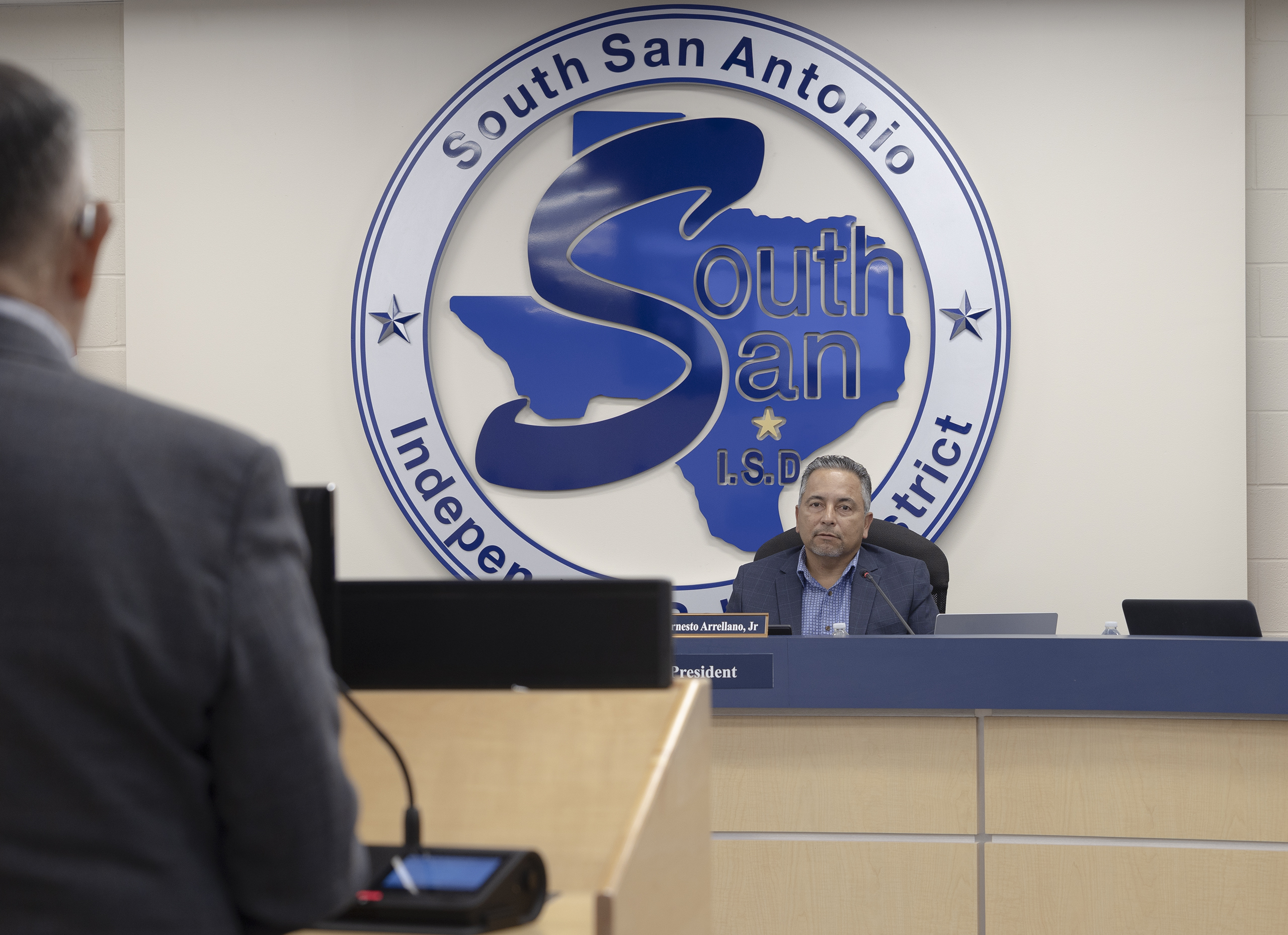
The Texas Education Agency has opened another investigation into South San Antonio Independent School District, just three months after concluding a two-year investigation that resulted in the placement of a state-appointed monitor to oversee the school board.
The agency notified Superintendent Marc Puig and board President Ernesto Arrellano Jr. in a letter Monday that Education Commissioner Mike Morath had authorized the investigation in response to complaints the TEA had received. The complaints claim the school board has interfered with the superintendent’s duties, including “getting involved with the suspension of a term employee and attempting to make employment recommendations for the chief financial officer,” the letter states.
In a statement, district spokesman Brad Domitrovich acknowledged that South San ISD has developed a reputation of discord and dysfunction in the boardroom.
“With the announcement of this newest special investigation, the board and superintendent pledge to promote an atmosphere of cooperation with the Texas Education Agency,” Domitrovich said. “Our main focus, from the board of trustees to administration to the hard-working people in the classroom, remains doing everything we can to be the best champions for our children and our community.”
Arrellano did not immediately respond to a request for comment Tuesday.
The TEA letter comes two weeks after monitor Abelardo “Abe” Saavedra told the board it violated state law and its own policy during recent meetings. Saavedra began serving as the state-appointed monitor on Sept. 30, a month after the TEA closed an investigation into similar problems between the board and superintendent.
Investigators found that trustees failed to cooperate with the superintendent and acted outside of their authority by contacting district staff to seek information and discuss district business, such as disciplinary issues and changes to board agendas. Board members also demonstrated overreach of their duties by contacting vendors, consultants, and other educational organizations on the district’s behalf without informing the superintendent, according to an Aug. 31 TEA letter to the district.
The Aug. 31 letter and final investigative report warned South San ISD that the TEA could issue further sanctions for the district if it did not correct the problems identified in the report and that more investigations could follow if district officials violated the law.
Since Aug. 31, the board majority has voted, with trustees Gilbert Rodriguez and Stacey Alderete dissenting, to publicly reprimand Puig for “dereliction of his employment duties to the board of the trustees” and “violations of the district’s school board procurement policies.” The board majority also has voted to commission an external audit of Puig’s expenditures since he started in May 2020.
Moreover, the board majority voted to request documents from J. Cruz & Associates “related to the superintendent’s procurement” of the law firm and to deliver those documents to the external auditors. Puig hired the firm earlier this year to investigate Felipe Barron III, the district’s head football coach, whom Puig placed on administrative leave pending the outcome of an investigation.
In a rebuttal letter to the reprimands, Puig wrote that his contract requires him to attend all board meetings, except closed meetings in which trustees discuss his employment or resolve conflicts among themselves. He stated he did not abandon his duties to the board at the Aug. 18 meeting — as the first reprimand states — when he left the closed session after trustees began “raising their voices, using foul language, aggressive posturing, and hurling personal disparagements” over personnel actions Puig took against Barron.
“Feeling threatened, I left the closed session during such heated exchange to allow the board members to discuss and resolve the obvious conflicts between the board members involved,” Puig wrote in the rebuttal letter.
He also wrote that district policy gives Puig the authority to hire investigators to conduct inquiries of complaints, which is what Puig did when he hired the law firm to investigate Barron.
In October, TEA Deputy Commissioner for Governance and Accountability Jeff Cottrill told board members that the statutory violations unearthed by the state investigation “persist to plague this school system and harm kids.”
“I want to make crystal clear that this is something that isn’t dated. This isn’t something that’s in the past,” he said at the October meeting. “We have what I would classify as exceptionally egregious allegations of governance, dysfunction, and statutory violations in this school system.”
Cottrill had attended the October meeting to introduce Saavedra to the board. Saavedra previously served as South San ISD superintendent from January 2014 to October 2018 and as Houston ISD superintendent from 2004 to 2009. As the monitor, Saavedra must work with the board and district to identify issues that led to the noncompliance and report back to the TEA.
(This is the final post in a two-part series. You can see Part One here.)
The new question-of-the-week is:
What are the best ways you are incorporating social-emotional learning in your classroom and what are you doing to ensure that it is culturally responsive?
In Part One, Tairen McCollister, Mike Kaechele, and Libby Woodfin shared their responses to the question.
Today, Jennifer Mitchell, Meg Riordan, Ph.D., Amber Chandler, and Bill Adair wrap up this series.
Don’t Use SEL to ‘Increase Compliance’
Jennifer Mitchell teaches English-learners in Dublin, Ohio. Connect with her on Twitter: @readwritetech or on her blog:
Any student or teacher can give countless examples of how our educational system has not only ignored but exacerbated and even directly contributed to mental-health issues for ourselves or our friends, colleagues, and students. Social-emotional learning can literally save lives.
But too often, SEL is sold to teachers as a system to manage students’ behavior and increase their compliance, rather than an essential classroom lifestyle infused with tools they can use to be happier, healthier, and fuller versions of themselves. We must ask ourselves: Do we want our students to tone down who they are to perpetuate the status quo or do we want them to embrace their unique selves and harness their power to build a better world? Do we want them to prioritize work over health and joy or do we want them to build the self- and situational awareness to recognize who they are, what they want, and how to respond to the obstacles they encounter?
Initially, I felt that SEL flowed naturally in my English classroom through literacy and discussions that affirm and explore identity, culture, and empathy. And while that is still a cornerstone of our work together, I realized that my students needed more. After seeing the destructive impact of mental illness, trauma, and racism in so many of my students’ lives, I dug passionately into a variety of SEL approaches. Now, a variety of essential strategies permeate our class culture, pushing us to slow down amidst the pervasive urgency that is so common in schools, to remember that honoring and connecting with each other is essential:
A calming box for students to access fidgets, visual timers, coloring/brain puzzle books, and a small binder of grounding exercises and mental-health tips
Frequent goal-setting and reflection, including WOOP-style goal-setting for which we brainstorm how to overcome obstacles that might prevent us from reaching our goals
Tim Kight’s R-Factor system (E+R=O framework): can help students reflect on what they can and can’t control, the power of their thoughts and emotions, how their responses can influence the outcomes of situations, and how individual actions shape the larger culture of a community. (Caution: infused with grind culture! Supplement with discussions of the importance of rest and recovery to keep going in a healthy way.)
Marc Brackett’s RULER framework for identifying, articulating, and managing feelings with robust, specific vocabulary; very helpful to my ELs. (Caution: Its packaged curriculum and the Yale organization have decided to eschew cultural responsiveness in favor of an imagined ideal of neutrality, disregarding the systemic issues that impact so many students. As scholars such as Duane et. al (2021) point out, SEL practices (and school in general) can directly harm the students they purport to help, especially when they are not implemented in an environment of social justice that affirms students’ identities and lived experiences.)
Weekly restorative circles are a powerful space for community-building, processing and sharing emotions, and collective problem-solving.
Periodic Story Exchanges build empathy, connection, and perspective-taking
A daily organizer routine where we begin and end class by recognizing our feelings, pausing for gratitude, grounding ourselves in affirmations and shared goals, and reflecting on our learning
Frequent opportunities for students to give me feedback
No matter which tools and opportunities educators provide, it’s essential that we constantly reflect and continue learning, just as we ask our students to do. We must listen to the brilliant educators of color who are sharing their expertise and their voices about how white supremacy impacts all aspects of education, particularly SEL work. We must constantly ask ourselves if what we are doing embraces or constrains our students’ identities, emotions, and experiences. Above all, we must listen to our students and make it undoubtedly clear to them that their voices matter, that we are their partners, and that we care enough to keep doing better.
‘A Powerful Approach’
Meg Riordan, Ph.D., is the chief learning officer at The Possible Project, an out-of-school program that collaborates with youth to build entrepreneurial skills and mindsets and provides pathways to careers and long-term economic prosperity. She has been in the field of education for over 25 years as a middle and high school teacher, school coach, college professor, regional director of NYC Outward Bound Schools, and director of external research with EL Education:
Social-emotional learning is a difference-maker. Decades of research show benefits beyond increased academic performance, including: positive self-concept, improved capacity to manage stress, and greater economic mobility. But what does it look like to effectively incorporate social-emotional learning (SEL) into the classroom? And how does SEL work with culturally responsive teaching to support all learners?
First, let’s lay a shared foundation: The Collaborative for Social, Emotional, and Academic Learning (CASEL) defines SEL as the process through which people acquire and apply the knowledge, skills, and attitudes to develop healthy identities, manage emotions and achieve personal and collective goals, feel and show empathy for others, establish and maintain supportive relationships, and make responsible and caring decisions. Culturally responsive SEL must offer opportunities for students to reflect on identity, use relevant topics to foster social awareness, develop decisionmaking through authentic projects, build relationships, and explore society’s varied expectations for self-management—and how to navigate those.
Key to the definition above is that SEL is a process, meaning it must be ongoing and embedded throughout students’ learning experiences. Much like teacher professional learning that should be sustained to be effective, the same holds for SEL. It’s not a one-shot opening circle, occasional workshop, or SEL survey. Building culturally responsive SEL is a process—requiring deliberate design across grade levels and classrooms and inviting collaborative inquiry between youth, educators, and families. It means developing transparent competencies, creating lessons and instructional interactions that spark collaboration and reflection, and educators modeling competencies themselves.
To be implemented effectively, SEL relies on a blueprint at the district, school, and program level. With a blueprint and ongoing professional learning, educators can engage with students to reflect on growth and identify areas of continued opportunity.
Post-blueprint, what does it look like to incorporate SEL that gets to the heart of CASEL’s definition and ensures cultural responsiveness? Below are snapshots that illustrate culturally responsive SEL in action:
Build Relationships and Create Relevance
At The Possible Project (TPP), a youth entrepreneurship and work-based learning program with a mission to advance economic equity, relationships are foundational for SEL and culturally responsive teaching. Building relationships means creating learning experiences that provide opportunities to learn about each other and share our identities. For instance, a virtual learning “opening chat box question” might ask: “What is your favorite comfort food—why?” or “What are you listening to on repeat?” Beginning with inquiry about who we are engages learners, illustrating curiosity and care; it invites a feeling of being seen and valued to bring our whole selves (virtually or otherwise) into a brave and safe space.
But caring about who students are doesn’t stop after an opening question. Learning experiences ignite connections to foster authentic relationships. At TPP, we ground our approach in The Search Institute’s Developmental Relationships Framework, which identifies five elements that promote powerful relationships: Express Care, Challenge Growth, Provide Support, Share Power, and Expand Possibilities. Before students build their businesses individually or collaboratively, they reflect on their passions and interests, practice problem-finding, consider authentic needs, and propose solutions. Our learning process relies on students’ sharing imaginative ideas, showing empathy for others, being willing to take creative risks, and envisioning possibilities that don’t yet exist. Designing real projects that involve students as active drivers signals that we take them seriously, trust them as decisionmakers, and create opportunities to achieve goals and lead their learning. Beyond an opening activity, sustained relationships emerge by doing real work together—helping one another iterate on ideas and giving feedback as draft business plans develop. Rooting learning in topics relevant to students’ lives and identities, such as building their own businesses, creates spaces where culturally responsive SEL helps young people thrive.
Connect to Community and Manage Emotions
While relationships and relevance to students’ lives are essential, other important opportunities to practice culturally responsive SEL include expanding students’ networks and developing awareness of what it feels, looks, and sounds like to manage emotions. We know recognizing, expressing, and managing emotions can be a challenge; we also know that these skills help us interact with others in and out of classrooms and are paramount in the workplace. That’s why at TPP we design learning experiences that bridge our community to the classroom and engage students in reflection to develop awareness of their feelings and behaviors and the connection between the two. An illustration: to promote entrepreneurial mindsets and skills, students interview local entrepreneurs to learn what sparked their business idea, what challenges they’ve overcome, and what they’ve learned running a business. Research indicates that role models motivate us, give us someone to emulate, and teach us how to overcome obstacles. When students see an entrepreneur who looks like them or represents a shared background, they’re better equipped to imagine themselves in that role.
TPP students also connect to community as consultants to local businesses, charged with developing an approach for a social-media campaign or creating materials for an internal Diversity, Equity, and Inclusion resource site. Community-based experiences offer higher stakes—though supported—-opportunities for students to express themselves in professional settings, listen to others, receive feedback, and manage emotions. Conversations about identity and code-switching in the workplace are particularly salient for students of color as research shows they are likely to experience a range of adversities in professional settings. Learning to effectively navigate spaces and manage varied emotions, while maintaining one’s identity, takes place through guided readings and discussion, skills practice, and written reflections. Connecting to community and bridging to workplaces ignites real-world SEL and culturally responsive experiences and offers applied opportunities to transfer skills.
SEL combined with culturally responsive teaching offers a powerful approach for learners to engage in experiences that provide opportunities to reflect on identity and develop skills that apply to career and life. This potent duo—implemented consistently across schools and programs—can equip young people with a strong compass to navigate and persist in shaping their futures.
‘Google Form Questionnaires’
Amber Chandler is the author of The Flexible SEL Classroom and a contributor to many education blogs. She teaches 8th grade ELA in Hamburg, N.Y. Amber is the president of her union of 400 teachers. Follow her @MsAmberChandler and check out her website:
The best approach to social emotional learning in the classroom community is always to take a wide-lens view to make sure that the practices we are attempting to employ are actually beneficial for all students. Some of the beliefs underpinning SEL can lead to a belief that all success is self-determined, especially when we spend lots of time on the concept of self-management and themes like grit and determination. To be culturally responsive, we must also recognize that institutionalized racism, sexism, poverty, and the like prevent success, despite our students’ best efforts.
I take a constructivist approach to social and emotional learning in the classroom. Making meaning together is the only way that we can be assured that we are being culturally responsive. In all the classes I teach to future teachers, I ask the question, “What is the most important data?” and after listening to lots of important facts, I let everyone off the hook. The most important piece of data isn’t something that a standardized test can measure, but rather it is who are the people in front of us? Who are the people in the room? What matters to them? Where are their hearts? Where are their minds? Instead of competing with all their distractions, how can we help them with them?
As simplistic as it sounds, simply asking students to share about themselves is the quickest route to gain the information that will allow you to be culturally responsive. Each fall I send a Google Form questionnaire to students that asks them to classify themselves in a variety of ways (shy or outgoing, talkative or quiet, orderly or disorganized, laid back or stressed). The questionnaire also asks, “What do I need to know to be a good teacher for you?” and “Is there anything I need to know that will help me understand you?” I have started to include the following question as well: “Are there any social issues that are especially important to you? If so, why?” These data points are the most important every year, and students enjoy the attention that I am giving them by letting them know that I care about who is in the room more than I do about the curriculum. Of course the curriculum is important, and armed with these crucial details about my students, I can choose to deliver it in a variety of ways that are best for those particular kiddos.
I also give them the link to share with an adult who knows them well—-I don’t qualify who the adult must be. I’ve gotten results back from former teachers, aunts, coaches, grandparents, and, of course, parents. Taken together, I can get a pretty good picture of the students in my room and I can avoid common pitfalls. For example, one year I learned that I had a student who had lost his brother over the summer. Thankfully, I was able to change what I was planning to teach—My Brother Sam is Dead—to still cover the required information but to also respect the individuals in the room.
As simplistic as these surveys are, they have proved to be one of the best ways to meet the social and emotional needs of students while being culturally responsive to their needs. Students learn quickly that you are constructing the class with them, and they are then more likely to fully participate in their own learning.
A View From Canada
Bill Adair is an educational consultant and practicing high school teacher. He also instructs postgrad classes at Douglas College in Canada specializing in the socioemotional/motivational component of physical literacy. He is the author of “The Emotionally Connected Classroom: Wellness and the Learning Experience” (Corwin Press):
As Canadians, we are currently experiencing a particularly shameful exposure of our past. Throughout much of Canadian history, Indigenous children were forcibly ripped from their families and placed in residential schools designed for the specific purpose of cultural genocide of First Nations peoples. The “lie” of assimilation for the greater good has resulted in profound intergenerational trauma. Much work has been done in the name of reconciliation, but the recent discovery of 215 children in a mass grave at one of these schools has retraumatized Indigenous communities and resulted in painful self-reflection for all Canadians. From the pained heart of survivors, the message is clear. “The education system was the cause of the trauma; it must be the beginning for healing”.
First Peoples Principles of Learning
Promoting First Peoples Principles of Learning is one positive step the government has taken. Indigenous learning is grounded in connection to the well-being of the self, community, and land. It is reflective, experiential, embedded in reciprocally rewarding relationships, and requires the exploration of one’s personal identity. For Indigenous students, this instills a sense of cultural pride in a traditionally marginalized community.
For those pursuing the most progressive SEL practices, Indigenous learning principles serve as a practical action plan. The principles transcend cultural boundaries because they are grounded in the universal human need for connectedness. First Peoples Principles of Learning can be used as a foundational piece to help all children pursue a more connected path to self-awareness while bringing us all closer together. For our small part, our physical education department has embraced and celebrated the concepts that parallel our best practice.
Physical education, and in fact all learning, is a highly charged emotional experience where children may experience profoundly different outcomes. It is easy is for student attention to drift toward performance expectations that fall short or social interactions buried in emotional pain. However, when we wrap daily curricular objectives in cooperation, purposeful objectives, playful mindsets, self-reflection or healthy perspectives of challenge, the socioemotional brain responds accordingly, and learning feels amazing. Where our emotional attention goes, our destiny will follow. In a world where children struggle to cope with anxiety, one would hope pursuing the tools to own their emotional experience would be the most important lesson at school.
An authentic connection playbook that guides thoughts, emotions, and behaviors in a healthier intentional manner becomes a valuable tool. Intentional lesson design and assessment are two ways we elevate the importance of healthy emotions and connections. If is worth teaching, it is worth assessing. If it is worth doing, it is worth owning the outcome.
In our physical education classrooms:
· We teach the simple neuroscience and attachment-theory recipe. “What you put in is what you get out.” Even young children can grasp and own this.
o Happy in, Happy out …
o Challenge and support in … Resiliency out
o Anger, shame, fear, isolation in … Anxiety out
· Daily assessable intentions help students guide their attention toward authentic experiences and emotions. A few examples of “emotionally rewarding” intentions might be
Today I will:
o Be a great peer coach
o Be an amazing cheerleader
o Be passionately playful and fun
o Value challenge, discomfort, and best effort
o Value yourself, value others
o Embrace nature
· Assessments are guided but always self reflective. If we want children to own their emotional experience, the process includes learning to assess in authentic ways.
o If a healthy emotional experience is the most important objective, we allow it to be the most important assessment.
o We never assess skill or performance as a primary objective. Only the commitment and feelings associated with the daily connection intention.
o We target intentions that nurture the capacity of children to freely share and graciously accept healthy emotional energy
· We frequently reference First Peoples Principles of Learning as an inspiration for our learning process.
Talking about SEL objectives is just talk. The human brain is designed to respond to actual emotional experiences. Daily connection intentions support authentic attachment and arm students with their own connection-intention playbook for health, learning, and life.
Thanks to Jennifer, Meg, Amber, and Bill for contributing their thoughts.
Consider contributing a question to be answered in a future post. You can send one to me at [email protected]. When you send it in, let me know if I can use your real name if it’s selected or if you’d prefer remaining anonymous and have a pseudonym in mind.
Education Week has published a collection of posts from this blog, along with new material, in an e-book form. It’s titled Classroom Management Q&As: Expert Strategies for Teaching.
Just a reminder; you can subscribe and receive updates from this blog via email (The RSS feed for this blog, and for all Ed Week articles, has been changed by the new redesign—new ones are not yet available). And if you missed any of the highlights from the first 10 years of this blog, you can see a categorized list below.