Want Students to ‘Build a Better World?’ Try Culturally Responsive Social-Emotional Learning (Opinion)

Want Students to ‘Build a Better World?’ Try Culturally Responsive Social-Emotional Learning (Opinion)

(This is the final post in a two-part series. You can see Part One here.)

The new question-of-the-week is:

What are the best ways you are incorporating social-emotional learning in your classroom and what are you doing to ensure that it is culturally responsive?

In Part One, Tairen McCollister, Mike Kaechele, and Libby Woodfin shared their responses to the question.

Today, Jennifer Mitchell, Meg Riordan, Ph.D., Amber Chandler, and Bill Adair wrap up this series.

Don’t Use SEL to ‘Increase Compliance’

Jennifer Mitchell teaches English-learners in Dublin, Ohio. Connect with her on Twitter: @readwritetech or on her blog:

Any student or teacher can give countless examples of how our educational system has not only ignored but exacerbated and even directly contributed to mental-health issues for ourselves or our friends, colleagues, and students. Social-emotional learning can literally save lives.

But too often, SEL is sold to teachers as a system to manage students’ behavior and increase their compliance, rather than an essential classroom lifestyle infused with tools they can use to be happier, healthier, and fuller versions of themselves. We must ask ourselves: Do we want our students to tone down who they are to perpetuate the status quo or do we want them to embrace their unique selves and harness their power to build a better world? Do we want them to prioritize work over health and joy or do we want them to build the self- and situational awareness to recognize who they are, what they want, and how to respond to the obstacles they encounter?

Initially, I felt that SEL flowed naturally in my English classroom through literacy and discussions that affirm and explore identity, culture, and empathy. And while that is still a cornerstone of our work together, I realized that my students needed more. After seeing the destructive impact of mental illness, trauma, and racism in so many of my students’ lives, I dug passionately into a variety of SEL approaches. Now, a variety of essential strategies permeate our class culture, pushing us to slow down amidst the pervasive urgency that is so common in schools, to remember that honoring and connecting with each other is essential:

  • A calming box for students to access fidgets, visual timers, coloring/brain puzzle books, and a small binder of grounding exercises and mental-health tips
  • Frequent goal-setting and reflection, including WOOP-style goal-setting for which we brainstorm how to overcome obstacles that might prevent us from reaching our goals
  • Identifying and reflecting on self-talk and how it affects us
  • Tim Kight’s R-Factor system (E+R=O framework): can help students reflect on what they can and can’t control, the power of their thoughts and emotions, how their responses can influence the outcomes of situations, and how individual actions shape the larger culture of a community. (Caution: infused with grind culture! Supplement with discussions of the importance of rest and recovery to keep going in a healthy way.)
  • Marc Brackett’s RULER framework for identifying, articulating, and managing feelings with robust, specific vocabulary; very helpful to my ELs. (Caution: Its packaged curriculum and the Yale organization have decided to eschew cultural responsiveness in favor of an imagined ideal of neutrality, disregarding the systemic issues that impact so many students. As scholars such as Duane et. al (2021) point out, SEL practices (and school in general) can directly harm the students they purport to help, especially when they are not implemented in an environment of social justice that affirms students’ identities and lived experiences.)
  • Exploring the science of the brain and emotions (I was inspired by Zaretta Hammond’s Culturally Responsive Teaching and the Brain!), and how that affects us
  • Weekly restorative circles are a powerful space for community-building, processing and sharing emotions, and collective problem-solving.
  • Periodic Story Exchanges build empathy, connection, and perspective-taking
  • A daily organizer routine where we begin and end class by recognizing our feelings, pausing for gratitude, grounding ourselves in affirmations and shared goals, and reflecting on our learning
  • Weekly reflections; quick and powerful!
  • A student-led squad structure that has greatly increased the sense of belonging and community in our class.
  • Frequent opportunities for students to give me feedback

No matter which tools and opportunities educators provide, it’s essential that we constantly reflect and continue learning, just as we ask our students to do. We must listen to the brilliant educators of color who are sharing their expertise and their voices about how white supremacy impacts all aspects of education, particularly SEL work. We must constantly ask ourselves if what we are doing embraces or constrains our students’ identities, emotions, and experiences. Above all, we must listen to our students and make it undoubtedly clear to them that their voices matter, that we are their partners, and that we care enough to keep doing better.

wemustconstantlymitchell

‘A Powerful Approach’

Meg Riordan, Ph.D., is the chief learning officer at The Possible Project, an out-of-school program that collaborates with youth to build entrepreneurial skills and mindsets and provides pathways to careers and long-term economic prosperity. She has been in the field of education for over 25 years as a middle and high school teacher, school coach, college professor, regional director of NYC Outward Bound Schools, and director of external research with EL Education:

Social-emotional learning is a difference-maker. Decades of research show benefits beyond increased academic performance, including: positive self-concept, improved capacity to manage stress, and greater economic mobility. But what does it look like to effectively incorporate social-emotional learning (SEL) into the classroom? And how does SEL work with culturally responsive teaching to support all learners?

First, let’s lay a shared foundation: The Collaborative for Social, Emotional, and Academic Learning (CASEL) defines SEL as the process through which people acquire and apply the knowledge, skills, and attitudes to develop healthy identities, manage emotions and achieve personal and collective goals, feel and show empathy for others, establish and maintain supportive relationships, and make responsible and caring decisions. Culturally responsive SEL must offer opportunities for students to reflect on identity, use relevant topics to foster social awareness, develop decisionmaking through authentic projects, build relationships, and explore society’s varied expectations for self-management—and how to navigate those.

Key to the definition above is that SEL is a process, meaning it must be ongoing and embedded throughout students’ learning experiences. Much like teacher professional learning that should be sustained to be effective, the same holds for SEL. It’s not a one-shot opening circle, occasional workshop, or SEL survey. Building culturally responsive SEL is a process—requiring deliberate design across grade levels and classrooms and inviting collaborative inquiry between youth, educators, and families. It means developing transparent competencies, creating lessons and instructional interactions that spark collaboration and reflection, and educators modeling competencies themselves.

To be implemented effectively, SEL relies on a blueprint at the district, school, and program level. With a blueprint and ongoing professional learning, educators can engage with students to reflect on growth and identify areas of continued opportunity.

Post-blueprint, what does it look like to incorporate SEL that gets to the heart of CASEL’s definition and ensures cultural responsiveness? Below are snapshots that illustrate culturally responsive SEL in action:

Build Relationships and Create Relevance

At The Possible Project (TPP), a youth entrepreneurship and work-based learning program with a mission to advance economic equity, relationships are foundational for SEL and culturally responsive teaching. Building relationships means creating learning experiences that provide opportunities to learn about each other and share our identities. For instance, a virtual learning “opening chat box question” might ask: “What is your favorite comfort food—why?” or “What are you listening to on repeat?” Beginning with inquiry about who we are engages learners, illustrating curiosity and care; it invites a feeling of being seen and valued to bring our whole selves (virtually or otherwise) into a brave and safe space.

But caring about who students are doesn’t stop after an opening question. Learning experiences ignite connections to foster authentic relationships. At TPP, we ground our approach in The Search Institute’s Developmental Relationships Framework, which identifies five elements that promote powerful relationships: Express Care, Challenge Growth, Provide Support, Share Power, and Expand Possibilities. Before students build their businesses individually or collaboratively, they reflect on their passions and interests, practice problem-finding, consider authentic needs, and propose solutions. Our learning process relies on students’ sharing imaginative ideas, showing empathy for others, being willing to take creative risks, and envisioning possibilities that don’t yet exist. Designing real projects that involve students as active drivers signals that we take them seriously, trust them as decisionmakers, and create opportunities to achieve goals and lead their learning. Beyond an opening activity, sustained relationships emerge by doing real work together—helping one another iterate on ideas and giving feedback as draft business plans develop. Rooting learning in topics relevant to students’ lives and identities, such as building their own businesses, creates spaces where culturally responsive SEL helps young people thrive.

Connect to Community and Manage Emotions

While relationships and relevance to students’ lives are essential, other important opportunities to practice culturally responsive SEL include expanding students’ networks and developing awareness of what it feels, looks, and sounds like to manage emotions. We know recognizing, expressing, and managing emotions can be a challenge; we also know that these skills help us interact with others in and out of classrooms and are paramount in the workplace. That’s why at TPP we design learning experiences that bridge our community to the classroom and engage students in reflection to develop awareness of their feelings and behaviors and the connection between the two. An illustration: to promote entrepreneurial mindsets and skills, students interview local entrepreneurs to learn what sparked their business idea, what challenges they’ve overcome, and what they’ve learned running a business. Research indicates that role models motivate us, give us someone to emulate, and teach us how to overcome obstacles. When students see an entrepreneur who looks like them or represents a shared background, they’re better equipped to imagine themselves in that role.

TPP students also connect to community as consultants to local businesses, charged with developing an approach for a social-media campaign or creating materials for an internal Diversity, Equity, and Inclusion resource site. Community-based experiences offer higher stakes—though supported—-opportunities for students to express themselves in professional settings, listen to others, receive feedback, and manage emotions. Conversations about identity and code-switching in the workplace are particularly salient for students of color as research shows they are likely to experience a range of adversities in professional settings. Learning to effectively navigate spaces and manage varied emotions, while maintaining one’s identity, takes place through guided readings and discussion, skills practice, and written reflections. Connecting to community and bridging to workplaces ignites real-world SEL and culturally responsive experiences and offers applied opportunities to transfer skills.

SEL combined with culturally responsive teaching offers a powerful approach for learners to engage in experiences that provide opportunities to reflect on identity and develop skills that apply to career and life. This potent duo—implemented consistently across schools and programs—can equip young people with a strong compass to navigate and persist in shaping their futures.

socialemotionalriordan

‘Google Form Questionnaires’

Amber Chandler is the author of The Flexible SEL Classroom and a contributor to many education blogs. She teaches 8th grade ELA in Hamburg, N.Y. Amber is the president of her union of 400 teachers. Follow her @MsAmberChandler and check out her website:

The best approach to social emotional learning in the classroom community is always to take a wide-lens view to make sure that the practices we are attempting to employ are actually beneficial for all students. Some of the beliefs underpinning SEL can lead to a belief that all success is self-determined, especially when we spend lots of time on the concept of self-management and themes like grit and determination. To be culturally responsive, we must also recognize that institutionalized racism, sexism, poverty, and the like prevent success, despite our students’ best efforts.

I take a constructivist approach to social and emotional learning in the classroom. Making meaning together is the only way that we can be assured that we are being culturally responsive. In all the classes I teach to future teachers, I ask the question, “What is the most important data?” and after listening to lots of important facts, I let everyone off the hook. The most important piece of data isn’t something that a standardized test can measure, but rather it is who are the people in front of us? Who are the people in the room? What matters to them? Where are their hearts? Where are their minds? Instead of competing with all their distractions, how can we help them with them?

As simplistic as it sounds, simply asking students to share about themselves is the quickest route to gain the information that will allow you to be culturally responsive. Each fall I send a Google Form questionnaire to students that asks them to classify themselves in a variety of ways (shy or outgoing, talkative or quiet, orderly or disorganized, laid back or stressed). The questionnaire also asks, “What do I need to know to be a good teacher for you?” and “Is there anything I need to know that will help me understand you?” I have started to include the following question as well: “Are there any social issues that are especially important to you? If so, why?” These data points are the most important every year, and students enjoy the attention that I am giving them by letting them know that I care about who is in the room more than I do about the curriculum. Of course the curriculum is important, and armed with these crucial details about my students, I can choose to deliver it in a variety of ways that are best for those particular kiddos.

I also give them the link to share with an adult who knows them well—-I don’t qualify who the adult must be. I’ve gotten results back from former teachers, aunts, coaches, grandparents, and, of course, parents. Taken together, I can get a pretty good picture of the students in my room and I can avoid common pitfalls. For example, one year I learned that I had a student who had lost his brother over the summer. Thankfully, I was able to change what I was planning to teach—My Brother Sam is Dead—to still cover the required information but to also respect the individuals in the room.

As simplistic as these surveys are, they have proved to be one of the best ways to meet the social and emotional needs of students while being culturally responsive to their needs. Students learn quickly that you are constructing the class with them, and they are then more likely to fully participate in their own learning.

itakeaconstructivistchandler

A View From Canada

Bill Adair is an educational consultant and practicing high school teacher. He also instructs postgrad classes at Douglas College in Canada specializing in the socioemotional/motivational component of physical literacy. He is the author of “The Emotionally Connected Classroom: Wellness and the Learning Experience” (Corwin Press):

As Canadians, we are currently experiencing a particularly shameful exposure of our past. Throughout much of Canadian history, Indigenous children were forcibly ripped from their families and placed in residential schools designed for the specific purpose of cultural genocide of First Nations peoples. The “lie” of assimilation for the greater good has resulted in profound intergenerational trauma. Much work has been done in the name of reconciliation, but the recent discovery of 215 children in a mass grave at one of these schools has retraumatized Indigenous communities and resulted in painful self-reflection for all Canadians. From the pained heart of survivors, the message is clear. “The education system was the cause of the trauma; it must be the beginning for healing”.

First Peoples Principles of Learning

Promoting First Peoples Principles of Learning is one positive step the government has taken. Indigenous learning is grounded in connection to the well-being of the self, community, and land. It is reflective, experiential, embedded in reciprocally rewarding relationships, and requires the exploration of one’s personal identity. For Indigenous students, this instills a sense of cultural pride in a traditionally marginalized community.

For those pursuing the most progressive SEL practices, Indigenous learning principles serve as a practical action plan. The principles transcend cultural boundaries because they are grounded in the universal human need for connectedness. First Peoples Principles of Learning can be used as a foundational piece to help all children pursue a more connected path to self-awareness while bringing us all closer together. For our small part, our physical education department has embraced and celebrated the concepts that parallel our best practice.

For a brief summary: First Peoples Principles of Learning.

Pinetree Secondary Physical Education – Connection Intentions

Physical education, and in fact all learning, is a highly charged emotional experience where children may experience profoundly different outcomes. It is easy is for student attention to drift toward performance expectations that fall short or social interactions buried in emotional pain. However, when we wrap daily curricular objectives in cooperation, purposeful objectives, playful mindsets, self-reflection or healthy perspectives of challenge, the socioemotional brain responds accordingly, and learning feels amazing. Where our emotional attention goes, our destiny will follow. In a world where children struggle to cope with anxiety, one would hope pursuing the tools to own their emotional experience would be the most important lesson at school.

An authentic connection playbook that guides thoughts, emotions, and behaviors in a healthier intentional manner becomes a valuable tool. Intentional lesson design and assessment are two ways we elevate the importance of healthy emotions and connections. If is worth teaching, it is worth assessing. If it is worth doing, it is worth owning the outcome.

In our physical education classrooms:

· We teach the simple neuroscience and attachment-theory recipe. “What you put in is what you get out.” Even young children can grasp and own this.

o Happy in, Happy out …

o Challenge and support in … Resiliency out

o Anger, shame, fear, isolation in … Anxiety out

· Daily assessable intentions help students guide their attention toward authentic experiences and emotions. A few examples of “emotionally rewarding” intentions might be

Today I will:

o Be a great peer coach

o Be an amazing cheerleader

o Be passionately playful and fun

o Value challenge, discomfort, and best effort

o Value yourself, value others

o Embrace nature

· Assessments are guided but always self reflective. If we want children to own their emotional experience, the process includes learning to assess in authentic ways.

o If a healthy emotional experience is the most important objective, we allow it to be the most important assessment.

o We never assess skill or performance as a primary objective. Only the commitment and feelings associated with the daily connection intention.

o We target intentions that nurture the capacity of children to freely share and graciously accept healthy emotional energy

· We frequently reference First Peoples Principles of Learning as an inspiration for our learning process.

Talking about SEL objectives is just talk. The human brain is designed to respond to actual emotional experiences. Daily connection intentions support authentic attachment and arm students with their own connection-intention playbook for health, learning, and life.

wefrequentlyadair

Thanks to Jennifer, Meg, Amber, and Bill for contributing their thoughts.

Consider contributing a question to be answered in a future post. You can send one to me at [email protected]. When you send it in, let me know if I can use your real name if it’s selected or if you’d prefer remaining anonymous and have a pseudonym in mind.

You can also contact me on Twitter at @Larryferlazzo.

Education Week has published a collection of posts from this blog, along with new material, in an e-book form. It’s titled Classroom Management Q&As: Expert Strategies for Teaching.

Just a reminder; you can subscribe and receive updates from this blog via email (The RSS feed for this blog, and for all Ed Week articles, has been changed by the new redesign—new ones are not yet available). And if you missed any of the highlights from the first 10 years of this blog, you can see a categorized list below.

I am also creating a Twitter list including all contributors to this column.

‘The Exponential Age’ and Online Learning in 2030

‘The Exponential Age’ and Online Learning in 2030

The Exponential Age: How Accelerating Technology Is Transforming Business, Politics, and Society by Azeem Azhar

Published in September of 2021.

Living through in-between pandemic times has made it difficult to think about the future of higher ed. Mostly, we are all trying to make it through our days. Planning for the university of 2030 feels like a luxury that we simply can’t afford at the moment.

Why should we be thinking about the higher ed of the future? One lesson that COVID-19 should teach us is that tomorrow’s institutional resilience is a function of today’s institutional investments.

What should we be doing now to build the anti-fragile university of the future?

One place to start thinking about the future of higher ed is to read (and talk about) books about the future. The Exponential Age is an excellent place to start.

The core argument of The Exponential Age is that 21st-century technologies are changing exponentially, while the institutions that structure our society evolve incrementally.

The difference between the speed at which technology progresses and our ability to change how we think and act leads to what the book’s author, entrepreneur Azeem Azhar, calls an “exponential gap.”

The Exponential Age is full of stories of how this gap plays out in areas of AI and computing, biology, renewable energy, and manufacturing.

Little attention is given to the potential impacts of exponential technological change on higher education. This is not a critique of The Exponential Age, but instead an appreciation that Azhar provides us a framework to think about some possible higher education futures.

What will it mean for higher education that by 2030, computer power will be 100 times as fast?

Today, I would judge online education to be at roughly the same state of development as electric vehicles (EV).

An EV has some areas of superiority to a vehicle powered by an internal combustion engine (ICE) and many other areas of comparative deficiency.

EVs are quieter and require less maintenance than an ICE vehicle, and they can be charged at home.

EVs, however, are today more expensive than comparable ICE vehicles, owing to the high costs of batteries. Electric cars also cannot travel as far on a full charge as a gas-powered car can travel on a full tank of gas. Charging an EV battery takes considerably longer than filling a gas tank. And the number of charging stations nationwide pales compared to the over 65,000 places in the US where you can fill up your gas tank.

Like EVs, online education does have some advantages over face-to-face learning. For adult working professionals, online education’s geographic and temporal flexibility makes this medium of learning and credentialing superior to residential alternatives.

For many learners, however, online education lacks many of the elements that make residential learning so impactful and effective. Online learning can make it challenging to structure one’s time effectively for students who are not well prepared to succeed in college.

The social element of learning, including the connection between educators and students, can be more challenging for some learners to achieve in a fully online environment. And today, creating high-quality immersive learning experiences that emphasize educator/learner relationships and active/experiential learning is not any less expensive for colleges and universities to deliver than comparable residential courses.

By 2030, the advantages that ICE vehicles have over battery-powered vehicles will likely have disappeared. Batteries may not get exponentially cheaper and faster, but they will drop in price and increase in capacity. By 2030, EV batteries will likely be a third as expensive and enable vehicles to travel twice as far between charges as today.

Will these changes mean that electric cars and trucks will replace gas-powered vehicles at a faster rate than we might comprehend today? I’d say that is likely.

How might online learning change by 2030?

One possible future is that advances in AI, coupled with a continued rapid scaling of online platforms, could fundamentally alter the economics of online education.

What happens when the integration of artificial intelligence into scaled online educational platforms enables the learning experience to feel entirely social, interactive, and immersive?

One of the points that Azhar makes is that exponential technologies make it harder to predict the future. We can never fully forecast how rapidly changing technologies, business models, and external events might accelerate changes in areas such as work, consumer behavior, and even politics. We are not good at thinking exponentially.

The point, however, is that we utilize a framework of exponential change to help us decide which areas we should invest in research, development, and experimentation.

Colleges and universities, even those fully dedicated to the delivery of a bundled residential learning experience, should carve out some time and space to invest in experimenting with tomorrow’s teaching and learning modalities.

Scaled online learning may never be as intimate, relational, interactive, and immersive as traditional online courses and programs. But it may get better much faster than we think, allowing the costs for teaching and credentialing to fall rapidly.

Investing in experimenting with new scaled online learning methods may also reveal new ways that residential education might be improved.

Reading and talking about The Exponential Age might be a tool to help us at colleges and universities to think beyond our day-to-day challenges and to imagine what higher education might look like in 2030.

What are you reading?

‘Halo Infinite’ fans are learning that ‘free’ comes with some costs

‘Halo Infinite’ fans are learning that ‘free’ comes with some costs

For some fans, it doesn’t matter that Halo Infinite “lives up to sky-high expectations.” The unlocks simply aren’t coming fast enough.

It’s still early days for Infinite, which technically launches on Dec. 8. But Microsoft and developer 343 Industries surprised fans on Nov. 15 with a surprise release of the new Halo’s competitive multiplayer mode. This PvP side of the game features one significant change for the series in particular: It’s entirely free to play.

The Dec. 8 release is still a $60 game with a story that finds Master Chief, longtime hero of the series, facing off against a new alien threat to humankind’s existence. But Halo is also a favorite among people who enjoy the thrills of competing against other players online, and there’s no up-front cost for that anymore. So now, anyone can play.

That kind of change has a ripple effect, though. The free side of the game still required an investment of time and money from Microsoft, which owns 343. And it’s not a charity. Free-to-play games generate their own kind of income, and the process of turning Halo into something like that means that 343 needed to follow the examples set by other successful games.

Halo Infinite‘s free-to-play pitch starts with a Battle Pass — a concept that should be familiar to fans of games like Fortnite. Just like in Epic’s hit battle royale, Halo’s Battle Pass gives players something to reach for. As they play PvP and level up, they unlock cosmetic items that can be equipped to change the look of their profile and their in-game space marine’s armor.


The free-to-play pitch in ‘Halo Infinite’ starts with a Battle Pass — a concept that should be familiar to fans of games like ‘Fortnite’.

The troubles for 343 start with what’s available Infinite‘s first Battle Pass. Each level only nets you a couple of items — there are 166 awards in total, spread across 100 levels — and much of what you get isn’t terribly exciting. For every cool helmet or visual effect that makes it look like your armor is on fire, there are scores of slightly different color schemes or visually similar armor attachments.

There’s also a free track to the Battle Pass that gets you an even smaller pile of stuff. But the premium track for this first Battle Pass, which costs about $10, doesn’t seem like a great buy just because of how boring the unlocks are. That’s a problem 343 should be thinking about as it looks to the next Battle Pass.

Uninspiring cosmetics are only part of the problem, though. The bigger issue is how much of a drag it is to actually level up that Battle Pass. In Halo Infinite, you only earn experience points (XP) toward the Battle Pass by completing challenges. You can lose every match and rank near the bottom of your team each time, but you’ll still be making regular progress as long as you’re checking off the boxes of your challenges.

At any given moment in Halo Infinite, you’ll have three challenges in your queue (or four if you’ve got the premium Battle Pass). Those challenges are randomly pulled from a pool and they come with requirements like killing a certain number of enemy Spartans (the name for Halo’s space marines) with a specific gun or completing some number of a specific match type.

The reward for completing a challenge rarely climbs higher than 300 XP. So if you’re consistently clearing a challenge or two in every match, you’re earning the 1,000 XP needed for a new level every three or four matches. It’s not quite that smooth in reality, however.

An image from Halo Infinite's PvP mode showing a player at the controls of a Ghost, which is Halo's take on an alien hoverbike, as they shoot at another player in the distance.


Credit: 343 Industries

Halo Infinite jumbles all of its different ways to play into playlists, largely built around two options: A smaller 4v4 playlist and a larger 12v12 “Big Team Battles” playlist. So if you’ve got a challenge calling for a win in the “Control” match type, where opposing teams fight to capture specific points on the map, you’ve got to wait for it to come up in whichever playlist you choose. It’s a similar issue with gun-based challenges: Everyone starts with the same weapons, so if your challenge calls for kills with one of the trickier-to-find firearms, you’re similarly stuck waiting until you track one down.

People don’t necessarily want to wait for random elements to fall in their favor, however. So Halo Infinite‘s challenges have created a situation where you get people who are playing for the XP rather than for the win. They’re dropping out of matches that don’t line up with whatever their current challenge calls for. Or they’re wandering off from their team to hunt down a particular gun, giving the opposing team a numbers advantage in the process.

The recent arrival of Halo Infinite‘s first in-game event highlights some these issues in a profound way. The event, Fracture: Tenrai, gives all players, free and paid, an event-specific track of unlocks to reach for — the highlight of which is Spartan armor with a distinctly samurai look. To get any of the unlocks, you need to complete event-specific challenges in the limited time “Fiesta” playlist.

The problem is, all of the Fracture challenges live in the same pool as standard challenges. So if you have three non-Fracture challenges queued up, you’ll need to clear at least one of them — or use one of the few “challenge swaps” you get from leveling up the free Battle Pass track — to have a chance at receiving a Fiesta-linked challenge. It’s entirely possible to land in a situation where playing the event’s Fiesta mode gives you no chance at actually making progress toward another unlock, ostensibly the reward for event participation.


The recent arrival of the first ‘Halo Infinite’ in-game event highlights some these issues in a profound way.

That’s absolutely bonkers. Events in games with “live” elements, such as Fortnite or Destiny, feel meaningful because they tie limited time activities directly to tangible rewards. Halo Infinite‘s first Fracture event fails on this most basic level because of how uncertain it is that you’ll actually make progress on a given day.

The studio is clearly listening. Already, 343 has acknowledged feedback about Infinite‘s progression issues and added a repeating “Play 1 match” challenge that nets everyone 50 XP for every match completed. It’s not the ideal way to level up; you’d have to play 20 matches to earn 1,000 XP. But it does provide a steady trickle of XP as you play, which wasn’t an option before. Hopefully, the next in-game event will embrace challenges with a similar line of thinking.

The flipside here is that Halo Infinite is remarkably enjoyable. I haven’t had this much fun playing a Halo game online with friends since the Xbox 360 era of releases, going back almost 15 years. It feels as fast and fluid to play as Halo always has, but with major improvements to the overall look as well as rule tweaks and a whole assortment of new firearms that make every match feel more balanced and winnable by either team.

I’ve made my peace with the rockier bits by just ignoring them. The thing about the Battle Pass, and cosmetics as a whole, is it’s entirely optional. If you ignore all that stuff, Halo Infinite is still there. It plays exactly the same, and carries the added bonus of you not having to worry about any of that challenge stuff. Your in-game avatar will looking a bit more boring to other players, but you yourself rarely see it outside of between-match menus.

A text-free menu screen from Halo Infinite's PvP mode showing a version of the unlockable samurai-inspired Spartan armor available from the Fracture: Tenrai in-game event.


Credit: 343 Industries

That’s not a great situation for 343 or Microsoft, of course. But it speaks to the challenges that lie ahead for a creative team that hasn’t ever attempted something like this before. Infinite is Halo’s first brush with free-to-play, and while 343 has plenty of experience building Master Chief adventures, the studio has never bundled that together with the kinds of hooks that make a free-to-play experience really sing.

That’s why I’m not alarmed by any of the issues Halo Infinite is dealing with right now. These are growing pains. Plenty of games come and go quickly because they’re simply not mechanically satisfying to play. That’s not a problem here. This is the best Halo’s been in a very long time, at least from where I’m sitting. That gives 343 an up-front advantage, and one that pairs easily with the name recognition the studio already enjoys as Microsoft’s principal creator of Halo games.

There’s no way of knowing if Halo’s free-to-play experiment will pan out in the long run. This 20-year-old series that’s been largely absent for the past six years is returning now to a game industry that’s been re-shaped by an explosion of high quality free-to-play experiences. It may be that Halo’s DNA simply doesn’t mesh well with the cosmetic unlocks that make the likes of Fortnite so alluring.

At this admittedly early stage of Halo Infinite‘s life, that’s what it feels like to me: Halo, a series that traditionally pitted generically armored red and blue teams against one another, doesn’t immediately feel like a great fit for the free-to-play cosmetics grind. But the team at 343 deserves the benefit of the doubt from fans and newcomers alike as they work to find the approach that works best for Halo in a free-to-play world.

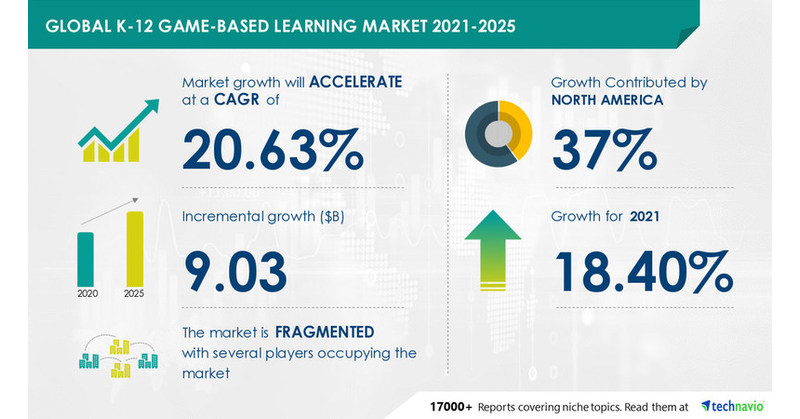
K-12 Game-based Learning Market to grow at a CAGR of 20.63{e4f787673fbda589a16c4acddca5ba6fa1cbf0bc0eb53f36e5f8309f6ee846cf} by 2025 | Surging Investments from Venture Capitalists to Boost Growth

K-12 Game-based Learning Market to grow at a CAGR of 20.63{e4f787673fbda589a16c4acddca5ba6fa1cbf0bc0eb53f36e5f8309f6ee846cf} by 2025 | Surging Investments from Venture Capitalists to Boost Growth

K-12 Game-based Learning Market 2021-2025: Scope

Technavio presents a detailed picture of the market by the way of study, synthesis, and summation of data from multiple sources. Our K-12 game-based learning market report covers the following areas:

K-12 Game-based Learning Market 2021-2025: Vendor Analysis

The market is fragmented, and the degree of fragmentation will accelerate during the forecast period. A Medium Corp., Banzai Labs Inc., Cognitive ToyBox Inc., Filament Games, Infinite Dreams Inc., Microsoft Corp., MONKIMUN Inc., Schell Games LLC., Smart Lumies Inc., and WayForward Technologies Inc. are some of the major market participants.

K-12 Game-based Learning Market 2021-2025: Drivers & Challenges

The surging investments from venture capitalists and the evolving teaching methodologies will offer immense growth opportunities for the K-12 game-based learning market. However, the high set-up costs will challenge the growth of the market participants. To make the most of the opportunities, market vendors should focus more on the growth prospects in the fast-growing segments, while maintaining their positions in the slow-growing segments.

K-12 Game-based Learning Market 2021-2025: Segmentation

  • Product
    • Subject-specific Games
    • Language Learning Games
    • Others
  • Market Landscape
    • Middle School Level
    • High School Level
    • Elementary School Level
  • Geography
    • North America
    • Europe
    • APAC
    • South America
    • MEA

K-12 Game-based Learning Market 2021-2025: Revenue Generating Segment

The K-12 game-based learning market share growth by the subject-specific games segment has been significant. Technavio report provides an accurate prediction of the contribution of all the segments to the growth of the K-12 game-based learning market size

Subscribe to our “Lite Plan” billed annually at USD 3000 that enables you to download 3 reports/year and view 3 reports/month.

K-12 Game-based Learning Market 2021-2025: Key Highlights

  • CAGR of the market during the forecast period 2021-2025
  • Detailed information on factors that will assist k-12 game-based learning market growth during the next five years
  • Estimation of the k-12 game-based learning market size and its contribution to the parent market
  • Predictions on upcoming trends and changes in consumer behavior
  • The growth of the k-12 game-based learning market
  • Analysis of the market’s competitive landscape and detailed information on vendors
  • Comprehensive details of factors that will challenge the growth of k-12 game-based learning market vendors

Related Reports:
Corporate Game-Based Learning Market  –The corporate game-based learning market size has the potential to grow by USD 73.90 million during 2020-2024, and the market’s growth momentum will accelerate at a CAGR of 6.46{e4f787673fbda589a16c4acddca5ba6fa1cbf0bc0eb53f36e5f8309f6ee846cf}. Download a free sample now!

K-12 Blended E-Learning Market –The K-12 blended e-learning market has the potential to grow by USD 19.59 billion during 2021-2025, and the market’s growth momentum will accelerate at a CAGR of 17.52{e4f787673fbda589a16c4acddca5ba6fa1cbf0bc0eb53f36e5f8309f6ee846cf}. Download a free sample now!

K-12 Game-based Learning Market Scope

Report Coverage

Details

Page number

120

Base year

2020

Forecast period

2021-2025

Growth momentum & CAGR

Accelerate at a CAGR of 20.63{e4f787673fbda589a16c4acddca5ba6fa1cbf0bc0eb53f36e5f8309f6ee846cf}

Market growth 2021-2025

USD 9.03 billion

Market structure

Fragmented

YoY growth ({e4f787673fbda589a16c4acddca5ba6fa1cbf0bc0eb53f36e5f8309f6ee846cf})

18.40

Regional analysis

North America, Europe, APAC, South America, and MEA

Performing market contribution

North America at 37{e4f787673fbda589a16c4acddca5ba6fa1cbf0bc0eb53f36e5f8309f6ee846cf}

Key consumer countries

US, China, UK, Canada, and Germany

Competitive landscape

Leading companies, competitive strategies, consumer engagement scope

Companies profiled

A Medium Corp., Banzai Labs Inc., Cognitive ToyBox Inc., Filament Games, Infinite Dreams Inc., Microsoft Corp., MONKIMUN Inc., Schell Games LLC., Smart Lumies Inc., and WayForward Technologies Inc.

Market Dynamics

Parent market analysis, Market growth inducers and obstacles, Fast-growing and slow-growing segment analysis, COVID-19 impact and future consumer dynamics, market condition analysis for the forecast period

Customization purview

If our report has not included the data that you are looking for, you can reach out to our analysts and get segments customized.

About Us

Technavio is a leading global technology research and advisory company. Their research and analysis focus on emerging market trends and provide actionable insights to help businesses identify market opportunities and develop effective strategies to optimize their market positions. With over 500 specialized analysts, Technavio’s report library consists of more than 17,000 reports and counting, covering 800 technologies, spanning across 50 countries. Their client base consists of enterprises of all sizes, including more than 100 Fortune 500 companies. This growing client base relies on Technavio’s comprehensive coverage, extensive research, and actionable market insights to identify opportunities in existing and potential markets and assess their competitive positions within changing market scenarios.

Contact

Technavio Research
Jesse Maida
Media & Marketing Executive
US: +1 844 364 1100
UK: +44 203 893 3200
Email: [email protected]
Website: www.technavio.com/

SOURCE Technavio

A Principal’s Award for the Remote Learning Assistant Program Team

A Principal’s Award for the Remote Learning Assistant Program Team
Members of the Remote Learning Assistant Program Team (top, l to r): Maggie Lattuca, Sandrine Hoindo-Donkpegan, Linda Webb and Darlene Hnatchuk. (Bottom, l to r): Amelia Stone, Nancy St-Pierre and Cara Piperni

When the world was hit with the initial surge of COVID-19 back in early 2020, educational institutions around the world scrambled in order not to lose the year. While the McGill community transitioned admirably to complete the 2019-2020 academic year by adopting alternative methods of teaching, it was clear that a lot more support would be necessary to sustain alternative teaching methods over the course of a full year.

Enter the Remote Learning Assistant Program Team.

Assembled in July 2020, the Team was given the mandate to design, implement, and support a program in which some 300 students were hired, trained, and deployed to support instructors with the technical aspects of remote teaching over the course of the 2020-2021 academic year. The project was so successful that the Team has been named winner of the Principal’s Awards for Administrative and Support Staff in the Team category.

The eight-person Team was comprised of the following members from Teaching and Learning Services; Career Planning Service; and the Scholarships & Student Aid Office:

  • Maggie Lattuca (Teaching and Learning Services)
  • Nancy St-Pierre (Teaching and Learning Services)
  • Sandrine Hoindo-Donkpegan (Teaching and Learning Services)
  • Sydnee Goodrich (Teaching and Learning Services)
  • Darlene Hnatchuk (Student Services)
  • Cara Piperni (Student Services)
  • Amelia Slone (Student Services)
  • Linda Webb (Office of Student Life and Learning)

Seamless collaboration

It is impressive, some would say remarkable, that this relatively small team could spearhead such an ambitious and impactful initiative in such a short period of time – and with such resounding success.

“Simply, each member of the team brought their expertise and was driven by the goal to improve the teaching and learning experience in a remote context,” says Maggie Lattuca, Manager – Online Programs Portfolio, Teaching and Learning Services. “The collaboration between units was seamless. Team members put in extra hours to get the initiative in place.”

It was a classic win-win situation, in which instructors received much-needed technical help and students, many of whom were without a job because of COVID-19 lockdowns, were gainfully employed again.

“As a team we applied for and received over a half-million dollars in federal wage subsidies by way of the TECHNATION Career Ready Program,” says Lattuca. “This, combined with McGill’s need-based Work Study Program, significantly reduced the cost of hiring remote learning assistants (RLAs).”

Not only were the student RLAs provided with much-welcomed income, the work experience gave them transferable skills. The program was designed to provide both domestic and international students employment and co-curricular work integrated learning opportunities.

“A Community of Practice group was created for the RLAs and TLS Teaching Technology Consultants within the myCourses platform to allow them to share best practices and resources, pose questions, and ask for guidance,” says Lattuca. “RLAs were also required to complete weekly reflections on their work experience. One of the most common reflections was that they found satisfaction in assisting instructors and students, and appreciated learning about what goes on ‘behind the scenes’ in planning course lectures and materials.”

Resounding buy-in across McGill

As demanding as the initiative was, Lattuca says it was inspiring to see how the McGill community responded.

“The Faculties were on board immediately,” she says. “Everyone saw the value of assisting instructors who had pivot their teaching style, often using technology they had never had opportunity to use.”

“The positive feedback we received from instructors and Faculties was gratifying,” she says. “We learned about the commitment of McGill instructors to provide students with the best possible learning experiences given the constraints of the COVID context. We learned about multiple creative strategies instructors used to create opportunities for student engagement. We learned about the value to students of gaining insights into the process of teaching and learning. And we learned about the power of collaboration when everyone is focused on the same goal – helping instructors and students.”

How Education Institutions Can Improve Online Learning Security

How Education Institutions Can Improve Online Learning Security

Education looks vastly different today than it was a few years ago. While online learning was present even then, it was only a small percentage of all educational institutions. Due to the pandemic, schools, and colleges, and all forms of educational institutions needed to find a way to transfer their processes and procedures online in order to accommodate the restrictions and to ensure their students’ learning progress doesn’t suffer.

Even when restrictions eased and it was possible to return to physical locations, a large number of institutions decided to remain online as they realized how much more convenient and accessible it is. But while they were concentrating on making the process run as smoothly as possible, online learning security wasn’t prioritized as much as it needed to be. Cyberattacks caused numerous schools and colleges to delay classes or even forced them to pay ransom to regain access to their servers.

Luckily, there are a few steps you can take to improve online learning security.

Implement cyber security tools

It is imperative that all educational institutions implement proper cybersecurity tools in order to protect their employees, students, and their data. Tools like firewall and anti-virus protection, browser fingerprinting, data enrichment, end-to-end encryption, and multi-level verification are the first line of defense and when used properly they can stop cyberattacks causing any damage.

Update Everything

This is actually the easiest step you can take to ensure online learning security as you can complete it just by turning on automatic system updates. By keeping your operating system, programs, and applications up to date, you can remove any security vulnerabilities that could be exploited by malicious actors.

While educational institutions have only control over their equipment, they should educate their students about the importance of keeping their equipment up to date to ensure the safety of both sides.

Secure File Sharing

Regardless of the type of educational institution, students and teachers or instructors need to have a secure method of sharing their files. By having a policy in place that mandates requirements and procedures of file sharing, providing a secure connection for uploads, and encrypting the files you can significantly reduce the risk of a data breach or ransomware attack. Make sure to make this process as simple as possible because students will have different levels of technical knowledge.

Backup all files

Having a backup can make a difference between having all of your data held hostage forcing you to pay the ransom or utilizing your backup and resuming normal business operations. Once you determine what data needs to get backed up, you need to make sure you back it up regularly.

Provide regular training

Ensure that you provide regular cybersecurity training to all of your employees and students to ensure everyone knows what their responsibilities are when it comes to mitigating cyber security risks. They need to be aware of what cyber security threats they might encounter, how to avoid them, or how to react if they happen.

The University of Utah had to pay cybercriminals almost half a million dollars after a ransomware attack on some of its computer servers, and it is just one in the long line of educational institutions that have become a victim of cyberattacks. By following these steps, and staying proactive you can avoid becoming one of them.

Featured Image: cottonbro, Unsplash.