LINDSAY, Calif. — On a morning this fall at Washington Elementary, a young boy, sitting at a table with five of his peers, held a tablet while he built a digital snowman — a cool proposition given the 85-degree heat just outside his air-conditioned classroom.
His neighbor, a girl, whose ponytail was tied with a bright red bow, used her index finger to move shapes around her screen. At another table, a child wearing a rainbow mask bent studiously over her workbook, meticulously coloring with a green marker.
Elsewhere in the classroom, an instructor knelt to chat with two boys engrossed in playing with blocks, while a second teacher supervised a group of five students as they completed worksheets.
Every 4- and 5-year-old in this transitional kindergarten classroom was doing something different, tailored specially to their academic development. It’s a scene that is replicated across the seven elementary schools and two high schools in this agricultural community of around 13,500 in California’s Central Valley.


There are few straight rows of desks at schools in this district, Lindsay Unified. Teachers rarely stand at the front of the classroom. Students instead focus on whatever assignment is next for them — often a task that differs completely from the work being performed by the other kids in the room.
Kids are helped along by access to take-home devices and individualized learning plans that allow them to progress through class material at their own speed.
It’s a model that’s paid dividends for the district. Lindsay Unified has seen significant improvement in academic achievement, graduation rates and the number of students going to college since it created a performance-based system in the mid-2000s. The model also helped students and educators weather the pandemic’s ups and downs more easily than other districts in the country. While the pandemic still took its toll, adapting to online learning was smoother in Lindsay due to its preexisting infrastructure and history of adaptation.
For years, Lindsay has experimented with competency-based education, a more personalized approach to education that involves letting kids learn on computers for at least part of the day. In mid-March 2020, schools in Lindsay Unified shut down in response to the coronavirus pandemic. And, as it did for millions of other students and teachers around the country, instruction went fully online.
But superintendent Tom Rooney likes to say that while facilities closed in Lindsay, “the learning never stopped.”
Now, with learning back in person in many places in the country, Lindsay’s experience keeping kids mostly on track, even during the most chaotic of times, offers lessons to other districts. Teachers in Lindsay are ready to shift from in-person to remote learning with minimal prep time — if a coronavirus outbreak requires a quarantine, for example, or a natural disaster causes school closures.
“With about a day planning, [teachers] shift right into distance learning,” Rooney said.


Ushering in a new model
Located near the foothills of Sequoia and Kings Canyon national parks, the town of Lindsay used to be known for two things: olives and oranges. But the community began to suffer economically after several major employers, including what was once the largest olive processer in the world, shut down in the early 1990s.
Today, more than 90 percent of the 4,000 children enrolled in Lindsay Unified are socioeconomically disadvantaged, and about 40 percent are English language learners. Ninety five percent of students in the district are Hispanic.
In 2007, administrators were frustrated by the district’s poor outcomes and low graduation rate. Even its most successful students had difficulties: 8 out of 10 high school valedictorians were placed in remedial English classes when they went to college, according to district officials.
The district convened a series of meetings with teachers, school leaders, parents, city officials and community members to discuss what kind of educational system the community needed. The result was the adoption of “a learner centered, personalized, competency-based” approach that allows students to meet learning goals on their own terms, Rooney said.
Related: Why a high-performing district is changing everything with competency-based learning
The new approach threw out many traditional facets of education such as the A-F grading scale and time-based learning in which students advance to a new grade level each year. Along with the changes came a new vernacular — teachers are “learning facilitators,” students are “learners,” grades are “content levels” and schools are “learning environments.”
Students are scored on a scale of 1-4, with a score of at least 3 needed to show proficiency in a subject. Educators say a 1 or a 2 doesn’t mean students have failed, only that they have more work to do to move on to the next level.
Lindsay High School junior Gaby León said that other students she meets are fascinated when she tells them she’s never received a letter grade. “I’m not familiar with the ABCs, because all my life I’ve gotten numbers,” she said.


What is competency-based education?
Lindsay is a forerunner among a growing number of schools and districts across the United States that have adopted a performance- or competency-based approach to education, said Susan Patrick, president and CEO of the Aurora Institute, a nonprofit that studies and promotes competency-based education. (Superintendent Rooney serves on the board of the Aurora Institute.)
Patrick said that 10 years ago, only a handful of states in the United States used competency-based education. Her organization estimates that now 6 to 10 percent of public school districts across the United States are piloting or planning competency-based approaches.
She expects that number will continue to grow in the wake of the pandemic.
“We just saw a shift where getting rid of time and space constraints unleashed a lot of creativity in helping to provide more flexibility for students,” Patrick said. “After the pandemic, the demand is really increasing for school systems around the U.S. to learn how to make the shift from traditional time-based systems … towards one that is truly organized around the learner.”
So, what is competency-based education, exactly?

It goes by many names, Patrick said, but at its core, the approach enables students to take charge of their own learning while they work towards a common set of learning goals. Students receive meaningful feedback on their progress and receive support until they achieve those goals. They show their mastery of a subject by presenting evidence, such as a paper or project, demonstrating what they know and are able to do.
One of the most frequent criticisms of competency-based education is that it is incredibly time consuming, Patrick said. There’s also little evidence that personalized learning improves student learning, in part because so many different approaches are used.
But educators in Lindsay say that, while there’s more work on the front end, the district’s model actually makes teaching easier in the long run.
Related: Does the future of schooling look like Candy Land?
“Every teacher in the district does what we call a personalized learning plan with each of our students at least twice a year,” said Marla Ernest, a drama and English language arts teacher at Lindsay High School. “I know that sounds like a lot of work, but it really frees up a lot of your planning, because you’re now really doing mini-lessons, instead of having to fill a 90-minute block.”
Matt Diggle is in his 28th year as an educator. After starting as the new principal of Washington Elementary in August, he’s been impressed by how much teachers have to know about their students in Lindsay’s model.
“I came from a grades-based system,” he said. “This requires a lot more depth and knowledge in terms of digging into the learning targets and really understanding [what] the child has to achieve.”


The role of technology
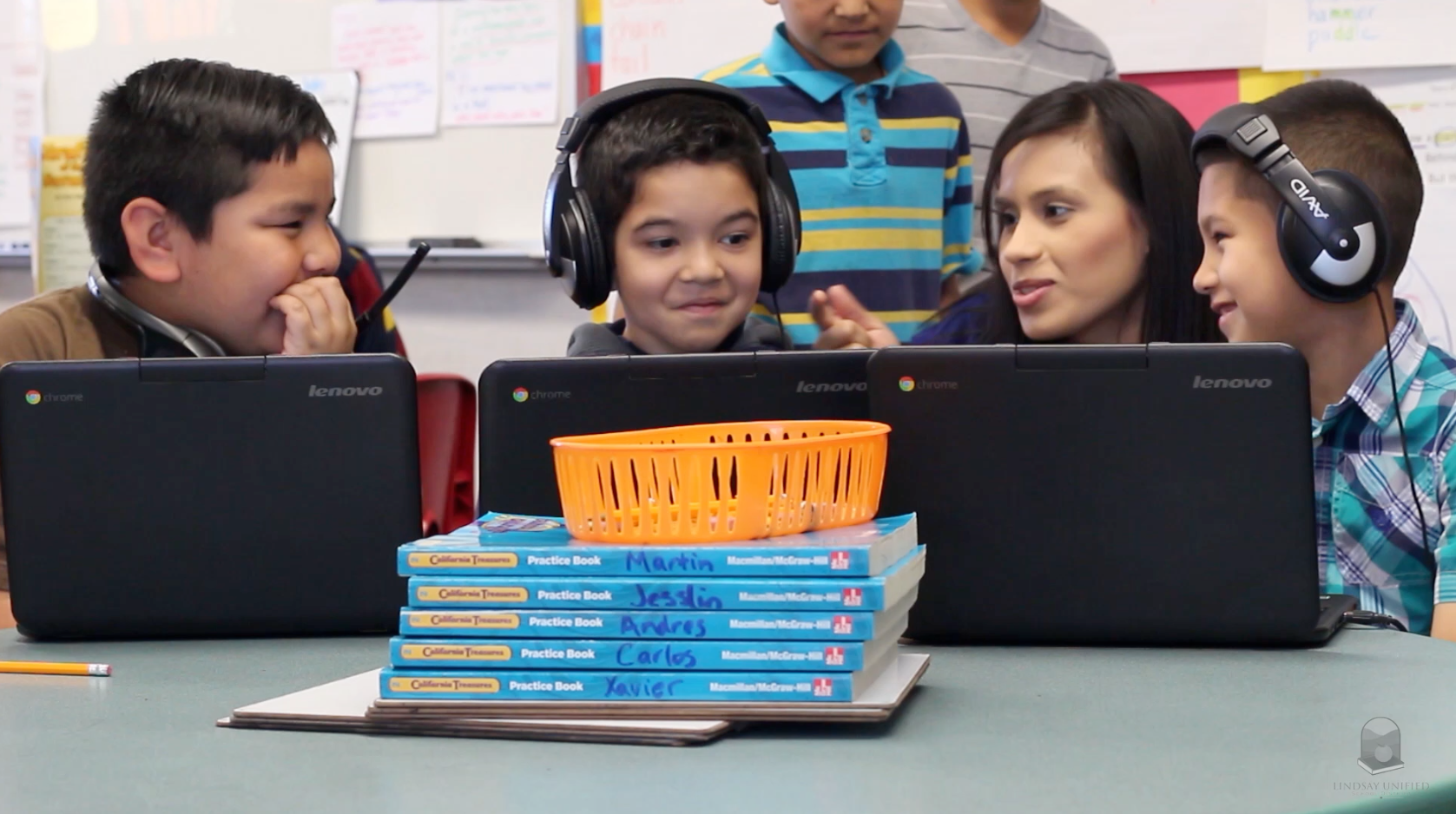
Lindsay’s ability to rapidly pivot to remote learning in spring 2020 was largely due to preexisting infrastructure. Unlike many districts where a lack of devices and spotty Wi-Fi made adapting to online learning difficult, almost all Lindsay students already had access to their own tablets or laptops — which are age-appropriate and replaced every three years — and community Wi-Fi.
Getting there wasn’t easy. In the early years of Lindsay’s experiment, few students had internet access at home. “I would come to work at 7 in the morning and there would be 60 kids on the front lawn of the district office because there was a hotspot,” said Barry Sommer, director of the district’s foundation.
After unsuccessfully approaching several major internet companies, the district decided to take matters into its own hands. The district asked the city of Lindsay if it could locate antennae on the community’s tallest buildings to expand the district’s network. Then they installed hotspots on 500 homes in Lindsay. By the end of 2016, almost 90 percent of the district’s students and their families had access to free internet at home.
“There’s always a certain pace that the teachers progress the class at, but with our Empower website, it allows students to progress further in the course by working independently and outside of the class.”
High school senior Connor Dunbar
Today, students are even able to access assignments on their mobile devices. León, the high school junior, held out her phone as she demonstrated how she’s moved through her math class this year. “You can learn anywhere,” she said. “You can complete assignments on road trips or at an airport.”
But educators say that technology by itself isn’t what makes Lindsay’s model work. It’s the combination of its personalized pedagogical approach combined with technology.
The district’s “learning management system,” Empower, is an online dashboard that allows teachers to upload, grade and keep track of assignments for their class. It also contains “playlists,” which might include videos or reading assignments, that students complete as they progress through a class.
Related: What lessons does special education hold for personalized learning?
Students, parents and teachers can log into Empower at any time to check on progress towards finishing a class. At any point, students can see what they’ve completed and what else they need to do to finish a subject. The courses are still based on California state standards, and students continue to complete external assessments such as iReady.
Empower also allows school administrators to pull aggregate reports on students’ pacing — whether and how quickly they are making progress in their respective subject areas.
“We’re able to look at the overall pacing for the learning facilitators and for learners, and then we’re able to dig in deeper if we needed to, to look at individual learners and see what progress they’re making towards completing by the end of the year,” said Jorge Ramos, learning director at Washington Elementary.

Training the teachers
Most teachers aren’t taught the competency-based approach in college, so there were growing pains when the district first adopted its performance-based model in the mid-2000s, Sommer said. Several teachers left because they could not adapt to the new system, he added.
“Teacher training programs are not preparing teachers for personalized competency-based learning models,” said Patrick, of the Aurora Institute.
In response, the district set up opportunities for professional development, programs that continued during the pandemic. Educators use Empower, the same platform the students use, for their training.
“They take that performance-based approach with us as well,” said Guadalupe Alvarez, who teaches eighth grade. New teachers are also paired with veteran teachers such as Ernest, the English teacher, who help show them the ropes.
Related: How one state’s teachers are sparking digital innovation
Ernest said that teachers have to have the right mindset to be successful in Lindsay. “You do have to have a staff that’s really open to lifelong learning and really open to flowing through change,” Ernest said. “Because in this model, nothing is static, you’re always looking for the best practice. You can’t as a teacher be stuck in ‘This is how I do it.’”
Fourth grade teacher Nelly Lopez said she used to think the perfect classroom was one in which students sat silently with their hands folded and the teacher was the center of attention.
“Now it’s like a full shift into where the focus is on them,” she said. “There’s no one size fits all.”

Students move at their own pace, with lots of support
One of the benefits of Lindsay’s approach to teaching and technology is that it accommodates different populations, such as students with disabilities and English language learners. The approach also reduces the stigma for students who might be “behind” in a traditional system because all students work at their own pace, whether they move ahead quickly or need extra help.
One of district’s early lessons, however, was that there is a delicate balance between letting kids do their own thing — and keeping them on track. Teachers still must make sure that students don’t fall behind.
John Woods, Lindsay’s director of special education, said it’s important to set incremental deadlines so students don’t wait until the last minute to try and finish everything. “We say we’re not time-based, [but] you have to have urgency,” he said. “There are certain kids that are very self-directed, but there are others that are not, if you just leave them to their own devices.”
Depending on the subject, students might work independently or move to another class with a different teacher. Within each class, students are grouped based on the learning targets they are trying to reach and their progress towards meeting those targets.
The system also helps accommodate students who are moving faster than their peers. “There’s always a certain pace that the teachers progress the class at, but with our Empower website, it allows students to progress further in the course by working independently and outside of the class,” said high school senior Connor Dunbar.
“After the pandemic, the demand is really increasing for school systems around the U.S. to learn how to make the shift from traditional time-based systems … towards one that is truly organized around the learner.”
Susan Patrick, president of the Aurora Institute
Alvarez said that whenever she has “fast runners,” she meets with administrators to come up with the best plan to meet students’ academic needs. “I have had groups of eighth graders that go to the high school for math and English and then they just come back to me for their subject matter in history as science,” she said.
León was able to take extra classes by completing her history class in one semester. “That allowed me to add a college class to my schedule for the following semester,” she said.
Ernest said she teaches three English classes, each at a different level, with students in each class grouped according to the progress they’ve made towards a learning target. She still gives short 15- to 20-minute lessons on topics that are applicable to the entire class, but then spends the rest of class period working with students in small groups or one-on-one.
“I’m still doing the same amount of grading that I’ve always done,” she said. “It doesn’t create more work. It just creates different work.”
Parent Jennifer Keeton, who works in the district’s financial services division, said that Lindsay’s model has helped meet the needs of both her children. Her son, who graduated in 2020, has autism. “With everybody being customized … it helped him not stick out,” she said.
Keeton’s daughter is a junior, currently on track to earn her associate’s degree from the College of the Sequoias, a community college, before she graduates from high school next year. Keeton said the system helped her daughter “because she didn’t get stuck waiting for everyone else to finish, because she was an avid reader … She was always finishing things fast, but she was allowed to work on other projects to give her a higher understanding of the concepts.”

Does it work?
Test scores leaped in Lindsay Unified after the district implemented competency-based learning. The number of students proficient on California’s academic standards increased from 26 percent in 2014-15 to 47 percent in 2018-19. Graduation rates rose from 69 percent in 2010-11 to 90 percent in 2017-18. College-going rates increased from 66 percent to 70 percent, and more students are going to four-year colleges, according to district data.
During the pandemic, the results were more mixed — teachers and students felt the same stresses that all districts faced, including a significant toll on social and emotional health. But Lindsay students still made progress in math and reading, although less than during a normal school year.
In March 2020, after curriculum experts gave teachers a weekend crash course in online instruction, students and teachers were back in school fulltime, in their virtual classrooms, within just a few days. They quickly learned to avoid all-day online classes in favor of small group work and one-on-one attention from teachers, something they’d already been doing in person before the pandemic.


And in the early weeks of the pandemic, the district had to boost its Wi-Fi connections as more kids and parents were suddenly online 24/7, Rooney said.
A year into the pandemic, Lindsay students had less growth in reading than in previous years, but — particularly among younger learners — still made more progress than their peers in other districts around the country with similar demographics, according to a recent report from the non-profit Learning Accelerator.
“We saw a lot less growth for kids in upper grade levels than we did for those in lower grade levels,” said Beth Rabbitt, CEO of the Learning Accelerator and one of the authors of the report. This could be because older students were more likely to have responsibilities such as working or taking care of younger siblings, according to the study.
The study also found that students classified as English learner, migrant, or homeless, and those receiving special education services, saw positive growth, thanks to frequent contact with counselors, translation services, access to a food pantry and social services and opportunities for an “early return” to school in fall 2020.
And students who came back in person as part of the early return model did better than their peers who remained at home, which could serve as a lesson when future disruptions occur. These kids continued with the same online curriculum as their peers studying from home, but worked at school in small groups with tutors who could give them extra support.
“That speaks to the power of kids having adults who, even if they’re not the primary content teachers, can be helping them connect and helping them stay on track.” Rabbitt said.
In Lindsay, “the learning never stopped.”
Superintendent Tom Rooney
Ernest said the switch to remote learning was especially hard for the recent immigrants she works with. “Trying to get them to a place where they can follow along with a computer when they’ve never had one, it was very difficult for the first few months,” Ernest said.
But after students got used to the technology, she said, the program was “the perfect model for someone who is just learning the language.” Some of her high school students started at a kindergarten level in English, but because they didn’t know they were beginning at such a basic level, they were able “to move at the right level, make progress and not feel ashamed about that,” she said.
Overall, the pandemic reinforced the role of competency-based learning and technology-based teaching in Lindsay, said Ernest. “We’ve been doing blended learning in this model for so long, the only difference for us was that [students] weren’t in a room with us.”
This story about adapting to online learning was produced by The Hechinger Report, a nonprofit, independent news organization focused on inequality and innovation in education. Sign up for Hechinger’s newsletter.
/https://specials-images.forbesimg.com/imageserve/6148d9fac8a65e4279811729/0x0.jpg "How Cohort-Based Learning Is Transforming Online Education")