
“If exercise could be packaged into a pill, it would be the single most widely, prescribed and beneficial medicine in the nation.” [1]
Dr Butler said this in 1978 when he was the director of the National Institute of Aging. The data accumulated since then has proven him right over and over again. Based on the same evidence and data, I would now adapt his statement to say “if physical activity could be packaged into a pill, it would be the best medicine for people to live longer, healthier and disease-free lives.”
This is not something new. Plato in 400 BC said, “In order for man to succeed in life, God provided two means, education and physical activity. Lack of activity destroys the good condition of every human being, while movement and methodical physical exercise can save it and preserve it.”

The even older Caraka Samhita said, “Physical exercise brings about lightness, ability to work, stability, resistance to discomfort and alleviation of impurities (dosas). It stimulates the power of digestion.”
Physical activity (PA) is the single most important part of our atmasvasth guide that I wrote and spoke about last week, to live long, healthy. It encompasses everything from yoga to dancing to walking, to running to tai-chi, to going to the gym…to just being more active and sitting less.
Unfortunately, because of the need to commercially “sell” physical activity at a price, it has been linked in the popular media to both, weight loss and ripped bodies, both of which are fine if they occur as a side-effect of moving regularly every day, but are not the end-goal of being active. This focus on toned and svelte bodies with six-packs and four-packs, also tends to put off a lot of people who intuitively believe and know that however much they run or go to the gym, they are never going to be able to achieve that ideal body they see on television or YouTube.
For example, one of the reasons people don’t run in India is because of its association with marathon racing. You don’t have to run races to run for health, but that message doesn’t really get through. Whatever the reason may be, studies have shown that almost 50{e4f787673fbda589a16c4acddca5ba6fa1cbf0bc0eb53f36e5f8309f6ee846cf} of adult Indians do not indulge in any form of relevant leisure time physical activity [2], which I think is a gross underestimation.
PA is much much more than just looking like a model or wanting people to tell you how good or thin you look. It is about living long, healthy — a concept that really has nothing to do with with having big biceps and quads.
Benefits of any type of PA [3]:
1. Better sleep.
2. Prevention or minimization of excessive weight gain in adults, maintenance of weight within a healthy range and prevention of obesity.
3. Reduction in the risk of dementia and cognitive decline.
4. Reduction in the risk of colon and breast cancer and likely cancers of the urinary bladder, uterus lining, esophagus, kidney, lung and stomach.
5. Reduction in the development of a new chronic condition, reduction in the risk of progression of a condition, if already present and improvement of physical function and quality of life. These include osteoarthritis, hypertension and type 2 diabetes, among others.
6. Reduction in cardiovascular incidence and mortality (heart attacks, stroke) and reduction in the incidence of hypertension and diabetes.
7. Improvement in all-cause mortality.
8. Reduction in the incidence of falls and falls-related injuries.
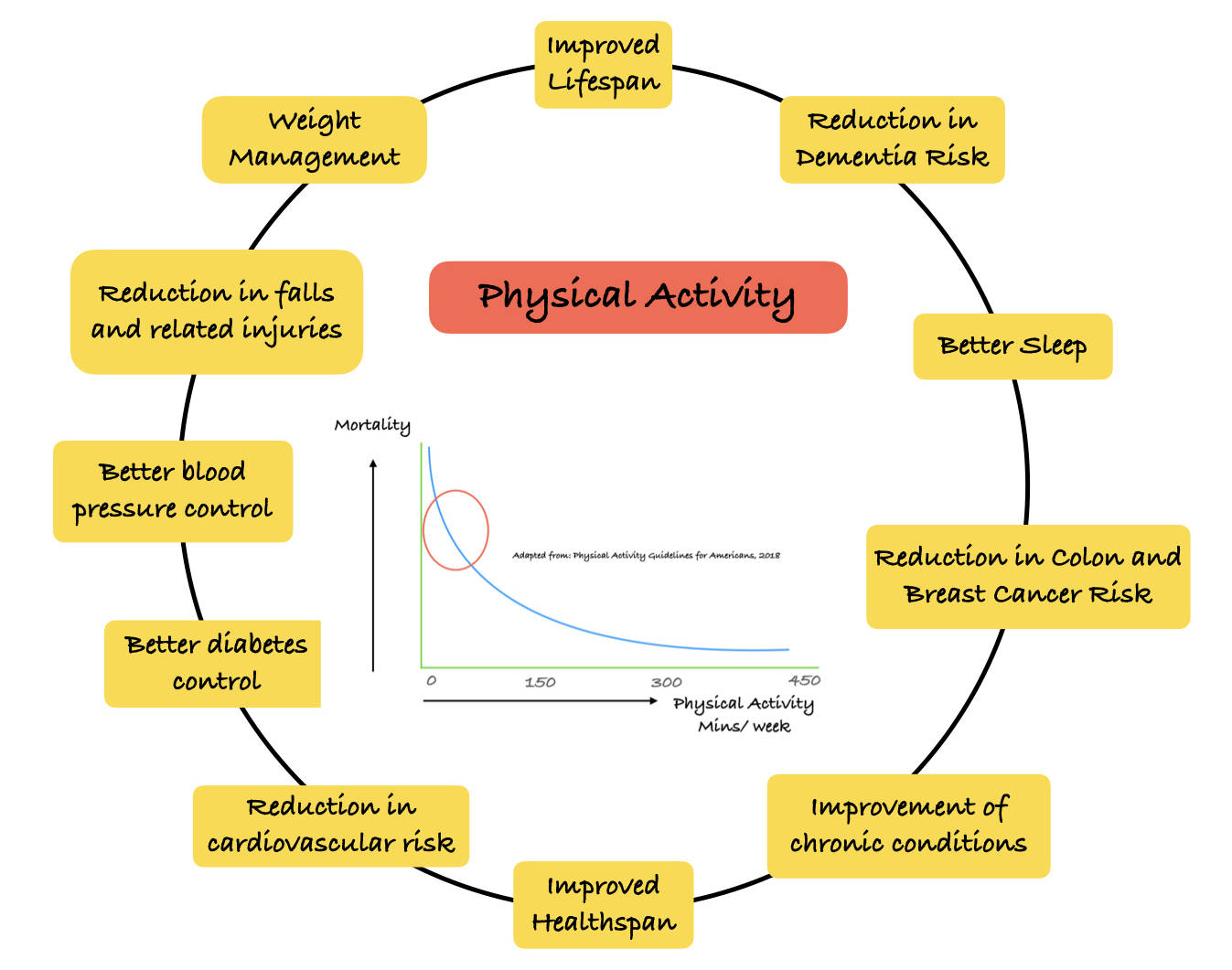
Today’s write up is really just about moving v/s not moving (in short, physical activity versus no physical activity). It doesn’t matter what kind of PA you indulge in as long as you are active, you will do better than if you just sit and do nothing as seen in the centre of the figure below.
Most guidelines recommend at least 150-300 minutes of moderate activity per week, which is equivalent to 30-60 minutes of reasonably brisk walking, 5 times per week. However, if you see the red circle in the centre graph, the biggest improvement in longevity is just between moving and not-moving, between being sedentary versus just getting up and doing ‘something’. In fact, even just 15 minutes of walking or 5-10 minutes of running per day increases your lifespan by almost 3 years compared to those who ”do nothing”. [4]
Simply put, the more active you are, the longer you live, as long as the PA is leisure time activity and not work-related [5]. As you also see in the graph, there is no significant health benefit beyond 300 minutes of moderate physical activity per week, though there is no harm as well, if being more active makes you feel good.
What does this mean for you and I? Simply ‘moving’ and being physically active will help us live longer and healthier as compared to being sedentary and physically inactive. And, it is never too late to start. Even if you have been a couch-potato all your life, your health and lifespan automatically start improving from the day you start moving [6].
PA is better than any pill or diet or supplement, but it needs some effort and motivation, there are no free lunches when it comes to managing our health.
So, which physical activity is the best? Walking? Running? Yoga? Going to the gym? Strength training? Pilates? Let’s address this issue another day, another time, but the short answer is — it doesn’t matter, as long as you do “something” every day.
In our atmasvasth quest to live long, healthy, to have an increased healthspan and lifespan, perhaps the single most important point in the list that I shared last week remains ‘moving’ or physical activity.
Footnotes
1. Butler RN. Public Interest Report No. 23: Exercise, the Neglected Therapy. Int J Aging Hum Dev. 1978 Mar;8(2):193–5.
2. Podder V, et al. Physical Activity Patterns in India Stratified by Zones, Age, Region, BMI and Implications for COVID-19: A Nationwide Study. Ann Neurosci. 2020 Jul;27(3-4):193-203.
3. 2018 Physical Activity Guidelines Advisory Committee. 2018 Physical Activity Guidelines Advisory Committee Scientific Report. Washington, DC: U.S. Department of Health and Human Services, 2018.
4. Wen CP et al. Minimal amount of exercise to prolong life: to walk, to run, or just mix it up? J Am Coll Cardiol. 2014 Aug 5;64(5):482-4
5. Pearce M et al. Is occupational physical activity associated with mortality in UK Biobank? Int J Behav Nutr Phys Act. 2021 Jul 27;18(1):102
6. Saint-Maurice PF et al. Association of Leisure-Time Physical Activity Across the Adult Life Course With All-Cause and Cause-Specific Mortality. JAMA Netw Open. 2019 Mar 1;2(3):e190355
Disclaimer
Views expressed above are the author’s own.
END OF ARTICLE
/https://www.wellandtribune.ca/content/dam/niagaradailies/opinion/contributors/2021/10/01/memorization-and-practice-are-still-important-to-learning/cab343fc70c944629d97a4f86cdf7598_cab343fc70c944629d97a4f86cdf759.jpg "Memorization and practice are still important to learning")