Computer Vision Projects: What Actually Worked for Me (and What Didn’t)

Computer Vision Projects: What Actually Worked for Me (and What Didn’t)

Why I Started Building Computer Vision Projects

I got into computer vision thinking it would be simple—just feed images into a model and boom, results. Yeah… that’s not how it went.

My first attempt at a computer vision project was honestly messy. I tried building an object detection system without understanding image preprocessing. The model kept misclassifying things, and I remember staring at my screen thinking, “Why is a cat being detected as a toaster?”

That’s when I realized something important: computer vision projects are less about flashy models and more about understanding the pipeline—data, preprocessing, training, and evaluation.

Once I accepted that, things started to click.

Beginner-Friendly Computer Vision Projects That Actually Teach You Something

1. Image Classification (My First Real Win)

This is where I’d tell anyone to start.

I built a simple image classifier using a small dataset of fruits—apples, bananas, oranges. Nothing fancy.

At first, I didn’t even normalize the images properly. The model accuracy was terrible. Like, embarrassingly bad.

After learning about:

  • Resizing images
  • Normalization
  • Train/test splits

My accuracy jumped from around 40% to over 85%.

That moment felt like a breakthrough. It showed me that data preparation matters more than model complexity.

2. Face Detection Using OpenCV

This project felt more “real-world.”

I used OpenCV’s Haar cascades to detect faces through a webcam. It worked… but not perfectly.

Sometimes it detected random objects as faces. Curtains, shadows—you name it.

Still, it taught me:

  • How real-time detection works
  • The limitations of pre-trained models
  • Why lighting conditions matter

And yeah, lighting matters way more than people think.

3. Object Detection with YOLO (Where Things Got Serious)

This one was a bit overwhelming at first.

I tried using YOLO (You Only Look Once) for object detection. The setup alone took me hours.

But once it worked, it felt powerful.

I could detect:

  • People
  • Cars
  • Everyday objects

But here’s the catch—custom training is hard.

Labeling images manually? That’s tedious. I underestimated how long it takes.

Still, this project gave me a real sense of how computer vision is used in industries like security and self-driving systems.

Intermediate Projects That Pushed My Limits

4. Hand Gesture Recognition

This one nearly broke me. Not gonna lie.

I used a combination of MediaPipe and a classifier to recognize hand gestures.

The challenge wasn’t the model—it was consistency.

Different lighting, hand angles, and backgrounds kept messing things up.

But I learned:

  • Feature extraction techniques
  • Importance of consistent datasets
  • Real-time processing constraints

When it finally worked, it felt like magic.

5. Image Segmentation Project

Segmentation is a whole different level.

Instead of just detecting objects, you’re identifying exact pixel regions.

I worked on a simple project to segment roads in images.

At first, the output looked like abstract art. Completely unusable.

After tweaking the model and improving the dataset, it became somewhat accurate.

This project taught me patience. A lot of it.

Advanced Computer Vision Projects Worth Trying

6. Real-Time Emotion Detection

This project combines face detection with emotion classification.

Sounds cool, right? It is—but also tricky.

The hardest part was getting a reliable dataset.

Emotions are subjective, and labeling them isn’t always accurate.

Still, it’s a great project to showcase in a portfolio.

7. OCR (Optical Character Recognition) System

I built a basic OCR system to extract text from images.

It worked well on clean images. But messy backgrounds? Not so much.

That’s when I learned about:

  • Image thresholding
  • Noise reduction
  • Text detection vs recognition

It’s a practical project with real-world applications like document scanning.

8. Self-Driving Car Simulation (Mini Version)

Okay, this one was ambitious.

I tried building a simple lane detection system for a simulated driving environment.

Edge detection, Hough transforms—it got technical fast.

But this project gave me insight into how computer vision powers autonomous vehicles.

And yeah, it’s harder than it looks.

Common Mistakes I Made (So You Don’t Have To)

Ignoring Data Quality

I used random datasets without checking quality.

Bad data = bad results. Simple as that.

Overcomplicating Models Too Early

I jumped into deep learning before mastering basics.

Big mistake.

Start simple. Always.

Not Evaluating Models Properly

I relied only on accuracy.

Later, I realized metrics like precision, recall, and F1-score matter more in many cases.

Tools and Libraries That Helped Me the Most

Here’s what I ended up using regularly:

  • OpenCV (for image processing)
  • TensorFlow / PyTorch (for deep learning)
  • MediaPipe (for real-time tracking)
  • LabelImg (for annotation)

I tried a few others, but these became my go-to tools.

Practical Tips for Building Better Computer Vision Projects

If I had to give advice based on experience:

Start small. Don’t jump into complex systems immediately.

Focus on understanding:

  • Image preprocessing
  • Dataset handling
  • Model evaluation

Also, document your work.

I didn’t do this at first, and it made debugging harder.

Another tip—test in different environments.

Lighting, angles, and backgrounds can completely change results.

The Emotional Side of Learning Computer Vision

I won’t sugarcoat it—this field can be frustrating.

There were days when nothing worked.

Models failed. Code broke. Results made no sense.

But then… small wins started happening.

A model finally worked. A detection improved.

Those moments make it worth it.

Are Computer Vision Projects Worth It for Your Career?

Absolutely—if done right.

Projects show:

  • Practical skills
  • Problem-solving ability
  • Understanding of real-world applications

But don’t just copy tutorials.

Build something, break it, fix it.

That’s where real learning happens.

Conclusion

Computer vision projects are one of the best ways to learn AI and machine learning, but they’re not as easy as they seem at first.

From my experience, the biggest growth came from making mistakes—bad datasets, wrong models, poor evaluation.

Each project taught me something different, from basic image classification to advanced real-time systems.

If you’re starting out, keep it simple, stay consistent, and don’t get discouraged when things don’t work immediately.

Because eventually, they will.

FAQ: Computer Vision Projects

  1. What is the best beginner computer vision project?

Image classification is the easiest starting point.

  1. Do I need a powerful computer?

Not always. Many beginner projects can run on a standard laptop.

  1. Which programming language is best?

Python is the most widely used for computer vision.

  1. How long does it take to build a project?

Simple projects can take a few hours; advanced ones may take weeks.

  1. Are datasets necessary?

Yes, and their quality significantly impacts results.

  1. Can I use pre-trained models?

Yes, they are commonly used and save time.

  1. Is computer vision hard to learn?

It can be challenging, but manageable with consistent practice.

  1. What industries use computer vision?

Healthcare, automotive, security, retail, and more.

TTABlog Test: Is “ELEPHANT LEARNING MATH ACADAMY” Confusable With “ELEPHANT GAMES” For Computer Game Software? – Trademark

TTABlog Test: Is “ELEPHANT LEARNING MATH ACADAMY” Confusable With “ELEPHANT GAMES” For Computer Game Software? – Trademark

&#13
To print this write-up, all you have to have is to be registered or login on Mondaq.com.&#13

The USPTO refused to register the mark ELEPHANT Understanding&#13
MATH ACADEMY
for downloadable academic computer software applications&#13
[LEARNING and MATH ACADEMY disclaimed], acquiring confusion likely&#13
with the registered marks ELEPHANT Video games, in&#13
regular people and in the logo variety shown down below, for,&#13
inter alia, computer recreation software program and digital recreation&#13
application for cell phones [GAMES disclaimed]. Effectively, the goods&#13
overlap, but what about the marks? After the disclaimers,&#13
what’s remaining in every mark but “ELEPHANT”? How do you&#13
assume this came out? In re Elephant Studying, LLC, Serial No.&#13
90556090 (July 13, 2022) [not precedential] (Impression by Judge Cindy&#13
B. Greenbaum).

1212980a.JPG

Power of the Cited Marks: Applicant argued&#13
that ELEPHANT is a weak formative for computer software items, pointing&#13
to ten or so use-dependent registrations for marks made up of the word&#13
ELEPHANT (e.g., BUBBLES THE ELEPHANT, ELEPHANT TREASURES, and ASIAN&#13
ELEPHANT). “Potentially additional importantly, the two cited&#13
registrations and the previously mentioned third-bash registrations coexist with&#13
Applicant’s recent registrations for the marks ELEPHANT&#13
Mastering (Learning disclaimed) (Reg. No. 6178676)) and ELEPHANT AGE&#13
(Reg. No. 6047589).” In gentle of all these registrations, the&#13
Board concluded that the cited marks are entitled to “a&#13
to some degree narrower scope of security than that to which marks with&#13
inherently exclusive conditions usually are entitled.”

The Marks The Examining Attorney managed&#13
that ELEPHANT is the dominant factor in the topic marks mainly because&#13
it is the 1st phrase in each and every mark and is additional probable to be&#13
amazed on the memory of a consumer. The Board, having said that, way too a&#13
unique tack:

[T]he proof talked about over&#13
demonstrates that the frequent term ELEPHANT is relatively weak due to&#13
the numerous 3rd-occasion registrations for software. The various&#13
connotations of the trailing phrases Game titles and Learning MATH ACADEMY&#13
substantially contribute to the different commercial impressions of&#13
the marks, as Game titles describes the laptop game titles recognized in the&#13
cited registrations, and Finding out MATH ACADEMY describes the&#13
goal of Applicant’s instructional mobile purposes, which&#13
youngsters will use to master math.

The Board found the marks to be more dissimilar than very similar in&#13
visual appeal, seem, indicating, and business effect. This getting&#13
was bolstered by the existence of applicant’s two prior&#13
registrations.

1212980b.JPG

The Products and Channels of Trade: The broadly&#13
worded computer system activity software discovered in the cited registration&#13
ought to be presumed to encompass all types of activity application, which include&#13
applicant’s video games that entertain and teach. In gentle of the&#13
overlap in merchandise, the Board will have to presume that these overlapping&#13
products travel via the similar, standard channels of trade to the similar&#13
classes of consumers.

Conclusion: Inspite of the overlap in merchandise and&#13
channels of trade, the Board identified the marks to be sufficiently&#13
distinct to avoid a chance of confusion. And so it reversed&#13
the refusal to register.

Read through remarks and put up your comment here.

TTABlogger remark: Superior to see that the Board&#13
did not totally ignore the disclaimed wording.

The content material of this post is meant to supply a standard&#13
tutorial to the matter make a difference. Professional tips ought to be sought&#13
about your distinct conditions.

Popular Content ON: Intellectual Home from United States

Logos Comparative Tutorial

Obhan & Associates

Emblems Comparative Manual for the jurisdiction of India, check out out our comparative guides segment to assess across numerous nations around the world

Don’t Patent That!

Wolf, Greenfield & Sacks, P.C.

Did you know that you do not have to have to patent every brilliant notion that you have in get to make revenue off it? Some of the most beneficial mental property is secured as a trade solution.

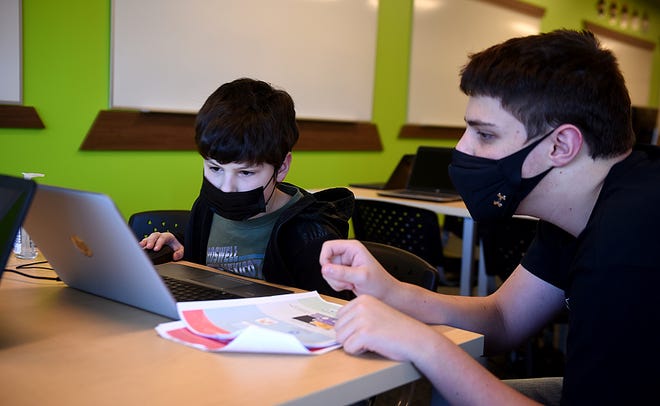
Kids learn to code computer games at Columbia Code Ninjas franchise

Kids learn to code computer games at Columbia Code Ninjas franchise

With time, exertion and particular instruction, William Bradley, 9, at the close of his session had achieved his mission.

He experienced designed and designed a computer recreation where by he accumulates points by touching dogs traveling earlier with a bunch of bananas in a bed room.

“I feel I’m very pleased of it,” William explained when finished.

William was introduced to Code Ninjas by his mom, Sheila Bradley, for a exam run.

“We have been looking at this for a prolonged time,” Bradley explained. “This is kind of the place we are going now, proper?”

It is really also exciting to obtain a thing in which learners hook up with other students with equivalent interests, she explained.

William is dwelling-schooled, and Code Ninjas dietary supplements her education and learning of him, she mentioned.

The new organization at 10 W. Nifong Blvd. opened Tuesday. Franchise proprietors are Monthly bill and Shelly Rowe. It really is in Suite 117 in the Nifong Sq. shopping center.

A lot more:How a Rock Bridge Significant University college student built history as the school’s initial male Homecoming queen

Code Ninjas co-owner Bill Rowe talks about the ranks of colored wristbands students earn as they progress in computer coding skills.

Code Ninjas started off in 2016 in Texas and became a franchise in 2017, Invoice Rowe explained. Now there are a small more than 300 Code Ninjas spots in the U.S., the United Kingdom and Canada, with about 180 in enhancement.

“Our thought is to give the young children a enjoyment and inviting environment to find out the worthwhile ability of coding,” he explained.

It makes it possible for small children to grow to be creators of written content alternatively of consumers of it, he explained.

UCI informatics professors relaunch center on computer games, learning and society | UCI News

UCI informatics professors relaunch center on computer games, learning and society | UCI News

Irvine, Calif., Sept. 22, 2021 – The intersection of laptop game titles, schooling and social activism is to be the focal level of a joint centre getting recently relaunched this fall at the College of California, Irvine by interactive media research and progress authorities Kurt Squire and Constance Steinkuehler.

The two professors in UCI’s Section of Informatics founded Online games + Learning + Modern society in 2005 when at the College of Wisconsin-Madison. Now they have reimagined it to discover sport improvement and investigate in a new context dominated by the ongoing COVID-19 pandemic, political upheaval and adjust in the United States and overseas, and reignited actions supporting racial justice and women’s rights.

In addition, GLS has been redesigned to let pupils to consider whole benefit of UCI’s exceptional position in Southern California’s pc gaming ecosystem, according to Squire.

“UCI is in the heart of ‘Silicon Beach front,’ which suggests college students in this article have completely ready obtain to a host of recreation developers headquartered in Irvine and other close-by metropolitan areas,” he said. “Our people today get to meet up with, collaborate with and study from builders at Blizzard, Activision and other firms both equally on the UCI campus and at the companies’ services – some thing which is just not feasible to this extent exterior this area.”

Squire claimed one more gain for pupils in the centre is the existing curriculum for UCI’s B.S. in sport design & interactive media. Commenced in 2009, it’s the 1st this kind of degree offered by a important general public college.

“A lot of other packages need to have to outsource to freelancers to build recreation technologies, web sites, apps and other qualities, but we have all those abilities in-residence here at UCI,” Squire mentioned. “Having these capabilities listed here at our disposal is a furthermore over other establishments and implies we can concentration on letting pupils harness their creativeness to create assignments.”

He added that ranking businesses seem at how perfectly programs train college students for the related career sector, and UCI excels for the reason that graduates gain the working experience of working on a match that has been created obtainable to the general public by the time they finish.

The major thrusts of GLS, in accordance to Steinkuehler, will be to use electronic communities and interactive media to assist encourage civic engagement, democratic principles, and equity and inclusion. Researchers in the middle will examine what fuels on the net extremism, disinformation, toxicity and harassment and get the job done to beat it. Other initiatives will support create an comprehension of the impression of online games in professional and educational spheres and how to design titles that positively impact studying, overall health and wellness, and social alter.

Steinkuehler stated the relaunch of the center stems in aspect from phone calls she has listened to by many others in the video games exploration and growth entire world.

“The feeling I get from our local community is that people are leaving the pandemic getting discovered what matters most to them and what may well not subject as significantly,” she explained. “People are actually committed to functioning on national challenges, utilizing video games as a lens and as a indicates to tackle these difficulties.”

Steinkuehler stated men and women can hope a really various GLS shifting forward.

“There is heading to be a lot a lot more aim on students as activity designers and on video games as a craft,” she reported. “In the past, the target was actually on the understanding section, but now there is likely to be as substantially, if not additional, emphasis on the online games and society pieces.”

Steinkuehler noted that the recreation improvement industry experienced terrible publicity a lot more than a 10 years in the past all around the difficulty of violence in movie game titles. That problem has diminished over time, she explained, mostly simply because tutorial scientists had been in a position to set games in a broader spectrum of explanations for societal discord, not the sole bring about.

“The principal concern now is the amazing sexism in the recreation development business – how that impacts its possess employees and how it is mirrored in the game titles they produce and release to the community,” she said. “As a centre, we’re interested in remedies and in considering about what we can do as a local community to establish have confidence in and tamp down hateful speak and behaviors. GLS will function on design and style options to deal with these problems.”

Squire explained that section of what inspired the relaunching of GLS is what has been going on at UCI over the previous 5 yrs.

“UCI provides these a good chance for the reason that it is a campus that’s seriously engaged with game titles – every little thing from our groundbreaking esports application to our enthusiastic pupil human body,” he mentioned. “On prime of that, UCI is genuinely very good all over challenges of range and inclusivity. If you put these two alongside one another, you appear out with a good foundation for a study lab like ours.”

In addition to relaunching GLS, Steinkuehler and Squire have announced that the next GLS Meeting will be held on the UCI campus June 15-17, 2022. The occasion will deliver collectively educational researchers, field representatives, game designers and developers, governing administration officials, and leaders at nonprofit businesses who are functioning on nationwide difficulties or social concerns and want to understand games as a motor vehicle for ameliorating individuals challenges or addressing them in some way. Steinkuehler mentioned the event will be prepared and executed completely by UCI graduate students and interns.

About the College of California, Irvine: Founded in 1965, UCI is the youngest member of the prestigious Association of American Universities and is ranked between the nation’s top 10 general public universities by U.S. Information & World Report. The campus has manufactured three Nobel laureates and is identified for its tutorial accomplishment, leading investigation, innovation and anteater mascot. Led by Chancellor Howard Gillman, UCI has much more than 36,000 learners and features 224 degree plans. It is found in just one of the world’s most secure and most economically lively communities and is Orange County’s 2nd-greatest employer, contributing $7 billion yearly to the community economic climate and $8 billion statewide. For extra on UCI, stop by www.uci.edu.

Media accessibility: Radio applications/stations could, for a charge, use an on-campus ISDN line to job interview UCI faculty and industry experts, subject matter to availability and university approval. For extra UCI news, go to news.uci.edu. Extra methods for journalists might be uncovered at communications.uci.edu/for-journalists.

About UCI’s Fantastic Upcoming marketing campaign: Publicly launched on Oct. 4, 2019, the Outstanding Long term campaign aims to increase awareness and assistance for UCI. By participating 75,000 alumni and garnering $2 billion in philanthropic expense, UCI seeks to access new heights of excellence in student achievements, wellness and wellness, analysis and extra. Discover extra by visiting brilliantfuture.uci.edu.