When the pandemic hit in 2020, production work in the taconite mines in northeastern Minnesota slowed way down. Yet mining companies still needed to provide health and safety training to their employees. With lockdowns in place, how were they going to do that?
Since the 1970s, this training had been provided by the miner safety and health training program through Minnesota State’s five northeastern Minnesota colleges. The federal Mining Safety and Health Administration (MSHA) mandates that all such training must be done in person. That requirement was rescinded temporarily in the spring of 2020, and courses shifted to 100 percent online. As Hibbing Community College safety and health instructor Eric Lund notes, “We’re still in that status as we speak.”
During the pandemic, about 4,200 students have been trained. Minnesota State’s training program also has extended its reach, providing its health and safety courses to students in other states—and in Iceland and New Zealand. The program has had international trainees before, but they had to fly in for a couple of days of face-to-face sessions. Now, Lund says, “they can do that training virtually from their home countries.”
Online education wasn’t invented in response to the pandemic. Minnesota’s colleges and universities had been offering virtual courses and degrees for several years before the coronavirus reared its ugly, spiky head. But in March 2020, Minnesota’s colleges and universities were forced to move their courses online. Nearly two years after the onset of the pandemic, schools, employers, and students have learned a lot about digital education.
Institutions of higher learning have made changes to what educators call “modalities”—the different ways education is delivered. They’re redesigning classrooms in ways that accommodate both online and in-person learning. They’re tapping new digital tools that go beyond Zoom. They’re creating more courses that are completely digital, or a blend of virtual and in person.
That’s because students, faculty, and the schools themselves have gotten used to online education and experienced its advantages and flexibility. Even after many students—mostly undergraduates—have returned to campus, it’s unlikely that higher education will return to a pre-pandemic normal.
Staying flexible
Like other colleges and universities, Saint Mary’s University of Minnesota shifted to completely online learning formats beginning in March 2020. Saint Mary’s traditional undergraduate campus was mostly back to class and the face-to-face format by the fall of 2021, says Andrea Carroll-Glover, vice provost for online strategy and programs. The university still offers fully online courses “to provide that flexibility to our students, and to ensure that our traditional undergraduate students are able to graduate with the technology skills that employers are looking for.”
On the bachelor completion and graduate side, the university is continuing to explore new opportunities online. Beyond fully online programs, Saint Mary’s also is offering more hybrid undergraduate programs, which combine online and in-person time. “It has really changed quite a bit in terms of how we think about our portfolio, how we think about delivery modalities, and how we’re able to serve our students in living our mission by leveraging flexible learning models with opportunities for practical application,” Carroll-Glover says.
Online education programs rely on platforms called learning management systems (LMS). In the fall of 2020, Saint Mary’s shifted to an LMS called Canvas. “This elevated the student experience,” Carroll-Glover says. Thanks to Canvas, the online teaching and learning experience became “mobile friendly, much more intuitive, and enhanced the faculty’s teaching experience,” she adds. For instance, faculty can use new mobile features to see when students are posting assignments or discussions.
Building on Canvas, Saint Mary’s integrated an online recording and streaming platform called Panopto to ensure it had strong video capabilities. The university also incorporated a tool into its Canvas LMS called Ally, which helps instructors provide alternative formats to make their courses more accessible for people with disabilities. For instance, Ally can help teachers accommodate students with color blindness through the use of more visible text colors and image captioning.
Carroll-Glover says that Saint Mary’s strong online experience has attracted many transfer students from other colleges. It also has allowed the university to extend its geographical market: More of Saint Mary’s new students live and study outside of Minnesota, some as far away as California.
Upgrading virtual business courses
Graduate-level business education programs also have adjusted their modalities for MS and MBA students. Again, many of these programs have been offered online for some time, but university business schools are incorporating what they’ve learned during the pandemic into new approaches to delivering education.
Case in point: Deploying Zoom, the platform that became the short-hand term for pandemic communication. “We all had to learn how to use [Zoom’s] breakout rooms and the annotation tools,” says Patricia Hedberg, associate dean of the University of St. Thomas’ Opus College of Business. “We expanded our understanding of the technology and are using it deeper than we had before.”
Hedberg says that St. Thomas invested a great deal in remote learning during the pandemic, and university faculty learned how to effectively present instruction online. “We’re seeing that pay off now—that we can offer that flexibility,” she says.
“We want that online experience to be similar to the learning experience you’d get in person,” Hedberg says. The St. Thomas online instructional group combines pedagogy with technology, and it works with faculty to “have the right tools to accomplish the same learning outcome [virtually] and a similar type of engagement with students.”
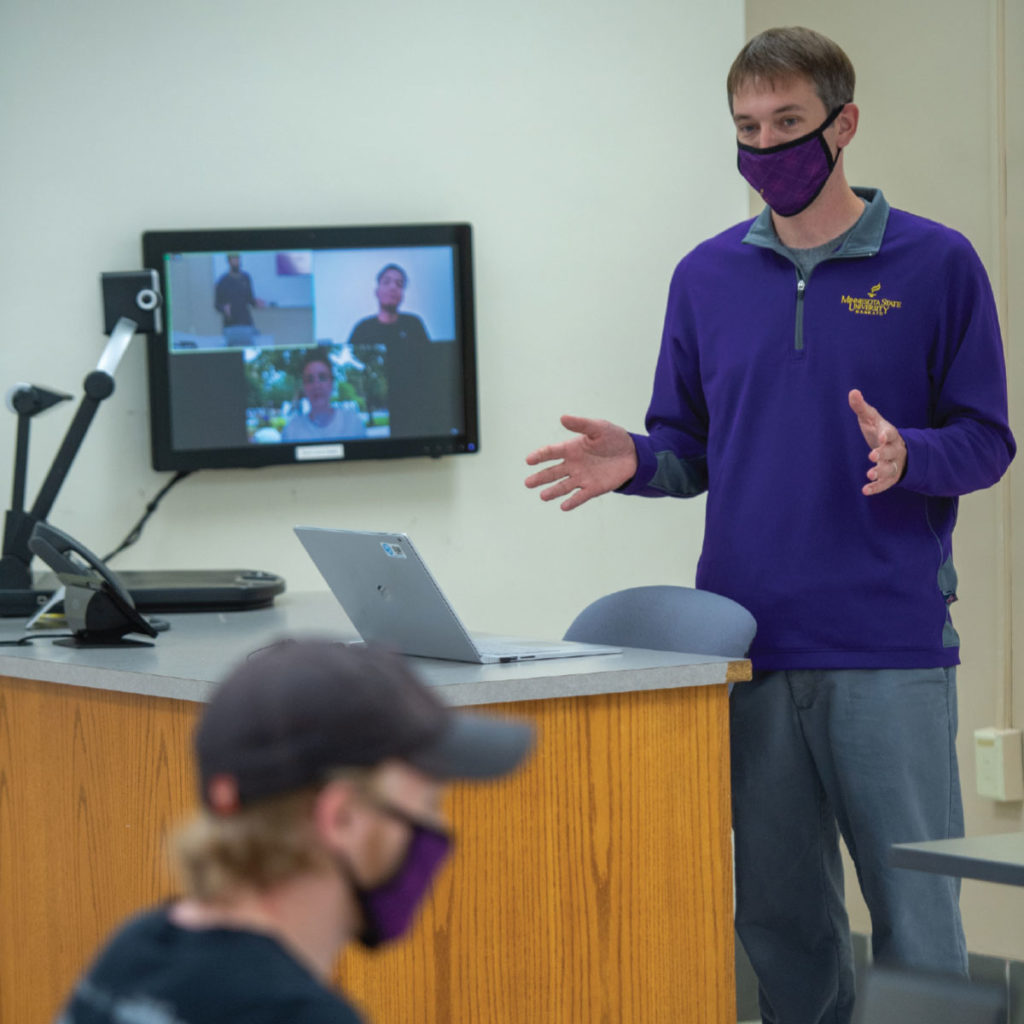
For instance, the group added more screens in university classrooms to allow online and in-person students to be together and interact. For such mixed classrooms, St. Thomas has added several tech enhancements. These include using a stylus “to scribble on the screen,” which shows up on the PowerPoints projected both online and in person.
Read more from this issue

For faculty, Hedberg says, this means more choices. “You have more opportunities to think about what you want the outcome to be for students,” she says. “What’s the best way to share information? What’s the best way to have some kind of interaction and discussion about the information?” In other words, St. Thomas believes that online education tools and platforms can actually enhance education. Opus is now looking at technologies that would allow its students to do projects with businesses across the world.
Phil Miller, assistant dean of MBA and MS programs at the University of Minnesota’s Carlson School of Management, notes that Carlson had been building its online capacity before the pandemic hit. “Our capabilities and our facilities have evolved to meet that changing landscape,” he says. During the pandemic, Carlson School Dean Sri Zaheer “made a commitment to make sure that students could participate whatever way they chose, as could faculty.” In the summer of 2020, Carlson made “a massive push” to make sure every classroom had a rear-mounted HD camera and ceiling mics. “At a minimum, every class can stream,” Miller says.
When it comes to how a hybrid course runs, Miller says “there’s a whole stack of tools that are embedded in Canvas,” an LMS that Carlson began using about five years ago. Now instructors are adding more technology to that toolbox.
Miller, for instance, teaches a problem-solving class at the MBA level that includes collaborative projects. To enable the professor and students to interact virtually, he began using a platform called FeedbackFruits, which allows participants to “cross-comment” on projects online. “It very easily allows me to structure that whole engagement so that you can post your deliverable and I can comment,” Miller says. Tools like FeedbackFruits have become an important part of delivering virtual education, he says.
The lessons of the pandemic also have influenced the way the Carlson School offers its non-degree leadership programs for business executives. Nora Anderson, executive director for executive education, introduced completely online leadership courses with the arrival of the coronavirus.
Carlson has created a new kind of online program. Instead of participants meeting on Zoom for four days straight, it extended the program across six months with regular two-hour online sessions. “We had leaders from Europe, Asia, and the U.S. all going through this learning experience together,” she adds. The Carlson School is now launching a second cohort of this program.
“I’d venture to say that we would not have designed the program this way before the pandemic,” Anderson says.
‘Hyflex’ higher education
This past summer, the Carlson School introduced what Miller characterizes as “the next evolution,” called hybrid flexible, or “hyflex.” Eight Carlson classrooms were fitted with “a higher degree of technology and integration,” including tracking cameras and large, prominent monitors. The result, Miller says, is “an immersive room that allows virtual and in-person participants to fully integrate in a class [at the same time]. We see a lot of our working professional programs evolving in that direction.”
Minnesota State senior vice chancellor Ron Anderson believes that hyflex has the potential to significantly impact the way his system delivers education. He distinguishes hyflex from hybrid, where a class meets in person once or twice a week, then online at other times.
Anderson also says that students will “move seamlessly between delivery modes depending on their needs.” Minnesota State is “seeing a lot of interest in this increasing flexibility for scheduling and juggling other commitments.”
“I would estimate about half of our non-credit offerings this current semester are being offered in an online modality,” he says. There are limitations—some courses still need to be hands on, such as those in which students handle industrial equipment. But even some of those courses “are now being coupled with some components being delivered online or via Zoom.”
Larry Lundblad, Minnesota State’s executive director of workforce and economic development, notes that “what we were doing on campus was paralleled by business and industry. They were getting used to Zoom and other distance formats. Everyone had to learn at once.”
With the persistent labor shortage and companies needing every hour of labor they can get from their current workforce, “many employers are reluctant to let employees participate in training,” Lundblad says. “These alternative ways of delivery are meeting a need where workers can stay in place for at least a portion of the training.”
Like nearly all educators, Lundblad doesn’t see a full return to the old normal. “This is a permanent shift,” he says. “The employers, the students, and the instructors are all saying that the flexibility can be a good thing. Now the emphasis is on, ‘How can we make this work better?’ ’’
Mining safety instructor Lund has seen a “generation gap” in terms of preferences for online and in-person instruction. Younger workers, he says, are quite comfortable with digital learning. And like many higher-education faculty members, he believes that the demand for online courses will continue to be strong, particularly because companies and students have gotten accustomed to it. It’s not yet known whether MSHA will allow some form of virtual learning to continue. “If they do,” Lund says, “it’s probably here to stay.”