A tiny school district in California is setting up a separate in-person instructional program for its unvaccinated students, courting a showdown with the biggest state in the country and a tussle over the legal limits of how schools can respond to the COVID-19 crisis.
The Alpine Union school district’s plan, the first of its kind in the country, is designed to save its unvaccinated students from losing face-to-face instruction when the state’s K-12 vaccine mandate—also the only one of its kind in the nation—goes into effect, for some grades as early as July.
In this small K-8 district, in the foothills east of San Diego, where “choice” is a rallying cry that dominates the COVID vaccine debate, district leaders estimate that 40 percent or more of the 1,500 students aren’t inoculated against the virus.
“I’m not opposed to vaccines. I got the vaccine and the booster, too,” said Alpine’s superintendent, Rich Newman. “But I feel I should represent my community, and overwhelmingly, they’re believers in choice. I don’t want some students falling through the cracks because of the state’s vaccine mandate.”
Alpine’s dilemma reflects a question district leaders across the country are facing, said Dan Domenech, the executive director of AASA, the School Superintendents’ Association: What kind of education should they provide for children whose parents won’t get them vaccinated?
California is the only state so far to add COVID-19 inoculations to the longstanding list of other vaccinations required for in-person school attendance, such as measles, mumps and rubella. The mandate will take effect in phases, when federal officials grant full approval for the vaccine’s use in each age group. Currently, COVID vaccines are fully approved only for those 16 and older. Younger children can receive them under an emergency-use authorization.
Once California’s requirement kicks in, families of unvaccinated students—other than those with state-approved exemptions—will have three choices: private school, home schooling, or “independent study,” a learn-from-home option offered by the state.
The predicament Alpine faces is likely to arise nationwide. Louisiana announced this week that it will require the COVID vaccine for school attendance. Five districts in California already require it. And at least a dozen districts around the country require the vaccine for some students, typically student-athletes.
Some districts have conducted short-lived experiments aimed at serving both masked and unmasked students by teaching them in separate rooms, but they quickly abandoned those practices. No district has yet tried a separate program for unvaccinated students.
In-person program for unvaccinated students could violate law
The California governor’s office signaled that any district that sets up separate in-person instruction for unvaccinated students would run afoul of its orders.
“If you do in-person instruction, you need to abide by the vaccine mandate,” said Alex Stack, a spokesman for Gov. Gavin Newsom.
County health departments will be tasked with enforcing the vaccine mandate, Stack said. Legal experts said the state also has the authority to seek a court order to shut down school programs that violate state law.
“I don’t think California will allow a school district to create a separate program for unvaccinated students. If it violates state law, a judge is going to shut that down,” said James Hodge, a professor of law at Arizona State University and director of its Center for Public Health Law.
Courts have upheld challenges to vaccine mandates in higher education, and last weekend marked a key ruling for such requirements in K-12. On Dec. 5, the U.S. 9th Circuit Court of Appeals upheld San Diego Unified school district’s vaccine requirement. Hodge said that would buttress other California districts that enact such rules.
Parents drove creation of new program
Alpine’s planned “choice academy” is drawing both applause and condemnation locally. The district’s Facebook page became a hotbed of disagreement when Newman, the superintendent, posted a letter announcing the academy on Nov. 22. He returned to work after Thanksgiving to find voicemails accusing him of being a Nazi and a segregationist.
But many parents and district staff members are cheering the academy. They commend the district for respecting all viewpoints in this predominantly conservative community and trying to ensure unvaccinated students get a quality education.
“I’m grateful we have a superintendent who wants to work alongside us parents instead of against us,” said Jalissa Hukee, whose two children have all their required vaccines except COVID. “Without the academy, I’d pull my kids out and home-school.”
Hukee is one of a group of parents helping Newman design the program. This fall, after Newsom announced the coming vaccine mandate, Newman invited their ideas. The parents gathered around a friend’s kitchen table and brainstormed an early outline.
There is still a lot to figure out. The district is working with its teachers’ and classified employees’ unions on how to staff the programs, and what safety protocols will be required. They don’t yet know whether they’ll mix the age groups, one-room-schoolhouse style, or divvy children up into grade bands. They have to find ways to preserve the district’s vaunted engineering and dual-language programs, and how to meet the needs of special education students in the new, separate setting.
Home schooling isn’t an option for some working parents
And they’re still looking for a good location: parents have eagerly offered living rooms and garages, but Newman is leaning toward keeping students together in a larger space, such as a community center or office building. But even an unfinished plan is finding a hero’s welcome among some parents.
“Thank God for the academy, because we can’t home-school,” said Jessica Dombroski, whose four children attend Alpine schools while she runs a dog-grooming business and her husband works as a paramedic. She and her children are unvaccinated, and she’s been scrambling to create a home-school pod with other families. Instead, she’ll opt for the choice academy.
Beacon Grayson has vaccinated her two daughters against COVID, and is eager for the state vaccine mandate to go into effect. But she’s happy the district is working to provide an alternative for parents who have not vaccinated their children.
“The district is doing what it can to straddle the divide between parents like me and parents who are ‘no vaccine,’” she said. “It’s caught in a really tough situation.”
Nearly 90 percent of Alpine’s staff is vaccinated for COVID; the rest undergo weekly testing. Yvette Maier, the district’s director of human resources, said many teachers have expressed an interest in teaching in the new academy, especially those who are unvaccinated. The district aims to iron out all details of the program by June, when families begin registering for fall 2021, she said.
New program is ‘asking for a COVID outbreak’
Lauren Weinberg, a 5th grade teacher who’s in her second year in Alpine, thinks the new program is an “incredibly unsafe” option, both for students and staff members.
“Putting a bunch of unvaccinated people in one area, it’s asking for a COVID outbreak,” she said. “You won’t catch me stepping foot on that campus.”
Weinberg worries that the choice academy will enable more families to forgo vaccination. But for others, that’s precisely the point.
“Without this academy, a lot of families will be forced to get the vaccine when they don’t want to,” said Erica Lyle, the dean of students at Alpine’s Shadow Hills Elementary. “We want to let families make their own choices.”
Districts risk legal challenges if they set up such programs, however, legal experts said.
In addition to possible shutdown by the state or by county health departments, they could face lawsuits for breaching a key legal standard: their duties to protect students from foreseeable danger, and to provide a safe and healthy workplace for staff, said Meredith Karasch, senior counsel at Liebert Cassidy Whitmore, a Los Angeles-based law firm that advises school districts.
“I’d tell districts to think very carefully about the issues before putting something like this into place,” she said.
Rochester-area public school students will create social change using video games at the AT&T & RIT ROCtheChange Game Jam held Jan. 15—the first free youth game jam in the region.
At the event, local students in grades 8-12 will learn about programming and get hands-on experience creating functional digital video games. With the event taking place on Dr. Martin Luther King Jr.’s birthday, students will be challenged to create games with the theme of social change and social good.
To eliminate economic barriers, the game jam is free. All technology and meals will be provided. Additionally, students are not required to have any previous experience with computer coding or digital game design.
The game jam is a collaboration between RIT’s School of Interactive Games and Media and AT&T. It aims to expand digital literacy skills and coding and game development opportunities for Rochester-area students—especially those from underrepresented schools and communities. The program seeks to help youth from all backgrounds and economic situations consider careers in the growing technology job market, an industry that is known for its lack of diversity.
The AT&T & RIT ROCtheChange Game Jam will take place from 9 a.m. to 7 p.m. Jan. 15, in RIT’s Golisano College of Computing and Information Sciences building. Parents can register their children on the Eventbrite page by Dec. 31, 2021. The event is limited to 65 students.
Throughout the day, professors and students from RIT’s School of Interactive Games and Media will help participants learn the basic technology and digital skills needed to create digital games. Additionally, game makers will be there to talk about what it’s like to have a career in game design and development.
When creating the games, students will incorporate ideas of social change into the themes and actions of the gameplay. Topics can include Go Green, Stand Up, Speak Up, Equality for All, and Mental Health Awareness/Support. The projects will then be scored by a panel of judges made up of game developers, local tech experts, community leaders, education experts, and elected officials.
AT&T’s partnership with RIT to develop and offer the free game jam aligns with AT&T’s legacy of supporting the digital divide and educational programs focused on digital literacy and STEM disciplines in New York, through the AT&T Aspire initiative. Aspire is one of the nation’s largest corporate commitments focused on advancing education, creating opportunities, strengthening communities, and improving lives, particularly amongst historically underserved populations, by creating new learning environments and educational delivery systems that promote racial equity in academic and economic achievement.
RIT’s School of Interactive Games and Media offers some of the best programs for aspiring game developers in the world, according to international rankings from The Princeton Review.
Nashville, TN – The American Heart Association, the world’s leading nonprofit organization focused on heart and brain health for all, the National Football League (NFL) and the Tennessee Titans are doubling down on kids physically active through NFL PLAY 60 as students return to the classroom following remote, distant and hybrid learning due to COVID-19 Coronavirus.
Now in its 15th year, the NFL PLAY 60 program establishes healthy habits and reduces sedentary behaviors in kids, which is key to immediate and long-term health benefits that can play a role in the classroom experience.
“Now that school is back in session, moving more is even more important following more than a year at home away from physical education classes, team sports, and daily recess,” Annie Thornhill, Executive Director of the Middle Tennessee American Heart Association. “Research has shown healthy behaviors are important in the classroom as active kids learn better. When kids are active, they focus more, think more clearly, react to stress more calmly, and perform and behave better in the classroom.”
In a recent scientific statement released by the American Heart Association, data continues to show poor cardiorespiratory fitness in youth, which includes cognitive and academic functions. As children return to the classroom, it is important for parents and educators to prioritize physical activity for immediate and long-term health.
Rooted in science, NFL PLAY 60, helps children to develop healthy physical and mental health habits for a better chance of a healthy adulthood. The program encourages kids to get a minimum of 60 minutes of vigorous physical activity each day to meet the U.S. Department of Health and Human Services’ 2018 Physical Activity Guidelines for Americans (Department of Health and Human Services, Physical Activity Guidelines, page 14. Available for download here).
The American Heart Association and the NFL will continue to provide free resources to support parents and educators in making physical activity fun and engaging.
Resources available now:
Powered by GoNoodle, a landing page of videos and activities to help kids get 60 minutes of movement each day along side fun animated characters.
NFL PLAY 60 App– The free NFL PLAY 60 app helps kids get more movement throughout the day. The PLAY 60 app allows users to control personalized avatars onscreen with their own physical movement. The app is available for iOS and Android devices.
NFL PLAY 60 Exercise Library– In collaboration with the 32 NFL clubs, the first-ever NFL PLAY 60 library features kid-friendly exercises to help kids to get their recommended 60-minutes of daily physical activity.
The NFL and the American Heart Association have teamed up since 2006 to inspire kids through a fun and engaging way to get physically active. The impact of physical activity on overall mental and physical wellness is essential to help children grow to reach their full potential.
Additional NFL PLAY 60 resources can be found online at heart.org/nflplay60.
About the American Heart Association
The American Heart Association is a relentless force for a world of longer, healthier lives. We are dedicated to ensuring equitable health in all communities. Through collaboration with numerous organizations, and powered by millions of volunteers, we fund innovative research, advocate for the public’s health and share lifesaving resources. The Dallas-based organization has been a leading source of health information for nearly a century.
NFL PLAY 60 is the League’s national youth health and wellness campaign to encourage kids to get physically active for at least 60 minutes a day. Since PLAY 60 launched in 2007, the NFL has committed more than $352 million to youth health and fitness through PLAY 60 programming, grants, and media time for public service announcements. Over the past decade, the NFL has partnered with leading academic, scientific, and nonprofit organizations to help children of all abilities lead healthier, active lives.
The NFL and its clubs have supported programs in over 73,000 schools and constructed more than 265 youth fitness zones nationwide—giving more than 38 million children an opportunity to boost their physical activity levels. NFL PLAY 60 is also implemented locally, as part of the NFL’s in-school, after-school and team-based programs.
When a child first starts learning to read, decodable texts can be an important tool. These texts provide them more practice in decoding, or sounding out, certain phonics patterns, or words, in the context of a story that they find interesting.
To supplement the Essex Elementary School (EES) collection of these types of texts, the Essex Elementary School Foundation (EESF) provided an $8,600 grant for the 2021–’22 school year for the purchase of new Geodes Decodable Texts that are now being used as part of K-2 instruction.
“Just yesterday I had the pleasure of observing a group of students reading one of the books,” said EES Principal Jennifer Tousignant in a phone interview. “They were actively engaged and genuinely excited to enjoy their new books.”
Tousignant said the books feature a variety of genres and are a mix of fiction and non-fiction.
“The illustrations in these particular books are bright and the story lines are far more interesting than decodables of the past,” said Tousignant. “Decodable readers have certainly come a long way.”
The texts are aligned with and complement the school’s reading curriculum, which is called the Wilson Fundations foundational reading program.
Tousignant said that the phonics and decoding skills taught through the school’s reading program are reinforced with decodable readers.
“Students can use and practice the skills that they were taught and that they learned,” with the decodable readers, said Tousignant.
Decodable texts are often used along with leveled readers.
“Leveled readers are characterized and categorized by level of difficulty,” said Tousignant. “They are more focused on meaning…and contain many sight words.
“So, there are benefits to both and both serve a valuable purpose. Teachers use multiple tools to support and differentiate literacy instruction to meet the needs of our students,” she continued.
Funding for the decodable readers was allocated to the school by EESF prior to the start of the current school year.
“The EESF is really neat, and I feel so fortunate to work with them,” said Tousignant.
She noted that Early Literacy Teacher Colleen Artymiak and Kindergarten Teacher Kelli Grace submitted the formal grant proposal to the foundation.
“Colleen and Kelly were interested in these books, and they came to me,” said Tousignant. “I feel like we could never have too many books and kids get very excited about new books…I fully supported it.”
The Geodes decodable texts were chosen based on their “systematic scope and sequence, which will allow our students to practice the phonics skills that have been explicitly taught in our phonics lessons,” said Artymiak in an email. “Geodes will scaffold children’s mastery and application of the alphabetic code in reading.”
According to a press release, EESF provided $50,000 in grants and program support to EES this school year.
In addition to the decodable texts, the funds support a collaboration with the Essex Historical Society for a Historian in Residence Program, a Summer Math Passport Program, and a Scientist in Residence Program offered by the Connecticut Audubon Society’s Roger Tory Peterson Estuary Center.
Other continued grants and programs include Bloom Art instruction, Lego Engineering and 3D Printing Makerspace afterschool programs. Another new program for the 2021–’22 school year is a collaboration with the Connecticut River Museum “to increase students’ knowledge of their town and connection to the Connecticut River,” according to the press release.
The foundation is also working to develop a science, technology, engineering, and mathematics (STEM) lab for students and teachers, for the 2022–’23 school year.
“We are thrilled to bring back some favorite learning opportunities in addition to some new collaborations with our local community organizations,” EESF President Bill Jacaruso stated in the press release. “We are grateful for the generous support from our local parents and community members to make these programs possible.”
When students and educators were sent home in March 2020, they quickly had to figure out what to do without being in person. Our ways of teaching and learning were disrupted by the coronavirus (COVID-19) pandemic and so we had to make do with what we had: online learning.
Around a year and a half later, online learning has turned the way we think about education on its head. Even today, as we are still slowly making our way out of the pandemic, virtual education is still implemented. Whether it be the virtual days due to inclement weather or the asynchronous classes that students are still taking this year, online learning is the way that we dealt with COVID-19 interrupting our education.
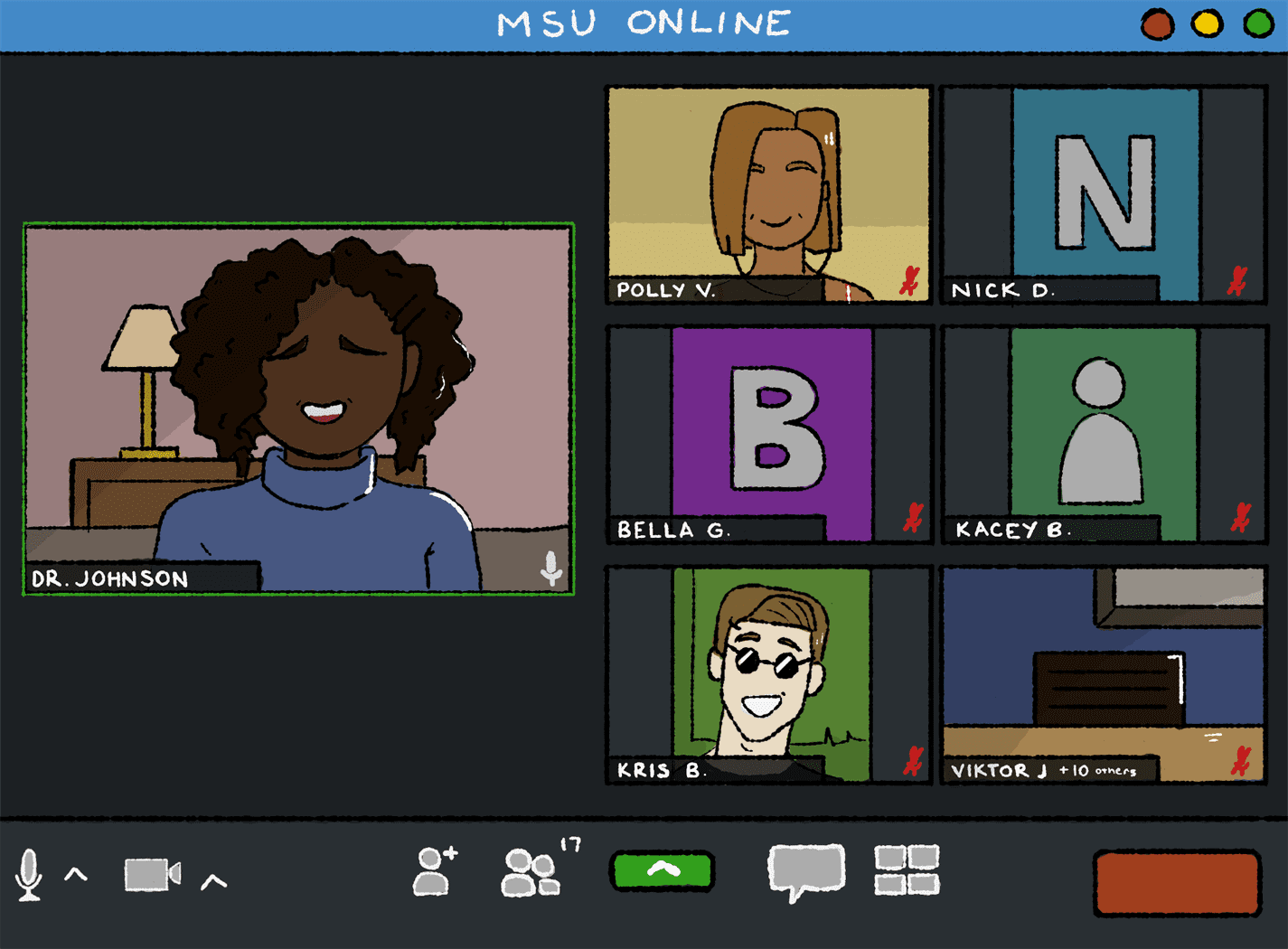
Students at Montclair State University have a lot to say about their experience with learning via Zoom. Although experiences differed in some ways, they left a lasting impression on most. Cam Martin, a junior sports media and journalism major, described how he handled the initial transition to learning online.
“Using Zoom for the first time was definitely unique to me partially because I’d never experienced an online school,” Martin said. “I can sleep in a little bit, but this is still kind of new to me. I’m good with technology, so I could find a way to successfully complete this, but it’s just really a matter of, ‘Can I really do this at the moment?’”
Cam Martin is one of many students who had to make the transition to online learning. Photo courtesy of Cam Martin
Mari Zuniga, a senior communication and media arts major, had a more difficult transition into what became the new normal for education.
“I find it hard to concentrate on the computer,” Zuniga said. “It’s really difficult for me because I’m looking at this and looking at that. I’m hearing them, but I’m not listening. I’m not paying attention.”
Mari Zuniga had her mental health affected by online learning. Sal DiMaggio | The Montclarion
Dr. Erik Jacobson, an associate professor in the teaching and learning department, noted how different students reacted in different ways to the initial switch over to virtual learning.
“[For students who prepared for online learning], it might’ve been slightly different than they were expecting, but I think classes still worked for them,” Jacobson said. “I think they got maybe not 100{e4f787673fbda589a16c4acddca5ba6fa1cbf0bc0eb53f36e5f8309f6ee846cf} of what they would have gotten normally, but I think they got a good chunk of it. And the students who were not prepared for it, I think really suffered.”
Dr. Erik Jacobson had much to say about how online learning impacted our way of education. Sal DiMaggio | The Montclarion
Students weren’t the only ones impacted by the move to Zoom. Professors had to deal with this change as well. Dr. Michael Koch, an adjunct professor for the School of Communication and Media, was one of many.
“[Online teaching is] not my preferable way to teach, but I wasn’t completely against it either,” Koch said. “I wanted to be safe, and I wanted everybody to be safe, too. So it was challenging, but I made the best of it that I could and I tried to be as accommodating as [I] possibly could be.”
Dr. Michael Koch says online learning made it difficult for him to engage properly with his students. Sal DiMaggio | The Montclarion
Mental health was also something that online learning affected. Going to classes has a social aspect to it as well as an educational one, and being forced to learn from home took that away.
In addition to being a professor at Montclair State, Koch is also a therapist, and he saw students struggling with their mental health. But he also noted that sometimes it’s hard to know what students are going through.
“I think that it’s a bit of a cliché to say everybody is struggling, but there is a lot of cumulative impact of this,” Koch said. “Maybe six months ago, some people [would say], ‘Yeah, I’m fine. I’m doing alright.’ But as it drags on and on, it just gets tiring. I think there’s a lot of mental exhaustion. [Even] myself and [other educators] are not immune to that at all.”
Zuniga went on to discuss her struggles with mental health while learning over Zoom.
“Before COVID-19, [my mental health] was already on the rocks,” Zuniga said. “So when online learning happened, it slightly got worse. [I thought] ‘How am I going to get through this? Are we always going to be on Zoom?’”
According to Jacobson, the decline in mental health wasn’t quite invisible to professors, but it was hard for them to tell exactly what was going on.
“I had students who would straight up tell me how they were doing and how they were feeling and others who fell off the radar,” Jacobson said. “So I [would] email them, ‘How are you doing? Is everything okay?’ But then there were students who showed up, did their work, were engaged and their personality wouldn’t lend themselves to saying, ‘Actually I’m struggling right now.’”
Despite this, online learning may have its advantages going forward if used correctly, especially here at Montclair State where traffic and parking seem to always be cause for concern for students, according to Jacobson.
“It certainly provides flexibility, right?” Jacobson said. “In terms of time, schedule and physical location. Montclair State has a lot of students who work outside of school. We have a lot of students who are commuters, [and] we’ve got terrible traffic and parking problems on campus. So certainly Zoom and using online learning platforms may be a way to address some of those things.”
As the future unfolds, the COVID-19 pandemic will continue to shape our education systems. No one can predict the future and tell what it has in store for us, but at the end of the day, one thing is clear: online learning has changed the way we think about education forever.
(This is the final post in a two-part series. You can see Part One here.)
The new question-of-the-week is:
What are the best ways you are incorporating social-emotional learning in your classroom and what are you doing to ensure that it is culturally responsive?
In Part One, Tairen McCollister, Mike Kaechele, and Libby Woodfin shared their responses to the question.
Today, Jennifer Mitchell, Meg Riordan, Ph.D., Amber Chandler, and Bill Adair wrap up this series.
Don’t Use SEL to ‘Increase Compliance’
Jennifer Mitchell teaches English-learners in Dublin, Ohio. Connect with her on Twitter: @readwritetech or on her blog:
Any student or teacher can give countless examples of how our educational system has not only ignored but exacerbated and even directly contributed to mental-health issues for ourselves or our friends, colleagues, and students. Social-emotional learning can literally save lives.
But too often, SEL is sold to teachers as a system to manage students’ behavior and increase their compliance, rather than an essential classroom lifestyle infused with tools they can use to be happier, healthier, and fuller versions of themselves. We must ask ourselves: Do we want our students to tone down who they are to perpetuate the status quo or do we want them to embrace their unique selves and harness their power to build a better world? Do we want them to prioritize work over health and joy or do we want them to build the self- and situational awareness to recognize who they are, what they want, and how to respond to the obstacles they encounter?
Initially, I felt that SEL flowed naturally in my English classroom through literacy and discussions that affirm and explore identity, culture, and empathy. And while that is still a cornerstone of our work together, I realized that my students needed more. After seeing the destructive impact of mental illness, trauma, and racism in so many of my students’ lives, I dug passionately into a variety of SEL approaches. Now, a variety of essential strategies permeate our class culture, pushing us to slow down amidst the pervasive urgency that is so common in schools, to remember that honoring and connecting with each other is essential:
A calming box for students to access fidgets, visual timers, coloring/brain puzzle books, and a small binder of grounding exercises and mental-health tips
Frequent goal-setting and reflection, including WOOP-style goal-setting for which we brainstorm how to overcome obstacles that might prevent us from reaching our goals
Tim Kight’s R-Factor system (E+R=O framework): can help students reflect on what they can and can’t control, the power of their thoughts and emotions, how their responses can influence the outcomes of situations, and how individual actions shape the larger culture of a community. (Caution: infused with grind culture! Supplement with discussions of the importance of rest and recovery to keep going in a healthy way.)
Marc Brackett’s RULER framework for identifying, articulating, and managing feelings with robust, specific vocabulary; very helpful to my ELs. (Caution: Its packaged curriculum and the Yale organization have decided to eschew cultural responsiveness in favor of an imagined ideal of neutrality, disregarding the systemic issues that impact so many students. As scholars such as Duane et. al (2021) point out, SEL practices (and school in general) can directly harm the students they purport to help, especially when they are not implemented in an environment of social justice that affirms students’ identities and lived experiences.)
Weekly restorative circles are a powerful space for community-building, processing and sharing emotions, and collective problem-solving.
Periodic Story Exchanges build empathy, connection, and perspective-taking
A daily organizer routine where we begin and end class by recognizing our feelings, pausing for gratitude, grounding ourselves in affirmations and shared goals, and reflecting on our learning
Frequent opportunities for students to give me feedback
No matter which tools and opportunities educators provide, it’s essential that we constantly reflect and continue learning, just as we ask our students to do. We must listen to the brilliant educators of color who are sharing their expertise and their voices about how white supremacy impacts all aspects of education, particularly SEL work. We must constantly ask ourselves if what we are doing embraces or constrains our students’ identities, emotions, and experiences. Above all, we must listen to our students and make it undoubtedly clear to them that their voices matter, that we are their partners, and that we care enough to keep doing better.
‘A Powerful Approach’
Meg Riordan, Ph.D., is the chief learning officer at The Possible Project, an out-of-school program that collaborates with youth to build entrepreneurial skills and mindsets and provides pathways to careers and long-term economic prosperity. She has been in the field of education for over 25 years as a middle and high school teacher, school coach, college professor, regional director of NYC Outward Bound Schools, and director of external research with EL Education:
Social-emotional learning is a difference-maker. Decades of research show benefits beyond increased academic performance, including: positive self-concept, improved capacity to manage stress, and greater economic mobility. But what does it look like to effectively incorporate social-emotional learning (SEL) into the classroom? And how does SEL work with culturally responsive teaching to support all learners?
First, let’s lay a shared foundation: The Collaborative for Social, Emotional, and Academic Learning (CASEL) defines SEL as the process through which people acquire and apply the knowledge, skills, and attitudes to develop healthy identities, manage emotions and achieve personal and collective goals, feel and show empathy for others, establish and maintain supportive relationships, and make responsible and caring decisions. Culturally responsive SEL must offer opportunities for students to reflect on identity, use relevant topics to foster social awareness, develop decisionmaking through authentic projects, build relationships, and explore society’s varied expectations for self-management—and how to navigate those.
Key to the definition above is that SEL is a process, meaning it must be ongoing and embedded throughout students’ learning experiences. Much like teacher professional learning that should be sustained to be effective, the same holds for SEL. It’s not a one-shot opening circle, occasional workshop, or SEL survey. Building culturally responsive SEL is a process—requiring deliberate design across grade levels and classrooms and inviting collaborative inquiry between youth, educators, and families. It means developing transparent competencies, creating lessons and instructional interactions that spark collaboration and reflection, and educators modeling competencies themselves.
To be implemented effectively, SEL relies on a blueprint at the district, school, and program level. With a blueprint and ongoing professional learning, educators can engage with students to reflect on growth and identify areas of continued opportunity.
Post-blueprint, what does it look like to incorporate SEL that gets to the heart of CASEL’s definition and ensures cultural responsiveness? Below are snapshots that illustrate culturally responsive SEL in action:
Build Relationships and Create Relevance
At The Possible Project (TPP), a youth entrepreneurship and work-based learning program with a mission to advance economic equity, relationships are foundational for SEL and culturally responsive teaching. Building relationships means creating learning experiences that provide opportunities to learn about each other and share our identities. For instance, a virtual learning “opening chat box question” might ask: “What is your favorite comfort food—why?” or “What are you listening to on repeat?” Beginning with inquiry about who we are engages learners, illustrating curiosity and care; it invites a feeling of being seen and valued to bring our whole selves (virtually or otherwise) into a brave and safe space.
But caring about who students are doesn’t stop after an opening question. Learning experiences ignite connections to foster authentic relationships. At TPP, we ground our approach in The Search Institute’s Developmental Relationships Framework, which identifies five elements that promote powerful relationships: Express Care, Challenge Growth, Provide Support, Share Power, and Expand Possibilities. Before students build their businesses individually or collaboratively, they reflect on their passions and interests, practice problem-finding, consider authentic needs, and propose solutions. Our learning process relies on students’ sharing imaginative ideas, showing empathy for others, being willing to take creative risks, and envisioning possibilities that don’t yet exist. Designing real projects that involve students as active drivers signals that we take them seriously, trust them as decisionmakers, and create opportunities to achieve goals and lead their learning. Beyond an opening activity, sustained relationships emerge by doing real work together—helping one another iterate on ideas and giving feedback as draft business plans develop. Rooting learning in topics relevant to students’ lives and identities, such as building their own businesses, creates spaces where culturally responsive SEL helps young people thrive.
Connect to Community and Manage Emotions
While relationships and relevance to students’ lives are essential, other important opportunities to practice culturally responsive SEL include expanding students’ networks and developing awareness of what it feels, looks, and sounds like to manage emotions. We know recognizing, expressing, and managing emotions can be a challenge; we also know that these skills help us interact with others in and out of classrooms and are paramount in the workplace. That’s why at TPP we design learning experiences that bridge our community to the classroom and engage students in reflection to develop awareness of their feelings and behaviors and the connection between the two. An illustration: to promote entrepreneurial mindsets and skills, students interview local entrepreneurs to learn what sparked their business idea, what challenges they’ve overcome, and what they’ve learned running a business. Research indicates that role models motivate us, give us someone to emulate, and teach us how to overcome obstacles. When students see an entrepreneur who looks like them or represents a shared background, they’re better equipped to imagine themselves in that role.
TPP students also connect to community as consultants to local businesses, charged with developing an approach for a social-media campaign or creating materials for an internal Diversity, Equity, and Inclusion resource site. Community-based experiences offer higher stakes—though supported—-opportunities for students to express themselves in professional settings, listen to others, receive feedback, and manage emotions. Conversations about identity and code-switching in the workplace are particularly salient for students of color as research shows they are likely to experience a range of adversities in professional settings. Learning to effectively navigate spaces and manage varied emotions, while maintaining one’s identity, takes place through guided readings and discussion, skills practice, and written reflections. Connecting to community and bridging to workplaces ignites real-world SEL and culturally responsive experiences and offers applied opportunities to transfer skills.
SEL combined with culturally responsive teaching offers a powerful approach for learners to engage in experiences that provide opportunities to reflect on identity and develop skills that apply to career and life. This potent duo—implemented consistently across schools and programs—can equip young people with a strong compass to navigate and persist in shaping their futures.
‘Google Form Questionnaires’
Amber Chandler is the author of The Flexible SEL Classroom and a contributor to many education blogs. She teaches 8th grade ELA in Hamburg, N.Y. Amber is the president of her union of 400 teachers. Follow her @MsAmberChandler and check out her website:
The best approach to social emotional learning in the classroom community is always to take a wide-lens view to make sure that the practices we are attempting to employ are actually beneficial for all students. Some of the beliefs underpinning SEL can lead to a belief that all success is self-determined, especially when we spend lots of time on the concept of self-management and themes like grit and determination. To be culturally responsive, we must also recognize that institutionalized racism, sexism, poverty, and the like prevent success, despite our students’ best efforts.
I take a constructivist approach to social and emotional learning in the classroom. Making meaning together is the only way that we can be assured that we are being culturally responsive. In all the classes I teach to future teachers, I ask the question, “What is the most important data?” and after listening to lots of important facts, I let everyone off the hook. The most important piece of data isn’t something that a standardized test can measure, but rather it is who are the people in front of us? Who are the people in the room? What matters to them? Where are their hearts? Where are their minds? Instead of competing with all their distractions, how can we help them with them?
As simplistic as it sounds, simply asking students to share about themselves is the quickest route to gain the information that will allow you to be culturally responsive. Each fall I send a Google Form questionnaire to students that asks them to classify themselves in a variety of ways (shy or outgoing, talkative or quiet, orderly or disorganized, laid back or stressed). The questionnaire also asks, “What do I need to know to be a good teacher for you?” and “Is there anything I need to know that will help me understand you?” I have started to include the following question as well: “Are there any social issues that are especially important to you? If so, why?” These data points are the most important every year, and students enjoy the attention that I am giving them by letting them know that I care about who is in the room more than I do about the curriculum. Of course the curriculum is important, and armed with these crucial details about my students, I can choose to deliver it in a variety of ways that are best for those particular kiddos.
I also give them the link to share with an adult who knows them well—-I don’t qualify who the adult must be. I’ve gotten results back from former teachers, aunts, coaches, grandparents, and, of course, parents. Taken together, I can get a pretty good picture of the students in my room and I can avoid common pitfalls. For example, one year I learned that I had a student who had lost his brother over the summer. Thankfully, I was able to change what I was planning to teach—My Brother Sam is Dead—to still cover the required information but to also respect the individuals in the room.
As simplistic as these surveys are, they have proved to be one of the best ways to meet the social and emotional needs of students while being culturally responsive to their needs. Students learn quickly that you are constructing the class with them, and they are then more likely to fully participate in their own learning.
A View From Canada
Bill Adair is an educational consultant and practicing high school teacher. He also instructs postgrad classes at Douglas College in Canada specializing in the socioemotional/motivational component of physical literacy. He is the author of “The Emotionally Connected Classroom: Wellness and the Learning Experience” (Corwin Press):
As Canadians, we are currently experiencing a particularly shameful exposure of our past. Throughout much of Canadian history, Indigenous children were forcibly ripped from their families and placed in residential schools designed for the specific purpose of cultural genocide of First Nations peoples. The “lie” of assimilation for the greater good has resulted in profound intergenerational trauma. Much work has been done in the name of reconciliation, but the recent discovery of 215 children in a mass grave at one of these schools has retraumatized Indigenous communities and resulted in painful self-reflection for all Canadians. From the pained heart of survivors, the message is clear. “The education system was the cause of the trauma; it must be the beginning for healing”.
First Peoples Principles of Learning
Promoting First Peoples Principles of Learning is one positive step the government has taken. Indigenous learning is grounded in connection to the well-being of the self, community, and land. It is reflective, experiential, embedded in reciprocally rewarding relationships, and requires the exploration of one’s personal identity. For Indigenous students, this instills a sense of cultural pride in a traditionally marginalized community.
For those pursuing the most progressive SEL practices, Indigenous learning principles serve as a practical action plan. The principles transcend cultural boundaries because they are grounded in the universal human need for connectedness. First Peoples Principles of Learning can be used as a foundational piece to help all children pursue a more connected path to self-awareness while bringing us all closer together. For our small part, our physical education department has embraced and celebrated the concepts that parallel our best practice.
Physical education, and in fact all learning, is a highly charged emotional experience where children may experience profoundly different outcomes. It is easy is for student attention to drift toward performance expectations that fall short or social interactions buried in emotional pain. However, when we wrap daily curricular objectives in cooperation, purposeful objectives, playful mindsets, self-reflection or healthy perspectives of challenge, the socioemotional brain responds accordingly, and learning feels amazing. Where our emotional attention goes, our destiny will follow. In a world where children struggle to cope with anxiety, one would hope pursuing the tools to own their emotional experience would be the most important lesson at school.
An authentic connection playbook that guides thoughts, emotions, and behaviors in a healthier intentional manner becomes a valuable tool. Intentional lesson design and assessment are two ways we elevate the importance of healthy emotions and connections. If is worth teaching, it is worth assessing. If it is worth doing, it is worth owning the outcome.
In our physical education classrooms:
· We teach the simple neuroscience and attachment-theory recipe. “What you put in is what you get out.” Even young children can grasp and own this.
o Happy in, Happy out …
o Challenge and support in … Resiliency out
o Anger, shame, fear, isolation in … Anxiety out
· Daily assessable intentions help students guide their attention toward authentic experiences and emotions. A few examples of “emotionally rewarding” intentions might be
Today I will:
o Be a great peer coach
o Be an amazing cheerleader
o Be passionately playful and fun
o Value challenge, discomfort, and best effort
o Value yourself, value others
o Embrace nature
· Assessments are guided but always self reflective. If we want children to own their emotional experience, the process includes learning to assess in authentic ways.
o If a healthy emotional experience is the most important objective, we allow it to be the most important assessment.
o We never assess skill or performance as a primary objective. Only the commitment and feelings associated with the daily connection intention.
o We target intentions that nurture the capacity of children to freely share and graciously accept healthy emotional energy
· We frequently reference First Peoples Principles of Learning as an inspiration for our learning process.
Talking about SEL objectives is just talk. The human brain is designed to respond to actual emotional experiences. Daily connection intentions support authentic attachment and arm students with their own connection-intention playbook for health, learning, and life.
Thanks to Jennifer, Meg, Amber, and Bill for contributing their thoughts.
Consider contributing a question to be answered in a future post. You can send one to me at lferlazzo@epe.org. When you send it in, let me know if I can use your real name if it’s selected or if you’d prefer remaining anonymous and have a pseudonym in mind.
Education Week has published a collection of posts from this blog, along with new material, in an e-book form. It’s titled Classroom Management Q&As: Expert Strategies for Teaching.
Just a reminder; you can subscribe and receive updates from this blog via email (The RSS feed for this blog, and for all Ed Week articles, has been changed by the new redesign—new ones are not yet available). And if you missed any of the highlights from the first 10 years of this blog, you can see a categorized list below.


 Nashville, TN – The