School boards, ATA respond to Alberta’s mask, online learning policies

School boards, ATA respond to Alberta’s mask, online learning policies

Article content

Edmonton’s two biggest school boards say they welcome the “clarity” provided by the province’s new policies on masking and online learning in schools.

Advertisement 2

Article content

Alberta’s United Conservative government announced changes to regulations Thursday that prevent school authorities from moving to online-only classes and state that mask-wearing can’t be a condition of attending in-person learning.

Article content

Mask mandates haven’t been in effect in schools since February, but a recent Court of King’s Bench of Alberta decision found the provincial government acted “unreasonably” last winter when it lifted the school COVID-19 mask requirement. At the time, Education Minister Adriana LaGrange told school authorities in a letter that they would not have the power to require students to wear masks, but Justice Grant Dunlop concluded that the minister’s words were not a regulation, so they didn’t actually prohibit school boards from taking action.

Advertisement 3

Article content

As schools have struggled with surging respiratory illnesses that have spiked student absenteeism rates this month, school authorities have been pushing for answers on what metrics would prompt the return of public health measures, and who should be expected to make the decision.

Both board chairwomen for Edmonton Catholic Schools and Edmonton Public Schools said Friday that the province has now given a clear answer on whether boards have the authority to implement health-related decisions.

“I think all Albertans now understand that it’s not within the jurisdiction and nor should it ever have been within the jurisdiction of individual school boards to make decisions that belong to health officials,” Edmonton Public Schools chairwoman Trisha Estabrooks said.

Advertisement 4

Article content

Edmonton Catholic Schools chairwoman Sandra Palazzo echoed the sentiment.

“We’re looking to our medical officials to make these decisions,” she said.

Emily Peckham, a spokesperson for LaGrange, said Friday that the government’s intent is to give guidance on measures “that may limit access to education.”

“Some school authorities have recently considered implementing at-home learning due to high rates of staff illness and some interest groups have been calling for school authorities to implement mask mandates,” she said.

“Given that there are currently no health orders to support these decisions, we are ensuring a consistent approach across the province.”
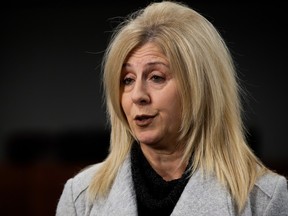
Edmonton Catholic Schools board chairwoman Sandra Palazzo responds to new provincial government regulations on masking in schools and the use of online learning in Edmonton on Friday, Nov. 25, 2022. David Bloom/Postmedia
Edmonton Catholic Schools board chairwoman Sandra Palazzo responds to new provincial government regulations on masking in schools and the use of online learning in Edmonton on Friday, Nov. 25, 2022. David Bloom/Postmedia Photo by David Bloom /David Bloom/Postmedia

ATA underlines school staffing issues

Alberta Teachers’ Association president Jason Schilling acknowledged in a Friday statement that the latest regulation changes offer school boards more clarity, but added that the government’s solutions are “unworkable.”

Advertisement 5

Article content

“Many schools across the province are struggling in the face of widespread outbreaks of COVID-19, influenza and RSV to maintain in-person teaching because of widespread teacher and student illness,” he said.

“If schools have no choice but to implement online learning in response to severe staff shortages and limited availability of substitute teachers, they simply will not have sufficient capacity to offer in-person instruction at the same time, as is required by the regulation.”

Estabrooks also said staffing issues don’t go away if an in-person teacher and an online teacher must be provided.

“In fact, it’s exacerbated, and so I would predict that could be a challenge,” she said. “We’re not at that point and I have full confidence in our superintendent that we’ll be able to manage and navigate this.”

Advertisement 6

Article content

Student absenteeism rates due to illness have been lower this week, after days in early November when 16 per cent of students in Edmonton’s Catholic schools and nearly 14 per cent in public schools missed class because they were sick.

As of Thursday, absenteeism rates at both Edmonton Catholic Schools and Edmonton Public Schools were about four per cent.

But Estabrooks said Edmonton public is still waiting for more details on how health officials are monitoring the rates of illness in schools and what thresholds they might consider in terms of future public-health orders.

“Across the province, there isn’t a lot of transparency. In fact, there’s no transparency in terms of the number of outbreaks that AHS has declared in schools across the province,” Estabrooks said.

“We’re still in this pandemic and we’re still looking for some answers, some thresholds and greater transparency.”

[email protected]

@meksmith

[email protected]

@JunkerAnna

Advertisement 1

Comments

Postmedia is committed to maintaining a lively but civil forum for discussion and encourage all readers to share their views on our articles. Comments may take up to an hour for moderation before appearing on the site. We ask you to keep your comments relevant and respectful. We have enabled email notifications—you will now receive an email if you receive a reply to your comment, there is an update to a comment thread you follow or if a user you follow comments. Visit our Community Guidelines for more information and details on how to adjust your email settings.

CRT and COVID policies in VA spark huge jump in homeschooling

CRT and COVID policies in VA spark huge jump in homeschooling

Homeschooling in Virginia has elevated by virtually 40{e4f787673fbda589a16c4acddca5ba6fa1cbf0bc0eb53f36e5f8309f6ee846cf} since 2019, which has been partly fueled by the implementation of essential race idea in lecture rooms and the coronavirus. 

“The little ones do not belong to the condition. I believe moms and dads definitely want to impart their very own values to their little ones – their values and beliefs and their have worldview. And that is a main explanation dad and mom are dwelling schooling,” Yvonne Bunn, director of authorities affairs for the House Educators Affiliation of Virginia, told the Virginia Mercury previously this month

There are at this time about 62,000 homeschoolers in Virginia, in accordance to Virginia Section of Education and learning info. There were 44,226 homeschoolers in the point out through the 2019/2020 school yr, marking a extra than 39{e4f787673fbda589a16c4acddca5ba6fa1cbf0bc0eb53f36e5f8309f6ee846cf} maximize. 

The quantities this calendar year are a little down from the 2020/2021 college year, when 65,571 students were being homeschooled. 

“I feel it will completely adjust the landscape of training,” Bunn added. “I don’t imagine it will at any time go back to the way it was prior to.”

Faculty shutdowns above the coronavirus and subsequent distant finding out brought on several mother and father to start out homeschooling, in accordance to professionals and mother and father who spoke with the Virginia Mercury. 

“We realized there was no way our little ones had been going to delight in staying on a laptop all day,” Tera Thomas, a mom and former high faculty English trainer, stated. “I really don’t even want to be on a computer system all working day.”

“Our little ones understand from us in various means,” mom Nikiya Ellis included. “And it doesn’t have to be this tutorial way of studying all working day, each and every day. They study from viewing us cook, observing how we take care of each other. It does not have to be sitting down down at a desk with pen and paper.”

The debate over critical race theory being taught in schools was a major issue in the Virginia gubernatorial race.
The debate around significant race principle being taught in universities was a significant situation in the Virginia gubernatorial race.
REUTERS/Leah Millis

The president of the Firm of Virginia Homeschoolers, Andrea Cubelo-McKay, mentioned a lot of created the transfer to homeschooling imagining it would be short term. McKay said they alternatively “decided to continue on home schooling mainly because it was a genuinely beneficial working experience for them.”

Virginia arrived less than the national highlight in the lead up to the gubernatorial election in November, as numerous mothers and fathers voiced their outrage with important race principle curriculum in classrooms. 

Cubelo-McKay explained this kind of curriculum drove much more Black and LGBT learners to homeschooling, as “they didn’t really feel harmless with the amount of hostility” towards racial fairness initiatives and transgender issues, in accordance to the Virginia Mercury. 

Bunn included that from September to January by yourself, HEAV has received much more than 21,000 cellphone calls inquiring about homeschooling. 

“It’s been unbelievable the surge in moms and dads just wanting to know what they have to have to do and how they could do it,” Bunn said. 

People holding up signs to protest CRT in schools at Loudoun County Government center in Leesburg, Virginia on June 12, 2021.
Individuals holding up signals to protest crucial race principle in universities at Loudoun County Government centre in Leesburg, Virginia on June 12, 2021.
Photograph by ANDREW CABALLERO-REYNOLDS/AFP through Getty Photographs

Other dad and mom pulled their small children from brick-and-mortar schools out of concern “that their kids will be bribed or coerced into having injected with a ‘so-called’ vaccine that has been established to be harming and even deadly to quite a few who get it,” J. Allen Weston, government director of the Nationwide Dwelling College Association, stated. 

The CDC advises everyone about the age of 5 to get the COVID-19 vaccine, and claims people more than the age of 12 should also get the booster shot, noting the shots are safe. 

There are about 100 homeschooling co-ops in the point out, which deliver classes and activities these as discipline excursions for pupils. Tera Thomas explained that this sort of groups supply local community for mothers and fathers and college students, and dispelled beliefs that homeschoolers are “unsocialized.” 

“There’s this idea that house-schoolers are unsocialized – weirdos, for absence of a better phrase. But there’s a substantial network of men and women,” she reported. “We have far more of a local community of good friends and parents than we ever did in the a few decades that we ended up at Springfield Park.”

Physical activity promoting policies in the era of COVID-19: is Europe on the right track?

Physical activity promoting policies in the era of COVID-19: is Europe on the right track?

European Union (EU) countries have been making gains in the development of policy on physical activity promotion since 2015, but during the COVID-19 pandemic progress has slowed down, shows a recent WHO publication. The new report, “2021 physical activity factsheets for the European Union Member States of the WHO European Region”, is based on data from all 27 EU Member States and presents an overview of policies and actions that have been implemented in the countries to promote health-enhancing physical activity (HEPA).

Regular physical activity provides health benefits to everyone, regardless of age or fitness level. Among adults, physical activity contributes to the prevention and control of chronic diseases, such as cardiovascular diseases, cancer, diabetes, anxiety, depression, dementia and obesity, and reduces overall mortality and premature deaths.

Physical inactivity: a serious risk factor for the Region

The report provides an overview summarizing the overall situation across the EU, as well as detailed country factsheets for each EU Member State. Indicators in the report signify what kind of WHO-recommended HEPA policies have been implemented in each country.

According to the report, an overall improvement in policy indicators can be observed between 2015 and 2021. Across the Region, the average proportion of the 23 indicators accomplished by Member States increased from 2015 to 2021, although the pace of progress slowed down after 2018.

“In the WHO European Region, around a third of adults are physically inactive. Lack of physical activity is closely connected to overweight and obesity, and consequently to many noncommunicable diseases and health risks,” said Dr Hans Henri P. Kluge, WHO Regional Director for Europe. “It is time for us to remember that healthy habits – from balanced diets to physical activity – are key factors that protect our health much more than we tend to think.”

EU policies implementation: what’s new?

As the report data shows, in 2021 countries of the EU had made progress implementing the following measures:

  • supporting interventions to promote physical activity in older adults (74{e4f787673fbda589a16c4acddca5ba6fa1cbf0bc0eb53f36e5f8309f6ee846cf} of countries);
  • promoting physical activity in the workplace (74{e4f787673fbda589a16c4acddca5ba6fa1cbf0bc0eb53f36e5f8309f6ee846cf} of countries);
  • training of physical education teachers (89{e4f787673fbda589a16c4acddca5ba6fa1cbf0bc0eb53f36e5f8309f6ee846cf} of countries);
  • granting wider access to exercise facilities for socially disadvantaged groups (78{e4f787673fbda589a16c4acddca5ba6fa1cbf0bc0eb53f36e5f8309f6ee846cf} of countries);
  • producing national recommendations on physical activity for health (85{e4f787673fbda589a16c4acddca5ba6fa1cbf0bc0eb53f36e5f8309f6ee846cf} of countries).

WHO and the European Commission: commitment to promoting healthy lifestyles for all

To increase physical activity levels, WHO has been collaborating closely with the European Commission and EU Member States to increase health-enhancing physical activity across the region. This collaboration has helped to enhance policy and practice in line with the WHO European Programme of Work 2020–2025 – “United Action for Better Health in Europe”.

The launch of the new report marked the start of an initiative called Healthy Lifestyles 4 All (HL4A) led by WHO/Europe and the European Commission. The 2-year campaign will showcase efforts and support countries in the EU to promote healthy lifestyles across generations and social groups, and to promote a global approach across policies and sectors – linking food, health, well-being and sport.

As an open and collaborative project, HL4A invites sports organizations, civil society, and international, national, regional and local authorities to join and create projects that bring together sports, physical activity and healthy diets. All participating organizations can submit a commitment for concrete actions in the online Pledge Board. WHO/Europe has submitted its contributions.

Looking forward, this important collaboration between WHO/Europe and the European Commission can play a role in supporting the societal and economic recovery from COVID-19, with a sustained and coordinated focus on attainment of a 15{e4f787673fbda589a16c4acddca5ba6fa1cbf0bc0eb53f36e5f8309f6ee846cf} reduction in physical inactivity by 2030 and achievement of the Sustainable Development Goals.

Impact of COVID-19 on physical activity

Physical activity can take place in various settings, during leisure-time activities, at school, at the workplace and at home during daily activities. However, maintaining sufficient levels of physical activity is becoming more difficult as most daily environments have become more sedentary.

According to the new WHO report, the ongoing COVID-19 pandemic has highlighted the importance of our environments and our access to opportunities to be physically active as part of daily life.

“Lockdowns and limited access to public and indoor spaces had a negative impact on levels of physical activity that were already at very low levels before the pandemic. Some countries of the WHO European Region still feel this impact. Now is a good time to bring physical activity levels up again. There are various health-enhancing policies to choose from, and they work best when combined,” said Dr Kremlin Wickramasinghe, Acting Head of the WHO European Office for the Prevention and Control of Noncommunicable Diseases.

By implementing HEPA policies, countries of the WHO European Region can provide long-term benefits for people’s health and health systems.