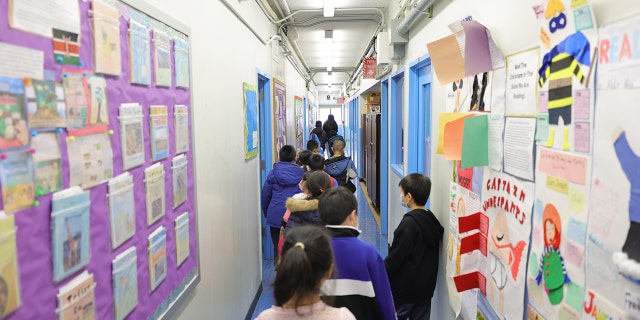
/cdn.vox-cdn.com/uploads/chorus_asset/file/24203189/ProPublica_Opener_Final_Stapleton_crop.jpg "Public Schools Are NYC’s Main Youth Mental Health System. Where Kids Land Often Depends on What Their Parents Can Pay.")
This article was produced for ProPublica’s Local Reporting Network in partnership with THE CITY. Sign up for ProPublica’s Dispatches to get stories like this one as soon as they are published.
On Staten Island, a middle schooler with a hair-trigger temper was in a fistfight every week. In north Brooklyn, a ninth grader cut class for months before he tried to commit suicide. A few miles east, where Brooklyn meets the marshlands of Jamaica Bay, a 13-year-old ended up in a psychiatric emergency room after the COVID-19 pandemic shut down her school.
These kids all had two things in common: First, they were part of a growing cohort of students with serious mental health and behavioral problems that got in the way of their education. And second, they lived in New York City, which meant that their problems became, at least in part, the responsibility of the city’s school system.
Under federal law, school districts are required to provide all students, including those with mental health and behavioral problems, a “free and appropriate education.” In theory, this means that when a student is struggling to learn, districts must conduct assessments, create individualized plans and, if a child’s needs can’t be met in public schools, pay tuition for a private school — all at no cost to kids or their families.
In practice, however, what happens to students in New York City’s special education system often depends on the personal resources a family brings to the table. At each step of the way — identifying a disability, creating a service plan, deciding where a child will learn and who will pay for it — a family’s ability to spend its own money can secure a completely different outcome from the city’s public education system.
In the city’s wealthiest neighborhoods, thousands of parents tap their personal funds to send children to private schools for students with disabilities and then sue the city Department of Education to reimburse them for tuition or other services. The schools these kids attend often charge well over $100,000 a year. Many offer the trappings of elite boarding schools, with bucolic settings and promises of advanced college prep. At some, students ride horses as part of their therapy.
The city doesn’t publish specific demographic data about students whose expenses are paid this way — commonly known as “Carter cases” after a 1993 U.S. Supreme Court decision, Florence County School District Four v. Carter, that affirmed schools had a duty to reimburse tuition in certain situations. However, Carter cases are not evenly distributed across New York City, which divides its massive school system into 32 geographical regions sometimes referred to as community school districts. Last school year, more than half of settlement agreements involved students who live in just four of the richest and whitest districts, which include neighborhoods such as Manhattan’s Upper East Side and Park Slope in Brooklyn. The poorest community school districts rarely see Carter case settlement money at all.
Meanwhile, more than 2,600 other kids — most of them Black or Latino and nearly all low-income — are labeled as having an “emotional disability” and shunted into city-run special-education schools, many of which fail across just about every measurable metric: At the schools where the city Department of Education most often places emotionally disabled kids, attendance rates are among the lowest in the city and dropout rates among the highest. By the end of high school, public school students with emotional disability classifications are far more likely to have quit school than to have graduated with a diploma, according to data provided by the New York City Independent Budget Office. Hundreds end up in juvenile justice facilities or on Rikers Island.
The inequities are not new. Critics have long argued that money for private tuition reimbursements should instead be invested in improving services for kids with disabilities in public schools. But the costs of Carter cases to taxpayers have grown exponentially in the past decade, with payouts reaching $918 million last year. And while the cases have historically been driven by kids with autism or learning disorders, something has shifted in recent years: Attorneys who represent students say there is an influx of young people who need private schooling because of mental health conditions. “I’m seeing more and more kids whose anxiety has gotten more severe since COVID, or who are really behind in social skills,” said Lauren Goldberg, a partner at The AGS Firm, which represents students in education law cases.
School closures and other pandemic stressors have contributed to the crisis, Goldberg and other attorneys say. But even before the coronavirus arrived in New York, schools were feeling the impact of shutdowns of another kind: As THE CITY and ProPublica have reported, New York state made a deliberate choice over the past decade to eliminate hundreds of beds for children and adolescents in psychiatric hospitals and residential programs while failing to follow through on promises to dramatically expand community-based mental health care.
When kids can’t find mental health services in their communities, the onus falls on school systems, which don’t have the option to turn students away. “As soon as the residential programs closed, those kids came to us,” said one social worker at a New York City special education high school that serves hundreds of students with emotional disability classifications. “The entire state of New York has shifted the burden of mental health to the school districts.”
In a written statement to THE CITY and ProPublica, Nicole Brownstein, a spokesperson for the city Department of Education, said her agency is working to expand access to high-quality programs that allow students with disabilities to succeed in all schools. The city has invested in software that will improve assessments and service plans, has expanded programs for students with sensory and mental health needs, has conducted trainings on implicit bias, and is creating a strategic plan to support students with emotional disabilities, Brownstein said. “We continue to work towards dismantling inequities in the special education process.”
ProPublica and THE CITY have documented the stories of three New York City kids, each of whom had a very different experience navigating the school system when they had a mental health crisis. We spoke extensively to each child’s mother, though not to the kids themselves; reviewed medical and educational documents; and interviewed dozens of mental health and education professionals who work with these and other students with disabilities. We also asked the city Department of Education to comment on the experiences of the two students who struggled to get the help they needed; Brownstein offered a brief statement on one. We allowed parents to decide whether and how we could identify their children. Read their stories below.

Holly Stapleton for ProPublica
1. A Child and a Crisis
Gary
Gary’s mom was sure that, if she didn’t do something drastic, her son would wind up arrested or dead.
Things had been scary for a long time. Gary was a ninth grader at a prestigious and competitive public school in Brooklyn, but he skipped class more often than he went. At the beginning of the school year, in the fall of 2018, he’d attempted suicide at least once — maybe twice, his parents still weren’t sure — and spent a week in a hospital psychiatric unit, said his mom, who asked us to identify Gary by his middle name to protect his privacy.
Still, it wasn’t until Gary left his Instagram account open that his mom’s worst fears were confirmed. She saw messages, going back for months, about using and selling hard drugs. “My stomach dropped,” she said. “We have serious addiction in the family. My sister drank herself to death.”
Months earlier, a counselor had suggested that Gary go to a residential program for kids with acute mental health conditions, but his parents had dismissed the idea. They didn’t want to send their child away from home, and anyway, they knew that a good program could cost thousands of dollars a week — not the kind of money they had sitting around.
Now, “full-on desperation set in,” said Gary’s mom. She mined her network, contacting other parents of struggling teens, talking to friends of friends who were mental health professionals. She turned to her own mom and her husband’s parents for help with money — a lot of it.
Within a week, she and her husband had a plan: They hired what’s known as a “youth transportation service” — two burly guys who came to Gary’s home in the middle of the night and escorted him by plane to Utah, where, at a cost of $60,000, he spent four months at a wilderness therapy program, getting sober and doing intensive individual and group therapy.
Sending her son away was one of the hardest things Gary’s mom had ever done, she said. But there was more bad news: At the end of wilderness therapy, Gary’s counselors said he still wasn’t ready to come home. His mom would need to find an even longer-term program — one that could keep him safe and continue to provide treatment while letting him move forward with high school.
“They told me, ‘You can’t bring this kid home. He’ll relapse right away,’” Gary’s mom said.
Taylor
Taylor Cardin had just turned 13 when the COVID-19 pandemic shut down schools across New York City, including the school she’d attended for years in Queens. Taylor is autistic, and when her routines disappeared, she panicked, said her mom, Tiffany Caldwell.
Taylor stopped sleeping at night and refused to go outside during the day. She’d always been a gentle, affectionate kid, but now little things infuriated her. As the months at home dragged on, she grew aggressive with her mom, hitting and scratching Caldwell when she got upset. When her school finally opened back up in person, she refused to get off the bus, crying and lashing out at anyone who tried to help her.
Taylor’s doctor recommended that Caldwell take her to a psychiatrist for an evaluation. Caldwell had always thought that she had good health insurance. She’d worked for nearly 20 years for New York state’s Office of Mental Health as an aide in a psychiatric hospital for adults. But when she called the list of psychiatrists in her insurance network, she found that not a single one was available to see Taylor. “They didn’t answer, or they weren’t taking new patients, or, if they were, the first appointment was sometime next year,” Caldwell said.
Desperate, Caldwell paid out of pocket — “money I didn’t have,” she said — for a session via Zoom with an out-of-network psychiatrist, who diagnosed Taylor with depression and anxiety and prescribed her a cocktail of medications that seemed to Caldwell to make everything worse. Taylor picked up new behaviors, like slamming doors and the toilet seat over and over again. “She had this look in her eyes like she was on another planet,” Caldwell said. Taylor’s violent episodes got so bad that Caldwell had to call the police to restrain her and take her to a psychiatric emergency room. Each time, hospital staff sedated her and sent her home. “They didn’t have any beds,” Caldwell said. “Once, I begged them to keep her overnight. They told me, ‘If you’re not here in the morning, we’ll call child services.’ It was like a punitive thing. There’s such a lack of regard and empathy and respect.”
By the end of 2020, Taylor had been out of school for nine months. She was talking less and refusing to do basic things, like shower and get dressed. Caldwell, who raises Taylor on her own, had used up her family medical leave and was on the verge of losing both her job and her apartment. The thought of separating from her daughter broke her heart, Caldwell said, but she realized that Taylor needed a residential school: “I was just watching my child regress every day.”
Davon
For Davon, the problems started in elementary school. He was skinny and shy, and kids picked on him, said his mom, Latoya Patterson, who asked us not to use Davon’s last name to protect his privacy. Patterson asked school officials for help, but Davon was quiet and didn’t cause problems, she said, so the school ignored him until fifth grade, when he started to fight back.
“He got sick of the bullying,” Patterson said. “If someone did something to him, he was reactive right away.” By middle school, Patterson was getting calls at least once a week to say that Davon had been in another fight.

Holly Stapleton for ProPublica
In sixth grade, Davon was classified as having an emotional disturbance, a term that was formally changed in New York this year to “emotional disability.” An emotional disability classification is not a medical diagnosis. Rather, it’s a catch-all term used by education departments for any number of mental health or behavioral challenges that show up in school. An emotionally disturbed student could be a first grader who hits other kids or a 10th grader who has psychotic episodes, or who’s too persistently sad to concentrate. Critics argue that the classification is far too vague and subjective. Under federal and state regulations, for example, students can be classified as emotionally disabled for such criteria as exhibiting “inappropriate types of behavior or feelings under normal circumstances.”
In New York City, Black boys get classified with emotional disabilities at a far higher rate than other kids. In the 2020-2021 school year, the most recent for which data is available, Black students made up less than a quarter of students overall, yet they accounted for nearly half of students classified as having an emotional disability. White students, who made up 15{e4f787673fbda589a16c4acddca5ba6fa1cbf0bc0eb53f36e5f8309f6ee846cf} of all students in New York City public schools, accounted for just 8{e4f787673fbda589a16c4acddca5ba6fa1cbf0bc0eb53f36e5f8309f6ee846cf} of emotional disability classifications.
That’s in part because evaluators may be more likely to interpret Black boys’ behavior as aggressive, advocates and attorneys say. But it’s also because white families more often come to the assessment process armed with detailed private evaluations and attorneys who advise them to push for a classification that carries less potential stigma, such as “other health impairment” or “multiple disabilities.”
“You want to get the right classification,” said Goldberg, the education attorney. “Colleges are going to see this. Middle and high schools are going to see this. You’re thinking about your kid’s future.”
Patterson, who’s Black, raises Davon by herself and works as a construction laborer. She didn’t know that some parents hire lawyers and paid educational advocates to represent them at special education meetings. Certainly, nobody suggested that she get Davon a private neurological or psychiatric evaluation. Instead, she participated in planning meetings, filled out paperwork and, for the most part, took Department of Education staff at their word when they said they wanted to help her son.
It was a belief that she came to regret.
2. ‘Please! We’re Drowning! Help Us!’
‘Please! We’re drowning! Help us!’
Gary
By the time Gary finished wilderness therapy, his mom had spoken to plenty of parents who’d sent their kids to private schools and then sued the city to be reimbursed for the cost. She knew that success depended on hiring the right people.
The frequency with which families pursue these Carter cases has given rise, in New York City, to an elaborate ecosystem of high-priced professional advisers and advocates. Parents frequently start by paying $5,000 to an educational consultant, whose job it is to broker admission to a private school. Sought-after schools often maintain relationships with particular attorneys, who might charge a family anywhere from $5,000 to $10,000 per year to pursue tuition reimbursement. In turn, attorneys may point parents to trusted psychologists, who — for another $5,000 or more — conduct detailed assessments and write reports that might support the claim that a child can’t be served in public school. That’s all in addition to the price of tuition, which, even if a family wins its case, may not be reimbursed for months or years.
Not everyone who pursues Carter cases has hundreds of thousands of dollars on hand. It’s not uncommon for parents to refinance their homes or pull cash from retirement plans to pay the deposit on a residential school that a family hopes will rescue their suicidal or addicted child. And there’s no shortage of GoFundMe pages set up by families begging for help with the final $10,000 or $15,000. There are also some attorneys in New York who specialize in taking on severely disabled kids without charging a retainer, and there are private schools that reserve spots for kids whose families can’t pay tuition upfront.
Nonetheless, the typical buy-in costs are high enough to rule out the vast majority of New York City families. “There’s a huge industry around teenage mental health, but it’s only for a particular demographic of our society,” said Gary’s mom, who is white and describes her family as middle-class. “It’s so clearly unjust. At the same time, when your child is attempting suicide, you can’t really get picky about diversity at the institutions you’re sending them to because you need to save your kid’s life.”
Gary’s mom had heard enough horror stories about abusive residential programs to know that she wanted professional advice on which one to choose. Based on recommendations from a friend, she hired an educational consultant who found a therapeutic boarding school in Arizona and then managed Gary’s application. “She had the relationships; she knew what to say,” Gary’s mom said.
With her in-laws’ help, Gary’s mom was able to cover tuition: a $25,000 deposit and then $11,000 per month. The next step was to try to get that money back from the public school system.
‘Please! We’re drowning! Help us!’
Taylor
Because Taylor was diagnosed with autism when she was little, Caldwell had years of experience navigating New York City’s special education system. She knew that most decisions go through a dedicated committee in a student’s local area, which is charged with approving individualized education programs and deciding which services kids should receive. To Caldwell, those decisions often seemed arbitrary. She’d wondered why some kids seemed to get more services than others, and whether Taylor might be getting less help because she’s Black.
After schools closed down in 2020, Caldwell reached out to her local committee, but months went by with no help. “I kept reporting, reporting, reporting: ‘This child is in crisis and it’s getting worse,’” she said. “It all fell on deaf ears.” Some of Taylor’s instructors tried to continue working with her virtually, but Taylor couldn’t engage via the computer screen, so she ended up receiving nothing — no classes, no speech therapy, no contact with anyone except her mom. “It’s like we’re floating around with an inner tube, and I’m yelling, ‘Please! We’re drowning! Help us!’” Caldwell said.
There was no way that Caldwell could pay upfront for Taylor to go to a private boarding school — she’d never even heard of anyone who did that. Her only option was to convince the Department of Education to approve Taylor for placement at a residential school and get the agency to pay the tuition directly.
The New York State Education Department holds contracts with approximately 200 private schools — typically shorthanded as “state-approved” schools — that serve kids from across New York who have disabilities that affect their education, such as intellectual delays, autism or emotional disabilities. While these state-approved schools are free for families, they vary enormously in quality, according to advocates and education attorneys. Some schools have excellent reputations and get far more applicants than they can take; others have been the subject of multiple complaints and lawsuits alleging mistreatment of kids. Little information is available publicly about each school, so parents who don’t have paid consultants or deep networks may have nothing to go on but online reviews.
State-approved schools are also deeply segregated by race. For example, at the Queens campuses of The Summit School, which attorneys describe as being highly sought after, 70{e4f787673fbda589a16c4acddca5ba6fa1cbf0bc0eb53f36e5f8309f6ee846cf} of students were white, while just 22{e4f787673fbda589a16c4acddca5ba6fa1cbf0bc0eb53f36e5f8309f6ee846cf} were Black or Hispanic during the 2021-2022 school year, according to state data. Just a couple of miles away, at the Theresa Paplin School, which is run by a large foster care and mental health services agency, 83{e4f787673fbda589a16c4acddca5ba6fa1cbf0bc0eb53f36e5f8309f6ee846cf} of students were Black or Hispanic, while just 13{e4f787673fbda589a16c4acddca5ba6fa1cbf0bc0eb53f36e5f8309f6ee846cf} were white.

Holly Stapleton for ProPublica
Getting placed at any of these schools can be a long and circuitous process, involving multiple meetings, referrals and interviews. And even then, there’s no guarantee that an appropriate school will have space. Kids sometimes wait months for a bed to open up at a therapeutic residential school on the state-approved list. In the worst cases, they cycle in and out of emergency rooms, sit in psychiatric hospitals or land in the juvenile justice system while they wait.
On her own, Caldwell couldn’t even get to the first step: scheduling a meeting to review Taylor’s special education plan. By the time Taylor had been out of school for close to a year, Caldwell’s own health was suffering, and she was exhausted and furious. “Children with disabilities are disregarded and pushed to the side,” she said. “They’re treated like second-class citizens.”
In January 2021, Caldwell found an education attorney who was willing to take Taylor’s case against the Department of Education without charging an upfront fee. “You have to fight for everything,” she said, “because they’re not going to willingly give it to you.”
‘Please! We’re drowning! Help us!’
Davon
While many parents battle to get their kids approved for private placement, Patterson found that Davon’s school was all too happy to recommend that Davon go elsewhere.
That’s not unusual for kids who are seen as aggressive, education experts say. Once a student has been classified with a disability, federal law requires school districts to educate them in the least restrictive possible setting, integrated with their nondisabled peers. In reality, teachers often don’t have the training to deal with kids who have repeated behavioral problems, said Kristen GoldMansour, a former teacher who works as a consultant in dozens of New York City schools.
The result is that struggling kids get punished for behaviors that are beyond their control, GoldMansour said. “If a kid is coming in to us completely traumatized and we just keep saying, ‘Sit down, pay attention, calm down,’ we’re not helping.”
Over time, the pressure can build up to drive difficult students out of general education schools, even if that child is academically and cognitively capable of doing grade-level work. A Brooklyn-based social worker who conducts special education evaluations, and who asked to remain anonymous for fear of repercussions at work, described the process like this: “My supervisor would be saying, ‘Let’s try a smaller class. Let’s try a paraprofessional.’ But the principal wants that kid out of the school immediately. It’s a touchy thing.”
At first, the special education committee that reviewed Davon’s case suggested that he transfer to a special day program for kids with mental health challenges, but the waitlist was months long, so the Department of Education changed his recommendation to a state-approved residential school. To Patterson, it sounded like Davon would be placed in a specialized boarding school, with all the mental health services that she couldn’t find for him at home. “They’re saying he’ll get therapy,” she recounted. “He’ll get a lot of different programs that will help him. I’m thinking this will be great.”
It was only after Davon got to the residential school — a campus in Westchester operated by the social service agency Graham Windham — that Patterson learned that many of the students had been placed there by a judge and seemed to have far more serious behavioral and psychological problems than Davon. Sending him there “was the worst decision I ever made,” she said.
Davon had been slightly behind his grade level when he left home; now he fell way back. Patterson said he never got the therapy he was promised because — like many mental health providers that rely on public funding — the school couldn’t keep counselors on staff. “It was like a revolving door,” Patterson said. “If he got two months of consistent therapy, I’d be surprised.” She asked the special education committee if she could bring Davon home, but was told that since he’d left the system with a record of behavior problems, a community school would be unlikely to take him back.
Graham Windham did not respond to requests for comment.
Davon started sneaking off campus with other kids and getting into increasingly serious trouble. He was arrested for being a passenger in a stolen car, and then again at the scene of a robbery, Patterson said. After he violated the curfew in his probation agreement, a judge sent him to a juvenile justice group home in Brooklyn, where he spent nine months.
To Patterson, the irony was excruciating. She had agreed to send Davon to the residential school in part because she was afraid that at home he’d end up in trouble with the police. Now she believed that the school system had put him on a direct path to the criminal justice system.
It’s a common trajectory for young people with emotional disabilities, who make up close to half the students enrolled at schools in New York City’s juvenile detention centers and in the Rikers Island jail, according to data from the Independent Budget Office. “There’s a school-to-prison pipeline for these kids,” said Dawn Yuster, an attorney who directs the School Justice Project at the community group Advocates for Children.
3. An Education in Treatment
An Education in Treatment
Gary
Gary’s therapeutic boarding school was exactly what his mom had hoped. It was small and family-run. Most of the staff had many years of experience; several were in recovery themselves. Gary got individual therapy multiple times a week, as well as evidence-based addiction treatment and full weekends of intensive family therapy. He and the other residents spent hours every day outside, taking care of horses and riding them through the desert. For years before Gary went to the program, “our house was so sad and tense,” his mom said. Now, “he was free. It was the coolest thing ever, to see your kid be a cowboy.”
From the start, Gary’s attorney was optimistic about the family’s prospects of getting a tuition reimbursement. “They won’t tell you that you’ll definitely win. They were like, ‘You have a good case,’” Gary’s mom said. “The suicide attempts help; making it a life-or-death situation helps.”
From a historical perspective, there was good reason to be hopeful. Back in the early 2000s, then-New York City Mayor Michael Bloomberg staffed up on lawyers to make it harder for parents to force the city to pay for private schools and services. In 2014, his successor, Bill de Blasio, changed tack, promising to make the settlement process easier and faster for families. The number of New York City students receiving Carter case settlements shot up, growing from less than 5,300 in 2015 to more than 17,700 in 2022, according to data provided by the Independent Budget Office. The city Department of Education declined to say what percentage of Carter case filings are successful or how many are settled without going to a hearing. But education attorneys say that they win reimbursement cases far more often than they lose.
It’s unclear whether the current administration under Mayor Eric Adams will try to bring the Carter case numbers down. At an advisory meeting over the summer, New York City’s schools chancellor, David Banks, infuriated some advocates by saying that private school parents had “figured out how to game this system,” siphoning funds at a time when public schools are contending with massive budget cuts. At a later City Council hearing, Department of Education staffers attempted to walk that accusation back, pinning the blame instead on attorneys and consultants who’ve turned filing Carter cases into a business model. In response, parents and City Council members argued that families wouldn’t need to resort to private schools if the city weren’t so abjectly failing students with disabilities.

Holly Stapleton for ProPublica
In the end, Gary’s case didn’t even go to a hearing. The city agreed to settle, reimbursing his family for $100,000 of the more than $140,000 they had paid in tuition at the therapeutic boarding school.
Gary came home in 2021, after 13 months at the private school, and enrolled in 11th grade at a public alternative school. He still gets hit by intense bouts of depression, his mom said. “It’s a hard road, and it probably always will be.” But he has strategies for dealing with his illness now — a fact that his mom credits almost entirely to the excellence of the treatment he received. “He came away with a lot of coping skills, a lot of integrity and a very clear understanding of who he is,” she said. “That’s a testament to the quality of the program, one hundred percent.”
“That place saved his life,” she continued. “The horses, the other boys, the therapists — they saved his life.”
An Education in Treatment
Taylor
About the time that Gary was flying home from Arizona, Taylor’s case began to crawl its way through the New York City special education system.
On the advice of her attorney, Caldwell made a formal request that the Department of Education reevaluate Taylor and write her a new education plan. “Taylor has regressed significantly,” she wrote in a January 2021 email. “I have been voicing my concern with the team for months.”
In response, the special education committee had Caldwell fill out forms and conducted a brief social-psychological assessment by video. But more months passed, and nothing changed: There was no meeting, no plan, no new services.
In April 2021, Taylor’s attorney filed a due process complaint with the Department of Education, charging that the city had failed to provide Taylor with a free and appropriate education. By law, that should have triggered what’s called an “impartial hearing” within 30 days, but the hearing system is notoriously backlogged, and Taylor and Caldwell waited four months. (This year, the city moved impartial hearings to a new administrative office and hired 40 new hearing officers, which has reduced the standing backlog of unassigned cases from thousands to hundreds, wrote Brownstein, the city Department of Education spokesperson.)
When Taylor’s hearing finally took place, the hearing officer ruled in her favor on all counts. The Department of Education must not only consider approving her for placement in a residential school, the officer wrote, but must also immediately start providing the services she should have been receiving all along, including tutoring, counseling, and speech and occupational therapy.
Even then, every step was a battle, Caldwell said. The Department of Education refused to provide in-home instruction; a request for an iPad to help Taylor communicate dragged on for months. Meanwhile, the question of Taylor’s residential school placement inched forward while Taylor sat at home. Two months after the hearing officer’s order, the Department of Education sent an application packet on Taylor’s behalf to multiple schools on the state-approved list. Six of those schools rejected her outright, probably because of her history of aggressive behavior, the attorney told Caldwell. One school — The School at Springbrook in Oneonta, New York — offered Taylor a spot, but they were full and couldn’t say how long it might take for a bed to become available.
In January, the Department of Education offered Caldwell a new option: She could send Taylor to a residential school in Pennsylvania, which had vacancies and would accept her right away. At first Caldwell was thrilled, but then she looked up online reviews for the facility and found dozens of stories referencing abuse and neglect. One reviewer alleged that her daughter had been raped by a staff member; others said their kids came home with bruises. Caldwell turned the placement down.
A space finally opened up for Taylor at The School at Springbrook in April, after she’d been at home for more than two years. Taylor’s thriving at the school, which uses evidence-based therapies designed for people with autism and emotional disabilities, Caldwell said. She’s going on field trips, getting along with other kids and regaining some of the skills she lost. Caldwell plans to move upstate, closer to the school, because she wants Taylor to stay.
But it still hurts her to think about the time that Taylor lost, Caldwell said. “She’ll never get those two years back.”
“I’m not going to let anyone dehumanize my daughter,” she continued. “She’s going to get the same quality education as if she didn’t have a disability. She should have the same rights as her peers. She’s human. She matters.”
An Education in Treatment
Davon
Ironically, the juvenile justice group home was better for Davon’s education than the residential school. He caught up on credits and did well in his classes, according to teachers who described him in written reports as a “polite student” who helped his peers with their work. By the time he left, he’d decided that he wanted to go to college and become a lawyer.
Still, when it was time to come home, rather than allowing Davon to attend a general education school, the Department of Education placed him at South Richmond High School — a special education school on the south shore of Staten Island. Like all such schools in New York City, South Richmond is run by an administrative entity called District 75.
Advocates have long argued that the city places far too many students in District 75 schools, where they receive a vastly inferior education with fewer resources and little hope of graduation. More than a decade ago, a city-commissioned report found that District 75 students were more isolated than students with disabilities in any other major urban school district. “District 75’s expectations for the students that it serves need to be elevated. Its programs and supports need to be improved,” the report said.
The Department of Education told THE CITY and ProPublica that it is working to ensure that students can receive the social and emotional support they need in all school districts. “We cannot live in a system,” Brownstein wrote, where “students receiving District 75 special education services are separated physically, academically and socially from their peers.”
Still, students with emotional disability classifications are placed in special education schools at an extraordinarily high rate: In the 2020-21 school year, over 33{e4f787673fbda589a16c4acddca5ba6fa1cbf0bc0eb53f36e5f8309f6ee846cf} of students with emotional disability classifications were in District 75, according to data provided by the Independent Budget Office. And within the district, those students were heavily concentrated into just a handful of schools. At several, students with emotional disability classifications made up close to half the student body.
Concentrating kids with emotional and behavioral problems into one school is a setup for failure, say parents, advocates and staff who work at the schools. “These schools tend to be … I don’t want to say ‘dumping grounds,’” said another social worker who has spent years working in District 75 high schools with very high concentrations of students with emotional disability classifications, and who did not have permission to speak on the record. Students come in throughout the year, often directly from juvenile justice facilities or residential foster care programs. One dysregulated student can easily set off others, leading to fights and chaos that make it impossible for other students to learn, the social worker said. “They’re in fight-or-flight all of the time.”
While most people who work in the schools are doing their best to make positive connections with students, the social worker continued, “We also have a number of staff who couldn’t get jobs in any other school.”
At South Richmond, where Davon was referred, nearly 60{e4f787673fbda589a16c4acddca5ba6fa1cbf0bc0eb53f36e5f8309f6ee846cf} of the school’s students were classified as having an emotional disability in the 2020-21 school year, compared to less than 1{e4f787673fbda589a16c4acddca5ba6fa1cbf0bc0eb53f36e5f8309f6ee846cf} of New York City public school students overall, the Independent Budget Office data shows. (The remaining South Richmond students have other educational disabilities, such as cognitive delays.) Like other schools where the city concentrates students with emotional disability classifications, South Richmond has exceptionally high rates of chronic absenteeism — 60{e4f787673fbda589a16c4acddca5ba6fa1cbf0bc0eb53f36e5f8309f6ee846cf} of students missed 20 days or more in the 2019-20 school year — and a dropout rate that is nearly five times as high as that of high school students citywide. Every year, it is on a short list of the schools that most frequently call in police officers to respond to students in emotional crisis, according to an analysis by Advocates for Children.
After a Daily News article highlighting problems with District 75 was published in July, New York City Mayor Eric Adams promised to improve conditions for kids with emotional disability classifications. Like several other District 75 schools, South Richmond has an on-site partnership with a mental health care agency, Brownstein wrote. This school year, the Department of Education is expanding after-school and Saturday programs for students with intensive sensory needs that affect their learning and behavior.
The city is also building on a pilot project that began in 2021, which places kindergarteners with emotional disability classifications in classrooms that are intentionally integrated with nondisabled peers. The program is now running in three classrooms, each of which has two teachers, a dedicated counselor and an occupational therapist to support students. An additional three classrooms are slated to open in January in community school districts with high numbers of referrals to District 75 schools.
“These are students who may have been on a trajectory to District 75,” Christina Foti, the city’s special education chief, told THE CITY and ProPublica. “We are rerouting them.”
To Patterson, any changes are too little and too late. Placing Davon at South Richmond was evidence that the school system had long since given up on her son, she said. “He felt like the classes were boring. The work was too easy. I think they just didn’t expect him to graduate.” Outside of class, Patterson continued, “the school was chaotic. They have a lot of fights. They can’t control the kids. Why are you putting a bunch of kids that get into trouble in the same place? It doesn’t make sense.”
Nearly as soon as he started at the school, Davon felt that he was being targeted by an assistant principal and school safety officers who knew that he had a history of being arrested. Things came to a head in May, when, according to Patterson, Davon refused to allow a school safety agent to search his bag. The school called the police, and Davon was handcuffed and eventually taken to a precinct. School officials told Patterson that Davon had marijuana in the bag and that he’d head-butted a safety agent. Davon said that the agent knocked him down when he was already in handcuffs. The Staten Island district attorney’s office declined to pursue a case against Davon, Patterson said, but he was briefly assigned an attorney, who advised Patterson to get in touch with Yuster from Advocates for Children.
The Department of Education said Davon was passing classes and earning credits at South Richmond High School. “He was offered the opportunity to participate in summer school programming for additional credit accumulation, which his family declined,” Brownstein wrote.
After months of letters, phone calls and meetings, Yuster helped Davon get a new education plan, which allows him to attend a general education school this year for the first time since seventh grade. “That’s what I wanted, to get him out of District 75,” Patterson said.
But it’s hard to have faith, Patterson continued, in a school system that seemed ready to throw her child away when he was in middle school. “My son is really smart,” she said. “But it feels like he’s never going to have a fair shot.”
THE CITY will be hosting an event related to this story virtually and in person early next year. Sign up for THE CITY’s daily newsletter The Scoop, which will include more event details when they are available.
/static.texastribune.org/media/files/10bca4d5e8d1e9cbd67c8080f279afae/1014{e4f787673fbda589a16c4acddca5ba6fa1cbf0bc0eb53f36e5f8309f6ee846cf}20Hmschool{e4f787673fbda589a16c4acddca5ba6fa1cbf0bc0eb53f36e5f8309f6ee846cf}20League{e4f787673fbda589a16c4acddca5ba6fa1cbf0bc0eb53f36e5f8309f6ee846cf}20City{e4f787673fbda589a16c4acddca5ba6fa1cbf0bc0eb53f36e5f8309f6ee846cf}20AM{e4f787673fbda589a16c4acddca5ba6fa1cbf0bc0eb53f36e5f8309f6ee846cf}2001.jpg "More Texas parents turn to home schooling after the pandemic")
/https://static.texastribune.org/media/files/e3b9f095d9fef387ef2d76fb948c161e/1014{e4f787673fbda589a16c4acddca5ba6fa1cbf0bc0eb53f36e5f8309f6ee846cf}20Hmschool{e4f787673fbda589a16c4acddca5ba6fa1cbf0bc0eb53f36e5f8309f6ee846cf}20League{e4f787673fbda589a16c4acddca5ba6fa1cbf0bc0eb53f36e5f8309f6ee846cf}20City{e4f787673fbda589a16c4acddca5ba6fa1cbf0bc0eb53f36e5f8309f6ee846cf}20AM{e4f787673fbda589a16c4acddca5ba6fa1cbf0bc0eb53f36e5f8309f6ee846cf}2007.jpg)

/cloudfront-us-east-1.images.arcpublishing.com/gray/WAHEJBRKBRB6JLGO7YEJU7BQUM.jpg "Bennington parents raise safety concerns after incident at elementary school")