10 tips for child’s well-being in today’s age of online learning

10 tips for child’s well-being in today’s age of online learning

A little more than a year ago, the world changed dramatically. Education moved online, with digital learning helping to ensure learning continues uninterrupted.

However, one important change for young learners was the lack of face-to-face interactions. It is critical that children are happy, healthy, and motivated to make the most of online learning, and the responsibility of ensuring this falls on parents.

Hands-on learning experience is a significant part of the socio-emotional development of the child.

Here are some easy pointers you can practice:

1. Set a daily schedule

Help guide your child’s learning by creating a daily schedule that embraces online learning and follow-up self-learning.

Any senior family member, such as a parent or elder sibling, can help reinforce this. It is critical to continue the discipline of daily scheduled sessions similar to that in schools.

2. Encouraging social interactions

We can continue to stimulate our child’s development by creating small contact groups with classmates or friends.

While the focus might vary from simple discussions to social gatherings, such as online birthday celebrations, the idea is to encourage social interaction at all times.

3. Manage screen time

It is too easy for our little ones to immerse themselves in their gadgets. Thus, it is a parent’s responsibility to limit screen-time to productive activity, such as online schooling or connecting with friends and relatives.

Be selective with the online content that your child indulges in, and choose educational content and apps carefully.

4. Engage in physical activities

Your collection of old board games, art sheets, paintings, and puzzles can play a key part in your child’s learning process.

Use them to engage your child in more hands-on activities on a weekly basis.

Not only does the child learn to associate learning with fun, but it also helps build happy and lasting memories for the child as the family bonds over a game of Scrabble!

5. Learn something new

Children are naturally curious, so make the most of this by getting them to learn a new skill or a new language during their extended stay at home.

This will help them to create positive associations with this period of lockdown.

6. Explore the outdoors

As restrictions get eased, make the most of this opportunity to explore outdoor areas with your kids, such as parks or other play areas.

You will, of course, need to keep in mind that children observe Covid-19 appropriate behaviour at all times.

7. Pick up a book

With video and audio content on the rise, it is all too easy to forget the role reading plays in a child’s development.

Sign them up with a library, or create a book exchange club with close friends and relatives to encourage them to read more.

8. Help them practice writing

While online learning has been greatly beneficial in keeping education ongoing, it has taken away some of the more tactile aspects of learning, such as the skill of writing.

Make sure to set aside 20-30 minutes every day to help children write. Start with simple copy-writing exercises and gradually encourage the child to write creatively.

9. Be emotionally supportive

With lockdown and the transition to online learning, it is normal for children to feel a little lost, experience bouts of frustration, or even depression.

Let children express themselves freely, including through positive mediums such as art, poetry, or by maintaining a daily diary.

10. Prepare children for a return to school

As schools reopen, it is important to prepare students to return to classrooms. The transition may not be an easy one, given that online learning has its own perks of a shorter learning day and no direct supervision, but it is essential that children be ready for physical formats of learning.

While incorporating each idea mentioned here might be challenging, keeping them in mind will surely enrich each child’s learning experience, and help you better support them along their respective learning journeys.

Read: 10 most difficult courses in the world you need to know

Read: 10 toughest places for a girl to get education

Access to online education can lead to better future

Access to online education can lead to better future

While travelling across the country by road, the extent to which we benefit from investment in infrastructure becomes apparent. Road travel has become a pleasant experience because of the vast network of well-maintained highways, connecting the country. This feat has enabled trade, encouraged tourism, boosted the automotive market, and created livelihood opportunities in remote villages by way of toll booths or highway restaurants. The infrastructure provided a conducive environment to realise India’s potential.     

Efforts and investments are ongoing to build the infrastructure that creates the potential for growth and development including roads, ports and airports, utilities like power, water and internet. India’s 5.98 million kilometres of roadways make it the second-largest road network in the world. In the last year alone, 13,298 km of highways were added. The government has also fast-tracked reforms in the telecom sector, enabling widespread internet penetration. The world’s second-largest telecommunications market, India is on track to reach 900 million internet users by 2025.

The true potential of the nation, however, is in empowering its youth through access to education. When people benefit from infrastructure investments to build financial security, pursue learning and career opportunities, and raise the standard of living, they achieve progress. The education sector is ready for reforms and investments. The pandemic has demonstrated a critical need to prioritise the digitalisation of education and learning. The low cost of smartphone devices and internet penetration present an opportunity that policymakers and educationists cannot afford to ignore. In 2020, when schools were closed, the digital divide only peaked; a very small minority of students were able to benefit from online classes, as it required additional spending from parents and schools.   

What does it take to enable access to education digitally? A smartphone or device in every student’s hand, affordable internet connection and customised content and learning delivery. While this seems simple, the  NCERT survey showed that at least 27{e4f787673fbda589a16c4acddca5ba6fa1cbf0bc0eb53f36e5f8309f6ee846cf} of students do not have access to smartphones or laptops to attend online classes, while 28{e4f787673fbda589a16c4acddca5ba6fa1cbf0bc0eb53f36e5f8309f6ee846cf} of students and parents believe that lack of electricity is one of the major concerns. For children who are from poor or disadvantaged circumstances, a device and internet connection can include them in mainstream education. Online education can also streamline the quality of education, with access to standardised or diverse content in various languages.  

The National Education Policy (NEP) envisions technology integration in online and digital education to ensure equitable use of technology. This will play out in the coming years. It is time for government, educationists and corporates to collaborate in creating the new digital order of education for all. Basic enablers such as the internet and devices can attract CSR funding. Re-inventing the method of instruction to make it suitable for online learning delivery needs thoughts on skills and curriculum. Teachers need to adapt and evolve new instructional methods, as well as acquire new skills and content creation capabilities. Schools will need the ability to invest in new systems and apps that are secure and designed for education, as well as capacity building for teachers. Evaluation criteria and exams will need to be re-imagined as well, with a collaboration between technology experts, industry, educationists, policymakers, teachers and parents.

For now, the simplest way to start is often the best — find a way to get smart devices and the internet to every student, so that no one is left behind. 

Just as the highway network had an exponential effect on livelihood and economy, the infrastructure and investments made in enabling digital education will allow India to extract the maximum potential from the large young population. India’s hope to be a world superpower is in its young population. The ‘demographic dividend’ window opened in 2018. Purported to be a 37-year period where India will have more working population than dependent population, investments in digital education will have the same exponential effect on the nation’s economy.   

Imagine the impact we can create if kids across the country could learn at their pace from free content available all across the internet. Some of these self-taught kids may end up building the next Google and Apple of the world! 

(The writer is the founder of an online learning platform)

Check out the latest videos from DH:

HGSE Launches Online Education Leadership Master’s Program Targeting Mid-Career Professionals | News

HGSE Launches Online Education Leadership Master’s Program Targeting Mid-Career Professionals | News

The Harvard Graduate School of Education plans to launch a fully-online master’s program in Education Leadership as part of its efforts to increase access for mid-career professionals, HGSE Dean Bridget Terry Long said in an interview Wednesday.

The new program is an outgrowth of an online, part-time cohort the school accepted through a one-time summer admissions cycle in 2020.

“When we went remote, we realized just how many talented, dedicated people are out there who want a master’s degree in education, who are not able to move to Cambridge, and so we’ve launched an online master’s degree,” Long said.

“[The program is] really focused on that group of people who would not otherwise be able to come to Cambridge, so it’s really about access, and new populations of students who want to benefit from Harvard,” she added.

Long said the program’s first cohort will arrive in summer 2022, and that the school will likely give students the ability to “come to campus for short periods of time” during the two-year duration.

Students currently enrolled in the remote, part-time program have voiced frustruations over remote course offerings and their lack of access to campus. In the interview, Long acknowledged those frustrations and said HGSE remains committed to accommodating remote students.

“When we committed to saying you could take the degree online, we wanted to guarantee for students who don’t have the ability to move to Cambridge that we could support them to degree completion and they wouldn’t have to come,” Long said.

Long defended the school’s remote learning offerings.

“We decided to have half of our courses online because we were so committed to the online students, and in some ways that was safe for us, given the fact that the Delta variant and Covid hurt so much,” she said.

“But this is the difficulty of being in a complex university with every tub on its own bottom — you try to maximize the opportunities, but you can’t quite control,” Long added.

In addition to increasing access through online programming, Long said the school is working toward creating a more engaging student experience in its newly-redesigned master’s curriculum.

The restructured program will graduate its first cohort in spring 2022. It features new Foundations courses held prior to fall term — which will become mandatory for future cohorts after this year — that Long said are an opportunity to “build a relationship with faculty, with teaching fellows” before starting at HGSE.

“We’re hearing a lot about the benefits of that — about how it reduced levels of anxiety, how it helps people feel part of the community and feel included, again, before they had even started,” she said.

Despite ongoing uncertainty over the Omicron variant, Long said the school is working to provide current and recently-graduated students with opportunities to visit campus through “homecoming” events in January and May 2022.

“[These] would be concentrated weekends to invite both those who graduated in spring 2021, as well as those who are continuing in the online program, [to] just have a chance to come to campus, to have some faculty lectures, to have social networking events,” she explained.

Those events would complement the joint commencements in May for the Classes of 2020 and 2021, which the University announced in November.

“The cohort that started fall 2020, as well as the ones that are continuing to this year, they never had a chance to come to campus,” she said. “We know that was a huge desire at some point to come, not just to come to campus, but to also meet their faculty, to meet each other in person.”

—Staff writer Omar Abdel Haq can be reached at [email protected].

The case for combining synchronous and asynchronous online learning

The case for combining synchronous and asynchronous online learning

There has been much debate in recent years on whether educators, trainers or L&D managers should focus on delivering synchronous or asynchronous online learning experiences.


What is the difference between synchronous and asynchronous learning?

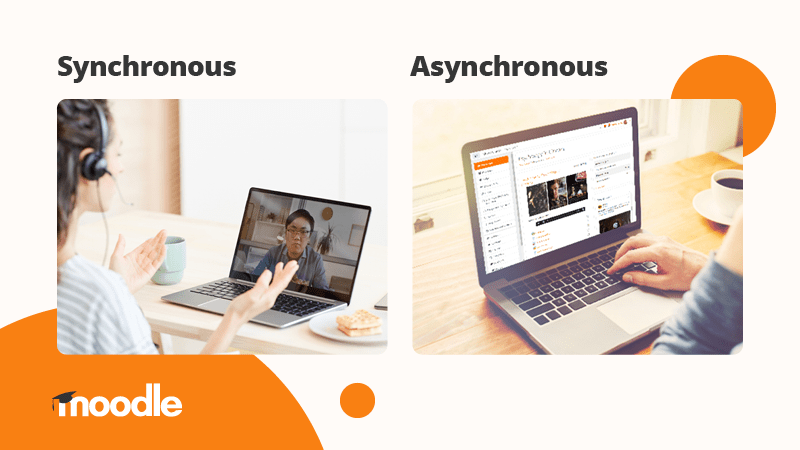
In the context of online education, synchronous learning experiences are those delivered live with an educator or trainer facilitating a learning session. There are a variety of tools that can be used in synchronous learning such as live meetings or virtual classrooms where educators and learners meet virtually in real-time (by means of a device over a network) and communicate and collaborate through video, chat, whiteboard and other synchronous tools. In contrast, while also requiring a device, asynchronous learning is a student-centred method usually delivered via a learning management system (LMS) that allows learning to occur in different times and spaces particular to each learner. In asynchronous learning, educators set up a learning program or course that students engage with at their own pace.


Social constructionism – learning as a social context

As many readers will be aware, Moodle is based on social constructionism, which is the understanding that people develop knowledge in a social context. Moodle advocates for, and supports, the importance of creating a collaborative community of learners where learners learn “by doing” and by observing their peers. A community where educators and trainers understand the context of learners so that they can customise the language and expression of concepts in ways that are best suited to the audience. And, where teachers or trainers recognise themselves as learners and are willing to collaborate, listen and share ideas in order to improve their own understanding and ultimately inform improvements to the learning program.


So, synchronous is better, right? Wrong.

This grounding in social constructionism could lead readers of this blog to think that Moodle would advocate for synchronous over asynchronous delivery. But to presume so would be wrong because asynchronous delivery also supports the theory of social constructionism. In order to create truly engaging learning experiences, it is equally important that asynchronous activities provide opportunities for learners to learn by doing and through relationships with each other and their teachers.

This does not mean that asynchronous instruction should replace the opportunity for educators, trainers and their learners to meet in real-time through virtual classrooms with live video and messaging functionality. Indeed, this modality of online synchronous delivery mirrors good traditional classroom instruction where a teacher or instructor supports students to become actively involved in their learning through interaction with each other and their teacher as they complete tasks or activities. 


Together is better

The issue is not whether asynchronous or synchronous delivery is better, but how both can be used to support the theory of social constructionism, accommodate different learning preferences and ultimately the engagement of learners through interaction with each other and their teacher.

Some face to face interaction is an essential component of good quality online instruction. That is why BigBlueButton, the open source web conferencing solution providing real-time sharing of audio, video, slides, whiteboard, chat and screen, will be incorporated into Moodle 4.0 as a standard feature. Currently available as a Moodle plugin, BigBlueButton, allows educators trainers to use breakout rooms, polls, multi-user whiteboard, and shared notes to engage learners in real-time. However, it is worth recognising that streaming video and connecting to online meetings use a lot of data and require fast internet connections, which not all learners may have at the same time. Even where connectivity is not an issue, technical issues can affect the quality of live interaction. These issues can be mitigated by using a combination of synchronous and asynchronous delivery methods.

More importantly, learners differ in the way that they perceive and comprehend information that is presented to them. For instance, some learners will understand content more quickly through visual or auditory means rather than printed text. Other learners with sensory disabilities or learning difficulties will have specific needs. To accommodate all learners’ preferences, it is important that educators create asynchronous Activities and Resources in a variety of modalities that learners can interact and engage with.

Online collaboration and group work can also be done well asynchronously. As an example, educators and trainers can use Moodle’s many standard features to encourage learner interaction and experimentation. For instance, they can invite personal response through Moodle Forum, create learner Groups, set Assignments, encourage collaboration through peer assessment with Workshops and allow students to create collaborative project plans and documents through Wiki. Asynchronous courses also accommodate more introverted students who may struggle to interact with other learners and their teacher or instructor in a live setting.

Both synchronous and asynchronous delivery has benefits for educators, trainers and learners:


Moodle was designed for ultimate flexibility, a toolbox that accommodates both synchronous and asynchronous delivery to empower educators and trainers to build their own education platform that is appropriate to their learners.

Find out more about our online learning platforms Moodle LMS or Moodle Workplace. Or, contact a Moodle Certified Service Provider who can help you with learning design, custom development, hosting, onboarding, installation and integrations.


References:

https://elearningindustry.com/blending-asynchronous-and-synchronous-digital-learning-modalities-part-5
https://www.brynmawr.edu/blendedlearning/asynchronous-vs-synchronous-learning-quick-overview
https://elearningindustry.com/right-learning-modalities-asynchronous-and-synchronous-interactions
https://elearningindustry.com/asynchronous-and-synchronous-modalities-deliver-digital-learning
https://educationrickshaw.com/2020/03/30/the-unproductive-debate-of-synchronous-vs-asynchronous-learning/

“Teachers Want to Teach!” Flexpoint Education Cloud on what Teachers Need from Online Learning

“Teachers Want to Teach!” Flexpoint Education Cloud on what Teachers Need from Online Learning

DECEMBER 6 – At the height of the pandemic, online learning was essential in keeping schools up and running on a remote basis. According to the United States Census Bureau, in 2020, nearly 93{e4f787673fbda589a16c4acddca5ba6fa1cbf0bc0eb53f36e5f8309f6ee846cf} of households with school-age children reported some form of distanced learning, with 80{e4f787673fbda589a16c4acddca5ba6fa1cbf0bc0eb53f36e5f8309f6ee846cf} of that being online. Flexpoint Education Cloud, an online learning provider, helped school districts across the US train over 14,000 educators, amounting to more than 500 hours worth of live professional development (PD).

The Florida-based company has been operating for over 20 years in providing learning materials for schools to create kindergarten to K-12 level learning programs. This is coupled with their catalog of over 180 online learning courses which can be customized to various state standards. With this background, the company has pinpointed several training topics teachers are most eager to learn, from leveraging LMS to keeping students engaged.

A 2021 Survey from Educators for Excellence found that 67{e4f787673fbda589a16c4acddca5ba6fa1cbf0bc0eb53f36e5f8309f6ee846cf} of teachers learned ways to integrate technology into their teaching and plan on carrying this on after the pandemic.

Personalized learning is a big issue that can be tackled through online tools. Teachers are looking at how best to utilize their learning management systems to create customized interactions with their students, according to Brooke Bess, the National Training Manager for Flexpoint. When training teachers in their PD sessions, Flexpoint uses a variety of visualization techniques that help educators transfer the activities they implement in a traditional brick-and-mortar classroom, to an online classroom setting. These activities are translated into the LMS, e.g. creating a digital homeroom that students can go to before logging on to their classes.

Bess goes into further detail about how LMS can be used by teachers, “we helped a group of science teachers build out a science fair project in their learning management system for students to participate in. We partnered with them to identify the assets and resources they wanted to include in the project and trained them on how to use the tools in the learning management system to create an engaging scientific inquiry experience for their students.”

Since 2018, Flexpoint has also been offering online learning courses for elementary school and pre-kindergarten teachers called Littlest Learners, which helps young students with learning online.

The Littlest Learners series contain multiple courses adapted for online learning, from their Emerging Readers course to their Littlest Mathematician course. Similar to the K-12 training sessions, teachers are taught how to implement LMS into their learning activities, and how best to plan and track the programs they deliver to their students. Also, like older students, young learners too benefit from connection and building a relationship with their teachers. This, in part, helps students become more engaged with their work.

“We show elementary teachers how to take their tried-and-true best practices from the physical classroom, and evolve them into fun and engaging activities for their students online,” Says Brooke Bess, when describing the type of training offered to kindergarten and elementary school teachers specifically. “Sometimes it looks like a “lunch bunch” so that teachers and students have more time to interact outside of lessons or teachers doing a science experiment that involves making a mess of their kitchen while their students laugh in Zoom. The engagement comes from the connections and relationships that the teachers make with their students.”

Flexpoint is also part of the Florida Virtual School (FLVS), a fully accredited statewide school district, providing tuition-free part-time and full-time online learning platforms. Students outside of Florida can also benefit from FLVS with the Global School.

The stress of the pandemic provided even more incentive for Flexpoint to extend online learning materials to hard-to-reach places. In early 2020, the company partnered with the Alaska Department of Education & Early Development (AK DEED), to create its first statewide virtual school. Alaska is home to some of the most rural school districts in the US, where teachers from small schools tend to teach across multiple subjects and grade levels.

Deborah Meyer, the Senior Director at Flexpoint, went into further detail about the importance of a virtual schooling platform for such remote learning environments in Alaska. “The COVID-19 pandemic hit, forcing school closures and requiring AK DEED to press fast forward on their plans for Alaska’s first statewide virtual school. With no time to spare, we partnered with AK DEED to launch Alaska State Virtual School in March 2020, two years ahead of schedule. We also licensed our digital curriculum with more than 180 courses and hosted intensive teacher training for more than 190 Alaskan teachers who wanted to help as many of their students as possible by teaching online during the pandemic. By partnering with AK DEED, we were able to establish a Kindergarten-12th grade virtual school to ensure equity and opportunity for all their students.”

With a virtual school, parents from hard-to-reach areas in America can enroll their children outside their designated state school, expanding their options for education.

A recent Flexpoint survey found that 75{e4f787673fbda589a16c4acddca5ba6fa1cbf0bc0eb53f36e5f8309f6ee846cf} of parents believe that online learning does help their children learn new skills which they would not otherwise learn in traditional teaching.

Meyer goes on to cement the ethos of Flexpoint, explaining how the importance of online learning and training extends past the immediate needs of the COVID-19 pandemic.

“Our goal is to be able to help even more educators deliver the right learning experience so their students can succeed – whether they are new to online learning and are looking for best practices or have experience with online teaching and want new and innovative techniques to use in the classroom.”

The 25 Most Popular New Online Courses of 2021

The 25 Most Popular New Online Courses of 2021
  • Foundations: Data, Data, Everywhere from Google via Coursera: This course introduces “the world of data analytics through hands-on curriculum developed by Google.”

  • Foundations of Project Management from Google via Coursera. The first of a series of six, this course is designed “to equip you with the skills you need to apply to introductory-level roles in project management.”

  • Foundations of User Experience (UX) Design from Google via Coursera. The first of a series of seven courses, it “will equip you with the skills needed to apply to entry-level jobs in user experience design.”

  • Ask Questions to Make Data-Driven Decisions from Google via Coursera. This one “will help you learn how to ask effective questions to make data-driven decisions.” 

  • Prepare Data for Exploration from Google via Coursera. In this class “you’ll learn how to use tools like spreadsheets and SQL to extract and make use of the right data for your objectives and how to organize and protect your data.”

  • Project Initiation: Starting a Successful Project from Google via Coursera. “This course will show you how to set a project up for success in the first phase of the project life cycle: the project initiation phase.”

  • Process Data From Dirty to Clean from Google via Coursera. “In this course, you’ll continue to build your understanding of data analytics and the concepts and tools that data analysts use in their work.”

  • Start the UX Design Process: Empathize, Define, and Ideate from Google via Coursera. “In this course, you’ll complete the first phases of the design process for a project that you’ll be able to include in your portfolio.”

  • Psychological First Aid: Supporting Children and Young People from Public Health England via FutureLearn. No extra credit for guessing why this one was popular in the time of Covid. It teaches adults “to support children and young people’s mental health during emergencies and crisis situations.”

  • Analyze Data to Answer Questions from Google via Coursera. In this one you move along to “explore the ‘analyze’ phase of the data analysis process.” 

  • Excel for Everyone: Core Foundations from the University of British Columbia via edX. “Learn Excel fundamentals including data wrangling, spreadsheet management, and basic data analysis.”

  • Data Analysis With R Programming from Google via Coursera. “You’ll discover how R lets you clean, organize, analyze, visualize, and report data in new and more powerful ways.” 

  • Introduction to Statistics from Stanford University via Coursera. This course is designed to help you “gain the foundational skills that prepare you to pursue more advanced topics in statistical thinking and machine learning.”

  • Share Data Through the Art of Visualization from Google via Coursera. “This course will show you how data visualizations, such as visual dashboards, can help bring your data to life. You’ll also explore Tableau, a data visualization platform.”

  • Agile Project Management from Google via Coursera. “This course will explore the history, approach, and philosophy of Agile project management, including the Scrum framework.”

  • Project Planning: Putting It All Together from Google via Coursera. “This course will explore how to map out a project in the second phase of the project life cycle: the project planning phase.”

  • Google Data Analytics Capstone: Complete a Case Study from Google via Coursera. The eighth course in the Google Data Analytics Certificate. “You’ll have the opportunity to complete an optional case study, which will help prepare you for the data analytics job hunt.”

  • Nature-based Solutions for Disaster and Climate Resilience from SDG Academy via edX. Another course on the list that speaks to the anxieties of our time. It aims to answer: “What are ‘nature-based solutions,’ or NbS? How can they help build resilience to disasters and climate-change impacts? Why is NbS relevant? How can I apply NbS in my work and everyday life?”

  • Build Wireframes and Low-Fidelity Prototypes from Google via Coursera. “In this course, you’ll continue to design a mobile app for your professional UX portfolio.”

  • AWS Cloud Technical Essentials from Amazon Web Services via Coursera. A course for those in a technical role who want to learn the fundamentals of AWS.  

  • Project Execution: Running the Project from Google via Coursera. “This course will delve into the execution and closing phases of the project life cycle.” 

  • Python Project for Data Science from IBM via Coursera. “This mini-course is intended for you to demonstrate foundational Python skills for working with data. The completion of this course involves working on a hands-on project.” 

  • Conduct UX Research and Test Early Concepts from Google via Coursera. “In this course, you will learn how to plan and conduct a usability study to gather feedback about designs.”

  • AWS Cloud Practitioner Essentials from Amazon Web Services via Coursera. This course provides an understanding of “fundamental AWS Cloud concepts to help you gain confidence to contribute to your organization’s cloud initiatives.”

  • Introduction to Google Workspace Administration from Google Cloud via Coursera. In this course “you will be introduced to your Cloud Directory and will learn how to split your organization into organizational units to simplify user and service management.”