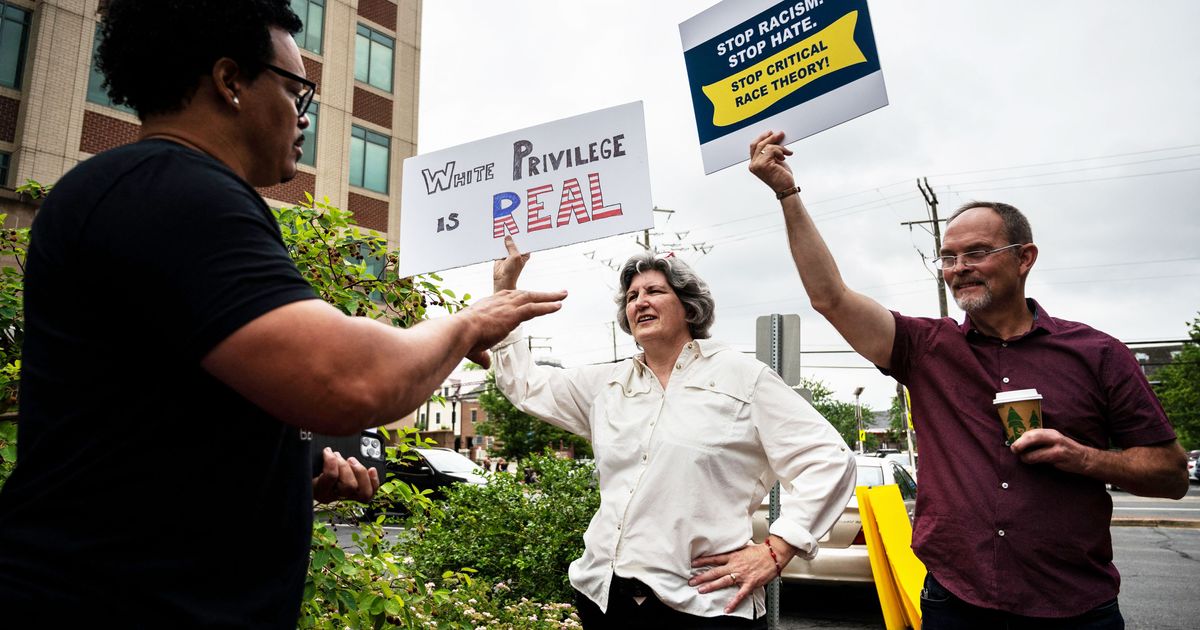

Defend the pursuit of racial justice. Defund accidentally racist equity consultants.
Photo: Andrew Caballero-Reynolds/AFP via Getty Images
A Republican won Virginia’s governorship last week after campaigning on a vow to “ban critical race theory in our schools.”
On one level, this was an odd campaign promise. Properly defined, critical race theory (or CRT) is a body of legal scholarship concerned with the ways that formally colorblind laws can camouflage racial discrimination and reproduce inequality. While taught in many graduate law programs, the works of leading CRT scholars such as Kimberlé Crenshaw and Derrick Bell do not feature in the official curricula of Virginia’s K-12 schools. And no Democrat in the state was trying to change that.
Yet it wouldn’t be right to say that Governor-elect Glenn Youngkin invented the CRT controversy out of whole cloth. Critical race theory has enjoyed influence beyond its immediate discipline, and theorists of pedagogy have applied its analysis to the pursuit of racial equity in public education. The resulting scholarship has informed proposals for curricular reform and teaching training sessions in some states and municipalities. None of this stuff is as radical or widespread as right-wing agitprop would lead one to believe. In California, equity-minded reformers are fighting for non-binding state guidelines that would advise school districts to offer statistics as an alternative to calculus; delay the separation of high- and low-performing math students into different curricular tracks until high school; and include concepts relevant to social justice in word problems.
No one should pretend that such proposals are nonexistent or self-evidently wise. But their prevalence and ambitions shouldn’t be exaggerated. Public education in the United States remains highly decentralized. While deep-blue cities debate how to minimize racial gaps in educational attainment, many students in the South are still being subjected to “Lost Cause” historiography (which casts the Civil War as a conflict over “states’ rights,” and Reconstruction as a campaign of northern tyranny). There is no campaign of crypto-communistic indoctrination in American schools. There are just efforts to modestly reform curricula and pedagogical training in some school districts.
Alas, there is also a conservative media apparatus hellbent on eliding the distinctions between those two things. Thanks to the right-wing activist Christopher Rufo, “critical race theory” has become a catchall term for just about any form of racial discourse, historical scholarship, or pedagogy that discomfits white conservatives. During the gubernatorial campaign in Virginia, CRT was variously invoked to describe history teachers “putting down Andrew Jackson” for his forays into genocide, English faculty assigning the novels of Toni Morrison, and “equity coaches” informing Loudoun County public-school teachers that nonwhite people are collectivists.
If this multiplicity of meanings renders “CRT” unintelligible as a concept, such ambiguity serves it well as a campaign prop. Reactionary Virginians could interpret Youngkin’s proposed CRT ban as a reassertion of white cultural dominance (and/or, a crusade against a totalitarian plot to indoctrinate their children), even as respectable centrists could interpret it as a mere prohibition on the most dogmatic strands of anti-racist pedagogy. Indeed, the GOP candidate encouraged this interpretation. On the stump, Youngkin affirmed that American history has “dark and abhorrent chapters,” and that “we must teach them,” while insisting that Virginia nonetheless cannot “teach our children to view everything through a lens of race.”
The actual political impact of all this is likely overhyped. The GOP’s gubernatorial candidate in New Jersey did not center his campaign on CRT. And he improved on Donald Trump’s 2020 performance in the Garden State by more than Youngkin did in Old Dominion. If all a political scientist had known about Tuesday’s election were Joe Biden’s approval rating and Virginia’s partisan lean, they would have projected a narrow Republican victory. Add in slowing economic growth and rising inflation, and it’s conceivable that Youngkin’s focus on CRT actually prevented him from winning by an even larger margin.
So, contrary to popular punditry, I don’t think Tuesday’s results proved the political toxicity of “CRT,” “wokeness,” or any of their synonyms. But electoral necessity shouldn’t be a prerequisite for progressives to engage in internal criticism. And it seems to me that some of the practices that Rufo & Co. have dubbed “CRT” do warrant the left’s disavowal, less on grounds of political pragmatism than on those of ideological principle.
In Virginia, the right used “CRT” to collapse the distinctions between three very different propositions: (1) that public-school curricula shouldn’t elide the centrality of white supremacy to U.S. history, (2) that public policy should proactively redress harms wrought by centuries of racial injustice, and (3) that public-school districts should spend tens of thousands of dollars on equity coaches who promote weird racial stereotypes.
That last idea has nothing to do with the preceding ones. And yet, it isn’t just conservatives who act as though they are all of a piece. When progressives withhold, deflect, or stigmatize criticism of ostensibly left-wing — but objectively inane and/or racist — discourse, we do the same.
A key flashpoint in Virginia’s CRT brouhaha came in July, when Loudoun County’s public schools revealed the contents of a training on “culturally responsive teaching” that its faculty had undergone. That training included a slide outlining the distinctions between the supposed individualism of white culture, and collectivism of “color group” culture:

It’s important to put this PowerPoint in context. Contrary to the insinuations of some anti-CRT agitators, this was not used as an instruction material for children. Nor was it meant to teach “that some races are morally superior to others.” Rather, it is a reductive summation of research on the ways that cultural insensitivity can impair educational outcomes for immigrant children.
It is also, by all appearances, racist. The notion that expecting one’s children “to form and express opinions” and “questions elders” is a definitionally white parenting style, while expecting children to “show respect by quiet listening” is a “color group” one, is a racial caricature. As is the broader idea that white families prize individualism over communal obligation. Positing fundamental cultural distinctions between people with different pigmentations — not different class, regional, national, or religious backgrounds, but merely different concentrations of melanin — is a task better left to white supremacists than equity coaches.
Notably, in other contexts, a parenting style that emphasizes familial duty and deference to elders over independent thinking and self expression is actually deemed characteristic of white conservatives. In political science, one popular gauge of a voter’s affinity for authoritarian politics consists of a series of questions about parenting such as “Please tell me which one you think is more important for a child to have: independence or respect for elders?” White voters who backed Donald Trump in 2016 were overwhelmingly likely to favor deference to elders over independence (i.e., “individualism”). This fact attracted much attention from left-of-center commentators in the wake of Trump’s victory.
To the extent that the “Bridging Cultures” framework describes anything real, it sketches the two poles of a cultural continuum that runs between global capitalism’s periphery and its center. A significant body of anthropological research suggests that people who live in societies structured primarily by tight kinship ties and those who live in ones structured primarily by market exchange view the world through different lenses. Which makes intuitive sense. The values and habits of mind that one needs to thrive in a world of subsistence agriculture, and those conducive to the accrual of “human capital” in a “knowledge economy,” are surely distinct.
As it happens, the “Bridging Cultures” framework was originally formulated with this divide in mind. In a 1999 primer for teachers of “immigrant Latino children,” the paradigm’s developers explain that the “collectivism” their framework describes is especially prevalent among “the rural poor who have had limited formal education” in “Mexico and in Central and South America.” The primer posits that that the gap between the cultural assumptions of emigrants from such communities, and those of American public schools, can inhibit immigrant children’s academic success unless such differences are accounted for.
I can’t speak to the validity or utility of this pedagogy. Its characterization of rural Latin American culture seems crude. Whether it nevertheless improves understanding between U.S.-born teachers and their immigrant students is beyond my purview.
What is pertinent, however, is that the framework describes a cultural divide rooted in disparate social systems and familial histories, not in different races. To characterize the division as one between “whites” and “color groups” in the United States is to obscure the divide’s origins, and lend a patina of social scientific legitimacy to the fiction of fundamental racial differences. America is home to many profoundly collectivist white communities (the Amish and Hasidim exist). And there are plenty of bourgeois liberals with nonwhite skin. The idea that there is some inherent connection between the cultural norms of Mexico’s rural poor, and those of northern Virginia’s Black middle-class, can’t be sustained without positing baldly racist assumptions.
If this poorly labeled slide were an aberration, it would scarcely merit critique. So, some well-intentioned equity consultants described the divide between certain immigrant cultures and America’s dominant one using problematic shorthand. Why nitpick? But a similar tendency towards racial essentialism crops up regularly in the progressive firmament. Last year, The Smithsonian’s National Museum of African American History and Culture infamously published (and then retracted) a graphic that described “rational linear thinking,” the valorization of “hard work,” “respect for authority,” and an inclination to “plan for the future” as values and traits peculiar to white culture — sentiments that would hardly be out of place in a Steve King speech, or Stormfront thread.

As with the “Bridging Cultures” framework, there were kernels of half-truth in the Smithsonian’s graphic. Certainly, Christians of European descent have long dominated the United States, and imposed their cultural assumptions upon the broader population. And it is also true that there is nothing natural about contemporary Americans’ relationship to time, which departs wildly from that of most human societies since the dawn of our species. Yet it was not whiteness that turned time into a commodity; that was the capitalist mode of production. The invention of racial hierarchies might have abetted capitalist development. But to suggest that Americans’ cultural tendency to follow rigid schedules derives, in the first instance, from whiteness — rather than from specific historical developments — is to treat “the white race” as a fundamental reality, rather than a malign fiction invented to rationalize the exploitation of nonwhite people. Put differently: It is to treat the white race as history’s agent, rather than its byproduct.
The Smithsonian’s graphic took inspiration from the work of Tema Okun, a co-leader of the Teaching for Equity Fellows Program at Duke University, and a popular consultant in progressive circles. In Okun’s account, “objectivity,” “a sense of urgency,” and thinking in binaries like “good or bad” and “right or wrong” are defining characteristics of “white supremacy culture.” She therefore advises progressive organizations to rid themselves of those “damaging” tendencies.
The notion that there is something inherently white supremacist about believing in a binary between “right and wrong” reads like a parody of progressive doctrine. And encouraging left-wing organizations to foster internal cultures that stigmatize a “sense of urgency” or “objectivity” sounds like a job for the CIA. Indeed, Okun herself acknowledges that her pamphlet on “The Characteristics of White Supremacy Culture” has routinely sown dysfunction within progressive groups by inviting their members to see any assertion of objective fact, authority, or deadlines as a manifestation of racism. As one “skilled facilitator” told Okun, “I could not possibly tally the number of hours I have spent over the last three years dislodging people from the reductive stance they construct based on the tool … I worked in one situation where the communications function had come to a grinding halt because a segment of the staff had decided that editing was white supremacist.” Okun’s acknowledgement of these problems is admirable. But her response is merely to say that her list should be used as a “tool,” not a “weapon.” She offers no framework for differentiating appropriate invocations of her concepts from abusive ones. And her teachings more or less forbid group leaders from creating their own, since doing so would require holding subjective claims of victimization to objective (and thus, “white supremacist”) standards of evidence.
Nevertheless, as Matt Yglesias notes, Okun’s work has been used in trainings for school administrators in New York City, and recommended by the National Education Association, the Minnesota Public Health Association, the Los Angeles chapter of Democratic Socialists of America, and the Society of Conservation Biologists, among many other left-wing institutions.
None of this validates the right’s panic over “critical race theory.” America’s schoolchildren are not being indoctrinated into Tema Okun thought. But a decent number of progressive groups and well-intentioned school districts do seem to be hiring quack consultants to dispense laughable race malarkey and recipes for organizational self-sabotage. Which is bad.
And progressives shouldn’t hesitate to say so. Our institutions should not be patronizing the dissemination of bizarre racial stereotypes, or modes of ostensibly anti-racist discourse that credit “white culture” for “the scientific method.” This would be true even if this stuff came with no political downside. But it is even more true now that the right is exploiting slideshows on “color group collectivism” to discredit the progressive movement’s broader agenda for racial justice.
The prevalence of laughable race malarkey in progressive spaces isn’t one of the left’s biggest problems. But it is among its most readily solvable ones. Liberal-minded public-school systems could simply not pay for teacher trainings that reify racist fictions. Progressive organizations could start handing out copies of Racecraft instead of Tema Okun’s pamphlets. House Democrats could not hire Robin DiAngelo to brief them on “white fragility.”
But none of that will happen (or stop happening) if progressives honor a taboo against criticizing any left-adjacent inanity that enters the right’s crosshairs. The abolition of “Lost Cause” historiography from public schools is an endeavor worth defending. The elimination of racial inequities in American schooling is too. But the bankrolling of accidentally racist equity consultants just isn’t. There is no inherent connection between acknowledging the inconvenient truths of U.S. history, using public policy to reduce racial inequality, and rebranding a bunch of broadly popular cultural values as “white” or “white supremacist.” Yet when proponents of those first two causes withhold criticism from the latter, we give the impression that they’re all inextricably linked.
That’s good for the conservative movement. And it’s also good for accidentally racist equity consultants. But it’s hard to see how it serves our society’s most disadvantaged. So, let’s just call the malarkey what it is and cease paying for it.