POMPANO BEACH, Fla., Dec. 16, 2021 /PRNewswire/ — Smart Horizons Career Online Education encourages Floridians who haven’t completed high school to make earning their high school diplomas a 2022 New Year’s resolution.
Thanks to the Florida Legislature, adults can earn an accredited private high school diploma with Career Online High School through their local public library. More than 2.5 million Florida residents 25 and older do not have a high school diploma, according to the 2019 U.S. Census.
“As everyone’s considering New Year’s resolutions and how they can improve their lives, we encourage them to finish high school and to earn a career certificate for free through their public library,” said Dr. Howard Liebman, Superintendent of Schools, Smart Horizons Career Online Education.
Anyone who is interested in finding out whether they are eligible for a scholarship through their public library should visit FL.CareerOnlineHS.org to complete a brief survey.
Participating libraries offer the nationally accredited private high school program, which includes a 24/7 online classroom, personal academic coaches, and real-world career training in nine fields.
The following Florida libraries are offering scholarships for this program:
Barbara S. Ponce Public Library of Pinellas Park
Boca Raton Public Library
Boynton Beach City Library
Broward County Library
Calhoun County Public Libraries
Charlotte County Libraries and History
Citrus County Library System
Clay County Public Libraries
Columbia County Public Library
Clearwater Public Library System
Dunedin Public Library
Flagler County Public Library
Haines City Public Library
Heartland Public Library Cooperative
Hendry County Libraries
Hialeah Public Libraries
Indian River County Library System
Largo Public Library
Leesburg Public Library
Mandel Public Library of West Palm Beach
Mulberry Public Library
Nassau County Public Library System
New Port Richey Public Library
New River Public Library Cooperative
North Miami Beach Public Library
Northwest Regional Library System (Bay, Gulf, & Liberty Counties)
Okaloosa County Public Library Cooperative
Orange County Library System
Osceola Library System
Safety Harbor Public Library
Santa Rosa County Library System
St. Johns County Public Library System
St. Petersburg Library System
Tampa-Hillsborough County Public Library
Tarpon Springs Public Library
Volusia County Public Library
Career Online High School is part of Smart Horizons Career Online Education, the world’s first private accredited online school district. Visit shcoe.org.
ALBANY, N.Y., Dec. 15, 2021 /PRNewswire/ — The past few years have been witnessing the popularity of smart e-learning solutions for the remote delivery of education, pivoting on flexibility and accessibility for learners. Education delivery institutes and universities promoted the importance of virtual learning platforms to stay on the course of learning. The global valuation of the market is projected to advance at CAGR of 12.3{e4f787673fbda589a16c4acddca5ba6fa1cbf0bc0eb53f36e5f8309f6ee846cf} during the forecast period of 2021–2031.
After the outbreak of COVID-19 pandemic, online education had become the new normal among most educational institutes, globally. The closing of education institutions across the world had offered tailwind to the online education market.
In the past few months, the shift to learning platforms has been rapid notably among learners who have been leveraging these for skill development, reskilling and online certifications, and corporate learning. The preference for e-learning platforms continues to grow, increasingly propelled by the growing awareness about and acceptance of various smart learning tools among teaching professionals and learners.
EdTech companies are keenly offering online courses for coding and programming in order to intrigue students. Some of the key applications of online education are language and casual learning, primary and secondary supplemental education, and higher education.
Integration of AI with Online Learning Platforms Boosting Outcomes: Prominent providers of smart learning systems are implementing innovative strategies such as artificial intelligence (AI) and machine learning tools to identify skill gaps in the workforce and promote talent development for meeting the needs for various end users in developed and developing economies. Stridently, cloud have rendered online education ecosystem more interactive and informative for both providers and end users.
Wide Access to High-speed Internet and Mobile Devices Propel Adoption: Technology is a key enabler for an effective and seamless online delivery of courses. Especially in the developing and developed economies, reliable access to high-speed Internet and cost-effectiveness of the courses are boosting the accessibility to and affordability of e-learning platforms. In this regard, 5G is expected to prove game-changing technology for connecting students on online platforms in real time. Smart learning modes have notably augmented the flexibility of learning, thus enriching the landscape. Moreover, the growing adoption of smart learning tools and apps is transforming the virtual learning experience, notes the TMR study on the online education market.
The proliferation of e-learning platforms has helped educators and learners to break away from the traditional learning mode. The rapid pace of digitalization of the education sector has imparted a steady impetus to the evolution of the online education market. The drive stems from the need for making learning more personalized and democratized.
Learners and educators globally are leveraging social media to connect with peers and actively participate in learning systems. These aspects underpin the growing role of online education in interactive learning worldwide.
North America held a major share of the global online education market. The revenue streams have been fueled by the rapid uptake of online learning platforms and tools in education technology industry in the U.S.
The Asia Pacific online education market is projected to rise at a prominent CAGR during the forecast period. Substantial spending by the governments of emerging economies on the education sector, notably India and China, is a key driver for the expansion of the regional market.
Online Education Market: Key Players
Some of the key players in the online education market are edX, Pearson PLC, MPS Interactive Systems Limited, McGraw-Hill Education, BYJU’S, Simplilearn Solutions, Excelsoft Technologies Pvt Ltd., EduComp Solutions, Blackboard Inc., and Adobe Corporation.
E-Learning Content Providers Market – Increase in rate of adoption of learning management system in the corporate sector and a rise in the demand for e-learning platform among individual users fuels the demand for advanced and interactive e-learning content for different age groups
Blended E-learning Market – Increasing adoption of advanced offline and online learning systems for students and working professionals is expected to drive the blended e-learning market during the forecast period.
E-Learning Virtual Reality Market – With the advent of virtual and augmented reality traditional e-learning is no more a boring theoretical lectures. The virtual reality makes it interesting with simulation, bring in a complete new dimension to e-learning platform.
About Transparency Market Research
Transparency Market Research is a global market intelligence company, providing global business information reports and services. Our exclusive blend of quantitative forecasting and trends analysis provides forward-looking insight for thousands of decision makers. Our experienced team of analysts, researchers, and consultants use proprietary data sources and various tools and techniques to gather and analyse information.
Our data repository is continuously updated and revised by a team of research experts, so that it always reflects the latest trends and information. With a broad research and analysis capability, Transparency Market Research employs rigorous primary and secondary research techniques in developing distinctive data sets and research material for business reports.
When the pandemic hit in 2020, production work in the taconite mines in northeastern Minnesota slowed way down. Yet mining companies still needed to provide health and safety training to their employees. With lockdowns in place, how were they going to do that?
Since the 1970s, this training had been provided by the miner safety and health training program through Minnesota State’s five northeastern Minnesota colleges. The federal Mining Safety and Health Administration (MSHA) mandates that all such training must be done in person. That requirement was rescinded temporarily in the spring of 2020, and courses shifted to 100 percent online. As Hibbing Community College safety and health instructor Eric Lund notes, “We’re still in that status as we speak.”
During the pandemic, about 4,200 students have been trained. Minnesota State’s training program also has extended its reach, providing its health and safety courses to students in other states—and in Iceland and New Zealand. The program has had international trainees before, but they had to fly in for a couple of days of face-to-face sessions. Now, Lund says, “they can do that training virtually from their home countries.”
Online education wasn’t invented in response to the pandemic. Minnesota’s colleges and universities had been offering virtual courses and degrees for several years before the coronavirus reared its ugly, spiky head. But in March 2020, Minnesota’s colleges and universities were forced to move their courses online. Nearly two years after the onset of the pandemic, schools, employers, and students have learned a lot about digital education.
Institutions of higher learning have made changes to what educators call “modalities”—the different ways education is delivered. They’re redesigning classrooms in ways that accommodate both online and in-person learning. They’re tapping new digital tools that go beyond Zoom. They’re creating more courses that are completely digital, or a blend of virtual and in person.
That’s because students, faculty, and the schools themselves have gotten used to online education and experienced its advantages and flexibility. Even after many students—mostly undergraduates—have returned to campus, it’s unlikely that higher education will return to a pre-pandemic normal.
Staying flexible
Like other colleges and universities, Saint Mary’s University of Minnesota shifted to completely online learning formats beginning in March 2020. Saint Mary’s traditional undergraduate campus was mostly back to class and the face-to-face format by the fall of 2021, says Andrea Carroll-Glover, vice provost for online strategy and programs. The university still offers fully online courses “to provide that flexibility to our students, and to ensure that our traditional undergraduate students are able to graduate with the technology skills that employers are looking for.”
On the bachelor completion and graduate side, the university is continuing to explore new opportunities online. Beyond fully online programs, Saint Mary’s also is offering more hybrid undergraduate programs, which combine online and in-person time. “It has really changed quite a bit in terms of how we think about our portfolio, how we think about delivery modalities, and how we’re able to serve our students in living our mission by leveraging flexible learning models with opportunities for practical application,” Carroll-Glover says.
Online education programs rely on platforms called learning management systems (LMS). In the fall of 2020, Saint Mary’s shifted to an LMS called Canvas. “This elevated the student experience,” Carroll-Glover says. Thanks to Canvas, the online teaching and learning experience became “mobile friendly, much more intuitive, and enhanced the faculty’s teaching experience,” she adds. For instance, faculty can use new mobile features to see when students are posting assignments or discussions.
Building on Canvas, Saint Mary’s integrated an online recording and streaming platform called Panopto to ensure it had strong video capabilities. The university also incorporated a tool into its Canvas LMS called Ally, which helps instructors provide alternative formats to make their courses more accessible for people with disabilities. For instance, Ally can help teachers accommodate students with color blindness through the use of more visible text colors and image captioning.
Carroll-Glover says that Saint Mary’s strong online experience has attracted many transfer students from other colleges. It also has allowed the university to extend its geographical market: More of Saint Mary’s new students live and study outside of Minnesota, some as far away as California.
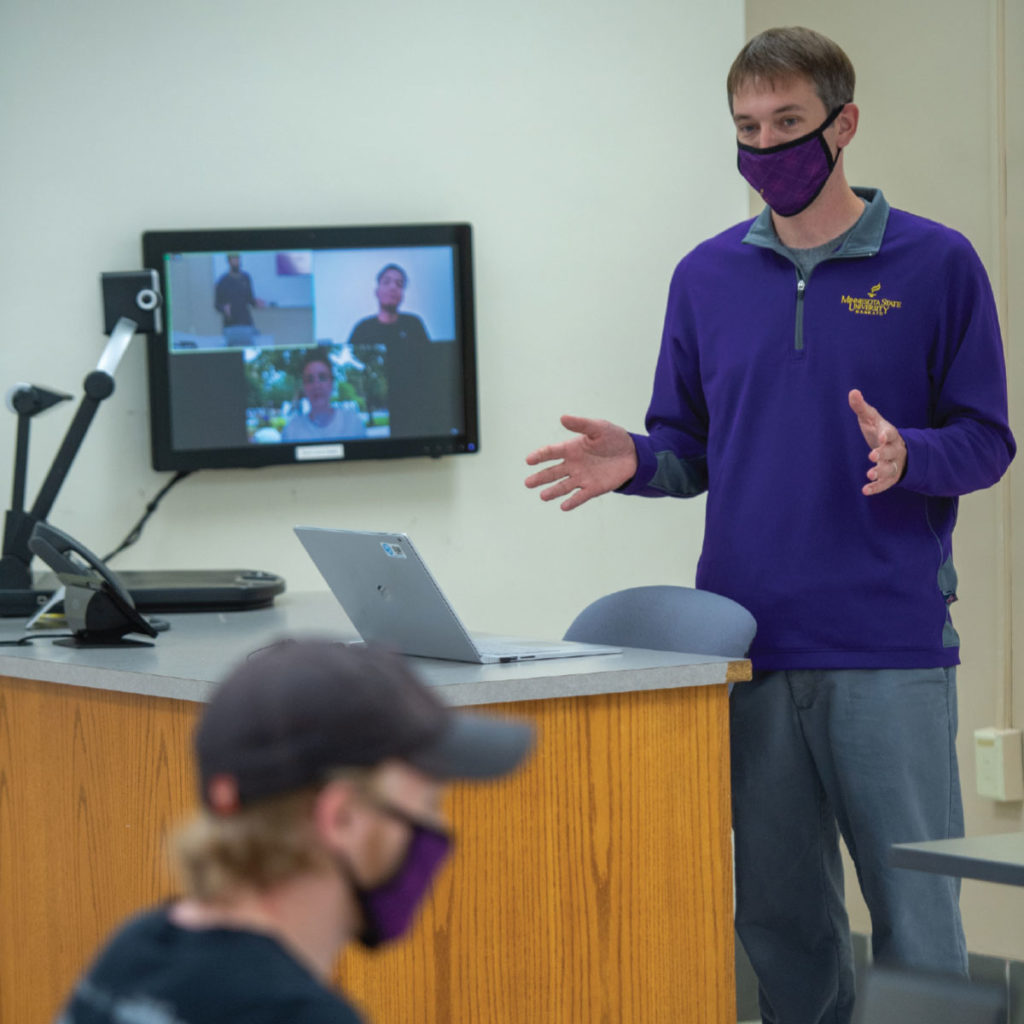
At Minnesota State University, Mankato, classrooms equipped with monitors, microphones, and speakers allow students to participate both in person and remotely.
Upgrading virtual business courses
Graduate-level business education programs also have adjusted their modalities for MS and MBA students. Again, many of these programs have been offered online for some time, but university business schools are incorporating what they’ve learned during the pandemic into new approaches to delivering education.
Case in point: Deploying Zoom, the platform that became the short-hand term for pandemic communication. “We all had to learn how to use [Zoom’s] breakout rooms and the annotation tools,” says Patricia Hedberg, associate dean of the University of St. Thomas’ Opus College of Business. “We expanded our understanding of the technology and are using it deeper than we had before.”
Hedberg says that St. Thomas invested a great deal in remote learning during the pandemic, and university faculty learned how to effectively present instruction online. “We’re seeing that pay off now—that we can offer that flexibility,” she says.
“We want that online experience to be similar to the learning experience you’d get in person,” Hedberg says. The St. Thomas online instructional group combines pedagogy with technology, and it works with faculty to “have the right tools to accomplish the same learning outcome [virtually] and a similar type of engagement with students.”
For instance, the group added more screens in university classrooms to allow online and in-person students to be together and interact. For such mixed classrooms, St. Thomas has added several tech enhancements. These include using a stylus “to scribble on the screen,” which shows up on the PowerPoints projected both online and in person.
Read more from this issue
For faculty, Hedberg says, this means more choices. “You have more opportunities to think about what you want the outcome to be for students,” she says. “What’s the best way to share information? What’s the best way to have some kind of interaction and discussion about the information?” In other words, St. Thomas believes that online education tools and platforms can actually enhance education. Opus is now looking at technologies that would allow its students to do projects with businesses across the world.
Phil Miller, assistant dean of MBA and MS programs at the University of Minnesota’s Carlson School of Management, notes that Carlson had been building its online capacity before the pandemic hit. “Our capabilities and our facilities have evolved to meet that changing landscape,” he says. During the pandemic, Carlson School Dean Sri Zaheer “made a commitment to make sure that students could participate whatever way they chose, as could faculty.” In the summer of 2020, Carlson made “a massive push” to make sure every classroom had a rear-mounted HD camera and ceiling mics. “At a minimum, every class can stream,” Miller says.
When it comes to how a hybrid course runs, Miller says “there’s a whole stack of tools that are embedded in Canvas,” an LMS that Carlson began using about five years ago. Now instructors are adding more technology to that toolbox.
Miller, for instance, teaches a problem-solving class at the MBA level that includes collaborative projects. To enable the professor and students to interact virtually, he began using a platform called FeedbackFruits, which allows participants to “cross-comment” on projects online. “It very easily allows me to structure that whole engagement so that you can post your deliverable and I can comment,” Miller says. Tools like FeedbackFruits have become an important part of delivering virtual education, he says.
The lessons of the pandemic also have influenced the way the Carlson School offers its non-degree leadership programs for business executives. Nora Anderson, executive director for executive education, introduced completely online leadership courses with the arrival of the coronavirus.
Carlson has created a new kind of online program. Instead of participants meeting on Zoom for four days straight, it extended the program across six months with regular two-hour online sessions. “We had leaders from Europe, Asia, and the U.S. all going through this learning experience together,” she adds. The Carlson School is now launching a second cohort of this program.
“I’d venture to say that we would not have designed the program this way before the pandemic,” Anderson says.
‘Hyflex’ higher education
This past summer, the Carlson School introduced what Miller characterizes as “the next evolution,” called hybrid flexible, or “hyflex.” Eight Carlson classrooms were fitted with “a higher degree of technology and integration,” including tracking cameras and large, prominent monitors. The result, Miller says, is “an immersive room that allows virtual and in-person participants to fully integrate in a class [at the same time]. We see a lot of our working professional programs evolving in that direction.”
Minnesota State senior vice chancellor Ron Anderson believes that hyflex has the potential to significantly impact the way his system delivers education. He distinguishes hyflex from hybrid, where a class meets in person once or twice a week, then online at other times.
Anderson also says that students will “move seamlessly between delivery modes depending on their needs.” Minnesota State is “seeing a lot of interest in this increasing flexibility for scheduling and juggling other commitments.”
“I would estimate about half of our non-credit offerings this current semester are being offered in an online modality,” he says. There are limitations—some courses still need to be hands on, such as those in which students handle industrial equipment. But even some of those courses “are now being coupled with some components being delivered online or via Zoom.”
Larry Lundblad, Minnesota State’s executive director of workforce and economic development, notes that “what we were doing on campus was paralleled by business and industry. They were getting used to Zoom and other distance formats. Everyone had to learn at once.”
With the persistent labor shortage and companies needing every hour of labor they can get from their current workforce, “many employers are reluctant to let employees participate in training,” Lundblad says. “These alternative ways of delivery are meeting a need where workers can stay in place for at least a portion of the training.”
Like nearly all educators, Lundblad doesn’t see a full return to the old normal. “This is a permanent shift,” he says. “The employers, the students, and the instructors are all saying that the flexibility can be a good thing. Now the emphasis is on, ‘How can we make this work better?’ ’’
Mining safety instructor Lund has seen a “generation gap” in terms of preferences for online and in-person instruction. Younger workers, he says, are quite comfortable with digital learning. And like many higher-education faculty members, he believes that the demand for online courses will continue to be strong, particularly because companies and students have gotten accustomed to it. It’s not yet known whether MSHA will allow some form of virtual learning to continue. “If they do,” Lund says, “it’s probably here to stay.”
While travelling across the country by road, the extent to which we benefit from investment in infrastructure becomes apparent. Road travel has become a pleasant experience because of the vast network of well-maintained highways, connecting the country. This feat has enabled trade, encouraged tourism, boosted the automotive market, and created livelihood opportunities in remote villages by way of toll booths or highway restaurants. The infrastructure provided a conducive environment to realise India’s potential.
Efforts and investments are ongoing to build the infrastructure that creates the potential for growth and development including roads, ports and airports, utilities like power, water and internet. India’s 5.98 million kilometres of roadways make it the second-largest road network in the world. In the last year alone, 13,298 km of highways were added. The government has also fast-tracked reforms in the telecom sector, enabling widespread internet penetration. The world’s second-largest telecommunications market, India is on track to reach 900 million internet users by 2025.
The true potential of the nation, however, is in empowering its youth through access to education. When people benefit from infrastructure investments to build financial security, pursue learning and career opportunities, and raise the standard of living, they achieve progress. The education sector is ready for reforms and investments. The pandemic has demonstrated a critical need to prioritise the digitalisation of education and learning. The low cost of smartphone devices and internet penetration present an opportunity that policymakers and educationists cannot afford to ignore. In 2020, when schools were closed, the digital divide only peaked; a very small minority of students were able to benefit from online classes, as it required additional spending from parents and schools.
What does it take to enable access to education digitally? A smartphone or device in every student’s hand, affordable internet connection and customised content and learning delivery. While this seems simple, the NCERT survey showed that at least 27{e4f787673fbda589a16c4acddca5ba6fa1cbf0bc0eb53f36e5f8309f6ee846cf} of students do not have access to smartphones or laptops to attend online classes, while 28{e4f787673fbda589a16c4acddca5ba6fa1cbf0bc0eb53f36e5f8309f6ee846cf} of students and parents believe that lack of electricity is one of the major concerns. For children who are from poor or disadvantaged circumstances, a device and internet connection can include them in mainstream education. Online education can also streamline the quality of education, with access to standardised or diverse content in various languages.
The National Education Policy (NEP) envisions technology integration in online and digital education to ensure equitable use of technology. This will play out in the coming years. It is time for government, educationists and corporates to collaborate in creating the new digital order of education for all. Basic enablers such as the internet and devices can attract CSR funding. Re-inventing the method of instruction to make it suitable for online learning delivery needs thoughts on skills and curriculum. Teachers need to adapt and evolve new instructional methods, as well as acquire new skills and content creation capabilities. Schools will need the ability to invest in new systems and apps that are secure and designed for education, as well as capacity building for teachers. Evaluation criteria and exams will need to be re-imagined as well, with a collaboration between technology experts, industry, educationists, policymakers, teachers and parents.
For now, the simplest way to start is often the best — find a way to get smart devices and the internet to every student, so that no one is left behind.
Just as the highway network had an exponential effect on livelihood and economy, the infrastructure and investments made in enabling digital education will allow India to extract the maximum potential from the large young population. India’s hope to be a world superpower is in its young population. The ‘demographic dividend’ window opened in 2018. Purported to be a 37-year period where India will have more working population than dependent population, investments in digital education will have the same exponential effect on the nation’s economy.
Imagine the impact we can create if kids across the country could learn at their pace from free content available all across the internet. Some of these self-taught kids may end up building the next Google and Apple of the world!
(The writer is the founder of an online learning platform)
The Harvard Graduate School of Education plans to launch a fully-online master’s program in Education Leadership as part of its efforts to increase access for mid-career professionals, HGSE Dean Bridget Terry Long said in an interview Wednesday.
The new program is an outgrowth of an online, part-time cohort the school accepted through a one-time summer admissions cycle in 2020.
“When we went remote, we realized just how many talented, dedicated people are out there who want a master’s degree in education, who are not able to move to Cambridge, and so we’ve launched an online master’s degree,” Long said.
“[The program is] really focused on that group of people who would not otherwise be able to come to Cambridge, so it’s really about access, and new populations of students who want to benefit from Harvard,” she added.
Long said the program’s first cohort will arrive in summer 2022, and that the school will likely give students the ability to “come to campus for short periods of time” during the two-year duration.
Students currently enrolled in the remote, part-time program have voiced frustruations over remote course offerings and their lack of access to campus. In the interview, Long acknowledged those frustrations and said HGSE remains committed to accommodating remote students.
“When we committed to saying you could take the degree online, we wanted to guarantee for students who don’t have the ability to move to Cambridge that we could support them to degree completion and they wouldn’t have to come,” Long said.
Long defended the school’s remote learning offerings.
“We decided to have half of our courses online because we were so committed to the online students, and in some ways that was safe for us, given the fact that the Delta variant and Covid hurt so much,” she said.
“But this is the difficulty of being in a complex university with every tub on its own bottom — you try to maximize the opportunities, but you can’t quite control,” Long added.
In addition to increasing access through online programming, Long said the school is working toward creating a more engaging student experience in its newly-redesigned master’s curriculum.
The restructured program will graduate its first cohort in spring 2022. It features new Foundations courses held prior to fall term — which will become mandatory for future cohorts after this year — that Long said are an opportunity to “build a relationship with faculty, with teaching fellows” before starting at HGSE.
“We’re hearing a lot about the benefits of that — about how it reduced levels of anxiety, how it helps people feel part of the community and feel included, again, before they had even started,” she said.
Despite ongoing uncertainty over the Omicron variant, Long said the school is working to provide current and recently-graduated students with opportunities to visit campus through “homecoming” events in January and May 2022.
“[These] would be concentrated weekends to invite both those who graduated in spring 2021, as well as those who are continuing in the online program, [to] just have a chance to come to campus, to have some faculty lectures, to have social networking events,” she explained.
Those events would complement the joint commencements in May for the Classes of 2020 and 2021, which the University announced in November.
“The cohort that started fall 2020, as well as the ones that are continuing to this year, they never had a chance to come to campus,” she said. “We know that was a huge desire at some point to come, not just to come to campus, but to also meet their faculty, to meet each other in person.”
—Staff writer Omar Abdel Haq can be reached at omar.abdelhaq@thecrimson.com.
Educators have the privilege and opportunity to shape both the future of education and the minds they educate. At once a challenging and fulfilling career, they play a key role in our society by equipping students of all ages with the knowledge and skills they need to succeed in life. For those looking to pursue supervisory roles or specialize in their careers, discovering what you can do with a master’s in education can be the key to pursuing professional goals and an exciting vocation.
Benefits of a Master’s Degree in Education?
Many recent college graduates grapple with whether to begin teaching or to pursue an advanced degree. For those opting to pursue a specialization or teachers who have work experience and wish to transition to a specialty or supervisory role, a master’s degree may be the gateway to reach these career goals. By pursuing advanced education, future leaders gain the skills and in-depth knowledge needed to excel in their specialty and the opportunity to earn the increased salary that can accompany it.
Some of the advantages of earning a master’s degree in education include:
Increased confidence within and outside of the classroom
Professional networking opportunities
Increased chances of consideration for specialized roles such as instructional coach, mentor teacher, or school district specialist
Potential for a higher salary and increased benefits
Subject specialization
Pursuing a master’s degree allows instructors to take control of both the content they teach as well as the type of position they wish to pursue. With added knowledge, skills, and a network of fellow teachers, candidates increase their value as an educator and may have a better chance at reaching their professional goals, dictating how, where, and when they work.
Educator Specializations
Earning a master’s degree provides an exciting opportunity for teachers to develop their skills and knowledge in a particular area of education. Specialization allows instructors to embrace the aspects of teaching that inspire them, working in various areas, including student-focused specializations, such as exceptional student education; leadership roles; or programs, such as instructional design and technology.
Exceptional Student Education
Teachers who work in exceptional education work with pupils with disabilities. For those who already have a certification in exceptional student education, pursuing a master’s degree in exceptional student education is an opportunity to refine and build upon existing skills, gain an in-depth knowledge of alternative strategies and techniques to approach education, and improve the lives of their students.
Applied Learning
Instructors who specialize in applied learning focus on innovation in teaching, adapting both the ways in which they teach and the ways in which students learn by engaging in active and reflective learning. An advanced degree in applied learning focuses on modern psychological theories, principles of human learning and motivation to create a positive and engaging learning environment for students.
Educational Leadership
The field of education is constantly evolving, requiring leaders to drive change and innovation in the development of both new techniques for the education of students and the theories that inform education itself. Candidates interested in pursuing supervisory roles may want to seek a master’s in educational leadership to influence those changes and policies.
Elementary Education
Students learn differently and benefit from various teaching techniques throughout their educational careers. Individuals who enjoy working with children may decide to specialize in elementary education and pursue an advanced degree that focuses on the theories and practices that are most effective for young students. With a master’s in education, candidates are able to pursue roles at elementary institutions and advocate for positive change in the development of young minds.
Instructional Design and Technology
As business becomes increasingly dependent on technology, educators need to understand and embrace technology to equip their students with the knowledge and skills to succeed in the modern workplace. Teachers interested in pursuing advanced education in instructional design and technology are able to focus on a rapidly evolving specialty, learning current processes and influencing the future of their field.
Career Opportunities and Salaries for Educators
With the proper education and qualifications, graduates have the freedom to pursue various types of education and employment. As teachers seek more specialized areas of focus, the value of an advanced degree increases exponentially. Some roles may require a set of core competencies that may not be taught at the bachelor level making the completion of an advanced degree a crucial step to building sought-after skills.
Special Education Teacher
Special education teachers work with students with a wide range of emotional and physical learning disabilities. With the ability to work in both private and public institutions, special education teachers can positively impact students of all ages. According to the U.S Bureau of Labor Statistics (BLS), special education teachers earned a median annual salary of $61,400 as of May 2020.
Literary Coach
As students in elementary and middle school work on developing their reading skills, many organizations rely on literary coaches to aid in both teaching students how to read and creating plans to teach reading skills. Through public speaking, evaluations and the development of reading-focused programs, literary coaches establish programs to improve reading ability and comprehension. According to PayScale, reading specialists earned a median annual salary of around $53,700 as of August 2021.
Instructional Technology Specialist
With strong communication and technical skills, instructional technology specialists develop programs and teach other instructors how to implement them. Leveraging their in-depth knowledge of specific technologies, programs, procedures and theories, instructional technology specialists assist in key activities, such as creating and reviewing curricula, suggesting ideas for future innovations, and helping staff identify effective teaching and learning outcomes. According to PayScale, instructional technology specialists earned a median annual salary of about $52,100 as of July 2021.
Curriculum Specialist
Schools rely on curriculum specialists to ensure that students are exposed to the most relevant and accurate information and to help shape the theories, programs, and topics that teachers cover. By analyzing test scores, student or teacher feedback, and the functionality of different subjects or program tracks in the classroom, these specialists adjust curricula to improve educational outcomes and graduation rates. According to PayScale, curriculum specialists earned a median annual salary of around $58,700 as of August 2021.
Education Consultant
Choosing the most suitable postsecondary path can be a daunting prospect for many students and their family members. Education consultants are experts who aid in the decision-making process and advise students of their options as well as the steps required to pursue avenues such as higher education or workforce entry. According to PayScale, the median annual salary for education consultants was about $63,200 as of August 2021.
Instructional Coordinator
Instructional coordinators collaborate with other educators to develop, implement, and assess the curricula and teaching standards of schools. By evaluating the effectiveness of programs, coordinators can guide the policies of an organization to improve the learning environment. According to the U.S Bureau of Labor Statistics (BLS), employment growth for instructional coordinators is projected to increase by 6{e4f787673fbda589a16c4acddca5ba6fa1cbf0bc0eb53f36e5f8309f6ee846cf} between 2019 and 2029. These professionals earned a median annual salary of $66,900 as of May 2020.
Dean of Students
Tasked with overseeing faculty research, student services and the success of academic programs at colleges and universities, postsecondary education administrators attend to a broad variety of highly influential responsibilities. Typically graduates of an advanced degree program, such as a master’s in education, administrators implement the policies and procedures that guide educational institutions and earned a median annual salary of $97,500 as of May 2020, according to the BLS.
Shape the Minds of Tomorrow
Leaders in education have the opportunity and responsibility to motivate and inspire current and future generations of students. By pursuing specializations and career paths that embrace their strengths and passions, individuals with an advanced degree in education set themselves up for success and achieve their professional goals.
With a passionate team of faculty members and several comprehensive online programs to choose from, the UCF Online’s master’s degrees in education are designed to provide you with every opportunity to succeed. Discover what you can do with a master’s in education and make a positive impact on the minds of tomorrow.