
Workplaces can help promote exercise, but job conditions remain a major hurdle

Workplaces can help promote exercise, but job conditions remain a major hurdle

We know regular exercise is really good for health, but even with the best of intentions, many workers do not exercise as much as they should. To get more workers in all types of workplaces to be active, public health messaging must move away from making it only an individual’s responsibility to be more active. It should instead recognize the important role employers can play in creating the conditions for workers to focus on exercise.

There’s much to be said for this approach. From a public health perspective, focusing on workplaces can seem like low-hanging fruit, since they are settings where people already go every day. Consider the resources that would otherwise be required to build activity-friendly environments, let alone address the root social causes of physical inactivity. However, the reality is more complicated.
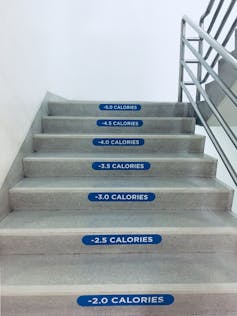
Stairs with each step labelled with the number of calories burned
On-site gyms and access to walking paths or stairs support workplace fitness.
(Shutterstock)

The World Health Organization’s physical activity guidelines recommend adults strive for at least 150-300 minutes of moderate-intensity aerobic physical activity, or 75-150 minutes of vigorous-intensity aerobic physical activity, or an equivalent combination every week. To meet these recommendations, for 80 per cent of working-age Canadians in full-time jobs, it means finding time to exercise before, after or at work.

That’s easier for some than others. I am part of a team at the Institute for Work and Health that published a paper showing that people in certain work conditions are less likely to exercise. These are workers who: report long work hours, have little say in how to use their skills, or are in physically or psychologically demanding jobs.

Other studies have reported the same. These findings support the theory that stressful and strenuous working conditions can increase a worker’s fatigue and decrease motivation and perceived time available to exercise.

Workplace spillover

A warehouse with a worker in the foreground sealing a box with packing tape on a conveyor belt and two other workers in the background
Job-related physical activity often does not provide the same health benefits of leisure-time exercise.
(Shutterstock)

The spillover of strenuous working lives on exercise participation is a reality for many people — especially when there are competing demands such as taking care of children. But the ability to overcome these barriers can depend on job type.

Supportive workplace facilities that offer standing desks, stairs, on-site showers and gyms and easy access to walking paths can make it easier for people to fit in exercise and reduce sedentary time. However, these are mostly available to white-collar, higher-income workers who already face fewer barriers to exercise outside of work.


Read more:
Lack of exercise linked to increased risk of severe COVID-19


Emphasizing worker responsibility for exercising more can exacerbate health inequalities between high- and low-income workers. Low-income workers in non-standard or precarious jobs often have little say about how they spend their work time. These workers also have few opportunities to exercise and engage in other healthy behaviours outside work.

Some manual labour jobs involve high levels of physical activity with little time to rest, while workers in service sector jobs can spend long periods of time standing. A body of research is showing the potential harm of these occupational activities — including the risks of physical activity for people doing such jobs. Job-related physical activity often does not provide the same health benefits of leisure-time exercise, and can even have negative effects because of factors like the nature of the movements and duration of work.

Healthy workers are safer workers
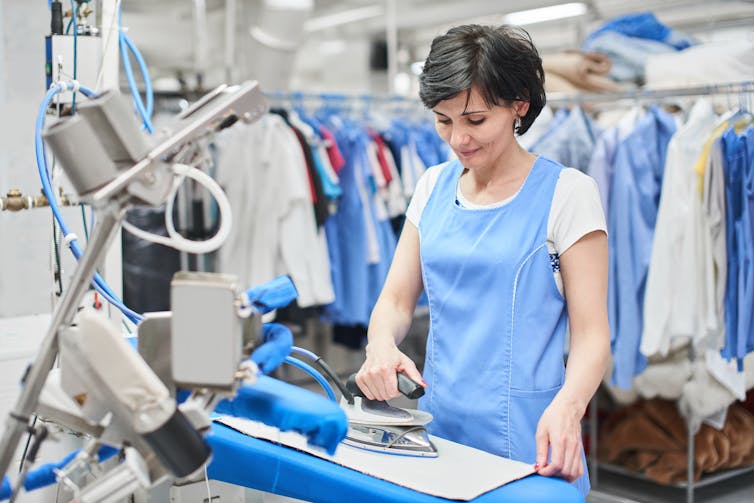
A woman in a blue apron ironing in an industrial laundry
Many employees have little say in how they spend their work time.
(Shutterstock)

Physical activity guidelines aimed at all adults will not be achievable for many workers. A more inclusive solution is for employers to create the conditions for their workers to thrive so that they can also prioritize their health.

This approach pushes for employers to think of workplace policies as levers to address the safety, health and well-being of their workers. Research shows that healthy workers are safe workers, and this concept is endorsed by international labour agencies and the Total Worker Health program in the United States.

What could such an approach look like? One example is the case of an insurance company offering flexible scheduling and telecommuting options to help its workers reduce their stress. This led to workers walking more, taking breaks away from their desks and engaging in stress-reducing social activities such as ping-pong competitions and indoor nerf basketball tournaments.

At one construction company, a 14-week intervention focused on health education, reinforcing safety and health behaviours and improving work-life balance. The result was more workers reporting exercising at least 30 minutes a day.

In another example, a police department reduced the number of night shifts for its officers. It also offered mental health support and allowed staff to take one hour off each shift to exercise. The result was a reduction in workplace injuries.

Enhancing working conditions
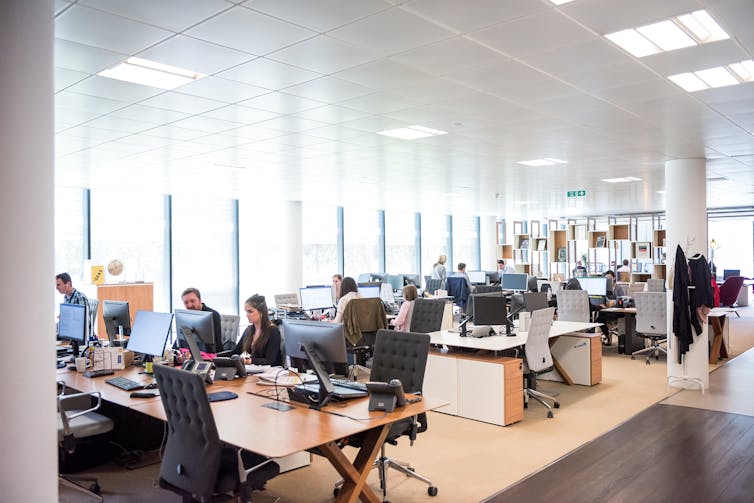
An open-plan office with workers at tables and in cubicles
Employers should discuss supportive policies and practices with workers to create a workplace environment that supports the safety, health and well-being of their employees.
(Unsplash/Arlington Research)

So how do we get more employers to get behind this? Our team’s research in Canada and other studies have highlighted the importance of convincing employers with data that this approach can be successful. For example, an employer-led approach has increased participation in safety and wellness efforts, and reduced workplace injuries and health-care costs.

Employers that want to create an environment conducive to the safety, health and well-being of their employees should discuss with their workers how policies and practices could support those goals.

While there is no simple solution to getting workers more physically active, an important step forward is to get employers involved in enhancing working conditions so that more Canadian workers are supported in getting the health benefits of regular exercise.

Bristol Elementary teachers raise concerns about ‘unsafe conditions’

Bristol Elementary teachers raise concerns about ‘unsafe conditions’

BRISTOL — A team of Bristol Elementary School teachers banded jointly to elevate considerations about protection challenges at the school in the course of Tuesday night’s MAUSD board conference in Bristol.


Teachers spoke of incidents in modern times and months when “young children had been hiding and crying in anxiety and employees associates have been injured. Hallways were cleared and college students and staff remained in the finding out room they have been in with the doors locked.”


They refered to the faculty as a “area of unrest” where “a common feeling of helplessness and concern has permeated our school.”


The entire statement, which was shared with the Independent earlier today, is integrated below.


Sarah Mangini, co-president of the Mount Abraham Schooling Affiliation, also made a public assertion to the school board Tuesday night, in which she thorough some of the dangers and hurt at the school.


This is a building story and will be up to date.


Assertion BY BRISTOL ELEMENTARY College Employees

Day: Oct 12, 2021

To: MAUSD Board Associates

From: Bristol Elementary Faculty Staff

Re: Failure to Make certain Security at Bristol Elementary Faculty

My name is Andrea Murnane and I am a 2nd Grade Trainer at Bristol Elementary School. I am talking to you this evening on behalf of BES academics and staff members and the Mount Abraham Training Affiliation to share the dire basic safety problems at BES and request that you consider swift action to handle them. The personnel at BES are right here united with each other to say that our university is not safe. Current procedures have continuously set learners and employees in harm’s way. The position quo is simply not sustainable.

We are here in advance of you for the reason that our prior, repeated efforts to deal with these critical safety issues at lower levels have so significantly been unsuccessful. There is a process outlined in our collective bargaining agreement for addressing get the job done-related problems and we feel strongly in that approach. We have attempted to use that process to address the unsafe conditions that pupils and staff members are encountering in our faculty. In this instance, that procedure is only not well timed and responsive sufficient to deal with the immediacy and severity of our basic safety worries.

Last Thursday, Oct 7, the basic safety circumstance at BES became so volatile that two school rooms have been relocated to alternate workspaces, and one particular classroom was severely weakened. Throughout these incidents, youngsters were hiding and crying in worry and staff customers ended up wounded. Hallways had been cleared and students and employees remained in the discovering space they were being in with the doorways locked.

Later on that exact same working day the personnel at BES spoke with Superintendent Reen for more than an hour expressing our considerations and fears. Several employees users remained at college that night right up until 7:00 p.m. serving to a teacher reassemble her classroom.

The next working day, Friday, Oct 8th, there had been at the very least seven “Secure the Hallway” phone calls from the workplace, in which team and students had been instructed to right away enter classrooms and lock their doors.

In this college year, college students are unsafe, the team is unsafe, discovering environments and studying instruments have been damaged, lessons are displaced from their space to alternative – and insufficient — workplaces, mastering for all grade levels has been disrupted, student get the job done is ripped from the hallway walls and a normal perception of helplessness and fear has permeated our faculty.

We are potent supporters of trauma-educated interventions for addressing pupils in crisis, together with individuals exhibiting violent and destructive behavior. On the other hand, in purchase for these techniques to be helpful and safe and sound for college students and personnel, they should be accompanied by sufficient staffing, coaching, assets and proper strategies for their implementation.

Thus, we are asking you to choose instant actions to tackle this scenario. Particularly, we are asking for you to apply the adhering to remedies and insurance policies:

1. Supply for the secure removal of students who endanger the basic safety of by themselves, other college students or workers to an option and secure office until finally their actions has been assessed by a specialist mental well being crisis group   (Access), mothers and fathers/guardians have been contacted, a assembly with parents has been scheduled, the classroom instructor and staff customers have been apprised of the circumstance and the youngster has remained serene, harmless and in handle for 24 several hours immediately after the episode.

2. Present 1:1 behavioral help for college students who endanger the protection of staff or students at BES.

3. Provide a crystal clear prepare for immediate response in situations in which a pupil endangers the security of staff or college students.

4. Guarantee that all employees who do the job with pupils who have displayed unsafe habits are designed completely mindful of the actions program and kept up to day on any alterations.

5. Make sure that the classroom trainer is included and offered voice in the growth and implementation of the behavior plan.

6. Make certain that right treatments are implemented to convey an conclusion to violence so that all learners can understand in a secure and correct atmosphere.

7. Hire a accredited mental well being experienced to help with the present problem, present instruction to staff and be out there to aid and seek advice from with the staff members at BES.

Our school has develop into a position of unrest when it must be a safe haven, a dependable area where by small children and adults discover and grow. We have to have your enable. We talk to that you take immediate motion on this really serious and hazardous situation.

Respectfully,
BES Personnel