When Damon and Lauren Paczkowski discovered that their two children’s public elementary school would only be open for half days in the fall of 2020, they started researching Catholic schools in the Archdiocese of Newark, New Jersey, for one that would offer full-day instruction.
But the need for a regular school day wasn’t the couples’ only reason, said Lauren, 43, a speech therapist who works at a Newark-area public school.
As she and her husband worked from home in Cranford, New Jersey, during the COVID lockdown and could more closely oversee their then-fifth-grade daughter and first-grade son’s schoolwork, they became aware of their children’s true academic abilities. They realized that neither of their kids was being sufficiently challenged at their public school, nor were their needs being met, Lauren said.
They were on waiting lists with other families seeking education alternatives at several Catholic schools and found out their first-choice school, Holy Trinity School in Westfield, New Jersey, had openings the day before classes started.
So the Paczkowskis, who are Catholic, decided to try it until the end of the year. A couple of months later, their children’s progress convinced them to stay, Lauren said.
“My children are going to come out of this school so academically ahead, so ready to face life, willing to be independent,” she said. “They can problem-solve, look at an issue and be able to figure out stuff on their own, and I love it. That’s everything that I’ve ever wished for, for my children.”
As the Paczkowskis and others had pandemic or other reasons for seeking education alternatives or they waited to enroll their pre-K or kindergarten-age children, U.S. public-school enrollment dropped by 1.3 million students to 49.5 million during the two years from the fall 2019 to fall 2021 — with the largest decline in the fall of 2020, according to the National Center for Education Statistics (NCES), the primary federal entity for collecting and analyzing data related to U.S. education.
During the same time period, many Catholic schools and home-schooling providers saw significant increases that have leveled off as some families returned to public school but that still represent more stable increases over pre-pandemic enrollment.
The pandemic boost didn’t completely offset an overall Catholic-school enrollment decline in the past decade, due in part to declining birthrates, population shifts and tuition-affordability issues for some families, experts say.
But Catholic-school enrollment has grown.
“Almost three years after the start of the COVID-19 health crisis, Catholic schools have continued the legacy that has characterized Catholic education: academic excellence, a strong partnership with parents, a sense of community and a faith-filled education for students nationwide. In the 2022-2023 school year, Catholic school enrollment has grown (0.3{e4f787673fbda589a16c4acddca5ba6fa1cbf0bc0eb53f36e5f8309f6ee846cf}) to 1,693,493 students in 5,920 schools, continuing the two-year trend of increasing Catholic school enrollment across the nation,” the National Catholic Educational Association (NCEA) stated in a Feb. 6 data release.
In addition, U.S. Catholic elementary and secondary school enrollment rose by 3.8{e4f787673fbda589a16c4acddca5ba6fa1cbf0bc0eb53f36e5f8309f6ee846cf} from the 2020-21 to the 2021-22 school year, according to Annie Smith, vice president of research and data at the NCEA, a Catholic-school education professional organization based in Leesburg, Virginia.
Catholic schools “have welcomed families and supported students’ academic, emotional and spiritual growth,” she said. “Recent assessment data is one indicator of how Catholic schools supported students throughout the pandemic. This has enabled them to retain new families and stabilize enrollment.”
Roughly 8{e4f787673fbda589a16c4acddca5ba6fa1cbf0bc0eb53f36e5f8309f6ee846cf} of U.S. households with at least one school-age child are home schooling, down from 11{e4f787673fbda589a16c4acddca5ba6fa1cbf0bc0eb53f36e5f8309f6ee846cf} in 2021, said Steven Duvall, home-school research director for the Purcellville, Virginia-based Home School Legal Defense Association (HSLDA), which offers legal representation to home-schooling families.
The home-school data is taken from the U.S. Census Bureau’s now-monthly “Household Pulse Survey” of roughly 33 million U.S. households. Even with the decrease, about two and a half times more families are home schooling than before the pandemic, he said.
“Hopefully we’ll see the numbers maintain at high levels because many parents will have discovered just how powerful home schooling is, even though it was thrust upon them, and they weren’t ready for it,” Duvall said.
By March 2020, Tony and Leona Hernandez had decided they would home-school their eldest son, Max, the following fall, but they started early when the Catholic school in St. Paul, Minnesota, where he attended kindergarten closed during the COVID lockdown, said Leona, 36, who has three other children — including one whose birth is expected in early May.
The decision to home school wasn’t easy, as the couple loved many things about their son’s school but ultimately concluded that teaching him and his siblings at home would be best for the family, she told the Register: “Once we decided we would try [home schooling] for at least a solid year, that’s when the shutdowns happened.”
Home schooling gave the family flexibility to travel together during the pandemic, as Leona, an ICU nurse, accepted several temporary nursing contracts around the country.
The Hernandez family moved permanently from Minnesota to near Naples, Florida, in 2021, partly because they thought the Land of 10,000 Lakes’ handling of the pandemic, especially the impact on public-school children, created a bad environment for their kids, Leona said. The couple is writing a book about their pandemic experiences.
Three years after starting home schooling, the couple annually reevaluates the decision to continue with their sons, now in third and first grades, and their daughter, who is 4 years old. Home schooling is sometimes hard, Leona admitted, but she added that it gives the family more time together, as well as opportunities for activities in the community and for gathering with other families.
Variable Pre-K and Kindergarten Enrollment
The biggest fluctuations in public-school enrollment during the pandemic were seen in pre-K and kindergarten, said Ross Santy, associate commissioner of NCES’ administrative data division. Enrollment in first through seventh grades also declined during the same period, while high-school enrollment was more stable, he said.
“Certainly we can speculate as well as anybody else that families with young kids were probably more nervous about school environments than others and especially the impacts of virtual education,” said Santy, noting that his division doesn’t study factors affecting enrollment changes. “If you’re already started in your education, that’s sort of one decision about going in and continuing virtual versus if you haven’t started.”
The Feb. 6 NCEA data found, “Pre-kindergarten enrollment is 1.0{e4f787673fbda589a16c4acddca5ba6fa1cbf0bc0eb53f36e5f8309f6ee846cf} higher than before the pandemic.”
A rebound in the number of pre-K students was a big reason enrollment in the Newark archdiocesan Catholic schools increased over the 2020-2021 school year following a 2{e4f787673fbda589a16c4acddca5ba6fa1cbf0bc0eb53f36e5f8309f6ee846cf} decline overall during the pandemic, said Superintendent Barbara Dolan. With the uncertainty of the pandemic during that school year, working parents wanted their pre-K children in school but were also concerned about them getting infected in a classroom, she said.
Some parents of younger children delayed school entry, but those with upper-elementary students who were required to be in school may have enrolled them in private school or home schooling, said Veronique Irwin, a member of the NCES annual reports staff, who also noted that NCES hasn’t yet released data on private and home schooling past 2019.
Parents of preschoolers and children who’ve never attended public schools will be the subjects of a 2024 HSLDA survey because Duvall said many have told him they disapprove of public-school instruction and don’t plan to enroll their children there.
“From what I’m hearing, I get the feeling we’re going to see a pretty high rate of parents who are fairly disturbed about what’s being taught; and if that happens, this level of new sustained growth will at least be maintained and maybe even continue to grow,” he said.
Parents may have been a little more cautious about moving into home schooling with their high-school-age children than their younger ones, said Draper Warren, admissions director at Seton Home Study School, a Front-Royal, Virginia-based accredited Catholic private pre-K-to-12 distance school and Catholic materials publisher.
Following a 2021 pandemic surge, Seton still has about 3,500 more students enrolled than before the pandemic, he said. High-school numbers rose slightly, but the biggest increases were in pre-K through third grade, Warren said.
“We had that great increase, and then we saw the drop-off,” he said. “The drop-offs were in all the same grade levels that we saw the increase. Basically, the numbers that we lost were in that pre-K-to-grade 3 category where we had seen the biggest COVID increases.”
Warren said he expects post-pandemic enrollment to stabilize but continue increasing more slowly, as it did before the pandemic.
Longer-Term Enrollment Concerns
Before the pandemic, public-school enrollment was declining in lower grades, consistent with NCES projections of an overall reduction in the school-age population, Irwin said. “We’ve already started seeing that in younger grades, and that will kind of move its way through our school-age students.”
Enrollment also decreased at Catholic schools in the decade before the pandemic; since 2011, it has fallen almost 17{e4f787673fbda589a16c4acddca5ba6fa1cbf0bc0eb53f36e5f8309f6ee846cf}, Smith said.
Data that NCEA is still analyzing indicates that enrollment changes appear to match population shifts, she said. “If we built 5,920 Catholic schools today, they’d be in different locations than the ones built in the early 1900s because neighborhoods are different,” Smith said.
Enrollment also has been affected by tuition affordability, especially in areas where school choice isn’t an option, she said.
The new data released Feb. 6 found, “Although 60 of the 175 Catholic school dioceses saw an increase of 1.0{e4f787673fbda589a16c4acddca5ba6fa1cbf0bc0eb53f36e5f8309f6ee846cf} or greater in enrollment since 2019-2020, nationwide Catholic school enrollment is still 2.6{e4f787673fbda589a16c4acddca5ba6fa1cbf0bc0eb53f36e5f8309f6ee846cf} lower than pre-pandemic levels. In the past three years, Catholic schools have innovated in order to meet the needs of their communities and attracted and retained new students to stabilize or increase their enrollment. They will need to continue to support their students and communities in the future to maintain the positive enrollment trend.”
The movement of families to less populated areas has impacted the Newark archdiocesan Catholic schools, Dolan said. At the end of the 2020-21 school year, the archdiocese closed eight of its schools that had significant enrollment decline, she said. “The pandemic really put us in a position where we had to make some difficult decisions, so we had to consolidate some of our school communities.”
Despite other enrollment challenges, principals of archdiocesan schools are conscious of the families who enrolled in their schools during the pandemic and have decided to stay because they appreciate all that sets Catholic schools apart, including faith formation and the faith community, Dolan said.
“They realized [that] by having these new families who came, who may not have experienced Catholic-school education before, it helped them to not take for granted some of the things that we are about.”
As parents who discovered Catholic schools during the pandemic and now want their kids to continue there, the Paczkowskis recognize that the quality of instruction at Holy Trinity School is just one reason their children are thriving, Lauren said.
Another factor in their success, she added, is the school’s close community of students, committed parents, and faculty and administrators who know each family by name: “You feel like you’re part of a family.”
SÃO PAULO – Struggling with opposition from each the Brazilian bishops and the National Association of Catholic Education and learning, conservative Christian groups are pressuring President Jair Bolsonaro and lawmakers to legalize homeschooling.
Brazil’s Supreme Court docket dominated in 2018 that whilst homeschooling was possible, unique legislation was necessary to enable it.
Looking for a 2nd expression in elections scheduled for upcoming thirty day period, Bolsonaro has achieved with advocates of homeschooling on two various occasions considering that the finish of August.
It is believed that close to 30,000 people in Brazil educate their little ones at household, despite the legal ambiguity encompassing the apply.
Devoid of precise lawful protection, they threat remaining charged by the authorities with the mental neglect of their young children.
In May well, a homeschooling invoice endorsed by Bolsonaro passed in the Chamber of Deputies, but still must be authorized in the Senate.
Whilst the Catholic Church in other international locations has been supportive of homeschooling – or at least neutral on the issue – the church in Brazil has been firmly opposed to the laws.
According to Ascânio Sedrez, an skilled principal of Catholic colleges in São Paulo and a member of the Nationwide Association of Catholic Education (ANEC), homeschooling “is a undesirable strategy on a number of ranges and appears to be particularly inappropriate in the present-day Brazilian predicament.”
“We have just witnessed firsthand how most family members evidently have been not in a position to handle the learning course of action of their small children at dwelling during the pandemic. Now all those people want to get education and learning to families again,” Sedrez instructed Crux.
Without a doubt, instructional assessment data released by the federal government on Sept. 16 showed that the COVID-19 pandemic had a brutal influence on the literacy improvement of elementary college college students. Experts worry the doable penalties of these deficiencies for potential understanding.
Sedrez argued that the Bolsonaro administration has been continuously dismantling previously consolidated academic procedures with the purpose of “reducing charges with educational institutions and opening the way for their privatization.”
Homeschooling in that sense is, at the very same time, an excuse for Bolsonaro’s no cost marketplace agenda and a way of “showing to his constituents that he is a professional-household president, specified that he supports the legal rights of family members to teach their young children at house,” he claimed.
Whilst homeschooling is generally supported by Evangelicals and Pentecostals, lots of conservative and traditionalist Catholics also like educating their children at house.
In the politically billed circumstance in Brazil given that Bolsonaro’s election in 2018, several conservative Catholics have been increasingly suspicious of educational institutions, frequently perceived as places of ideological indoctrination by still left-wing teams. That has been a prime rationale for the new interest in homeschooling.
“Schools overcome generally the Catholic Church and its 2,000-12 months believed. It is unhappy to see that the episcopate is aligned versus the chance of a genuinely Catholic schooling for our small children,” reported Ricardo Silva, father of a a person-year-old son.
For two many years, he and his spouse have been customers of the Culture of Saint Pius X, a traditionalist fraternity launched by Archbishop Michel Lefebvre in 1970 that is in irregular communion with the Vatican. Silva is worried about secular training, “which attacks the church and struggles from its doctrine, at the exact same time relativizing the knowledge in quite a few spots,” he mentioned.
“The most vital point about homeschooling is that I will be in a position to train my son about the church doctrine the way it made use of to be taught until 60 or 70 decades ago. Besides, understanding at home is more rapidly and far more effective than studying at school,” Silva explained.
He stated that he does not dread his son will eliminate nearly anything by not likely to college because his household is ready to deliver a excellent surroundings for socialization.
“I consider family members really should have the proper to educate their small children at house,” he said.
Sedrez reported homeschooling “appears for some individuals as a way of preserving a Catholic identity that has been perverted by the earth.”
“But it is element of an ideology that opposes general public universities and universities. It opposes almost everything that can lead to emancipation,” he added.
A lot of private organizations have been giving symptoms that they are completely ready to get into the current market of academic devices to enable families in homeschooling.
“They know there is cash in it. Numerous of those people people have monetary situations of employing a tutor. It is actually an elitist job,” Sedrez said.
Auxiliary Bishop Joaquim Mol Guimarães of Belo Horizonte, one of the members of the episcopate who has been next the discussion on homeschooling about the earlier few years, argued that it is in no way a fantastic answer, presented that it disregards related financial disparities in modern society.
“That is a alternatively excluding and elitist challenge that could have awful penalties if the poor finish up staying set aside – like they are in other elements,” he told Crux.
Guimarães, who is the president of the Pontifical Catholic University of Minas Gerais, pressured that the two households and universities have fundamental roles in the mastering approach, but “schools can at occasions supplant the households that absence the disorders to sufficiently supply the fundamental things of schooling.”
“Schools have an indispensable relevance since they place young children side by side, a little something that is primordial for human advancement in mastering assignments guided by well-well prepared academics,” he claimed.
Sedrez emphasised that a genuinely Christian academic viewpoint has to take into consideration that “ours is a gregarious species, so schooling have to be a collective encounter.”
“Besides, Catholics will need to be educated for typical existence – in neighborhood and in society as a whole,” he stated.
The parents’ skill to adequately instruct their children is one more concern amid education and learning professionals in Brazil.
In accordance to Guimarães, very good teachers are skilled to enable students think about truth and its indicating.
“We cannot be absolutely sure that relatives associates, even although they have researched to have a vocation in this or that area, have the conditions and the pedagogical methods needed to educate all topics,” he mentioned.
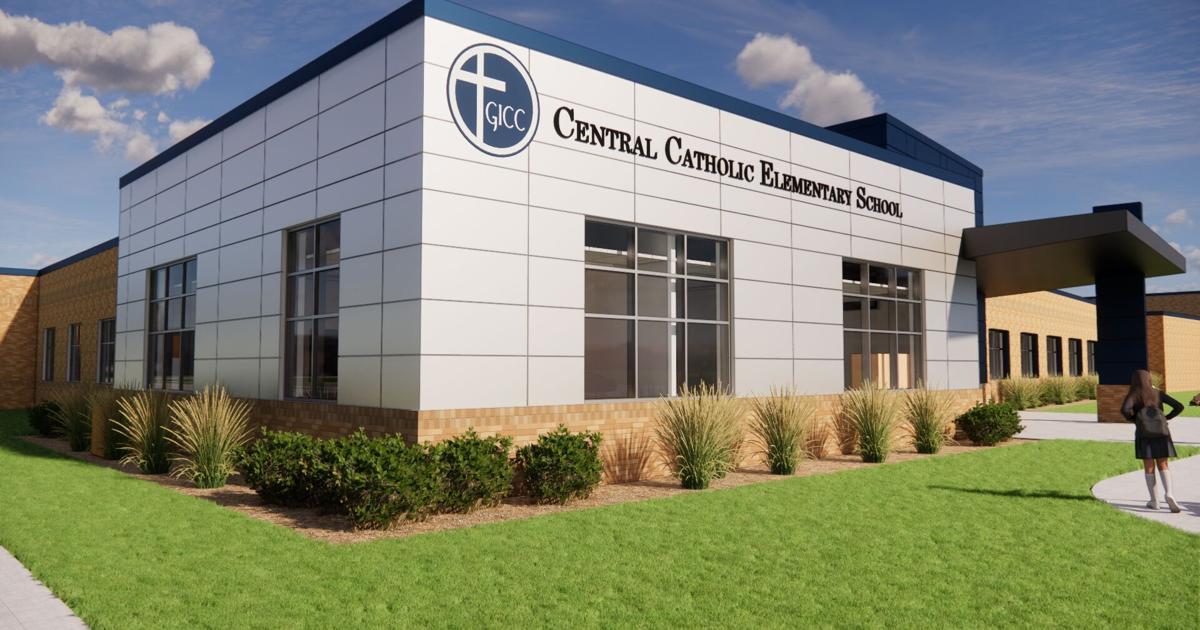
GRAND ISLAND, Neb. — Supporters of a new Catholic elementary college in Grand Island say they are delighted with the progress of the marketing campaign so far.
Much more than $6.8 million in pledges has been obtained, and supporters are just commencing the community part of the campaign.
The marketing campaign, termed “Grounded in Religion — Constructing Our Potential,” was introduced Wednesday night at an function at Riverside Golf System that was attended by additional than 200 men and women.
The goal of the campaign is $11 million. Grand Island Central Catholic wants $9 million to make the school, which will provide prekindergartners through fifth graders. Organizers hope to designate $2 million to the Bishop Golka Legacy Fund, guaranteeing that the faculty will continue to work for many years.
A campaign video demonstrated at the function integrated responses from long run learners of the elementary university “to a group of folks who have been supporters of this course of action considering that the commencing,” Central Catholic Principal Jordan Engle reported Thursday.
People today are also reading…
Organizers are “really, seriously pleased with where by we are in this system ideal now,” Engle mentioned.
Pledges lifted so much are the result of private requests. “We’ve still to go out and ask the general public for their support as well,” he said.
As they chat to individuals, officials uncover that guidance for a Catholic elementary college is not short term, Engle stated.
“It is guidance that is deep and meaningful from the local community — from men and women who have been Central Catholic supporters for a prolonged time and people who just want to see anything happen in Grand Island which is heading to assist the potential of our local community,” Engle said.
A Catholic elementary school will support the city by obtaining an “additional option of instruction and having something that is heading to entice youthful households back again to Grand Island, when the alternative of a Catholic elementary faculty is there,” he mentioned.
The elementary college will be built on the northwest facet of the current making.
The school’s cafeteria will be remodeled as part of the task.
Grand Island Central Catholic at this time educates pupils in sixth by means of 12th grades.
“I am overjoyed with the reaction we’re getting,” Jolene Wojcik, the govt director of the Central Catholic Advancement Basis, stated in a push launch. “For decades, benefactors explained to us Grand Island needs a Catholic elementary school to complement our existing curriculum. We heard them, and immediately after considerably discernment and prayer, we eagerly took on the job. Now our donors are responding with their items, demonstrating a willingness to assist the challenge.”
Officials made a decision to go in advance with the undertaking in early February, Engle explained.
Think CRT is only found in public schools? Think again
Catholic parents labeled terrorists for raising concerns about CRT
Catholic students afraid to defend Catholic faith in a Catholic school for fear of attack
Equity consultant teaches all are racist – Pope Francis? Mother Teresa?
By Brett Healy
Questionable Curriculum: Critical Race Theory In Wisconsin – A Continuing Series
Over the past year, the MacIver Institute has been sharing real examples of Critical Race Theory (CRT) in Wisconsin classrooms. While most of MacIver’s work to date has focused on CRT in public schools, we have also come across CRT in private schools. One of the worst cases of CRT indoctrination, public or private, is found at the all-female Divine Savior Holy Angels (DSHA) High School, located in Milwaukee. According to the website, DSHA is a “dynamic Catholic college-preparatory educational environment’ ” with a firm devotion to “our Catholic identity and theology.”
DSHA is considered one of the better schools in the state, typically graduating all of its students and boasting of a 100{e4f787673fbda589a16c4acddca5ba6fa1cbf0bc0eb53f36e5f8309f6ee846cf} college acceptance rate.
A large group of concerned parents has been attempting to work with the DSHA administration for over a year to voice their concerns about the indoctrination of their children with CRT. The parents object to CRT’s core belief that racism is everywhere — our country is fundamentally racist and that every one of us is a racist, no matter what an individual does or does not do. These parents have actively tried to come to an understanding and a mutually agreed-upon solution with DSHA but to no avail.
DSHA’s mission is “to make known the goodness and kindness of Jesus Christ” and to develop “our students into capable young women of faith, heart, and intellect who accept the gospel call to live lives that will make a difference.” The administration has repeatedly referred back to this set of core beliefs throughout the conversation about CRT in the school.
Unfortunately, many parents feel that DSHA no longer actually believes in this mission because of the actions of the school. The parents feel that the administration does not truly value their input or care about their strong opposition to the teaching of CRT at DSHA.
These parents truly believe in the school’s stated goal that every person of every race be welcomed to DSHA with open arms and they want to work with the administration to reach that goal. They believe diversity and inclusion are a fundamental part of their Catholic faith and that it is vital to the intellectual and spiritual growth of their children. It is one of the reasons why they choose to send their daughters to DSHA.
As we have documented all over the state, CRT, however, does not unite. CRT does not bring parents, educators, or a community together. CRT actually divides a school and breeds discord between groups based on skin color, ideology, faith, politics, and other factors. Instead of bringing everyone together in pursuit of the common good, CRT labels and divides people into different factions, pitting them against one another. That is exactly what has happened at DSHA.
Even though hundreds of parents have made it known to the administration that they do not want CRT taught at DSHA, the administration continues to promote and push CRT onto the students.
The education establishment is reluctant to use the term “Critical Race Theory (CRT).” Instead, they refer to CRT by other names.
In one of the more recent incidents, many DSHA parents were disappointed and dismayed when their daughters received an invitation from the Diversity, Equity, & Inclusion Council (Dasher Dialogue) to attend a discussion about “performance activism & white savior complex.”
What is white savior complex? According to Savala Nolan, director of the Thelton E. Henderson Center for Social justice at UC Berkeley School of Law (in an interview with Health Magazine):
The white savior complex is an ideology that is acted upon when a white person, from a position of superiority, attempts to help or rescue a BIPOC (Black, Indigenous, Person of Color) person or community. Whether this is done consciously or unconsciously, people with this complex have the underlying belief that they know best or that they have skills that BIPOC people don’t have.
“[They think] they are somehow in the position that should enable them to have more power in terms of solving the problem than the people who are impacted [by the problem],” Nolan tells Health.
If you are kind or helpful to someone who is different than you, white savior complex blames you. If you help someone, white savior complex finds your motives not to be altruistic or pure but to be selfish and spiteful. What a dark and diabolical view of the world and your fellow man.
Most alarming for the parents was the fact that the invitation shared with them only mentioned “performance activism.” The invitation sent to parents deliberately left off the “white savior complex” part of the conversation.
Unfortunately, this is just the latest example in a long line of incidents where the administration at DSHA is deceiving parents and alumni about their efforts to incorporate CRT into every aspect of a DSHA education.
The administration minimizes their feelings by ignoring, denying, and delaying the concerns raised. This has happened so often that many are left no choice but to think that the deception and misleading statements by the Administration are deliberate and direct proof that school leaders wholeheartedly endorse CRT, its radical view of our country, and its divisive teachings.
DSHA’s “Equity” Consultants
Like many other schools across the state, DSHA has hired multiple equity consultants to push CRT at the school in recent years. While CRT proponents try to cast the work of these consultants as an open conversation about how a teacher can become a better person and a more effective educator, in reality, the consultants push the CRT dogma that our country is fundamentally racist and that all of us are racist at our very core. The CRT consultants demand that this supposedly anti-racist political point of view be put into practice in the classroom and across all of education. It is changing how our children are taught and what our children are being taught. In districts all across the state, implementing CRT is leading to the elimination of all grades, the replacing of an F with a “No Pass” designation so a student’s GPA isn’t impacted, the elimination of standardized testing, the use of a minimal grade even if a student fails to turn in an assignment or scores below that minimal grade, and the elimination of honor classes. CRT is fundamentally changing the way we educate our students.
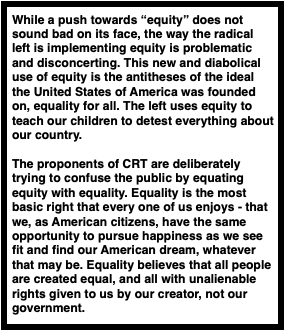
Equity is the opposite of equality. Equity, as the radical left is using it today, means every American, no matter their ability, work ethic, or moral fiber, should end up achieving the same result. This version of equity is rooted in communism.
DSHA hired an equity consultant following an “equity audit” of school operations and the environment at DSHA. The audit of the school was ordered after a video surfaced of a DSHA student using a racial slur and some DSHA alumni called on the school to make public the punishment handed out to those involved.
DSHA is not alone. Equity audits have been carried out by dozens of schools across the state. An equity audit is designed to find disparities in educational outcomes, school discipline or other metrics by different elements such as race, gender, ethnicity, or class. Instead of seeing the world through a colorblindness prism where you are judged not by the color of your skin but by your character and moral fiber, an equity audit judges everything by race, color of skin, ethnicity, etc. Equity audits, conducted by outside high-priced consultants, always show – surprise, surprise – that additional equity work is desperately needed and that the high-priced consultant can conveniently provide the services required to make the district anti-racist or at least attempt to make the district anti-racist.
It is important to point out that the DSHA equity audit was not shared with parents – not even a redacted version and not even after it was specially requested. This lack of transparency from the administration and the unwillingness to share such a key document lead some parents to question if the administration is trying to hide something.
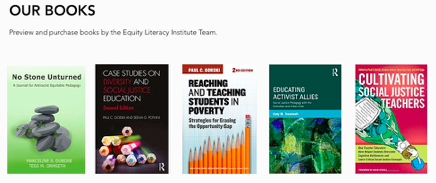
One of the consulting firms hired by DSHA is theEquity Literacy Institute (ELI), whose motto is “Learning to be a threat to inequity and a cultivator of equity in our spheres of influence.” ELI touts their expertise:
Prepar[es] us to recognize even the subtlest forms of bias, inequity, and oppression related to race, class, gender identity and expression, sexual orientation, (dis)ability, language, religion, immigration status, and other factors. Through equity literacy we prepare ourselves to understand how experience disparities, not just quantitatively measured outcome disparities, affect student access to equitable educational opportunity free of bias, inequity, and discrimination.
ELI believes that colorblindness is not only impossible, but it is also dangerous. Colorblindness is, of course, what Dr. Martin Luther King talked about when he said “I have a dream that my four little children will one day live in a nation where they will not be judged by the color of their skin but by the content of their character.”
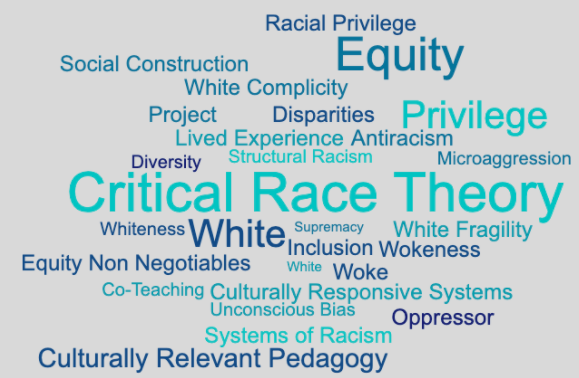
Now, in the name of antiracism, equity, white privilege, culturally responsive teaching, white supremacy, or whatever term the radical left is using for Critical Race Theory, colorblindness is no longer acceptable and, in fact, groups like ELI determine it to be dangerous? Dangerous? Really?
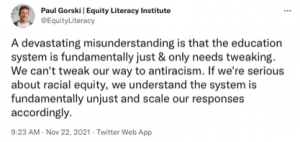
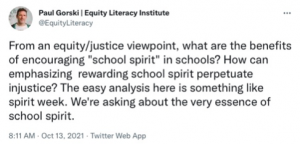
Paul Gorski, ELI founder, has also expressed some radical and anti-religious views. In one tweet, Gorski states he believes that “the canon of western literature is white supremacy” and that educators should remove some of the classics from the curriculum and classroom. In another, Gorski celebrates teachers that are subversive, saying that those who “subvert what they’re told to do, to subvert systems designed to repress them and their students,” their “badassity” picks up his spirit.
How are his views consistent with the school’s mission to make known the goodness and kindness of Jesus Christ?
In late January of 2021, one of the trainers from ELI — Dr. Taharee Jackson — gave a presentation called “What’s Whiteness Got to Do with It? Facing Race, Racism, and Whiteness at DSHA” to staff members at the school. Again, this is not just a casual conversation about how a teacher can be a better person or a more effective educator. This presentation includes a call to action for teachers to actively push CRT in their classrooms and their work.
ELI defines equity as “a commitment to action: the process of redistributing access and opportunity to be fair and just” and “a way of being: the state of being free of bias, discrimination, and identity-predictable outcomes and experiences.”
Identity-predictable outcomes? The more you read about what CRT consultants are pushing on schools, the more you question if it is purposefully amorphous and incoherent.
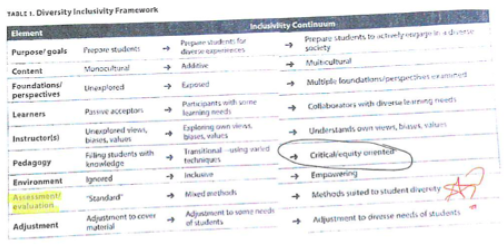
Another presentation, entitled “Diversity Inclusivity Framework,” includes a chart outlining the “inclusivity continuum” and where DSHA is on that continuum. Two of these movements are particularly telling. The element of pedagogy — how students are taught — starts at “filling students with knowledge” and ends with the goal of making students “critical/equity oriented.” The “Assessment/evaluation” continuum starts with “Standard” and ends at “Methods suited to student diversity.”
It should be alarming to parents that “filling students with knowledge” is not the ultimate goal of teaching according to ELI. Instead, the goal is to implant students with the belief that our country is fundamentally and actively racist. ***
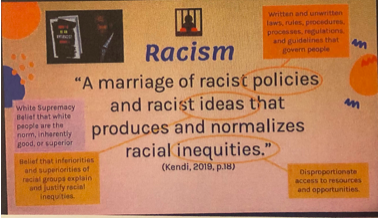
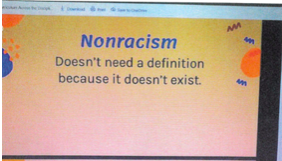
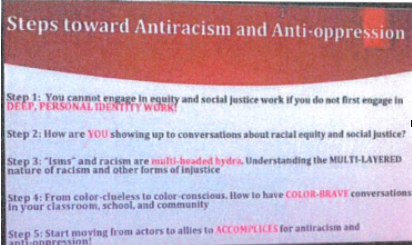
Another staff training from January 2021 was called “Antiracist Curriculum Across the Disciplines.” The presentation was led by Dr. Katy Swalwell. It starts out by defining race as an “ever-shifting social category based on perceived biological differences that don’t exist but have real-world consequences because of racism.” Swalwell also includes a slide with the term nonracism listed and then states that nonracism “doesn’t need a definition because it doesn’t exist.”
Think about that for a second. CRT proponents believe that every one of us, no matter how good a person we are or what is actually in our hearts, is a racist.
Pope Francis is a racist? Mother Theresa was a racist?
ELI is teaching staff at a catholic school that everyone and everything in this world is racist, even the most devout and pious follower of Christ? Does ELI believe that DSHA students are capable young women of faith, heart, and intellect? ELI seems to believe that every single one of them is a racist.
Given that there is no such thing as nonracism or being a nonracist, consulting firms like ELI will never be short of work. There will always be a need to teach others how to be “antiracists”. If you can conveniently never be successful in an endeavor or, in this case, in the elimination of a problem, there will always be high-paying work for these modern-day con artists.
Dr. Swalwell concludes her presentation with four considerations for the DSHA staff. The first consideration is to “Let student’s interests and needs inform you, recognize intragroup diversity.” The second is to “recognize and interrogate mechanics and impacts of oppression; interdisciplinary, year-round commitment.” The third consideration for staff is to “move beyond the ‘white gaze’ to make room for creativity and celebration.”
Finally, the last consideration is a call to action, asking teachers to “examine and practice taking action that disrupts racism.” Disrupting racism does not refer to stopping or addressing a specific incidence of racism. ELI wants DSHA teachers and Administration to incorporate CRT into their curriculum and classroom.
Many CRT advocates, including some school administrators we have highlighted previously, attempt to placate concerned parents by claiming that their CRT work is only “teacher training” and that it is not actually leading to any substantial changes in the curriculum or classroom.
That is exactly what has happened at DSHA.
Katie Koniecznyk, DSHA’s President and 1992 graduate, sent out a video message to the DSHA community, after parents spoke up to share their concerns with CRT, stating that “DSHA is not teaching critical race theory, we just aren’t, it’s not in our DEI plan, it’s not in our academic curriculum, it’s just not something that we are doing and I want to be clear about that.”
Koniecznyk could not be more direct or clear in her statement.
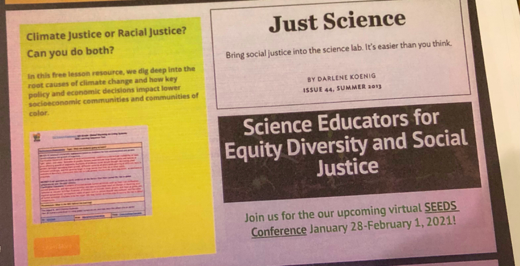
Unfortunately, Koniecznyk’s assurance turns out, is patently untrue. Not only is CRT teacher training everywhere at DSHA, but CRT is also impacting the curriculum. One of ELI’s slides talks about bringing social justice into the science lab and notes that it is easier than you think.
If that isn’t enough proof for you, consider this.
DSHA requires students to read “Unpacking the Invisible Knapsack” (Peggy McIntosh) for a senior theology class. McIntosh’s piece leads with the quote, “I was taught to see racism only in individual acts of meanness, not in invisible systems conferring dominance on my group.” McIntosh documents her own self-inspection as she attempts to identify “some of the daily effects of white privilege in my life.” Some of the more noteworthy observations:
I can avoid spending time with people whom I was trained to mistrust and who have learned to mistrust my kind or me
I can turn on the television or open to the front page of the paper and see people of my race widely represented
I can be sure that my children will be given curricular materials that testify to the existence of their race
I can go into a music shop and count on finding the music of my race represented, into a supermarket and find the staple foods which fit with my cultural traditions, into a hairdresser’s shop and find someone who can cut my hair
I can arrange to protect my children most of the time from people who might not like them
I can talk with my mouth full and not have people put this down to my color
I can swear, or dress in second-hand clothes, or not answer letters, without having people attribute these choices to the bad morals, the poverty, or the illiteracy of my race
I can go home from most meetings of organizations I belong to feeling somewhat tied in, rather than isolated, out-of-place, outnumbered, unheard, held at a distance, or feared
I can be pretty sure that an argument with a co-worker of another race is more likely to jeopardize her/his chances for advancement than to jeopardize mine
I am not made acutely aware that my shape, bearing or body odor will be taken as a reflection of my race
If my day, week, or year is going badly, I need not ask of each negative episode or situation whether it had racial overtones
I can choose public accommodation without fearing that people of my race cannot get in or will be mistreated in the places I have chosen
I can easily find academic courses and institutions which give attention only to people of my race
I can choose blemish cover or bandages in “flesh” color and have them more or less match my skin
The color of a bandage is proof positive that our country and society are fundamentally racist? My body odor is a reflection of my race? My wife would tell you it just means I’m getting lazy and gross. If someone talks with their mouth full, I don’t care what color their skin is or think about their ethnicity, I just chalk it up to a lack of awareness and rudeness. Nothing more, nothing less.
When President Koniecznyk was confronted with McIntosh’s CRT teachings and the fact that this CRT training WAS a part of DSHA’s curriculum, despite her adamant and clear denial to the contrary, she tried to ignore and deny the main point of their concern. She tried to placate the parents by responding that McIntosh has been in use at DSHA for at least ten years. Koniecznyk did not acknowledge her mistake (lie), did not apologize for deceiving the parent group, and did not put out a new video to the DSHA community admitting her mistake or setting the record straight.
No, she thought it would be better to explain it away by saying that CRT has been around for at least ten years at DSHA.
Parents pointed out to the administration that these materials present only one point of view of the world, a very biased perspective that the country is made up solely of oppressors and the oppressed. Rather than present this one very slanted viewpoint as the gospel truth, parents have asked the Administration to acknowledge the extreme bias of CRT and bring in different perspectives or at least one that is grounded in their Catholic faith.
Koniecznyk denied their request.
The Impact on Students
The goal of CRT and many of the equity consulting groups — such as ELI or ICS Equity — is to create “an even playing field” for students. While this may sound again like a good thing, in practice, it means that Honor or Advanced Placement (AP) classes should be eliminated. Honor classes need to be eliminated because of CRT’s fundamental racist belief that some kids, some kids with a different skin color, cannot ever succeed at an academically rigorous endeavor like an honor class, and therefore, no one should have that opportunity. At DSHA, the school administration quietly did just that.
Through the 2020-2021 school year, freshman students were given the option to enroll in either Biology or Accelerated Biology. Now, all students take the same biology course. While it is called Accelerated Biology, this is not optimal for any of the students. Students who need a biology class to graduate but do not want to pursue biology as a career are now in the same class as a student who has a deep interest in biology or is looking to gain Advanced Placement credits towards their college education. This push to treat all students the same by forcing them into one class will only end up hurting all students. But it is key to CRT.
In CRT, there is no such thing as meritocracy. CRT does not believe your individual talent, work ethic or resoluteness should determine success or your lot in life. CRT believes that we all should end up at the same place, a safe and non-threatening place.
This push to eliminate honor classes in the name of equity didn’t stop with just biology. At a Diversity, Equity, and Inclusion (DEI) meeting in the Spring of 2021, the Dean of Students announced that the school would be moving to eliminate Honors Chemistry as well. However, thanks to the hard work and diligence of parents at DSHA, the administration reversed course and kept Honors Chemistry as a separate class. Parents did notice also that the announcement to eliminate Honors Chemistry did not come from an academic curriculum meeting but the DEI committee. The initial decision didn’t come from the group tasked by the school to ensure students are academically successful and college-ready. The decision came from a group pushing CRT, white privilege, and implicit bias. This came from a group concerned about political correctness, not a group concerned about what your daughter needs from DSHA to attend an Ivy League school.
The push to incorporate CRT into the classroom, the curriculum and to make everything about race at DSHA has also had a very real impact on the atmosphere at the school. Instead of creating an environment of greater inclusion and harmony, it has fostered animosity, fear, and emotional distress.
Students have been bullied online for political beliefs that contradict the CRT narrative. Many have felt too scared to voice their love for their Catholic faith when the Church and its teachings have come under attack. Girls have been excluded from certain clubs because of the color of their skin. Others have felt the need to stay home from school on demonstration days rather than be ostracized by DSHA staff or fellow students. Some girls have even felt discriminated against based on their religious opposition to the racist and divisive views of CRT. Girls who care deeply about their catholic faith are afraid to speak out about their faith in a catholic school.Too many girls have decided to stay silent for fear of attack or retribution.
One girl described the effect the charged atmosphere is having on her. “I feel afraid to speak honestly during Dasher Dialogs or assemblies because no matter what I say, someone will point a finger and call me a racist.”
The atmosphere and the change in the Catholic culture have been so bad that several parents have decided to withdraw their daughters from DSHA and move to a different school.
Even after many months of trying to get the administration to understand their concerns and supplying real examples of CRT at the school, DSHA’s Board of Directors continues to claim that “CRT is not part of the DSHA curriculum and you won’t find it in any of our syllabi. All professional development and training programs are closely aligned and consistent with our mission and values.”
Yet, the administration clearly pushes forward with Critical Race Theory. The school recently signed a new contract with Carney, Sandoe & Associates (CSA) to help in the district’s search for a Director of Diversity, Equity, and Inclusion. Some parents believe that the diversity program is dividing girls, labeling girls, and doing more harm than good. Parents question how it is acceptable to label girls as racist for sincerely-held views that are consistent with the Catholic Church.
CSA is a faculty recruiting firm that places a heavy emphasis on Diversity and Equity. CSA was the firm that found the school’s current President Koniecznyk.
“At Carney, Sandoe & Associates, we are committed to the importance of increasing equity, diversity, inclusion, and belonging – both within our own organization and among the educational communities with whom we partner. Cognizant of our ability to reach a wide variety of schools, teachers, and educational leaders, it is our goal to provide educators with resources that help foster diverse and inclusive environments. We aim to facilitate continued learning and to encourage valuable networking opportunities.”
CSA, according to its website, believes that racism is the norm and that everyone is an active participant in white supremacy. CSA supports the controversial and factually-challenged 1619 project. ***
The decision by the administration to contract again with CSA demonstrates that the concerns of parents have not been taken seriously and that, after many months of effort, no real progress has been made.
In fact, the administration has stopped pretending to want to work with the parents altogether. Some teachers at the school and the Board of Directors now are openly and publicly criticizing the parent group. The Board, in a letter to the entire school community, labeled them as detractors who want to attack the school and undermine the integrity of the school. The parent group, which has always approached this conversation with respect and civility, is disappointed and dismayed by the Board’s attack.
At a staff meeting, a teacher referred to parents questioning CRT as terrorists. Terrorists? Call them a terrorist for the sin of wanting to preserve and strengthen DSHA’s Catholic identity? A terrorist? Really? It should be unthinkable that one would utter such bile but it seems to be rather commonplace these days for CRT zealots to attack and bully anyone who will not dutifully profess allegiance to their warped dogma.
Despite the hostile treatment from the administration and the Board of directors, the concerned parents still believe a resolution is possible.
The parents believe the answer lies with their faith. The parents believe that the DSHA full community can and should lead on diversity in a way that is consistent with their Catholic values.
The parents believe that everything needed to create an environment of inclusiveness can be found in the Bible, not CRT.
Even if you are not Catholic, DSHA should serve as a wake-up call for you. The sad and infuriating situation at DSHA is a warning to all who believe in our country and the abundant opportunities it affords everyone who is blessed to live here. If you thought that CRT was just a problem of the public secular schools or only happens in a liberal bastion like Madison, you are sadly mistaken.
CRT and the dramatically-growing industry of anti-America academics, swindler consultants, and paid protestors who push CRT intend to indoctrinate every one of our children with its vile beliefs and will not stop until every institution of our country is fundamentally changed to indoctrinate all of us with their evil view of humanity and the world that we live in.
We all need to wake up before it is too late.
Questionable Curriculum: Critical Race Theory (Et Al) In Wisconsin – A Continuing Series
If you have additional tips or examples of CRT in the classroom that warrant investigation, please contact us at: info@maciverinstitute.com.
WASHINGTON — Many families have found renewed faith and togetherness after deciding to home school amid the COVID-19 pandemic. The U.S. Census Bureau noted earlier this year that 11.1{e4f787673fbda589a16c4acddca5ba6fa1cbf0bc0eb53f36e5f8309f6ee846cf} of families with school-age children were home schooling in the 2020-2021 school year, double the amount from the year before. That number is increasing as schools continue pandemic restrictions like mask wearing and virtual learning. Michael Donnelly, senior counsel at the Home School Legal Defense Association (HSLDA), told the Register that the number of families home schooling continues to grow this school year. Census Bureau data has shown “that home schooling has grown fastest in Hispanic and Black communities,” Donnelly said. “We were starting to see home schooling pick up in those communities before the pandemic, but it seems like the pandemic just lit a fuse to the rocket in those communities.” The Census Bureau estimated last year that 16{e4f787673fbda589a16c4acddca5ba6fa1cbf0bc0eb53f36e5f8309f6ee846cf} of all Black families were home schooling and about 12{e4f787673fbda589a16c4acddca5ba6fa1cbf0bc0eb53f36e5f8309f6ee846cf} of Hispanic families were home schooling.
Gisela Quiñones, founder of the Latinos Homeschooling group and a Catholic Indiana mom, told the Register about how her group got started and grew in numbers in a virtual format over the pandemic. She chose to home school her children five years ago due to her concerns over the quality of private schools. She also discovered that one of her daughters was struggling in the classroom setting due to dyslexia. She said her daughter “thrives on more hands-on learning,” and “we didn’t want her self-esteem to be affected by the school and testing.”
Expansion of Online Resources
Quiñones, who is originally from Mexico, began home education in a Catholic home-schooling co-op and decided to start a group for Latinos in 2019.
“We organized a few events around Hispanic Heritage Month two years ago from our classes and crafts and little lessons,” she said. “Those did pretty well, but then the pandemic happened, and our group pretty much exploded. We got people from all over the country, and they were asking us questions.”
She said a lot of people have started home schooling because of the pandemic. Her group did a webinar where “we went through all of the different teaching styles,” and “soon after that, we started doing a lot of things online. We’ve done story time, where we try to find Latino authors and books that are bilingual or in Spanish, and then we’ve done some STEM challenges online. I have done some Latino history classes online.”
Quiñones and a team of six other home-schooling moms organized a conference in July that covered a range of topics, including “helping parents teach math confidently,” along with panel discussions about the struggles of parents who work remotely and home school. She and her husband are among those parents who work remotely, and she said it helps that they “share the same vision of home schooling,” so he is able to take over and teach when her work gets busy.
Nadia Flores Wedderburn, a Chicago mom who is a member of Latinos Homeschooling, told the Register about how she chose to home school in the fall of 2020 due to concerns over the pandemic and wants to continue home schooling. She said she and her husband saw “too many cons for our children to go back to school” in person.
“In 2020, my husband and I were just inquiring about what home schooling was about; and so far, we liked it, especially because we were hearing so many positive things from families who were already home schooling,” she said. “We’re both full-time employees; we’re very lucky to have the opportunity to work from home.” Wedderburn said working while home schooling has been difficult, but she and her husband want to continue to home school because they have seen the benefits.
She said she got to know her daughter “so well, this last year and a half,” and they were able to identify that her daughter had attention deficit hyperactivity disorder (ADHD) and anxiety while her school had just said “she’s misbehaving; she’s not following instructions — because that’s what was happening years prior to the pandemic.”
A ‘Golden Age of Home Schooling’
Kendra Price, a former public-school-chemistry-teacher-turned-Texas-home-school mom, is in her eighth year of home schooling her four children and is a speaker for Black Family Homeschool Educators and Scholars, a group formed in April 2020.
Price blogs about her experience home schooling and told the Register that between the “Clubhouse app and my interactions within the Facebook groups, I’ve seen a ton of increase regarding new home-schooling families and people considering home schooling.”
“A lot of parents have been dissatisfied with the virtual public schooling,” she said,” where the child is plugged into a computer screen for a number of hours a day.” Price said home schooling is “about relationship,” and “one of the things that I discovered as one of the great gifts of home schooling when I first began — and I think one of the things that a lot of the parents during the pandemic discovered — was that home schooling has a lot to do with the relationship with your child. You get to learn about your child as an individual; you get to spend quality time.”
Price said that during her time as a public-school teacher, she observed “some of the low expectations and the labels that they placed on children, I felt unduly, and I did not want that for my children because I’m an African American female, I’m an African American mom, my children are African American.” She said that as a Christian she also “wanted to be able to impart my values and my faith in my children. I wanted Jesus to be able to be spoken of freely.”
“This is a golden age of home schooling, especially for Black home-schoolers, because there are a lot more resources available, and there’s a lot more support. No matter where we are in the nation,” Price emphasized, “we’re able to connect with other people that look like us and have some of those needs that we have addressed specifically through organizations like Black Family Homeschool Educators and Scholars.”
West Virginia state Sen. Patricia Puertas Rucker, R-Jefferson, the first Hispanic woman elected to the state’s senate, is a mom of five who began home schooling 15 years ago. She chairs the Senate Education Committee and told the Register that she knows many families who started home schooling due to the pandemic.
She said in her own family, “we see benefits from it that I never planned on, like the fact that my children love each other and actually hang out well together. The closeness that my family has is something very precious to me, not to mention the fact that they’re all very strong Catholics.”
“When I first started home schooling, there were limited options of Catholic home-school curricula, and now it’s just wonderful,” she said. “You have so many choices, so many flexible things you could do, and now we have Catholic virtual school, too, which is awesome. There are really some very exciting things that can really help a parent to home school. It makes it a lot easier than it was 15 years ago.”
She said that when parents approach her nervous about home schooling, she tries to “reassure them that no amount of extracurricular things can substitute for someone who truly cares for your child; and because you, the parent, truly care for your child, you’re going to find ways to help your child, whether they’re delayed in a certain subject, whether there’s a particular weakness — because it’s your child, you’re just going to care more.”
Parents’ Concern
Colleen Spotts, a West Virginia Catholic who began home schooling her two children just this fall, told the Register that “the major factor” for her decision was “that they were going to make the children wear masks at school and “knowing that they would probably be closing the school down again, and then they’d be stuck on a not-so-great online option.”
A widow, she said the decision-making “weighed very heavily on me throughout the summer, especially trying to make that decision of what to do, whether to just send them back.”
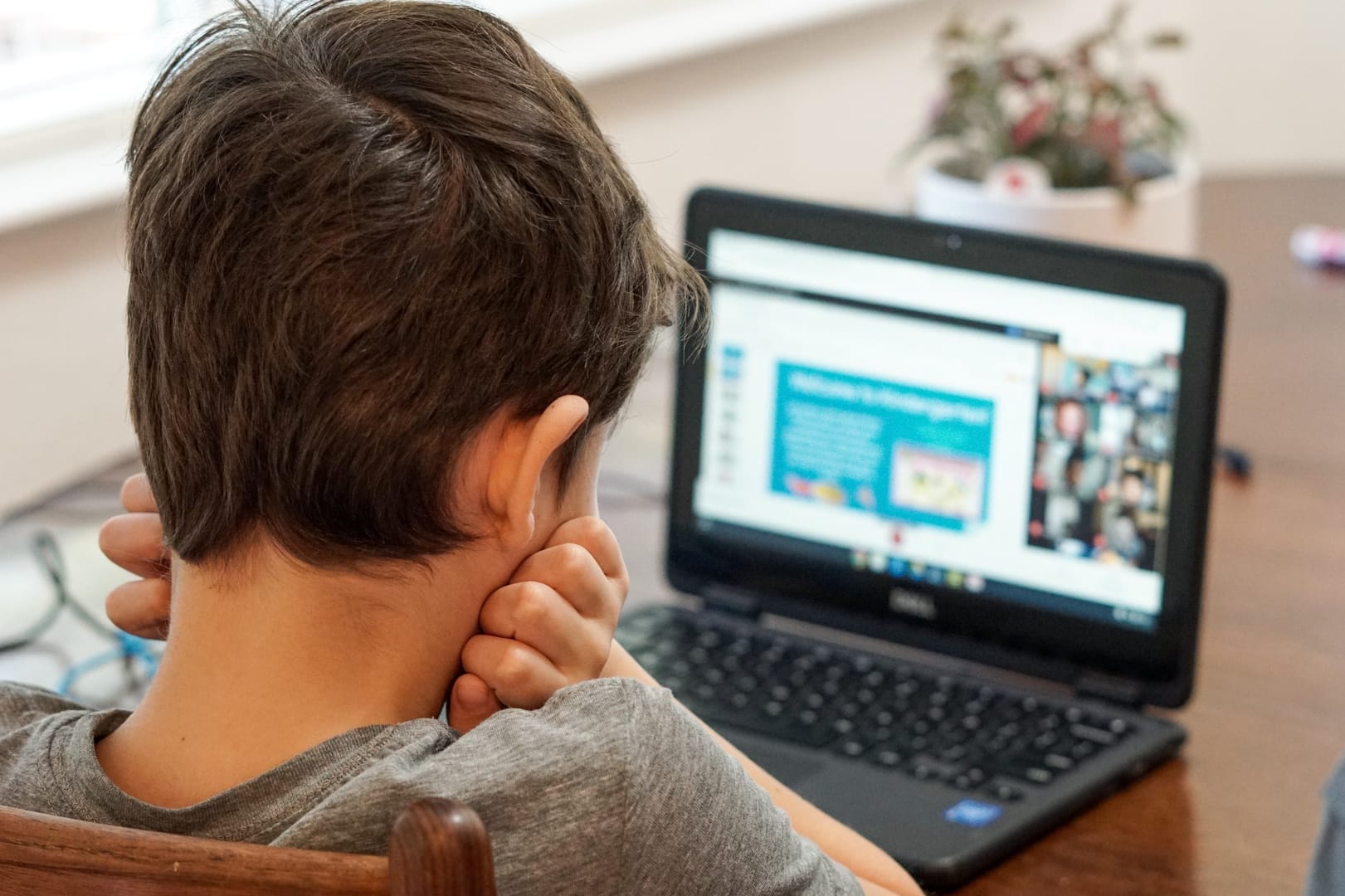
She described an online program her seventh-grade son had used in the public-school system as “a disaster.” Spotts said with the virtual format that her children’s school work “had diminished so much that it was almost nonexistent,” and there were problems with the virtual platforms the teachers used, where “work was being handed in, and then we would get calls and emails that he has not been turning his work in. It was really stressful.”
Jamie Smith, another West Virginia mom, told the Register that her family began home schooling last fall because “we didn’t like the options that were given during the pandemic, the back and forth, the kids not knowing whether or not they were going to be in school, whether it was going to be virtual.”
Jessica Verret, a Texas mom who began home schooling in the fall of 2020, told the Register that her family made the decision to home school after the parish school, where three of her children attended, said “the kids were going to have to wear masks all school day.” She then was informed by the public school that her oldest son would have attended that “they were going to go virtual for the first two or three weeks of the school year” and then alternate between virtual and in-person learning the rest of the year. Verret said she and her husband were concerned about all the restrictions and didn’t “want to have to force our kids into that environment.”
A Tailored Experience With Resources
More than a year into home schooling, Smith said that her children are “much more excited about the schoolwork because we can tailor it to what they like.” Her daughter loves making bracelets, so she has made math “interesting to her” by having her count with different color beads. She has seen “the older siblings help the younger siblings with their school work, and it’s a whole different relationship.”
Smith and her husband both work but receive help from her husband’s mother and then schedule the schooling around the hours they are free.
“There are so many companies that create the whole curriculum for you; they help you keep track of grades, which is great,” she said. “We actually used Mother of Divine Grace our first year, and then this year we’ve developed our own curriculum.”
Spotts’ daughter is now part of an online high-school program that she said was more “self-paced and self-guided,” and her son is in a K-12 home-school program that is “much more tailored for him and his needs.” She said that, at this point, “we’re so used to them being home so much anyway that that part of that transition was not as difficult as I had perceived it to be years ago watching other people home school.”
Verret said using the Seton Home Study School program helped her ease into home schooling, as “they give you all the lesson plans and all the books, and you just read through it and say ‘this is what works for my kid.’”
She said that home schooling has also helped her faith life. When her children went to Catholic school she knew they had religion classes and exposure to the sacraments and “didn’t feel the pressure to be their first teacher when it came to catechizing them.” She said that since home schooling, she has realized her responsibility in that regard and has “wanted to go to confession more. I wanted to go to daily Mass. I wanted to be reading the word of God every day. I wanted to make sure I was praying every day, because I was in charge of making sure they learned how to do that.”