More Black families are homeschooling their children. Here is why

More Black families are homeschooling their children. Here is why


CNN
 — 

Tracie Yorke grew concerned about the quality of education her son was receiving after his school moved to remote learning during the pandemic in 2020.

Yorke, of Hyattsville, Maryland, described her fourth grader’s Zoom classes as chaotic – it looked as if teachers had not been trained in virtual instruction, she said.

That summer, the police killing of George Floyd in Minneapolis sparked a national racial reckoning. With only one Black teacher at the school and none past the fourth grade, Yorke said her son Tyce, who is now 13 years old, had no one he could relate to.

“There was a lot of mayhem,” said Yorke. “I really realized, ‘I don’t think this environment is healthy for my child.’”

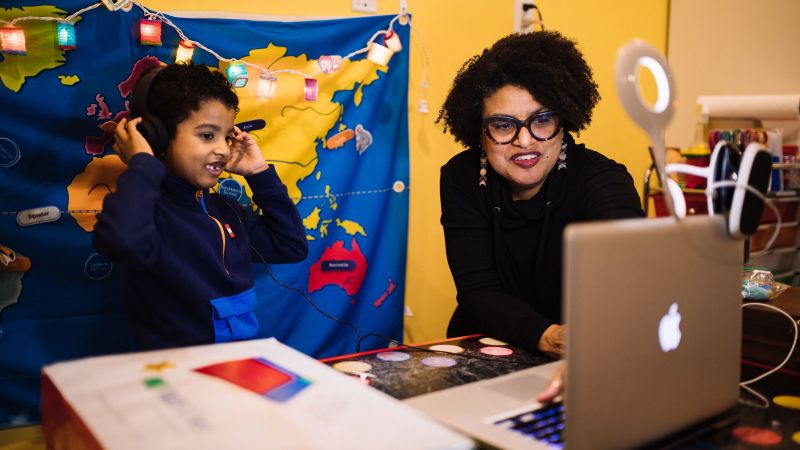
Yorke decided to homeschool Tyce, and has done so for the last three years. She has put together a curriculum that meets his specific needs and can teach him about race and African American history without the risk of politicians intervening.

While homeschooling isn’t new, advocates say a growing number of Black parents are educating their children at home so they can exercise more control over what they are taught and how they are treated. Many made the switch to homeschooling during the pandemic, but interest is growing as national debates over teaching systemic racism and Black history in the classroom continue, advocates say.
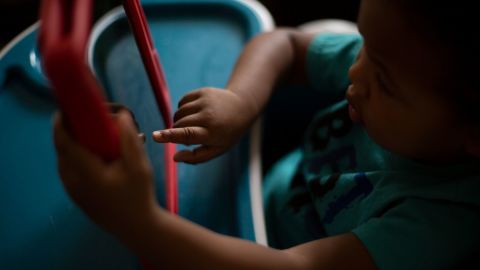
Aurora Bean's 2-year-old son, Kairo, plays on a tablet. Bean began homeschooling her children four years ago.

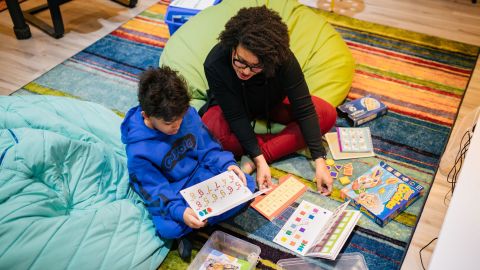
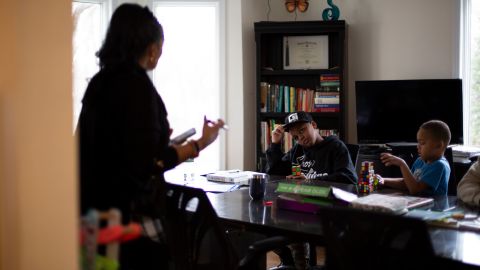
Sherri Mehta and her older son Caleb work on an assignment at their home in Laurel, Mayland. She first turned to homeschooling in 2020.

In the last few years, lawmakers, mostly Republicans, have called on schools to remove critical race theory – a concept that legal scholars say acknowledges that racism is both systemic and institutional in American society – from their curriculums. (Educators argue that critical race theory itself is generally not included in the grade school curriculum.) There have also been widespread efforts by lawmakers, parents and school boards to ban books about race, gender and sexuality. And most recently, Florida’s Department of Education rejected an Advanced Placement African American studies course.

According to census data, the number of Black households homeschooling their children jumped from 3.3.{e4f787673fbda589a16c4acddca5ba6fa1cbf0bc0eb53f36e5f8309f6ee846cf} at the start of the pandemic in 2020 to 16.1{e4f787673fbda589a16c4acddca5ba6fa1cbf0bc0eb53f36e5f8309f6ee846cf} by the fall of that year. That jump was the largest of any racial group. Meanwhile, the proportion of homeschooled children in the US overall nearly doubled from 2.8{e4f787673fbda589a16c4acddca5ba6fa1cbf0bc0eb53f36e5f8309f6ee846cf} before the pandemic to 5.4{e4f787673fbda589a16c4acddca5ba6fa1cbf0bc0eb53f36e5f8309f6ee846cf} in the 2020-21 school year, according to the US Department of Education. The data may not present a complete count of families because every state regulates and tracks homeschooling differently.

Cheryl Fields-Smith, a professor in elementary education at the University of Georgia, cited several reasons why more Black families are choosing to homeschool, including the disproportionate rates of discipline against Black students, the resegregation of schools, the denied access to gifted education in Black and brown communities, and bullying compounded by school safety concerns.

Fields-Smith said while these issues are often researched in isolation, many Black families are having to face them all at the same time. So they are developing learning routines that fit their children’s needs and forming homeschooling co-op groups with other families to teach their children together and socialize them, Fields-Smith said.

“I conceptualize it as a form of resistance,” Fields-Smith told CNN. “Instead of accepting the status quo, families are resisting what’s happening in their schools.”

Some families say they chose to homeschool because they were living in majority White school districts and wanted to teach their children to have confidence in their Black identity. Others expressed a desire to shield their children from the nation’s polarizing racial climate.

Sherri Mehta, of Laurel, Maryland, said she first turned to homeschooling in 2020 to help her young son who wasn’t doing well with remote learning as a kindergartner.
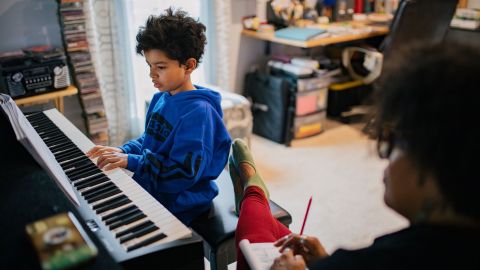
Sherri Mehta watches Caleb practice the piano.

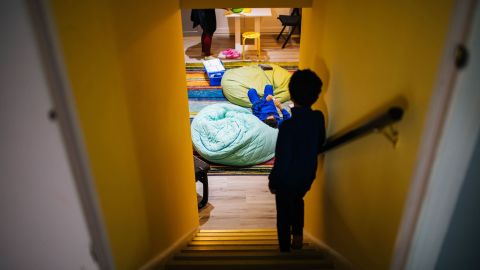
Gabriel Mehta stands on the stairs while his brother Caleb lounges on a bean bag chair during a break between lessons.

Mehta said she was also becoming concerned about her two children facing a “cultural gap” or racism because they were not around teachers who looked like them in their school district. And she saw few Black children included in the school’s gifted program.

With homeschooling, Mehta said she and her husband can split the responsibilities of teaching different subjects, teaching the truth about Black history and slavery, and can rely on co-op groups for hands-on learning, such as woodworking.

Mehta said she doesn’t want her children to experience the same racial trauma she experienced in public school. She recalled growing up in Richmond, Virginia, and competing against sports teams with names such as the Rebels and the Confederates.

“There is a sort of innocence lost and I just think my kids are deserving of something different,” Mehta said. “They’ll face racism. It’s not going away. But having the experience they have now of being surrounded by this nurturing of their entire being, I think what they have now will help them face challenges as they get older.”
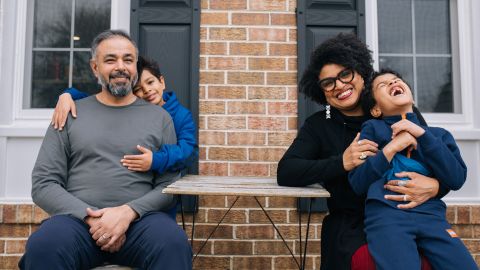
The Mehta family poses for a portrait in front of their Maryland home.

Carlos Birdsong, of Charlotte, North Carolina, said he wanted his two daughters to have “a greater sense of cultural identity” amid the political divisiveness in the country.

“We moved here from South Carolina to this area because these public schools were supposedly good,” Birdsong said. “The charter schools in our area are mostly White. The private schools are White. They are very good schools, but they may not be the best fit because they’re majority White,” he said.

Some families who homeschool are driven by their own experiences with traditional schooling or because they want to emphasize religious training in their instruction.

Aurora Bean, a mother of three from Matawan, New Jersey, began homeschooling her children four years ago because she was uncomfortable with schools discussing gender identity issues at a young age and wanted to be able to teach her children about their faith. She was also opposed to the Covid-19 vaccine requirements many schools introduced during the pandemic.

She supplements her children’s learning with coursework provided through Acellus Academy, an online K-12 private school that offers classes in Spanish, history and other subjects. Bean said she has embraced the freedom homeschooling provides, including the ability for her family to spend several months traveling the world as part of a Christian discipleship training program later this year.

“It’s so important for my kids to see beyond our nice neighborhood,” Bean said. “It’s important for them to see the other side of things, more of the world, less of the privilege.”
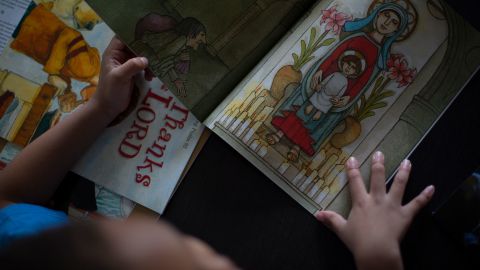
Khari, 5, practices reading with his mother, Aurora Bean.

Bean begins each day by teaching her family about devotion and their faith. Most mornings she wakes up before the kids to have time to herself and to read the Bible.

Many families have leaned on support groups and virtual education providers such as Outschool – which Yorke uses – to help them navigate teaching their children at home.

Khadijah Z. Ali-Coleman and Fields-Smith created the group Black Family Homeschool Educators and Scholars in 2020 to help families who want to homeschool but don’t know where to start. Ali-Coleman, now the organization’s sole owner and managing director, said she had homeschooled her daughter, Khari, off and on for years. And Khari was later able to attend the University of San Francisco on a full scholarship, she said.

Families who homeschool come from all socioeconomic backgrounds, Ali-Coleman and Fields-Smith say.

“When I homeschooled, I was not upper-middle-class, married – although I live with my partner who is my daughter’s father – Christian or politically conservative,” Ali-Coleman told CNN.

She advises parents who want to homeschool to start with a mission statement spelling out their goals, and she holds virtual teach-ins to help families navigate challenges. Ali-Coleman said some families turn to homeschooling because institutional schoolwork isn’t challenging enough.
“We’re now seeing the way people are speaking out loud about how they have a problem with the way we’re teaching history,” Ali-Coleman said.

Ali-Coleman also said homeschooling requires parents to adjust their thinking and potentially change what they do to earn money. While homeschooling, she worked jobs that offered her flexibility, she said.

“This gig economy that is now more formalized is something homeschooling parents have been doing for ages,” she said. “You have to think ‘what are the unique needs of your family and what are the support systems you need to create?’ I never want to give the impression that it’s easy. It’s always based on what the unique needs of the family are. Adjustments are definitely required and that’s something that you need to go in knowing.”
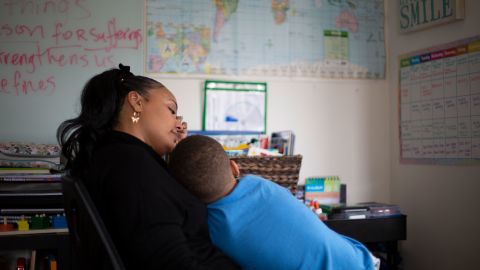
Bean holds her son, Khari, in her arms while they look at a map of the world. The book they were reading mentioned Paris so she asked him if he could point to it on a map.

Back in Maryland, the Yorkes explore Black history all year as part of Tyce’s curriculum. Last year, he studied Amharic, an Ethiopian language not offered in most schools and took a course on “Blacks in Comics” through a local Black homeschool co-op. This year, he took a class on astronomy that highlighted African and Black contributions to the field.

“I’ve always had concerns about educating a young Black boy, with the perceptions and stereotypes and coming off of George Floyd,” Yorke said. “I want to be able to discuss race in the classroom.”
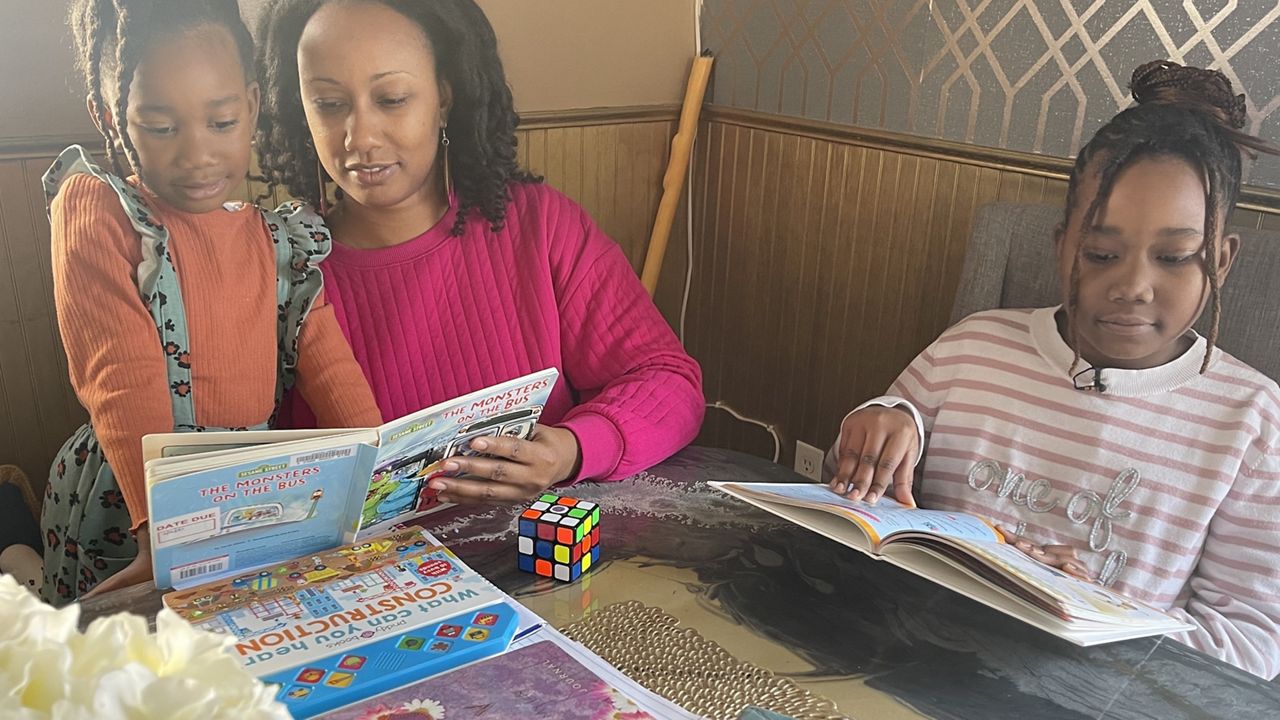
More Black families turn to home schooling

More Black families turn to home schooling

Diversity is rising in the home-schooling neighborhood as extra New York households flip to educating their possess little ones.

The U.S. Census studies that residence-schooling fees doubled all through the pandemic, and the sharpest soar was among the Black families.

“Great! We’re heading to get some movement likely this morning, right women?”

The commence to every early morning for Shaniqua Bowden’s daughters, who are household education, is yoga. Although it may perhaps not look like a common way to begin the university working day, there’s indicating at the rear of each individual motion.


What You Will need To Know

  • The U.S. Census says home-education prices doubled through the pandemic, with the sharpest soar amongst Black families
  • Shaniqua Bowden home-colleges her two daughters, 10 and 5, tailoring the curriculum to their strengths and helping them lean into their Black identity
  • Bowden claims a lot more Black parents in the group are turning to the property-university motion mainly because the public university procedure isn’t functioning out for them

“It offers them healthful patterns, it teaches them how to breathe. It teaches them how to keep tranquil throughout the working day,” Bowden stated.

Upcoming on the program is diet class, and a entertaining, palms-on activity like earning a smoothie. It is really a probability to discover and do.

Bowden is equally instructor and mom. Her two daughters are ages 10 and 5.

“As an African American spouse and children, it is incredibly critical to train about how sugar will get digested in the overall body, especially if you have diabetes in your household lineage as we do,” Bowden mentioned. “It’s essential to inform the girls how to consume nutritious, how to count their carbs.”

In 2022, Bowden and her spouse pulled their daughter out of a community Montessori school just before she began fifth grade.

“I had good deal of difficulties with like encouraging the trainer to have an understanding of the value of Black History Month, how do we lean into that programming? How do we assist her recognize who she is as a minority college student in a university that has predominately white instructors and predominately white students? I did not want that to get misplaced in the curriculum,” Bowden explained. “It’s essential she has that basis to lean on and that self-assurance as she grows up.”

Household schooling is starting to be a lot more well-known among the Black communities in the U.S. The U.S. Census claims about 3{e4f787673fbda589a16c4acddca5ba6fa1cbf0bc0eb53f36e5f8309f6ee846cf} of Black college students have been household-schooled pre-COVID-19. By Oct of 2020, that quantity grew to 16{e4f787673fbda589a16c4acddca5ba6fa1cbf0bc0eb53f36e5f8309f6ee846cf}.

It truly is time to bounce into the guides, a imaginative composing course for Bowden’s eldest, so she can expend one-on-just one time with her youngest daughter.

“I have buddies that are undertaking it, that have moved into the homeschool motion as effectively,” Bowden stated. “My women are very tranquil and reserved, but the homeschooling teams have served with that, by being open up to acquiring perform dates.”

Sunil, 10, opens up about how she feels.

“What I miss about going to school is that I don’t get to see all the folks, but in residence university, I get to do more art and follow my gymnastics,” she reported.

Bowden is using homeschooling to lean into her daughter’s strengths, tailoring the curriculum to be more arts-focused or imaginative.

“Every mother or father might not have the capacity to residence-university. Not every single mum or dad desires to homeschool. Some dad and mom seriously feel in our university procedure, which is terrific if that’s doing work out for you,” Bowden explained. “I’m a mum or dad. I’m dedicated to this function. I place my adore into it each and every working day. I want to see my girls prosper.”

Bowden explained homeschooling has also strengthened her spouse and children unit. She and her husband are able to expend additional time with their daughters. She does mornings and he does the afternoons.

Considering that they’re new to residence-education, they are providing it a attempt for a person yr and will reassess ahead of their oldest daughter is due to get started the sixth quality.

Why More Black Families Are Home-Schooling

Why More Black Families Are Home-Schooling

In August 2022, the University Board, a countrywide nonprofit accountable for higher education readiness packages these as Superior Placement (AP) courses and the SATs, announced the introduction of an AP African American research program to its curriculum. 5 months into its initially round of piloting the training course for higher college college students, it has been reduced to what lots of phone a “watered-down” model of U.S. record.

Originally meant to deliver experienced pupils with a present day, in-depth education on race in U.S. history, the system was established to address topics these kinds of as the Black Life Make any difference movement and queer Black scientific studies. In January, Florida’s Section of Schooling sent a letter to the Higher education Board rejecting the course. Later that month, Republican Gov. Ron DeSantis held a push convention to denounce the curriculum for “its absence of educational value” and for imposing a political agenda on pupils, which violates Florida’s ”Quit WOKE act.

For people blissfully unaware, Prevent WOKE — an regretably crafted acronym that stands for “Wrong to Our Little ones and Employees” — is meant to safeguard small children and employees from critical race theory (CRT) schooling and education due to the fact of the belief that it is politically driven. Certain, since heaven forbid we at any time center Black Individuals in American history.

A consultant from School Board, which is composed of education and learning professionals from 6,000 of “the world’s primary educational establishments,” to begin with explained to The New York Periods it would not be swayed by “statements of political leaders.” However, a revised version of the curriculum unveiled times after this statement omits product relevant to current-day race-associated movements, social troubles and modern writers and thinkers like Kimberlé Crenshaw, the Columbia Law professor who coined the now-ubiquitous term intersectionality. It also added “Black Conservatism” as an place of research.

So, yeah, children will be blocked from understanding about up to date Black revolutionaries battling to dismantle racism — but they will get to delve into the globe of submit-“Clueless” Stacey Sprint.

Educators all around the country are pushing again on what could turn out to be a contagious rash of ignorance, blocking critical education and learning. On Saturday, the College or university Board introduced a statement stating it ought to have swiftly addressed promises by Florida’s Office of Instruction that the system was detrimental and unnecessary. While the nonprofit promised that it is forging ahead in its commitment to Black experiments, it also claimed in its statement that “we really should have manufactured very clear that modern events like the Black Life Make a difference movement, reparations, and mass incarceration were being optional topics in the pilot study course.”

These subject areas are not optional education and learning for my baby. And I assure you, if we censor them, for more mature learners, the erasure will not cease there. The affect harmful conservative politics has more than community education and learning and academic liberty is getting a very little much too serious. As a mother adamant about furnishing my child with the info they will need to understand their globe, I have been not too long ago experience additional inclined to get their instruction into my possess hands.

Quite a few of my friends are in the identical boat. For Black people, household-education has been on the rise for some time. Continue to, there was a significant uptick throughout quarantine when mothers and fathers had been dwelling with young children reliant on virtual learning. According to the U.S. Census, 3.3{e4f787673fbda589a16c4acddca5ba6fa1cbf0bc0eb53f36e5f8309f6ee846cf} of Black households were house-education their young children at the get started of the pandemic, which improved to 16.1{e4f787673fbda589a16c4acddca5ba6fa1cbf0bc0eb53f36e5f8309f6ee846cf} by the drop.

In the previous, the concept of residence-schooling was synonymous with the strain of forgoing 1 total house income, and opportunity stigma for the kids. But now, it could be a viable alternate to public instruction, and really should perform as an equitable resource for Black people increasing young children in doing the job-course homes. But censorship of their curriculum disrupts this fairness. Now, I come to feel I may well have a superior probability at fostering success for me and my kid by juggling dwelling-school and function.

Community learning pods truly feel desirable in this second, when you take into consideration investigate that’s demonstrated that in universities, there are racist tactics that law enforcement Black pupils, a palpable achievement gap and the ongoing combat about the inclusion of “controversial (Black) matters.” Also, the disparity in Black enrollment in gifted systems and the basic underfunding of packages that educate Black pupils are sound reasons that make me want to have extra of a hand in my child’s instruction.

The harsh fact is that censorship of factual information and facts linked to the Black encounter is not heading wherever. If just about anything, the erasure of our record and tradition has always been widespread, and the politicians who legalize it are as emboldened as ever. Even though my loved ones doesn’t reside in Florida, DeSantis will attempt to spread this agenda — especially if he runs for president. His brand name of racism is, I argue, far more dangerous than Trump’s since he looks more arranged. Rather than hold out it out, I’ll be investigating property-school collectives.

‘No more skewed history’: why Black families homeschooling grew fivefold | US education

‘No more skewed history’: why Black families homeschooling grew fivefold | US education

Since she began homeschooling her children in Louisiana in the early 90s, Joyce Burges has watched the practice explode in popularity among families like hers.

“Parents nowadays – this woke generation of 25- to 40-year-old parents – their eyes are open. They’re just not having that whitewashed, skewed history any more,” she says.

Back when she started homeschooling, it was against the advice of friends and family who questioned how she could teach effectively without a college degree – only a handful of states require homeschool teachers have a GED or high school diploma.

She’d decided to teach her son at home after his principal said he was struggling academically and would need to find a new school. “Here I am, Black woman, and our children are not welcomed into the system. So homeschooling was the only option at that time that we had.”

Though her son wasn’t expelled for behavioral issues, Black students in general have long been overrepresented in exclusionary practices. It’s especially true for boys. Data from the US Department of Education’s Office of Civil Rights show that Black boys in 2017-2018 were expelled and suspended at proportions that were three times their proportion of enrollment.

Under a structured regimen of chores and study time, Burges’s son blossomed, and she went on to educate all of her five children at home and co-found, in 2000, along with her husband, the National Black Home Educators organization. She says the organization now serves “hundreds of families a year”, providing them with study plans as well as community.

The homeschooling landscape today is vastly different from what it was when Burges was starting out. According to data from the US Census Bureau’s Household Pulse Survey, there was a dramatic rise after the start of the pandemic from an estimated 5.4{e4f787673fbda589a16c4acddca5ba6fa1cbf0bc0eb53f36e5f8309f6ee846cf} of school-aged children homeschooling in spring 2020 to 11.1{e4f787673fbda589a16c4acddca5ba6fa1cbf0bc0eb53f36e5f8309f6ee846cf} the following school year. The number of Black families increased more than five times over – from 3.3{e4f787673fbda589a16c4acddca5ba6fa1cbf0bc0eb53f36e5f8309f6ee846cf} to 16.1{e4f787673fbda589a16c4acddca5ba6fa1cbf0bc0eb53f36e5f8309f6ee846cf} – a bigger jump than any other racial group.

children sit side by side with a list of “homeschool rules” in the background
Jacoby Brown, 11, and his sister Felicity, nine, practice math at home in Austin, Texas. Photograph: Eric Gay/AP

There’s no single motivating factor driving Black families to homeschool. But those who spoke to the Guardian described being fed up with a public school system that disproportionately punishes Black children, relies heavily on standardized testing and lacks diverse representation in the literature and history books their children are given. As the number of Black families turning to homeschooling grows, they are simultaneously creating communities that allow Black children to learn in a culturally affirming environment, free from the punitive approach of traditional schools.

Chris Stewart, a parent, education activist and former member of the Minneapolis school board, has for years been a vocal advocate for the importance of creating such educational environments for students – both as a refuge from systemic racism and a means of empowerment.

He recognizes that homeschooled students represent only a small portion of the students in the US, but he sees promise in the frameworks Black families are creating through networks and cooperatives.

“While we don’t have robust research to support the idea this is something everybody should be doing, I think we have enough research to say that for many African Americans and people of color, when they put their kids into the safe harbor of learning environments that are created specifically for them, it’s a positive direction to go,” he says.

Burges says she’s met a lot of people who perceive homeschooling as primarily an option for white families, a notion she’s never agreed with. “There were definitely a lot of myths – as though those of us who were homeschooling were ‘Benedict Arnolds’ after Martin Luther King Jr fought so hard for public education. But as parents we didn’t wrap our heads around any of that. We just wanted the best possible education for our son,” she says.

More recently, Burges has encountered more families who are interested in homeschooling not because they’re fleeing public schools, but because they can give their children the educational experience they deserve at home. With more Black families opting in than ever before, children can also find the community they need to thrive.

“Nowadays homeschooling is a much more sophisticated option,” Burges says. “We’re no longer the mom sitting at the kitchen table homeschooling children. You’re seeing moms and dads teaching on cruise ships, grandparents homeschooling kids, families coming together at local parks.”


Homeschooling predates the nation’s public education system, says James Dwyer, a professor at William & Mary School of Law and author of Homeschooling: The History and Philosophy of a Controversial Practice. But the modern version began in the 1960s with leftist parents who had grown suspicious of the state and any curriculum it sponsored.

The ranks of homeschoolers ballooned during the 1980s, Dwyer says, partly in response to a series of supreme court decisions that banned prayer in schools as well as an increase in youth violence. Homeschooling had a few more growth spurts, but remained largely stable from about 2012 until the pandemic hit. Today, an estimated 3 to 5 million children in the US are homeschooled; the exact number is difficult to pin down due to differences in reporting methods.

Drew Waller, seven, Zion Waller, 10, and Ahmad Waller, 11, left to right, study at home in Raleigh, NC.
Drew Waller, seven, Zion Waller, 10, and Ahmad Waller, 11, left to right, study at home in Raleigh, North Carolina. Photograph: RED/AP

Dwyer isn’t opposed to homeschooling and says he’s considered the option for his own children. But he says it’s hard to argue homeschooling is a good fit for all students because laws and requirements vary by state – about a dozen states don’t require parents to notify school districts that their children are homeschooled, making it more difficult to track students’ whereabouts and ensure their safety; some states require that homeschool teachers cover basic subjects like math, science and language arts, while others do not, which may create a challenge for monitoring academic progress.

There’s also the chance that homeschooling doesn’t work and parents re-enroll their children in public schools, at which point they may have been set back academically. “If parents decide to call it quits and their child loses a year or two of academic advancement, is that a tragedy? Maybe not. But I think we can call it sub-optimal,” Dwyer says.

That wasn’t the case for Khadijah Ali-Coleman. She homeschooled her daughter, who enrolled in college classes while she was still in high school, a status known as dual enrollment. Her daughter went on to earn her associate’s degree at 17 and is now in her second year at the University of San Francisco on a full scholarship.

For Ali-Coleman, who has spent a decade as a community college educator, teaching dual-enrolled students – who overwhelmingly exhibited skills they needed to be successful in college, such as the confidence to ask questions and the ability to self-pace – confirmed what was missing from traditional education and became the basis of her dissertation. “I wanted my dissertation to focus on African American dual homeschool students, because I think that their practices can be incorporated in pre-college programs for our students whether or not they’re homeschooled,” she says.

Along with the University of Georgia researcher Cheryl Fields-Smith, Ali-Coleman co-founded a group called Black Family Homeschool Educators and Scholars, which she describes as a repository of research and a community where parents can share information and best practices free from vendors trying to market new products.

In addition to the study skills Ali-Coleman noticed among the dual enrolled students she interviewed, her research revealed something she wasn’t expecting: the students seemed to have an awareness not only of their own cultural identity, but a sense of responsibility to be allies to other Black students.

“They were talking about things they just picked up from their parents and hearing their parents engage with other Black people,” she says. “They wanted to make sure that a person felt comfortable in an environment where they were a minority.”

boy smiles at table as another child raises hand
RJ Bernard participates in a creative writing class through the Sankofa Homeschool Community/Collective. Photograph: The Washington Post/Getty Images

Bernita Bradley sees this in the students she serves as a facilitator and partnership manager for Engaged Detroit, a co-op and advocacy network for homeschooling families. “Children thrive where they know that they’re loved. And that becomes, ‘I will learn to love learning what I’m learning,’” she says.

Bradley notes the anxiety students have about school when she first starts working with them; she sees it in the way they disengage, hang their head or shrug their shoulders. And she watches them come alive and open up to learning when they trust that the adults around them care about them.

She’s watched the same change happen in her own daughter, Victoria, who attended traditional public schools and charter schools. She enjoyed learning but struggled to deal with the disruptions familiar to public schools – one year, Victoria had three different science teachers; she endured bullying and impatient teachers. Victoria had always been one to ask questions in class, but she believes some teachers saw that as a challenge to their authority.

“A lot of schools in brown and Black communities have become this space where they want children to fit in this square peg. And, and if they don’t fit in that square peg, then there’s something wrong with you as a child – not our broken system that’s historically failed brown and Black families,” she says. “Homeschooling flipped my thinking about education upside down.”

A turning point came when Victoria struggled with a chemistry class and began to check out of her studies. Bradley’s instinct was to pressure her daughter to buckle down, but on the advice of a friend and mentor, she instead asked her daughter what class she wanted to take. Victoria chose forensic science, which Bradley said was more advanced than chemistry. But she flourished; it was no longer a struggle to focus. Victoria came away with a plan to become a criminal psychologist, Bradley says.

“I realized I had been doing the same thing that public schools have done to kids. When kids don’t do things the way that they want them to, they shut them down and make it seem like there’s something wrong with them, instead of letting them be guided by their own passion.”

Black families are challenging education’s status quo by home-schooling

Black families are challenging education’s status quo by home-schooling

For Thorpe and the other households, the gains of dwelling-education have been several. They documented better tutorial effectiveness by their kids, enhanced mental nicely-staying, and more robust familial bonds. “If they want support with some thing, the more mature ones help the youthful types,” Thorpe claimed. “It fosters household. It will help strengthen the bonds between siblings. They search out for 1 yet another.” 

Some 10 and 15 yrs back, resources tailor-made for Black mother and father on the lookout to household-school ended up hard to come across. This is why advocates like Thorpe began groups to achieve Black residence-schoolers considerably and wide. Hers is amongst dozens of teams where property-schoolers share assets, curriculum, guidance and far more. 

Some of the households instructed NBC News that they at first joined nearby co-cops, largely white-run and usually religious, but located the expertise to be isolating, whole of microaggressions and remarkably politicized. So they made the decision to type their individual teams, centering the ordeals and wants of Black and Indigenous family members and other persons of coloration. 

Jessica Dulaney, communications director with the nonprofit Coalition for Accountable Home Training, said the encounters of Black families observe with the fact that property-education was systemically deregulated in the 1980s and ’90s after Christian fundamentalists fought to prioritize home-school training that aligned with their ideologies and excluded all other folks. 

“Traditionally a lot of of the most preferred dwelling-university curriculum and means around the final couple of a long time are comprehensive of that ideology,” Dulaney mentioned. “So it’s frequently hard for household-education mothers and fathers who are Black or brown or in any other case from far more marginalized communities to uncover house-education sources that replicate their record, their tradition, their experiences, and at times that can translate into a property-faculty group.”

She mentioned that while residence-education in co-ops or other neighborhood teams can be a good way to discover and mitigate the baby abuse that is from time to time present in isolated home-university configurations, mom and dad must do the study essential to “determine if a house-faculty co-op is the best suit for your spouse and children.” 

“The most effective dwelling-college groups are those that are as welcoming and inclusive as attainable,” she reported. 

Economic limitations to Black dwelling-education

The existing point out of Black residence-schooling marks a shift in the apply. For decades, Black house-schoolers drew criticism for turning absent from a traditional schooling technique that Black persons experienced fought so hard to be a element of. What was at the time perceived as a apply for  rich white households now would seem obtainable, and even preferable, for some functioning- or middle-course Black households. 

Cheryl Fields-Smith, a professor of education at the College of Georgia, explored the rise of single Black mothers deciding on to residence-college in her 2020 reserve “Exploring One Black Mothers’ Resistance Through Homeschooling.” One moms typically make home-schooling function by preparing around their schedules and relying on co-ops and school-dependent programs like extracurricular activities and after-college sporting activities.

Camille Kirksey, who is not a one mother, property-educational facilities her sons, 15 and 11, and her 7-year-old daughter, in their Detroit hometown and has devoted herself to encouraging other dad and mom get started residence-education, no make any difference their money conditions or marital standing. By her platform, The Intuitive Homeschooler, she aids dad and mom and guardians navigate point out dwelling-education specifications and uncover curriculum, and presents overall steerage. 

More Black parents embrace home-schooling, seek resources

More Black parents embrace home-schooling, seek resources

I scratched my head, and I considered. Is it the lack of sources? Is it a lack of culturally correct and ideal curriculum? Is it the deficiency of local community and sensation isolated?

I questioned my fellow Black house-schoolers what they believed the biggest situation experiencing them was. Some said, “The absence of obtain to STEM schooling.” One more said, “Access to programming.” Even now, a further claimed, “The absence of curriculum for Black persons by Black people today.”

The checklist held going on. However, as I appeared at that checklist and mirrored on preceding discussions, the 1 thread that connects them is the absence of resources. The pandemic forced 9 million learners household for remote instruction.

In accordance to the 2019 census, Black people were 3.3{e4f787673fbda589a16c4acddca5ba6fa1cbf0bc0eb53f36e5f8309f6ee846cf} of the house-education populace. By the tumble of 2020, the charge experienced improved to 16.1{e4f787673fbda589a16c4acddca5ba6fa1cbf0bc0eb53f36e5f8309f6ee846cf}. Now, Black households are the speediest-escalating house-university population in the United States. The Black residence-college group is flourishing, but not devoid of some expanding pains.

I have come across numerous Black families who are annoyed with the training technique for a myriad of explanations. After residence-schooling through the pandemic, they now see property-schooling as a feasible option but normally lack the assets to make it occur.

This is why communities like the Ga Black Household Educators Network, a collaboration of Black household educators from DeKalb Christian Residence Educators, EPIC Homeschool Community, and Northeast Independent Preparatory Academy, are so essential.

The mission of the Georgia Black House Educators Network is to offer options, make certain access and secure sources that empower Black people as property educators. Amongst the sources presented: house-university advising to support families figure out the place to begin, very low-price tutoring for learners that need to have a minor extra help, STEM lessons, community subject days, HBCU faculty excursions and transcript enable for homeschooled large schoolers, to title a couple of.

This week, the Georgia Black Household Educators Community, alongside with several sponsors, is web hosting the inaugural Black Relatives Homeschool Conference entitled Flourish! to convey together means in home training from all around the state and the nation. It starts now and goes via Friday.

I am grateful for companies like the Home University Legal Protection Association and the sure. just about every child. basis. that see this will need and assistance Black property-faculty people.

If absence of methods is the main dilemma dealing with Black home-college households, as I believe it is, we are starting off to obtain the alternative and actively searching for community partnerships to aid these.