


World-first study looks at 65,000 news articles about Australian teachers

World-first study looks at 65,000 news articles about Australian teachers
No wonder no one wants to be a teacher: world-first study looks at 65,000 news articles about Australian teachers
Credit: Shutterstock

Remember when former Morrison government minister Stuart Robert lashed out at “dud” teachers? In March, the then acting education minister said the “bottom 10{e4f787673fbda589a16c4acddca5ba6fa1cbf0bc0eb53f36e5f8309f6ee846cf}” of teachers “can’t read and write” and blamed them for declining academic results.

This is more than just a sensational headline or politician trying to get attention. My research argues the way teachers are talked about in the media has a flow-on effect to how people feel about becoming a teacher, and how current teachers see their place in the community.

So, when we talk about the shortage of teachers in Australia, we also need to look at media coverage of teachers in Australia.

My new book examines how teachers have been represented in the print media for the past 25 years. When you look at the harsh criticism and blame placed on teachers, it’s no wonder we are not attracting enough new people to the profession and struggling to retain the ones we have.

My research

In a world-first study, I explored how school teachers have been portrayed in Australian print media from 1996 to 2020. I looked at more than 65,000 media articles from all 12 national and capital city daily newspapers, including all articles that mentioned teacher and/or teachers three times or more.

With an average of 50 articles per week for 25 years, and a total word count of more than 43 million, my analysis is one of the largest of its kind.

While a lot has been written about teachers in the media over the years, this is the first study to systematically analyze such a large number of articles, representing such a complete collection of stories about teachers in newspapers, published over such a long time.

So what did I find? A lot. But here are three key findings that are critical when it comes to the way we think and talk about teachers and their work.

We are fixated on ‘teacher quality’

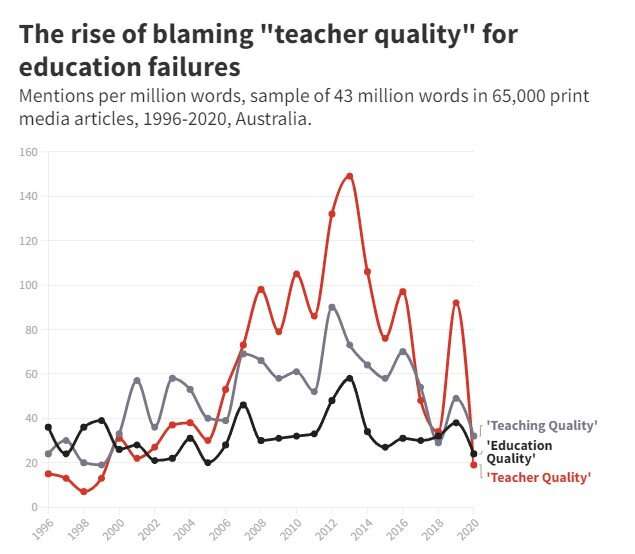
First, my research charts the rise and rise of attention to “teacher quality,” especially between 2006 and 2019. This period covers the start of the Rudd-Gillard “education revolution,” which reframed education in Australia as all about “quality.” It ends with the start of COVID, when reporting on teachers and education temporarily concentrated on home schooling.

My analysis found the focus on “quality” was far more on teachers than, say, teaching approaches, schools, schooling, education systems or anything else.

The graph below shows my tracking of the three most common uses of “quality.”
No wonder no one wants to be a teacher: world-first study looks at 65,000 news articles about Australian teachers
Credit: Author provided, from the book “Constructing Teacher Identities: How the Print Media Define and Represent Teachers and Their Work”

Why is this an issue? It puts the emphasis on the purported deficiencies of individual teachers rather than on collective capacity to improve teaching.

It detracts from system quality—the systemic problems within our education system. “Teacher quality” is a way for politicians to place the blame elsewhere when they should be committing to addressing the root cause of these problems: inadequate and inequitable funding, excessive teacher workload, unreasonable administrative loads, or teachers being required to work out of their field of expertise.

Teachers’ work is made out to be simple (it’s not)

The second key thing I found is media reporting on teachers consistently talks about their work as simple and commonsense, as though all decisions made by teachers are between two options: a right one and a wrong one.

The phrase “teachers should” appears about 2,300 times in my database. Examples include, “teachers should be paid according to how their students succeed,” “teachers should not adopt a cookie-cutter approach to learning,” “teachers should arrive in classes prepared” and “teachers should not be spending time organizing sausage sizzles.”

Research conducted in the 1990s, and still widely referred to by scholars, found teachers make roughly 1,500 decisions in the course of every school day.

Recent research, including some I’m currently doing with colleagues, suggests teachers’ work has greatly intensified and accelerated over the past 30 years. So it’s likely 1,500 decisions per school day is now a very conservative estimate.

These decisions include everything from “what texts will we focus on in English next term?” to “should I ditch what I’d planned for this lesson so we can keep having this conversation because the students are absorbed by it?”.

It also includes social decisions, such as “do I intervene right now and potentially escalate what’s going on at the back of the classroom or just keep a close eye on it for now?”.

Every single one of those decisions is complex. And yet, in media coverage, claims of what “all teachers” or “every teacher” can, should or could do come thick and fast.

Teaching is relentlessly difficult, and while not everyone needs to understand that—in the same way not everyone needs to understand exactly how to conduct brain surgery—we do need to pay some respect to the 300,000 or so Australian teachers who navigate the profession every day. Just because the complexity may not have been evident to us in our 13 years as school students doesn’t mean it wasn’t there.

Teacher-bashing is the norm

Finally, I found stories about teachers were disproportionately negative in their representations. I did find “good news” stories in my research but they were outnumbered by articles that focused on how teachers, collectively and individually, don’t measure up.

This included the linking of “crises” to “poor quality” teachers. Take, for example, former education minister Christopher Pyne’s comment that: “[…] the No. 1 issue, in terms of the outcomes for students, is teacher quality, in fact [the OECD] said 8 out of 10 reasons why a student does well in Australia or badly is the classroom to which they are allocated. In other words, the teacher to whom they are allocated.”

In other words, “teacher-bashing” is the norm when it comes to stories about teachers in the Australian news media.

The PR around teaching needs to change

As we consider what to do to improve teacher numbers in Australia, we need to think about the way we talk about teaching and teachers in the media.

If all people hear is that teachers are to “blame” for poor standards and they should be finding their demanding, complex jobs easy, this is hardly likely to encourage people into the profession. Nor does it give those already there the support and respect they need to stay.


Teachers are leaving the classroom, but the pandemic is not yet to blame


Provided by
The Conversation


This article is republished from The Conversation under a Creative Commons license. Read the original article.The Conversation

Citation:
No wonder no one wants to be a teacher: World-first study looks at 65,000 news articles about Australian teachers (2022, July 11)
retrieved 11 July 2022
from https://phys.org/news/2022-07-teacher-world-first-news-articles-australian.html

This document is subject to copyright. Apart from any fair dealing for the purpose of private study or research, no
part may be reproduced without the written permission. The content is provided for information purposes only.

What mandatory consent education will look like in Australian schools

What mandatory consent education will look like in Australian schools
Consent instruction is set to be mandated in all Australian colleges following calendar year soon after decades of community stress.

The new curriculum will reportedly aim on age-suitable consent and respectful connection education and deal with data about gendered stereotypes, coercion and power imbalances.

But what does this essentially glance like in practice?

A new curriculum will attribute consent schooling reforms soon after it was mandated. (AAP)

This is what we know about the new curriculum and what has adjusted above the a long time in Australian intercourse education.

What has consent education and learning appeared like in Australian universities?

The actual date consent schooling started in Australia is hard to pinpoint having said that Honorary Professor Deborah Ollis at Deakin College said it various across states and territories but the beginnings of sexual intercourse instruction arrived in the 1980s.

“In the 1980s they created the National Statements and Profiles with eight studying parts and 1 of all those areas was health and fitness and physical schooling and into that curriculum again then sexuality training was an location of aim,” Professor Ollis reported.

In the early 1990s the curriculum focused on gender-based mostly violence right after the rollout of the “no worry” useful resource, she stated.

Honorary Professor Deborah Ollis at Deakin University speaks about consent education.
Honorary Professor Deborah Ollis at Deakin College speaks about consent schooling. (Deakin University)

This is when a mandate was specified to Australian educational institutions to educate sex schooling, and this new countrywide curriculum involved consent.

“That was supplied to all Australian educational institutions from prep to year 12,” she explained.

“In that there was a massive ingredient on consent and it was a lot of the spine on the marriage schooling.”

Professor Ollis explained in the early 2000s the language in the curriculum changed to chat about respectful associations “out of a issue of violence towards women”.

“It can be not new, one thing like consent has been protected in the curriculum for decades,” she explained.

So what is the new curriculum all about if consent instruction has been taught for decades?

Perfectly, it has never been mandatory for all faculties to train and the curriculum was open up to “interpretation”.

“Colleges have had enormous flexibility about how they interpret the curriculum,” Professor Ollis mentioned.

This is a vital reason for the adjust and why university student activist Chanel Contos started petitioning for reform a 12 months in the past.

Consent education will be mandated in all Australian schools.
Consent instruction will be mandated in all Australian educational institutions. (Instagram/Liliana Zaharia)

Yet another issue is consent has been bundled in the general public university curriculum but could not constantly be taught in non-federal government educational facilities due to the flexibility around instructing.

“It is really unique when government jurisdictions have curriculum guidelines but I guess in other sectors, religious and non-government educational institutions that could not be the scenario,” Professor Ollis mentioned.

Now that is mandatory, each general public and independent schools will be in a position to have particular suggestions about it.

“Acquiring consent embedded in the countrywide curriculum should make it less complicated for all colleges to train consent and allow them to access curriculum elements that are regular throughout the country,” an Independent Schools Australia spokesperson stated.

What should the curriculum contain?

Just one of the critical items about educating consent is setting up at an early age.

“Age-proper” instruction is a term that is thrown all-around a great deal in this conversation, and that indicates starting up with students in early principal.

It can be taught by a friendship lens from kindergarten and establish up to converse about personal and intimate associations as college students improve up.

Professor Ollis said this implies college students will have a track record being familiar with of consent when they get to the discussions about sexual consent, so it does not arrive as a entire shock.

“College students in Calendar year 1 have to have to recognize issues all over their entire body and that people never have the suitable to touch it without having consent,” Professor Ollis said.

Dr Jacqueline Hendriks from Curtain University extra that modelling consent in an age-proper way could require discussions about no matter whether or not learners really feel comfortable “offering somebody a hug or you want to give a large five”.

With obtain to the web, much more youngsters are gaining accessibility to pornography at an early age, Professor Ollis extra, so teaching media literacy and sexualisation on the net requirements to get started early.

Other criteria Professor Ollis outlined consist of the accurate language all around sexual organs, gender and electric power associations, and sex positivity.

“Consent is considerably extra advanced than just ‘say no’,” Professor Ollis stated.

NSW students will start a staggered classroom return from late October, the state government announced. (AAP)
Authorities said consent instruction must start off from an early age. (9)

What will the new curriculum glance like?

The Australian Curriculum Assessment and Reporting Authority which is dependable for delivering the nationwide curriculum claimed it will fortify “the express educating of consent and respectful interactions” in age-correct approaches.

Dr Hendriks claimed “strengthening” implies applying the word consent in the classroom.

“The language just isn’t specific ample then a faculty can just converse about balanced and unhealthy interactions and skirt all over that with no likely into excellent detail,” she mentioned.

The countrywide curriculum has been endorsed by schooling ministers and will be available to check out next time period, so we cannot be sure of the ins and outs of the curriculum just still.

But Dr Hendriks who has observed the draft of the new curriculum claimed it “seriously mentions” consent and respectful interactions.

She also explained the new curriculum will commence “age-appropriate” consent schooling at an early age, fundamentally from kindergarten.

But Dr Hendriks explained the nationwide curriculum is not always adopted fully by condition and territory educational institutions.

“NSW and Victoria have both explained they will adapt and create their individual curriculum and likewise in Western Australia,” she explained.

So there will however be some flexibility to the curriculum but Dr Hendriks explained the mandate is a “starting up issue” and she hopes getting a countrywide regular will boost the depth of consent education embedded in educational institutions.

A teacher at a NSW school conducts a lesson in the classroom.
Consent education and learning requirements to be accompanied with teacher development. (Edwina Pickles)

The two Dr Hendriks and Professor Ollis emphasised the great importance of professional improvement for lecturers when instructing consent, a little something that has not been addressed in the new mandate.

“You would not hope a maths trainer to educate maths without the need of an adequate track record,” Professor Ollis mentioned.

“Except if we offer in-company skilled advancement for academics in universities we can’t assume them to be addressing these delicate problems.”

Qualified development can look like funding and time for trainer relief to go to external workshops.

Connecting the faculty and community is also crucial in consent training, Dr Hendriks said.

Andrew Forrest, Mike Cannon-Brookes and Scott Farquhar, Gina Rinehart

Australia’s prime 10 richest men and women uncovered

“It is a societal thing and we all require to perform collectively collectively,” she stated.