what the science really says about an American safety obsession.

what the science really says about an American safety obsession.

Last year, health officials in Seattle decided to stop requiring bicyclists to wear helmets. Independent research found that nearly half of Seattle’s helmet tickets in recent years went to unhoused people, while Black and Native American cyclists in the city were four times and two times more likely, respectively, than white cyclists to be cited.

Whether people should wear helmets was not the motivation behind the repeal, King County Councilmember Girmay Zahilay said at the time. “The question is whether a helmet law that is enforced by police, on balance, produces results that outweigh the harms the law creates.” For lawmakers, the answer was clear: The potential benefits of a helmet mandate were not worth the harms it did to marginalized Seattle residents.

But some local bike advocates argued that there was a second advantage: Repealing the law could make riding more safe. Helmet mandates intimidate potential riders, they argued, by framing cycling as an activity so dangerous it necessitates body armor. That, in turn, can suppress ridership, and take away the safety benefits of riding in numbers. The more bicyclists take up space on the road, the more visible they become to drivers. And as cars more regularly contend with bikes, the more consideration bikes will get in conversations about transit safety and road infrastructure.

Other jurisdictions have done away with their helmet mandates too: In 2020 Tacoma, Washington, repealed its requirement; in 2014 Dallas did the same for adults. These repeals push back at the notion that bike safety starts and ends with helmets and suggest that helmet laws might actually pose a risk to cyclists. Now some avid cyclists are going so far as to loudly proclaim forgoing helmets on principle.

I feel unsafe, always, on my bicycle—and for sound reason.

I have been a bike commuter in every city I’ve lived in as an adult, including Minneapolis, Milwaukee, Chicago, Columbus, and New York City. I travel on two wheels for the exercise and fresh air, for environmental reasons, and for independent, efficient mobility.

In exchange, I feel unsafe, always, on my bicycle—and for sound reason. I’ve gotten doored in Times Square. I’m forced to weave in and out of bike lanes to avoid the vehicles that constantly park and loiter there. I hold my breath when a passing truck leaves only a few inches between my shivery flesh and its metal flanks.

I do what I can to protect myself. I use front and rear lights. I gravitate toward roads with designated bike lanes. I signal turns with my arms and ding my handlebar bells to attract the attention of inattentive drivers. And I never, ever leave home without my neon yellow helmet.

But as with many cyclists and lawmakers, I’ve increasingly found myself wondering: How much does my helmet help me, really? Are there costs to our single-minded devotion to it?

In the past 50 years, as helmet designs have become more sophisticated, adult cycling deaths in the United States have not declined—they’ve quadrupled. As I dug into the history of these humble foam-and-plastic shells, I learned that helmets have a far more complicated relationship to bike safety than many seem ready to admit.

In 1883 the League of American Wheelmen paraded in Manhattan to celebrate the group’s third anniversary.

At the time, the penny-farthing’s supersized front wheel offered more cycling efficiency than its predecessor, the velocipede—and also threatened taller falls for riders. Face-dives were a common hazard. A significant-enough number of American Wheelmen took “headers” during their Fifth Avenue procession for the New York Times to notice: “Twenty bicycles were broken in this process but no one suffered anything worse than a good shaking,” the paper remarked.

As mass production made bicycles cheaper and more commonplace, the need for head protection grew increasingly obvious. Cyclists’ earliest choice was a single-use, plant-based pith helmet (basically, a safari hat) that broke upon impact. Next up, a leather halo padded with wool or cotton—referred to as a “hairnet”—did little more than protect a cyclist’s ears and face “from dragging the ground when sliding across pavement,” as the product review website Gearist put it.

It wasn’t until 1975 that the first modern bike helmet, the “Bell Biker,” emerged, with an expanded polystyrene liner and stiff plastic shell. The modern helmet, unlike its predecessors, was designed to cushion collision impacts, absorbing shock so the human head didn’t. This made it potentially lifesaving in slow-speed crashes—for example, if a biker hit a pothole and flew off the handles. “The primary way they protect your head is by their own self-destruction,” said David Halstead, a biomechanical engineer at the University of Tennessee and founder of the Southern Impact Research Center, a private testing company. “I would never ride without one.”

The “bicycle boom” was underway, with an estimated 60 million bikes in use by 1972—a trend kindled by an increase in environmental consciousness, a national energy crisis, and the growing popularity of physical fitness. Though helmets had not yet emerged as bike safety’s primary symbol, their design evolved. They became lighter, thanks to polyethylene terephthalate (or PET, as in a soda bottle or clamshell plastic) and other novel, thin-but-strong plastics. New nylon straps and plastic buckles helped keep everything in place.

Not long after, fueled by concern about head injuries among bike-riding children, jurisdictions around the country began implementing the first mandatory helmet laws for minors. By the 1980s, as scholars have chronicled, cycling advocates, news outlets, and medical literature alike encouraged widespread helmet use. “I am alive today because I was wearing a helmet,” New York state’s bicycle coordinator told the New York Times in 1986 about his collision with a taxicab years prior. In 1999 the U.S. Consumer Product Safety Commission voted unanimously to create mandatory federal safety standards for bike helmets.

Those standards require that helmet manufacturers evaluate their product’s safety performance by dropping a helmeted dummy head made of magnesium about 6.5 feet onto a variety of steel anvils. Accelerometers and gyroscopes inside the dummy measure the impact’s kinetics. The drop test lasts less than two seconds total; the impact itself happens in a third of the time it takes to blink.

You can’t predict a bicycle accident the way you can expect collisions in a football game.

This test, while crude, partially captures the dangers to an unprotected head, which can suffer a life-threatening skull or intracranial fracture after falling from a height of just 18 inches. “The energy’s got to go somewhere—it can be your head, or your helmet,” said Steve Rowson, a biomechanical engineer and director of Virginia Tech’s Helmet Lab, which aims to decrease the incidence of injuries, and in particular concussions, in everything from sports to military contexts.

But lab tests of helmeted dummies in vertical free fall do not capture how most people hit their heads while bicycling.

Studying “real world”–like bike crashes in an artificial setting is itself a scientific challenge. You can’t predict a bicycle crash the way you can expect collisions in a football game, for example; there are simply more variables on the road than on a playing field. (To get around this, Rowson’s lab reverse-engineers the dynamic by acquiring helmets from real bike crashes, CT scanning them to create 3D models of the damage, and replicating crash conditions such as velocity, angle of impact, and surface conditions by plastering the drop-test anvil with adhesive sandpaper and other materials to imitate asphalt or gravel roads.)

Lab tests also fail to capture a whole body in motion, which some experts argue underestimates impact forces. It’s rare in the real world for someone to fall directly onto the top of their head; hitting the ground somewhere between a 30-degree and 60-degree angle is far more typical.

And standard drop tests, critically, don’t factor in the rotational forces at play as a rider falls not only down but forward. These forces—which are akin to bouncing a bobblehead—have been long associated with life-threatening or disabling traumatic brain injury. Among sports-related concussions, including contact sports, “cycling’s normally near the top of the list,” Rowson said. In recent years, helmet manufacturers have developed new “anti-concussion” technologies to reduce rotational forces’ impact on the head; experts are divided about the extent of this extra protection.

An evolution of the bike helmet, as it spins from the earlier pith model to the modern version.

Outside the lab, researchers struggle to study the population-level protection conferred by bicycle helmets.

“The data around bicyclist crashes is very limited,” said Elise Omaki, an epidemiologist at the Johns Hopkins Center for Injury Research and Policy. It’s also often incomplete or biased.

Most crash data come from traffic-safety monitoring systems that happen to catch motor-vehicle-related bike injuries and fatalities. Medical records from bike-crash victims focus on diagnosis, treatment, and outcome, while typically leaving out details of the circumstances of the crash itself; they also fail to capture people who cycle without ever needing medical attention. Insurance claims and police reports catalog some bicycle crashes, but miss plenty: One study by San Francisco’s public health department found that 39 percent of bicyclists who required ambulance transport were not documented in police records. The United States can’t even accurately tally overall bike helmet use.

In this absence, several meta-analyses have pooled together existing studies to gauge the protective effect of bike helmets.

One—a roundup of 55 studies between 1989 and 2017—found that helmet use reduced serious head injury by 60 percent, mild head injury and traumatic brain injury by about 50 percent, and the total number of seriously injured or killed cyclists by 34 percent. But its author, Alena Høye, a traffic-safety researcher at the Institute of Transport Economics in Norway, had some major caveats. For one, Høye pointed out, helmets offer more injury protection in single-bicycle crashes. “Bicycle helmets have only limited potential to protect from serious head injury in high energy impacts or when a cyclist is overrun by a motor vehicle,” she wrote. Høye also noted that many studies concluding that people who wear helmets are less likely to suffer a head injury don’t account for the simple fact that helmet-wearers may be more generally cautious. (The opposite is true too: Non-helmeted cyclists are more often under the influence of alcohol or riding without light in the dark, and are more likely to be involved in single bicycle crashes.)

Epidemiologists who have studied mandatory helmet laws have drawn mixed conclusions, with some showing a reduction in overall head injury rates and others suggesting that those trends may be better explained by improvements to cycling infrastructure, as well as educational safety campaigns that provide free helmets or teach defensive-biking techniques.

More than a decade ago, Ian Walker, an environmental psychologist at Swansea University in the U.K., set out to study the effect of helmets on drivers.

His experimental series involved riding around in a variety of cycling outfits, including a “long feminine wig” meant to stand in for female riders, a stereotypical spandex cyclist suit, and a vest embossed with “Novice Cyclist.” In each, Walker measured how much space passing cars afforded each rider “type.”

Walker—who was struck by buses and trucks alike during his research—found that traffic passed significantly closer when he rode farther from the road’s edge, and that it gave more space to “female” riders (again, Walker in a wig). Notably, Walker discovered, motorists and commercial truck drivers in particular afforded less space—not more—to helmeted cyclists. In his second experiment, the only outfit that widened the average passing distance granted by motorists was a vest that prominently featured the word “Police” and warned that the rider was video-recording their journey.

Helmets, we know at the very least, are not an adequate safeguard for protecting riders from the most dangerous threat they’ll encounter on the road.

Cyclists are statistically more likely to die in urban areas, if alcohol is involved, and if they are male. In 2020 two-thirds of bicyclist deaths in the United States occurred in motor-vehicle traffic crashes, according to National Center for Health Statistics mortality data. That year, 938 cyclists were killed in traffic crashes, up almost 100 deaths from the year before; in 5 out of every 6 crashes with a single vehicle, the car, truck, or bus first hit the cyclist from behind—likely without spotting the rider until it was too late.

“Looking at helmets as a solution is very shortsighted,” said Alison Dewey, the League of American Bicyclists’ education director. “It’s like a tertiary, or even farther down of a level, to keep you safe.”

After a drunk driver going 60 mph in his 3,500-pound BMW hit and killed cyclist Eric Ng, the New York Times pointed out that he had been helmetless. “Mentioning whether or not Eric wore a helmet is akin to blaming an egg for cracking against a pan,” wrote Ng’s friend and journalist Jessie Singer in their 2022 book There Are No Accidents. Cycling advocates have long argued that finger-wagging over helmet use unfairly shifts blame onto the most vulnerable people on the road instead of targeting risks at their source.

“What’s really kind of lurking over everything is that you are exposed to danger from private motor vehicles,” said Robert Davis, chair of the U.K.-based cycling advocacy group Road Danger Reduction Forum. “You go out there and it’s your job to watch out. It’s your job to grab hold of some product.”

From a zoomed-out perspective, helmets are simply not the road-safety panacea we want them to be. Several analyses suggest that U.S. riders are more likely to wear helmets compared with cyclists in other countries—all while suffering the highest fatality rate per distance traveled. Research shows that among a 14-country cohort, the Netherlands enjoyed the lowest bicyclist fatality rate per mile traveled. The Dutch also largely eschew the helmet: 73 percent of adults and 84 percent of children in the Netherlands report they never wear a helmet while bicycling. There’s a simple reason for that. Surveys show that Dutch residents feel safe biking, and attribute that sense of security to the country’s long-standing cycling culture and network of dedicated cycling lanes.

“We have this unquestioned idea that the roads are there for cars.”

— Robert Davis

“They made it safe so that people don’t feel the need to wear helmets,” Davis said. “They think of cycling as a normal activity,” not as one that is inherently dangerous. This Dutch helmet paradox demonstrates the scale—cultural and infrastructural—of problem-solving required to address traffic safety.

But in cultures where transit prioritizes convenience for motorists, that’s a hard sell. “Our roads and systems were really designed around car users,” Omaki said. Davis agreed from his side of the Atlantic. “We have this unquestioned idea that the roads are there for cars,” he said.

A spinning caution sign turns into a overcrowded "Share the Road" sign.

Putting the responsibility of safety solely on individual shoulders all but guarantees failure, said Kathleen Bachynski, an assistant professor of public health at Muhlenberg College, in Allentown, Pennsylvania, who has studied bike helmet and sports injuries. “It’s an enormous burden,” she said. Asking individuals to spend money on helmets, lights, and reflective gear without investing in better transit culture ignores the fact that the real danger to cyclists comes from behind the wheel, not from behind handlebars.

“We can talk about bike helmets because it’s something we can blame for individual decision-making,” said Alison Bateman-House, an ethicist and medical historian at New York University who has studied mandatory helmet laws.

In 2019 the National Transportation Safety Board released a report analyzing bicyclist safety—something it hadn’t done for 47 years. It targeted many recommendations at changing driver behavior and road infrastructure.

The fear that I feel biking in cities isn’t actually a fear of biking; it’s a fear of cars.

For one, the NTSB suggested reducing traffic speeds, pointing to data that show that bicyclist crashes at locations with speed limits of at least 50 mph were more than five times as likely to result in fatal or serious injuries than were crashes in speed-limit zones of 25 mph or less. The safety board also encouraged federal motor-vehicle standards to require evaluating headlights in real-world settings, and for the auto industry to modify collision avoidance systems to detect bicycles. It encouraged municipalities to invest in bicycle-compatible drainage grates and maintenance-hole covers, as well as to repurpose traffic lanes into separate travel lanes for cyclists, more pedestrian space, or additional street parking.

Increases in cycling transit—prodded by bike-share programs and the growing adoption of tricycles as well as recumbent, tandem, and foldable bikes—could also transform our car-centric culture into one that is safer for all road users, Dewey said. “To many motorists, it’s often forgotten that that’s a person,” she said. “The more we can open that tent and bring people in, the more, I think, empathetic that person will be as a motorist.”

When it comes to the dangers threatening cyclists, wearing a helmet is like bringing a knife to a gunfight. America’s top-selling vehicle model, the Ford F-Series, weighs up to 7,500 pounds. Its hood stands 4.5 feet tall—at the height of my chin. The fear that I feel biking in cities isn’t actually a fear of biking; it’s a fear of cars. Only a suite of infrastructure changes can combat the deadliest risk to cyclists. Not helmets alone. As a spokesperson for helmet-maker Giro told a cycling trade magazine in 2020: “There are many misconceptions about helmets, unfortunately,” adding: “We do not design helmets specifically to reduce chances or severity of injury when impacts involve a car.”

Regardless, experts I spoke to were unanimous about what these flaws don’t mean: that helmets are useless. They all believe you should wear one. “Every time I see someone on a bike in New York City without a helmet, it makes me sick to my stomach,” said Bateman-House. (For my part, I agree.) It may not save you from a car crash, but in a slow-moving fall, “it can be the difference between life and death,” said Rowson, who runs the Helmet Lab.

During the COVID-19 pandemic, public-health experts popularized the “Swiss cheese” harm-reduction model: the notion that imperfect protection stacked together can provide more safety than any single layer could on its own.

For infectious diseases, this ideally means combining individual measures such as mask-wearing and hand-washing with broader policies such as paid sick leave, widespread remote work, and universal access to tests, treatments, and vaccines. For bike safety, this would mean a combination of personal behaviors, like wearing helmets and using bike lights, and infrastructure, like protected bike lanes and reduced speed limits.

During the pandemic, much of the U.S. showed resistance to this kind of profound social and structural change, which would have saved lives but would have also required money, sacrifice, and consensus. “We chose not to do that,” Bateman-House said. We’re approaching bike safety, for the time being, with the same attitude. And those of us waiting for a safer ride are left to don our plastic shells and hope for the best.

How to improve American students’ math skills

How to improve American students’ math skills

In the past two a long time, scientists have made excellent strides in uncovering how little ones learn math, but tiny of that new expertise has trickled down to academics, in accordance to a new ebook on math education and learning.

The hole involving exploration and follow is specifically unlucky, provided the current state of American students’ math skills, said Nancy Krasa, co-writer of How Children Learn Math: The Science of Math Mastering in Analysis and Apply.

&#13

American kids are not executing nicely at math. In 2019, only about a person-fourth of high school seniors scored at or higher than the proficiency degree in math. And all indications are that this has only gotten worse with the studying loss associated with the COVID-19 pandemic.”

&#13
&#13

Nancy Krasa, Adjunct Assistant Professor of Psychology, The Ohio State University

&#13

But there is a way to fulfill this problem, in accordance to Krasa, who is a certified psychologist specializing in youngsters with understanding issues, which include individuals who have issues with arithmetic.

“The scientific investigate on how children learn math has exploded in the previous 20 years, with countless numbers of new experiments centered on how small children occur to understand quantities and numerous other features of math,” she mentioned.

“The problem is that tiny of this do the job has been obtainable to teachers on the front line.”

Krasa mentioned she and her co-authors, Karen Tzanetopoulos and Colleen Maas, wrote How Small children Find out Math to deliver the most up-to-date discoveries in math finding out to lecturers and moms and dads and give them research-dependent ways to instruct the fundamentals to youthful college students. The e book focuses on toddlerhood by way of the finding out of fractions.

A superior instance of one of the new discoveries is understanding spatial skills. The importance of spatial skills in early math is one of these crucial findings that has not made it to early education and learning lecturers, Krasa said.

Most persons believe of spatial skills in conditions of geometry, but modern research indicates that a person’s spatial competencies are linked with their math abilities much more usually.

“Which is anything most lecturers would have no notion about, but the benefits are remarkably regular,” she reported.

“What is not but solely crystal clear is how they are similar – why do folks with fantastic spatial techniques have an much easier time with math?”

One particular speculation is that humans think of numerical portions alongside a psychological number line, as if they existed in place. Just one authentic-life classroom software is that a actual physical variety line in the classroom, if thoroughly applied, may possibly help teach youthful youngsters about figures.

But investigation exhibits that youngsters begin producing spatial skills even just before they get to faculty. Just one way extremely younger kids understand spatial capabilities is by enjoying with blocks.

A single analyze Krasa and her co-authors mention in the guide located that when mothers and their 3-year-olds build with blocks alongside one another, the total of spatial language, connected gestures, and preparing guidance the moms deliver predicts the children’s math ability in initially grade.

The influence of enjoying with blocks and its effects on spatial competencies goes effectively over and above the early grades.

Yet another examine discovered that children’s preschool block-creating techniques predicted their large college math training course selections, math grades and standardized math scores.

One particular implication of modern investigation is that youngsters ought to be screened for spatial competencies early in lifestyle, just as they are for looking through competencies, Krasa reported. The fantastic news is that “spatial capabilities are trainable, particularly if we can discover those who want assist early.”

Another essential discovering of the latest research is the importance of language in learning arithmetic, she claimed.

“Math language is quite summary. Students may well realize math ideas far better with acquainted terms, this kind of as ‘and’ alternatively of ‘plus’, for illustration.”

“Also, math is not separate from studying. Analysis has shown that small children with reading through disabilities, specifically dyslexia, are at a excellent threat for math failure.”

A single review uncovered that of small children who experienced been identified with a developmental language disorder in kindergarten, 55{e4f787673fbda589a16c4acddca5ba6fa1cbf0bc0eb53f36e5f8309f6ee846cf} experienced major math complications by the fifth quality – far more than 10 occasions the price discovered in the standard population.

Irrespective of the alarming figures about math awareness amongst American kids, Krasa said doing work on the reserve has persuaded her that the problem is not hopeless.

“I consider that with the correct supports, all youngsters in the typical assortment of intelligence can understand math. Even with troubles like poverty, reading and language incapacity, weak spatial capabilities and attentional concerns, they can master and recognize the basic concepts,” she stated.

The crucial is that students have to get started early, or, if they never, they have to go back and start out with the fundamentals. Math abilities and principles that students discover in significant university are crafted on those from elementary faculty – and individuals are developed on capabilities realized in preschool and at residence.

That indicates several of the problems that learners confront in large college obtain their roots in early math education.

“If we’re going to get it right, we have to commence from the commencing,” Krasa stated.

The U.S. failure in math schooling is not the fault of academics, she mentioned. They are carrying out the finest they can presented their teaching and the problems they facial area.

“We want lecturers to have the latest research on how youngsters actually learn math so they can assist flip factors close to. That’s why we wrote this e book.”

The ebook delivers functions that are conveniently easy to understand for instructors and mothers and fathers, but that aren’t presently becoming utilized in most classrooms, she reported.

These new approaches are desperately necessary.

“Plainly, a thing is not functioning in math education in this region. We could be performing significantly, substantially much better,” Krasa stated.

ELAM: Living through history – Odessa American

ELAM: Living through history – Odessa American

It is claimed that most live by significant alterations in record devoid of noticing it.

Sequoia Funds (the agency which backed Apple, Google, and Air-bomb) apologized to its traders for its $150M publish-off of FTX.

Wall Avenue Journal Wednesday

233 a long time just after the founding of America’s Structure, we are dwelling in a fast-shifting earth, does any person understand it? Let us consider a appear.

College shut-downs owing to COVID alerted dad and mom to what their young children were being and were being not understanding in university. This has been a improve for residence-schooling and discovering pods. A mastering pod is a volunteer group of moms and dads arranging non-public instruction for their youngsters. General public schools and recently ousted boards, consider observe.

Get the job done from home may perhaps endlessly modify the concept of the workplace. By now, former places of work are being transformed to personal condos.

Mobile telephones, cheap laptops, and the net also have created perform from house possible, but what have we dropped in personal interaction?

As official increased training (university) gets at any time much more high priced, Google Certificates and on the career Amazon style instruction are radically switching this market place. Is any individual in greater ed noticing?

The COVID shut-in led to ‘streaming companies for enjoyment.’ Sit-in theaters had been squashed but Netflix and Disney, each down over 50{e4f787673fbda589a16c4acddca5ba6fa1cbf0bc0eb53f36e5f8309f6ee846cf}, have unsuccessful to increase their content material for shareholders.

Technology results in billionaires on the way up, but chews portfolios to bits on the way down (Sequoia above). Railroads had been the tech craze of the 1800s. But the proliferation of strains intended couple as quite a few went broke as designed funds. Radio Company of The united states peaked in 1929 but did not recuperate right until the early 1950s. The FANG stocks have all tumbled. Now those people companies are laying off countless numbers of employees. Can even whiz CEO Musk deal with Twitter?

Similar intercourse relationship and questioning just who a single is are now mainstream, did anybody count on that?

As described very last week, we are in the third early warning period of problems on Wall Avenue. Those would be the dot.com crash, the sub-key home finance loan crash, and what will this 3rd a person be termed as soon as it is in excess of?

The Dow Industrials feel to be searching for 34,400. That ought to conclusion the current rally.

I imagined crude oil might go to its 200 7 days moving normal around 65. Its sharp spike might have finished at $75 this 7 days. The reality of the EU squeezed for electricity by Russia and the Biden’s war on oil and gas is noticed. This should really mark this as the lower in price as winter sets in, see Buffalo, NY as an instance.

NEW: Arlington sets record after again ranking No. 1 on American Fitness Index | ARLnow

NEW: Arlington sets record after again ranking No. 1 on American Fitness Index | ARLnow
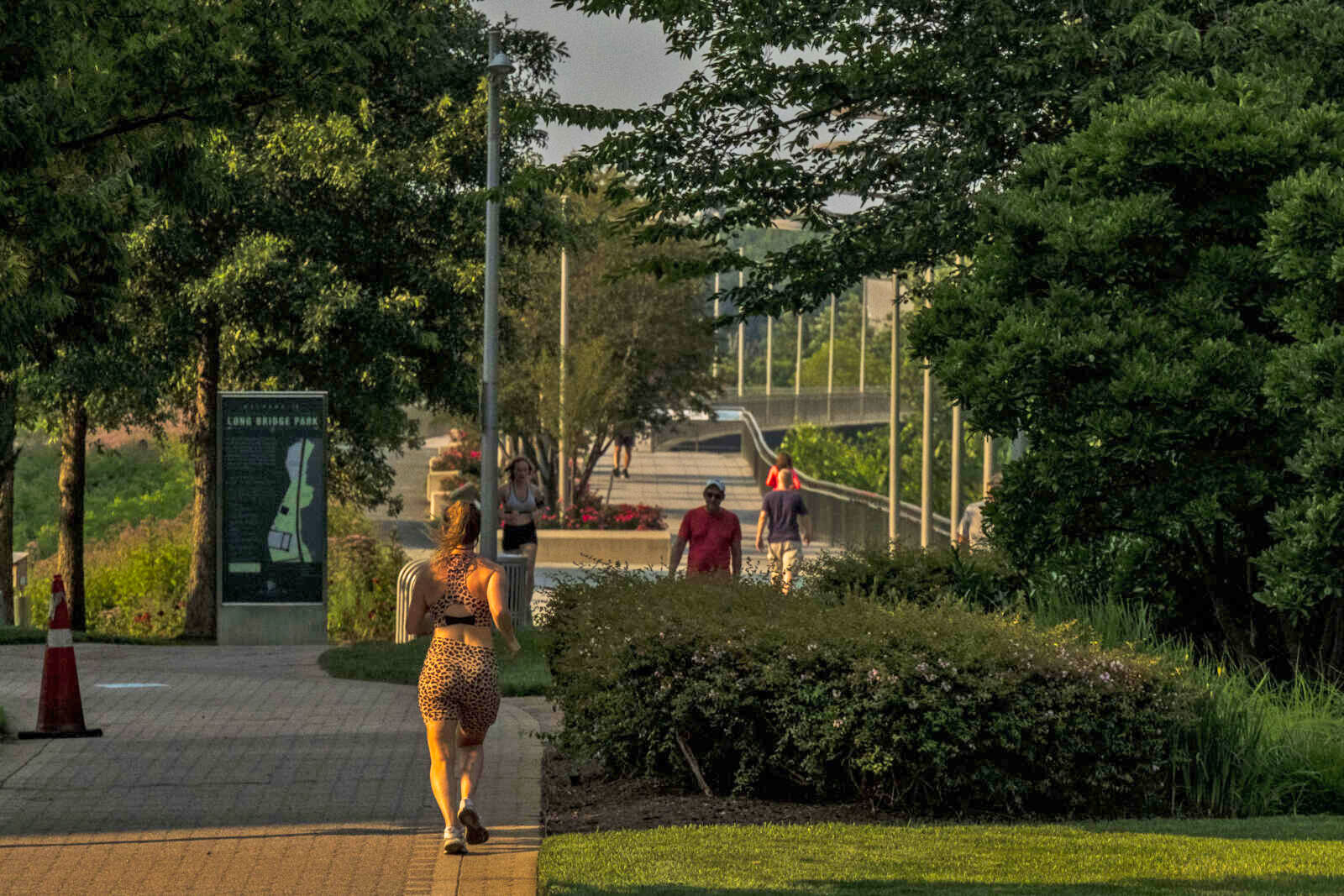
Runners in Long Bridge Park in Crystal City (team picture by Jay Westcott)

Arlington has rated No. 1 on the American Fitness Index for a history fifth yr in a row.

The county topped the listing, posted by the American Faculty of Sports activities Drugs (ACSM) and the Elevance Health and fitness Basis, after placing initial in the nation in 6 separate exercise and health groups. The new rankings have been introduced this morning.

“Arlington, Virginia, gained its No. 1 designation for the fifth time, a Conditioning Index file, by ranking first in six indicators and scoring amongst the prime 10 towns in 19 of the 34 groups,” ACSM explained in a push launch. “Arlington was ranked No. 1 in both of those the own health and neighborhood/ecosystem sub-scores.”

The groups for which Arlington received leading marks, out of the 100 U.S. localities indexed by ACSM, are below.

  • {e4f787673fbda589a16c4acddca5ba6fa1cbf0bc0eb53f36e5f8309f6ee846cf} doing exercises in the final 30 days (Arlington 93.8{e4f787673fbda589a16c4acddca5ba6fa1cbf0bc0eb53f36e5f8309f6ee846cf}, metropolis typical 77.6{e4f787673fbda589a16c4acddca5ba6fa1cbf0bc0eb53f36e5f8309f6ee846cf})
  • {e4f787673fbda589a16c4acddca5ba6fa1cbf0bc0eb53f36e5f8309f6ee846cf} in excellent or pretty superior overall health (Arlington 70.1{e4f787673fbda589a16c4acddca5ba6fa1cbf0bc0eb53f36e5f8309f6ee846cf}, metropolis normal 55.9{e4f787673fbda589a16c4acddca5ba6fa1cbf0bc0eb53f36e5f8309f6ee846cf})
  • {e4f787673fbda589a16c4acddca5ba6fa1cbf0bc0eb53f36e5f8309f6ee846cf} physical overall health not good for the duration of the previous 30 times (Arlington 16.1{e4f787673fbda589a16c4acddca5ba6fa1cbf0bc0eb53f36e5f8309f6ee846cf}, town average 27.5{e4f787673fbda589a16c4acddca5ba6fa1cbf0bc0eb53f36e5f8309f6ee846cf})
  • {e4f787673fbda589a16c4acddca5ba6fa1cbf0bc0eb53f36e5f8309f6ee846cf} with superior blood force (Arlington 15.2{e4f787673fbda589a16c4acddca5ba6fa1cbf0bc0eb53f36e5f8309f6ee846cf}, city typical 30.4{e4f787673fbda589a16c4acddca5ba6fa1cbf0bc0eb53f36e5f8309f6ee846cf})
  • {e4f787673fbda589a16c4acddca5ba6fa1cbf0bc0eb53f36e5f8309f6ee846cf} with stroke (Arlington .4{e4f787673fbda589a16c4acddca5ba6fa1cbf0bc0eb53f36e5f8309f6ee846cf}, city typical 3.2{e4f787673fbda589a16c4acddca5ba6fa1cbf0bc0eb53f36e5f8309f6ee846cf})
  • {e4f787673fbda589a16c4acddca5ba6fa1cbf0bc0eb53f36e5f8309f6ee846cf} with diabetic issues (Arlington 5.2{e4f787673fbda589a16c4acddca5ba6fa1cbf0bc0eb53f36e5f8309f6ee846cf}, city normal 10.3{e4f787673fbda589a16c4acddca5ba6fa1cbf0bc0eb53f36e5f8309f6ee846cf})

Arlington’s overall rank was 85, when compared to an typical of 51.7, even though the county’s individual overall health rank was 86.8, when compared to an ordinary of 50.5.

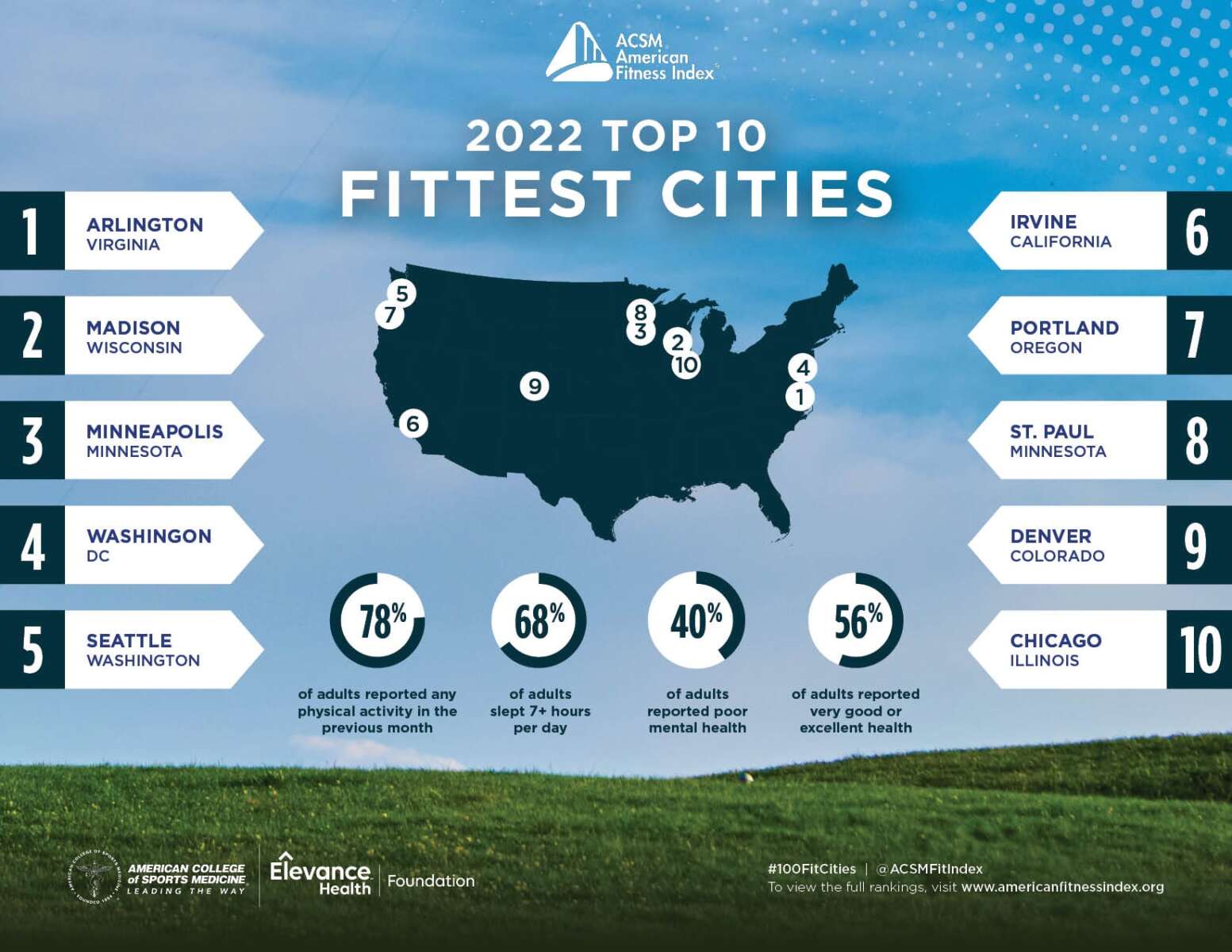
2022 Exercise Index Top rated 10 Infographic (courtesy ACSM)

There was fantastic news for a country in as a total in this year’s rankings, with ACSM reporting an “increase in the percentage of Individuals exercising in the prior month (77.6{e4f787673fbda589a16c4acddca5ba6fa1cbf0bc0eb53f36e5f8309f6ee846cf}) sleeping 7+ hrs/working day (68{e4f787673fbda589a16c4acddca5ba6fa1cbf0bc0eb53f36e5f8309f6ee846cf}) and reporting great/very very good well being (55.9{e4f787673fbda589a16c4acddca5ba6fa1cbf0bc0eb53f36e5f8309f6ee846cf}), because past year’s Conditioning Index.”

An excerpt from this morning’s press release is below.

Arlington, Virginia, has been named “America’s Fittest City” in the once-a-year American Physical fitness Index® rankings released by the American Faculty of Athletics Medicine (ACSM) and the Elevance Well being Basis, the philanthropic arm of Elevance Wellness.

The ACSM / Elevance Conditioning Index evaluated America’s 100 major towns making use of 34 proof-based mostly indicators. Rounding out the leading 10 fittest metropolitan areas are Madison, Wisconsin Minneapolis, Minnesota Washington, D.C. Seattle, Washington Irvine, California Portland, Oregon St. Paul, Minnesota Denver, Colorado and Chicago, Illinois (first time in the best 10). Full rankings and scores, a summary report, town comparison instrument and other insights are accessible on the Fitness Index web page.

“Congratulations to all those city leaders and planners who led initiatives to produce parks and playgrounds, establish bicycle paths and safe and sound streets, and supply a constructed atmosphere that encourages actual physical action,” stated Shantanu Agrawal, M.D., main wellbeing officer of Elevance Health and fitness. “As we entered a different yr of the pandemic, wellness disparities in our communities ongoing to be an challenge, which only encourages us to deal with wellbeing equity head on. We ended up also confronted with a further yr of reduction, illness, and isolation, resulting in the need for improved mental wellbeing. As we start to return to our previous routines, we need to underscore the important psychological and actual physical wellbeing gains work out in our life.”

Now in its 15th 12 months, the Health Index gives city leaders useful research to make probably lifestyle-switching conclusions in coverage, devices and environmental adjust procedures that push physical fitness and well being enhancements in their communities.

As psychological wellbeing concerns grow promptly throughout the country, this year’s Health Index gives statistical evidence relating to the problem’s scope. On common, 39.6{e4f787673fbda589a16c4acddca5ba6fa1cbf0bc0eb53f36e5f8309f6ee846cf} of inhabitants in the Exercise Index metropolitan areas noted bad mental overall health. Almost 58{e4f787673fbda589a16c4acddca5ba6fa1cbf0bc0eb53f36e5f8309f6ee846cf} of older people in the U.S. understand a pandemic-relevant destructive impact on psychological or mental well being. Towns reporting the highest charges of poor mental wellbeing (outlined from highest to least expensive) involve New Orleans, Louisiana Laredo, Texas San Francisco, California Washington, D.C. San Jose, California Madison, Wisconsin Lubbock, Texas Stockton, California Riverside, California and Cincinnati, Ohio.

There is fantastic news. Study has demonstrated actual physical action – both equally aerobic and strength coaching – to be effective in stopping and cutting down signs and symptoms of panic and melancholy, increasing temper and self-esteem, and increasing good quality of snooze.

ACSM issued a statement in August 2021 and is featuring methods on the positive aspects of physical activity for individuals with psychological health and fitness concerns

“The Fitness Index Advisory Board hypothesized that poor mental wellbeing issues might be a considerable variable simply because the pandemic disrupted just about every stage of our lives, some a lot more than others,” claimed Stella Volpe, Ph.D., R.D.N., ACSM-CEP, FACSM, chair of the American Conditioning Index Advisory Board. “Our selection to hone in on this crucial element was accurate. We identified that towns ranked in the major 25 tended to rating nicely in personalized well being indicators on the other hand, there was one particular exception – mental health. 4 cities in the top rated 25 also rated amongst the cities with the poorest mental well being.”

ACSM and the Centers for Sickness Regulate and Avoidance (CDC) recommend at minimum 150 minutes per 7 days of reasonable-depth cardio activity, about 22 minutes for every day. They also propose muscle mass strengthening action two times a week. Volpe said 22.4{e4f787673fbda589a16c4acddca5ba6fa1cbf0bc0eb53f36e5f8309f6ee846cf} of grownups in the Health Index metropolitan areas described no workout in the earlier thirty day period, and only 50.9{e4f787673fbda589a16c4acddca5ba6fa1cbf0bc0eb53f36e5f8309f6ee846cf} satisfied the cardio action recommendations, whilst an even lesser share (23.8) met the guidelines for both aerobic and power things to do.

“Increases in actual physical exercise are possible to enable minimize the mental overall health load,” claimed Volpe. “This underscores the want for nearby community leaders to step up and make bold paying out choices, policy choices, and infrastructure variations to boost opportunities for citizens to be bodily lively and wholesome. Nearby neighborhood actions that modify individual behaviors also cut down being overweight fees, incidence of continual disorder and anxiety. ACSM and the Elevance Well being Basis now employ year-round training and outreach routines close to the Conditioning Index success to aid discover requires in every single town and contribute to possible answers.”

American Society for Radiation Oncology welcomes new VP of Education and Director of Diversity, Equity & Inclusion

American Society for Radiation Oncology welcomes new VP of Education and Director of Diversity, Equity & Inclusion

Newswise — ARLINGTON, Va., June 1, 2022 — The American Society for Radiation Oncology (ASTRO) not long ago employed Chris Neumann as its new Vice President of Finding out and Schooling, and Kirsta Suggs as its initial Director of Diversity, Equity and Inclusion (DEI).

As the head of ASTRO’s training division, Neumann prospects the medical society’s academic programming, which includes the nation’s major conference devoted to radiation oncology and the ASTRO Academy, an on the net library of digital programs, webinars and continuing clinical instruction (CME) assets. He also oversees attempts to grow and diversify ASTRO’s education choices, this sort of as rising access to learning opportunities by delivering a lot more stay virtual things to do and personalized-curated OnDemand content material.

Neumann has in depth working experience main education and learning initiatives for health care societies, including tenures as Director of Schooling at the American Roentgen Ray Culture (ARRS) and the Affiliation for Healthcare Philanthropy (AHP). In those roles, he oversaw the enhancement, implementation and analysis of nationwide health care conferences and on the net education and learning systems. Prior to that, he served as Interim Govt Director of the American Affiliation for Actual physical Activity and Recreation (now Condition The united states).

“Chris delivers to ASTRO significant comprehension of the fast-transforming educational landscape for professional medical specialists,” reported ASTRO CEO Laura Thevenot. “He has previously implemented enhancements to our future Annual Meeting, this sort of as reside-streaming every session for virtual attendees and which include OnDemand obtain to all assembly content with every single registration.”

Suggs is ASTRO’s first director dedicated to diversity, fairness and inclusion (DEI) initiatives. In this job, she sales opportunities the progress and implementation of a assortment of DEI plans and initiatives across the society, which include strategies to engage and retain a numerous membership that superior signifies the client communities radiation oncologists serve, as well as efforts to mitigate heath fairness disparities for men and women with cancer and other precedence DEI subjects that are determined as section of an forthcoming cultural audit. Suggs also oversees ASTRO’s early-job improvement systems together with its Aspiring Researchers and Medical professionals Method, Minority Summer time Fellowship, Leadership Protégé Pipeline and citizens committee, and she is the most important team liaison to ASTRO’s lately established Overall health Fairness, Range and Inclusion Council.

Before signing up for ASTRO, Suggs invested two many years as a essential contributor to the strategic route of the Endocrine Society’s DEI attempts, such as 15 a long time targeted on establishing profession improvement and DEI initiatives. Suggs produced the society’s flagship management growth education packages to develop endocrinology’s pipeline of underrepresented minority scientist and health practitioner leaders, and she also formulated academic programming about overall health disparities and other DEI problems.

“Kirsta brings to ASTRO a wealthy history in making pathways to aid people today from underrepresented minority communities in drugs and science,” reported Thevenot. “ASTRO is committed to developing a more powerful, a lot more various specialty. We are psyched to have Kirsta sign up for us in this significant job and to function with her and our volunteers to increase ASTRO’s portfolio of DEI and early-job enhancement initiatives.”

ABOUT ASTRO

The American Society for Radiation Oncology (ASTRO) is the premier radiation oncology society in the environment, with nearly 10,000 customers who are doctors, nurses, biologists, physicists, radiation therapists, dosimetrists and other wellbeing treatment professionals who focus in dealing with people with radiation therapies. For information and facts on radiation remedy, visit RTAnswers.org. To find out much more about ASTRO, take a look at our web site and comply with us on social media.

Meadville Elementary School raises more than $10,000 for American Heart Association | Education

Meadville Elementary School raises more than ,000 for American Heart Association | Education

Mentor Sunshine Martin, who is a bodily training trainer at Meadville Elementary School, prepared and implemented a wide variety of actions for the Kid’s Heart Problem, earlier regarded as Bounce Rope for Coronary heart, at Meadville Elementary School this calendar year.

Getting everybody included in the prepared functions compensated off in the end.

Pupils, teachers, administration, workers and local community involvement led to Meadville Elementary School elevating $10,141.98 for the American Heart Association.


Meadville

Meadville Elementary Faculty nurse, Tina Slabach, receives iced down from all students who arrived at the $30 degree for the Kid’s Heart Obstacle.


Pupils grew to become concerned with raising income for the American Coronary heart Association by participating in the Kid’s Coronary heart Obstacle at the school. As pupils reached selected monetary ranges, they ended up authorized to do distinct enjoyable issues to employees associates.

At the $15 stage, students acquired to shade blast a selected teacher at the $25 degree, they had been allowed to foolish string a trainer at the $30 stage, they had a possibility to ice the nurse a pie in the encounter of a specified trainer was authorized for all those learners achieving the $40 amount and so forth.


Meadville

Haley McKinney, teacher, gets a pie in the experience from a learners who reached the forty greenback amount for the Kid›s Coronary heart Problem.


The highest monetary degree was $100.

College students who lifted $100 for the Kid’s Coronary heart Problem obtained the chance to tape a designated personnel member to the wall/basketball poles. As college students achieved certain aims, they not only bought to do their prize achievement, but also all the prizes beneath their amount.

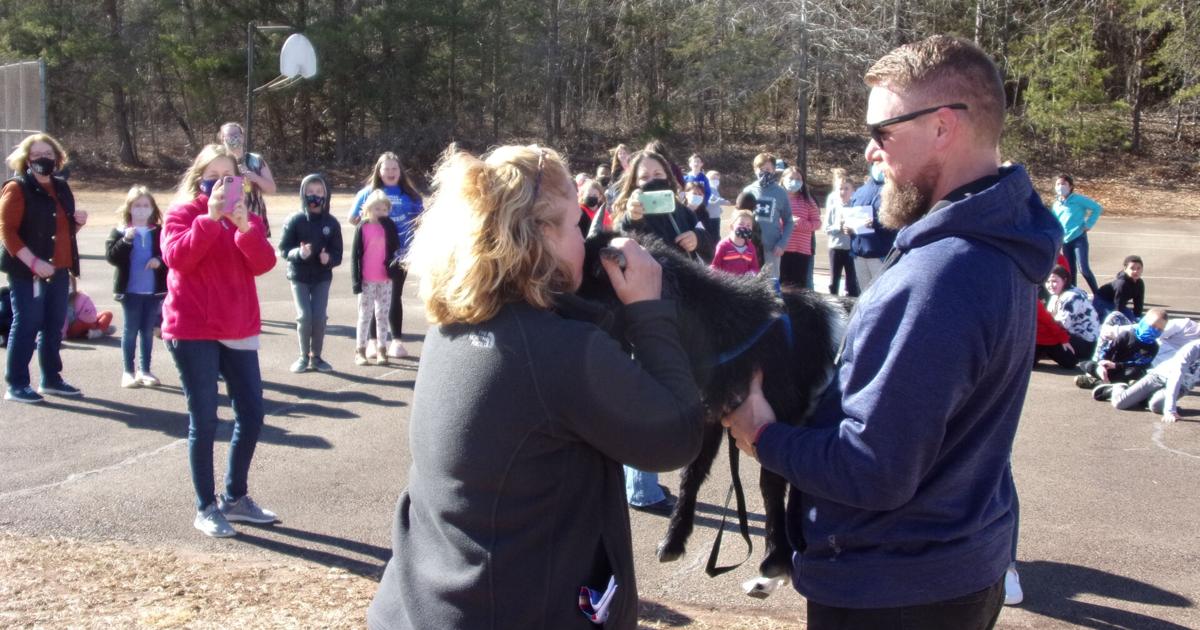
For achieving and exceeding the $10,000 mark for the Kid’s Heart Challenge, college students acquired to see coach Martin kiss a goat, and to their surprise, see the principal, Kevin Neal, kiss the goat in appreciation for all the assistance from every person for the duration of this school function.

The prime four fund raisers, Brooklyn Skipworth, Ian Smith, Chase Hudson and Emma Gentry, acquired to have their picture taken on a fire truck from Liberty Volunteer Fire Division.


Meadville

The best 4 fund raisers for the Kid’s Coronary heart Challenge at Meadville Elementary University are pictured with a fire truck from Liberty Volunteer Hearth Department. They are Brooklyn Skipworth, Ian Smith, Chase Hudson and Emma Gentry.


Skipworth, over-all leading fund raiser for the party, savored a journey house in the hearth truck after university with the appears of sirens and flashing lights in motion.