Do you feel stressed? Has your fitness routine lagged due to COVID-19 or for other reasons? You might need a new challenge to get back on track. Walk Across NWA can help you!
It’s not too late. Register for the Fall 2021 Program and gain access to Health and Wellness resources from the U of A Division of Agriculture and make a difference in the environment. Participation is free. Registration is open now and the program lasts through Nov. 7.
Online registration is available at walk.uada.edu. More details are located on the following sites: uaex.uada.edu/nwa-wellness along with on the Facebook Page @NWALivingWell and our NWA Living Well Facebook Group to receive additional support with stress management, nutrition tips, healthy recipes and more.
Earlier this year, 890 Arkansans statewide participated in the Spring 2021 Walk Across Arkansas, logging 1,469,867 minutes, with 217 teams from counties walking across the state. Many of those participants reported they had more energy, slept better, controlled stress, strengthened relationships, lost weight or inches and improved their blood panels and blood pressure.
Physical activity can lower the risk of early death, coronary heart disease, stroke, high blood pressure, high cholesterol, Type 2 diabetes, metabolic syndrome and some cancers, according to the Centers for Disease Control and Prevention. Exercise also helps with weight loss and can improve mood and energy level and help us stress less.
National physical activity guidelines recommend that adults achieve at least 150 minutes of aerobic physical activity and two strength training sessions per week, and youth need at least 60 minutes of exercise daily.
To participate, find a few friends, classmates, family members or co-workers to form a team and register online. If you do not know others who are interested, make up a team name and be a team of one. Joining a team provides support to help you reach your goals, but team members do not have to be physically active together. Then, through Nov. 7, just record the number of minutes you spend walking, jogging, gardening or getting any other form of exercise. You can do any type of physical activity to increase your heart rate or break a sweat.
Minutes can be logged online daily or entered weekly, or you can contact your local County Extension Agents for paper forms. Team captains can log in minutes for team members. Even if you do not have an email address, this program is still for you.
For more information about Walk Across NWA, contact the Washington County Family and Consumer Sciences Extension Agent Anna Goff by email at agoff@uada.edu, or you can call or text 479-841-1212 or office 479-444-1755. In Benton County, contact Family and Consumer Sciences Agent Trudy McManus at tmcmanus@uada.edu or 479-271-1060.
Have some fun this fall with friends and family — physically distancing of course — and make a difference as you get healthy with Walk Across NWA.
Special thanks to Jamie Baum at the U of A Center for Human Nutrition for support in promotion of this program.
The University of Arkansas System Division of Agriculture offers all its Extension and Research programs and services without regard to race, color, sex, gender identity, sexual orientation, national origin, religion, age, disability, marital or veteran status, genetic information, or any other legally protected status, and is an Affirmative Action/Equal Opportunity Employer.
School life is full of stress and anxiety at every level. Studying, researching different topics, and making summaries every day can make a student’s life stagnant and boring, resulting in depression and failure.
To help prevent such issues, most schools have incorporated physical education classes. These classes involve several physical activities that help in improving the quality of students’ lives.
Importance of Physical Education (PE)
PE allows students to enjoy and succeed in various physical activities. Students get to develop several skills and the ability to use strategies, compositional ideas, and tactics to perform successfully both physically and academically.
During participation, students think about what they’re doing, analyze their situation, and make informed decisions. As a result, they develop confidence and understand the importance of healthy lifestyles.
Other Benefits of Physical education include:
Encouraging a healthy and active lifestyle
Nurturing sportsmanship in all aspects of competition
Assists students to reach their physical potential in a variety of sporting environment
Develop their confidence
Promote physical body image in teenagers, especially among girls
Benefits of Running for Student
What type of activity is running? Running or jogging is a popular form of physical activity. Running appeals to many individuals since it doesn’t cost a lot to take part and you can run anywhere, anytime.
Running is an essential part of physical education. Any free physical education essay example at https://gradesfixer.com/free-essay-examples/physical-education/ talks about the benefits of running for the young body of students. The benefits include improvement of overall health and academic performance.
With the help of essays, students will learn how to get better at running. Also, they will get new ideas on how to write and improve their content and essay paper structure. With that said, let’s look at the various benefits of running.
Improved cardiovascular health
Running prepares your heart for heavy loads so you won’t feel any discomfort and pain when lifting your heavy backpack. Short jogs during physical education class help to increase the contractions of your heart muscle per minute. As a result, you will have a healthy cardiovascular system.
Helps students learn about perseverance
Just like any sport, improvement doesn’t happen overnight. Therefore, running can help students learn about the power of perseverance and practice. As they run regularly, their stamina and performance improve. They will also discover that they can stick to something and succeed, even if it seems hard.
Improves confidence
Besides physical health improvement, running can boost your confidence and self-esteem. Confidence can have a positive aspect in all areas of a student’s life. It will help a kid integrate quickly and make friends.
Relives Stress
At school, many things can trigger stress, from endless coursework to bullying. Running can help reduce stress and anxiety, which can cause some health and mood-related problems. Stress can also affect a student’s appetite and sleep quality.
When you jog, you push your body to utilize excess energy and hormones, thus alleviating stress and anxiety. In addition, running eliminates the risk of experiencing tension headaches.
Improve brain and memory health
Enhanced brain and memory well-being are among the many health benefits of running, especially for students. As a physical activity, running helps to increase blood flow to your brain. As such, your brain receives sufficient oxygen. Enough oxygen in your brains means improved memory, reaction, and other characteristics of your body. Also, it means improved academic performance – you will understand and memorize different concepts easily.
How to make running as safe as possible for students
Physical education teachers must select the best running shoes for students. The shoes should fit well and have good support with a thick shock-absorbing sole. Students should also avoid wearing socks made from 100{e4f787673fbda589a16c4acddca5ba6fa1cbf0bc0eb53f36e5f8309f6ee846cf} cotton. When cotton gets wet, it stays wet, meaning you will have blisters during summer and cold feet if it’s winter.
To prevent injuries while training and running:
Students should receive sports physical before they run
Train sensibly, by increasing distance and speed gradually
Stretch and warm-up before running
Stop running if they feel pain or get hurt
Additionally, students should dress for the weather. If it’s cold, they need warm layers of sweat-wicking fabric, gloves, and a hat. During hot days, they need extra water and light-colored clothing.
Conclusion
Running as part of physical education is incredibly beneficial to the student’s body, mind, and spirit. Short runs can leave the student feeling more energized, focused, and healthy.
A student who runs regularly will experience improved mental health and increased academic performance.
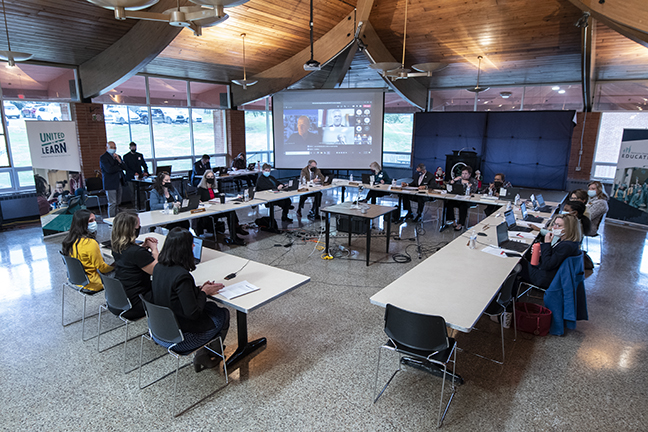
The Kentucky Board of Education held its Dec. 1 regular meeting on the campus of the Kentucky School for the Deaf.
The Kentucky School for the Deaf (KSD) had the opportunity to host the Kentucky Board of Education (KBE) on its campus for the board’s regular meeting on Dec. 1. As part of a packed schedule, the board approved a regulation relating to the use of corporal punishment.
A 1982 Kentucky statute permits the use of corporal punishment by teachers for the purpose of maintaining classroom discipline. In 2019, the legislature passed KRS 158.4416, which requires KDE to provide resources related to, and requires districts to adopt, trauma-informed discipline policies. Trauma-informed discipline policies seek to balance accountability with an understanding of traumatic behavior.
“There is a persistent rub between our work related to trauma-informed discipline and the permissive statute KRS 503.110,” said Matthew Courtney, policy advisor in KDE’s Office of Continuous Improvement and Support (OCIS).
Based on the KBE’s authority to promulgate regulations related to student discipline and student welfare, he said KDE saw fit to bring forward the regulation to place guardrails around corporal punishment and what it looks like in Kentucky.
Courtney clarified it is the stance of KDE that corporal punishment is not a trauma-informed discipline resolution, and should not be used in Kentucky public schools. KDE has actively fought to prohibit corporal punishment for about 30 years.
The American Academy of Child and Adolescent Psychiatry suggests that corporal punishment at school may be harmful to students and may increase problematic behaviors, may hurt a student’s ability to self-regulate and make it harder for them to develop trusting and secure relationships with adults. Many other national advocacy organizations have taken a similar stance.
Since corporal punishment cannot be viewed through a trauma-informed lens, KDE applied a harm reduction approach in drafting the new corporal punishment regulation.
“This should not be seen in any way as an endorsement of corporal punishment from the department or the board,” said Courtney. “This is the next step in what has been a 30-year mission to end corporal punishment in Kentucky.”
The regulation defines corporal punishment as the deliberate infliction of physical pain by any means upon the whole or any part of a student’s body as a penalty or punishment for misbehavior. It also seeks to exempt from corporal punishment students with an Individual Education Plan (IEP), 504 plan and those who are classified as homeless or are in foster care.
If a district chooses to allow corporal punishment, the regulation requires schools to get written consent from a student’s legal guardian within the first five days of the school year if the guardian wishes to allow corporal punishment to be used as a behavior intervention for their child. Before administering corporal punishment, the school must receive an additional verbal consent from the student’s parent or guardian.
The corporal punishment must be administered by a principal or assistant principal and must be in the presence of at least one additional certified staff member who is of the same gender as the student. Each corporal punishment incident must be recorded in the student information system.
After administering corporal punishment, the student must receive a minimum of 30 minutes of counseling provided by the school guidance counselor, school social worker, school psychologist or other qualified mental health professionals by the end of the next school day.
Each local school board must adopt a policy that either prohibits or allows use of corporal punishment. There currently are 156 districts in Kentucky that explicitly prohibit the use of corporal punishment in their district policy manuals. Four school districts have permissive policies and 11 have no clear corporal punishment policy.
“I’m on record as saying I consider this a barbaric practice,” said Education Commissioner Jason E. Glass. “I’m embarrassed that it exists anywhere in the state of Kentucky.”
KBE Chair Lu S. Young said she received several comments encouraging the approval of the regulation
“We do know that there is an effort afoot to engage the General Assembly in a conversation about revising the statute in such a way to ban corporal punishment entirely,” said Young. “In the absence of such a statute, I applaud this work.”
Now that the regulation is approved by the KBE, it will be filed with the Legislative Research Commission on or before Dec. 15. Depending on various steps in the legislative review process, the regulation will likely become effective near July 2022.
Early literacy initiatives
KDE Chief Academic Officer Micki Ray discussed Kentucky’s early literacy initiatives and ways KDE’s Office of Teaching and Learning (OTL) is working to support local schools and districts in addressing students’ literacy needs.
According to Ray, between 2015-2019, approximately 118,000 Kentucky students in 3rd grade performed below proficient on the K-PREP reading assessment. In 2019, a total of 47.3{e4f787673fbda589a16c4acddca5ba6fa1cbf0bc0eb53f36e5f8309f6ee846cf} of Kentucky’s 3rd-grade students did not meet proficiency on the K-PREP reading assessment.
Ray said this issue goes beyond assessment scores. Students who are proficient in reading by the 3rd grade are more likely to have continued academic success; less likely to have problems with attendance, dropout rate and juvenile crime; more likely to feel higher self-esteem and feelings of adequacy; and more likely to break the cycle of intergenerational poverty.
Ray discussed early literacy initiatives, including the Read to Achieve (RTA) grant. The RTA grant is a two-year, renewable grant that, per KRS 158.792, was “created to help teachers and library media specialists improve the reading skills of struggling readers in the primary program.” Applications are currently being taken for the next round of Read To Achieve grants.
At its Sept. 30 meeting, the Reading Diagnostic and Intervention Grant Steering Committee approved the grant size and range of awards and the request for applications (RFA) notice as specified in KRS 158.794 and 704 KAR 3:408. Since the time the RFA was released, KDE has received questions and concerns about the current RFA. Some of those questions were from potential applicants through the RFA question-and-answer process. Other concerns have been sent more informally through the KBE’s public comment documents.
KDE is committed to the success of RTA programs to assist struggling readers throughout the state. KDE does have the option of amending the RFA and extending the deadline to apply. At the close of the RTA question period, KDE anticipates amending the RFA to provide clarity and address some concerns. As it has done to date, KDE must continue to comply with statutory requirements regarding RTA grants, regulatory requirements of the KBE and state procurement requirements for RFAs.
Since this involves an active RFA, KDE is unable to provide details of exactly how the RFA may be amended. However, KDE is committed to the successful implementation of reading intervention programs for struggling readers throughout the Commonwealth.
In other business, the board:
Presented the Kevin M. Noland and Mary Ann Miller Award for Outstanding Public Service to Kentucky Schools to Reeca Carver, state advisor for the Family Career and Community Leaders of America at KDE;
Heard updates from AdvanceKentucky Executive Director Anthony Mires and KDE’s Ray;
Heard an update from KDE Associate Commissioner Robin Kinney on the KDE Employment Report;
Heard from KDE Associate Commissioner Kinney and Division Director Karen Wirth on the audit update and expense reports;
Heard an overview of the recommendations of the School Facilities Task Force;
Heard a report from the Council on Postsecondary Education;
Heard a report from Deputy Secretary of the Education and Workforce Development Cabinet Mary Pat Regan;
Heard Glass present the commissioner’s report;
Approved consent agenda items:
New District Facility Plans;
Amended District Facility Plans;
2020-2021 school year Local District Working Budgets and Local District Tax Rates Levied;
702 KAR 1:115, Annual In-Service Training of District Board Members;
Amendments to 704 KAR 19:002, Alternative Education Programs;
Request to withdrawal emergency regulations 702 KAR 1.191E and 702 KAR 7.125E;
704 KAR 3:395, Extended School Services;
Heard a year in review update from 2021 Kentucky Teacher of the Year, Donnie Piercey;
Listened to a presentation from Kentucky School for the Deaf Principal Toyah Robey and KSD students;
Approved the recipient of the 2021 Kevin C. Brown Strategic Priority Award;
Approved KBE’s legislative priorities;
Approved the federal Carl D. Perkins Consolidated Annual Report;
Approved emergency regulation 702 KAR 1:191E, District Quarantine Leave, which allows any fully vaccinated district employee that is quarantined by a licensed treating physician, physician’s assistance, advanced practice registered nurse, local health department, Department for Public Health or local school district to be eligible for paid leave;
Approved certification of 702 KAR 7:140, School Calendar, to prevent expiration; and
Heard a litigation report from KDE General Counsel Todd Allen.
It’s almost time for gym class, and my fifth grader can’t find her tennis ball.
“Adrienne, did you take it?” she demands of her younger sister, who swears she didn’t (though she probably did).
“How about a soccer ball?” I ask. They’re practicing dribbling skills.
“No, Mom,” she says firmly. “We’re indoors.” It has to be a tennis ball. She searches under the coffee table and behind the couch; scours her sister’s cluttered room. No tennis ball.
This is what remote phys ed looks like in our house.
And this is what it sounds like: Thundering footfalls from the bedroom above my office, as my third grader jumps over virtual dinner plates, dodges pixels of pumpkin pie and karate-chops cartoon carrots in a Thanksgiving-themed online fitness game that her PE teacher is using as a warmup.
The coronavirus pandemic and the resulting widespread shift to remote learning have brought major changes to phys ed in the United States. Gone are the team sports played in wide-open fields behind the school. In their place are Turkey Ninja Warrior and water-bottle bowling, solitary pursuits conducted couch-side, in spaces as small as a studio apartment. Rolled up socks and laundry baskets have replaced balls and nets, as schools seek everyday alternatives to stranded sports equipment.
The author’s daughter, Emma, 11, practices water-bottle bowling in her living room. Credit: Kelly Field for the Hechinger Report
The PE instructors I spoke with said the students seem to be having fun — the ones they can see on video, at least. Privacy policies in many districts bar teachers from requiring students to keep their cameras on, and some students don’t.
But it’s hard to gauge if they’re getting the same benefits from online PE as they did from in-person classes. Some students lack the equipment, space or parental support to participate fully. Instructors say it’s tough to teach and assess motor skills, like catching and kicking, online.
Meanwhile, public health experts say kids need exercise more than ever.
“PE is so important, because our kids are sitting from 8 to 3,” said Michelle Huff, a high school PE teacher in New Jersey.
In a majority of districts, students are spending some or all of their school days online. They’re missing out on recess and extracurricular sports, many of which have been cancelled for safety reasons. And they’re eating more junk food, according to research from Ireland and Italy. Public health experts here are worried about unhealthy eating too. Compounding these issues, many students around the country live in crowded apartments or in neighborhoods where it’s not safe to exercise outside. In some cities, parks are closed due to the pandemic.
If school closures continued through the end of this year, childhood obesity rates would climb by more than 2 percent.
If school closures continue through the end of this year, childhood obesity rates will climb by more than 2 percent, according to estimates in a recent study by a researcher at Washington University in St. Louis.
And though there’s little hard data on how much exercise kids are getting right now, the anecdotal evidence is that they are not moving as much as they should. In surveys Huff conducted this fall with 200 students at Metuchen High School, students said they had headaches from staring at the screen, that their backs hurt from sitting, and that they weren’t retaining anything.
Related:How a growing number of states are hoping to improve kids’ brains: exercise
School-age children should get an hour or more of moderate-to-vigorous physical activity daily, according to the Centers for Disease Control and Prevention. Students in elementary school should spend 150 minutes a week in PE while students in middle and high school should receive 225 minutes a week of PE instruction, according to recommendations from the Society of Health and Physical Educators (SHAPE), which represents PE and health instructors.
The benefits of exercise for children are well-established. Children who are aerobically fit are not only physically healthier than their sedentary peers — their brains are more developed, too, said Charles Hillman, a psychology professor at Northeastern University. His research indicates that fit children appear to have more mature prefrontal cortices and hippocampi — the parts of the brain associated with attention, memory and self-regulation, and by extension, academic achievement.
Exercise can also alleviate depression and anxiety — conditions that have intensified in many students during the pandemic. And it’s critical to combatting childhood obesity, which affects one in seven kids between the ages of 10 and 17 nationally, with even higher rates among low-income children and children of color.
“You have to keep them moving, because if they aren’t focused, if they have too much energy, they aren’t going to learn anything.”
Leslie Monterrosa, a second-grade teacher in Concord, California
Yet, even before COVID-19 shut down schools, fewer than half the states set any minimum amount of time that students must participate in PE, according to SHAPE.
With much of PE now online, some kids are getting even less time in class than before. In March, California’s governor waived the state’s time requirement, prompting some districts to eliminate PE as a stand-alone class or make it an elective. At least two Massachusetts districts have eliminated elementary PE altogether this year, according to the president of the state’s SHAPE chapter.
Portland, Oregon nearly laid off all its elementary adaptive PE instructors, who work with children with disabilities, before teachers defeated the move. Neighboring Hillsboro, a diverse city, was less lucky: The district reassigned all but one of its 15 elementary PE instructors to classroom positions to meet Oregon’s pandemic class size guidelines. That left the lone remaining gym teacher to teach 11,000 students asynchronously by creating Google slides for them to use.
Advocates for phys ed fear more cuts could be coming, as districts grapple with looming budget cuts stemming from the current economic downturn. And if the Great Recession is any guide, those cuts could fall hardest on high-poverty districts, where students already have less access to afterschool sports than in wealthier ones.
“Not all students have the privilege of taking ballet classes or sports clubs,” said Julia Stevens, the president of Oregon’s SHAPE chapter.
Related: Immigrants find hope in soccer, but some states won’t let them play
For now, though, PE instructors are focused on finding creative ways to keep their kids engaged. They’re sending kindergarteners on scavenger hunts that have them running around their homes to collect items. They’re challenging high schoolers to “beat the teacher” by performing more push-ups in a minute than their instructor.
“We’re disguising fitness,” said Brett Fuller, the president of SHAPE’s national board of directors, and a curriculum specialist for health and physical ed within Milwaukee Public Schools. “You can’t just do a fitness class, because kids will say it’s no fun.”
Back in New Jersey, Huff is working hard to make her classes fun. She’s created Tik Tok dance and exercise challenges, some of them with her sister, a PE teacher in another school. (And she’s not the only gym teacher embracing Tik Tok.) She’s also teaching students movement and mindfulness exercises they can perform, even during Zoom classes.
Since most kids don’t have a whole lot of gym gear in their homes, SHAPE’s reopening guidance recommends that teachers ask students what they do have on hand and provide a checklist of common household items that could be repurposed as sports equipment.
Some substitutions are simple — cut plastic gallon milk cartons for catching, or unopened canned soup for weights. Others are trickier. Kyle Bragg, an elementary school PE instructor in Scottsdale, Arizona, said he’s yet to find an acceptable alternative to a jump rope; nothing rotates at the same speed. He’s told kids to ask their parents to buy one, but he can’t force them. So for now, he’s stuck with some students jumping over pillows.
“It’s kind of like taking a pencil away from a classroom teacher,” he said. “It’s nearly impossible to meet a jump rope standard without a jump rope.”
Some districts are purchasing take-home kits containing jump ropes, balls and bean bags. But the kits can be pricey, and not all districts can afford them. In normal times, the median budget for PE equipment and supplies is just $764 a year per school, according to a 2016 report by SHAPE.
So some teachers are soliciting supplies online, through sites like DonorsChoose.org. Between July 1 and Dec. 1, teachers submitted 860 requests (out of 181,000 total) that referenced virtual PE, according to Christopher Pearsall, the website’s vice president for brand and communications. The most sought-after items, by far, were jump ropes.
“It’s kind of like taking a pencil away from a classroom teacher. It’s nearly impossible to meet a jump rope standard without a jump rope.”
Kyle Bragg, an elementary school PE instructor in Scottsdale, Arizona
One of the requests came from Leslie Monterrosa, a second grade teacher in Concord, California. She knows her low-income, English language learners tend to live in small apartments and have busy working parents, so she asked for equipment they could use on their own, in small spaces — jump ropes and bean bags. A donor stepped up within days.
“You have to keep them moving, because if they aren’t focused, if they have too much energy, they aren’t going to learn anything,” she said.
Some instructors are offering students choices: If they don’t have the equipment they need for one activity — say soccer — they can try another, like running. The alternative might not target the same skills, but at least it gets them moving.
And in the midst of a pandemic that has upended nearly every aspect of education, some standards may simply need to be set aside for a bit, instructors say.
“You gotta be OK with OK,” David Daum, an assistant professor of kinesiology at San Jose State University in California, said he tells teachers. “If you are trying hard, your students will see it. Just do your best.”
The hardest things to teach and evaluate online, instructors say, are the skills, strategies and collaboration involved in team sports. There’s just no way to play soccer alone in your living room.
Related: Ed tech can transform physical education classes, too
That’s why online PE courses — which have existed at the high school and college levels since at least the late 1990s — have historically favored fitness-based instruction, like interval training and biking, over the development of gross motor skills like jumping and throwing. Covid-era classes seem to be following the same trend, said Daum, who researches online PE.
This neglect of motor skills in online PE courses has been one of the chief criticisms of the delivery of classes via the internet. In its guidelines for online PE, SHAPE argues that the development of motor skills competence is “the highest priority of physical education,” and should be a “central component of any online physical education course.”
During the pandemic, some teachers have been asking students to send short video clips of themselves performing individual skills, like jumping rope. (Cooperative skills, like passing a ball, are harder to measure, since not everyone has a partner.) But there are limitations and drawbacks to that approach: Some parents aren’t comfortable with their children sharing videos of themselves and some students send clips that are far too long. With dozens of students per grade, reviewing the submissions can take an instructor hours.
The alternative is to conduct assessments in livestream classes, but that can open students up to ridicule and cyber-bullying. Some districts have policies stating that students can’t be required to keep their cameras on.
In such districts, it can be hard to tell if students are participating at all. They might be doing jumping jacks, or they might be watching YouTube.
To gauge participation, many instructors are asking students to answer a question in a chat box or complete an exit ticket with questions about the lesson and their own performance. Some schools with fully asynchronous PE are relying on the honor system, with students using logs to report how much exercise they get each day.
It’s unclear how many students are actually doing the portions of PE that aren’t livestreamed. Are busy working parents enforcing it? Given the hassle involved — one lesson in our house required my daughter to collect no fewer than seven household items — should parents just send their kids out to play instead?
No, said Stephanie Morris, the CEO of SHAPE America. Outdoor play is great. But PE is about more than just being active, she said. It’s about “learning skills to be healthy.”
Related: Schedules for distance learning are all over the place (and it’s making parents crazy)
Despite the challenges involved in remote learning, Fuller, SHAPE’s president, sees the pandemic as an opportunity to show that PE is not only about team sports. Teachers are learning technological skills that “none of us ever dreamt they’d have,” he said. And students are discovering that fitness can be fun, even without group games.
“Sitting on a couch in front of a computer may be some people’s dream job, but it drives me crazy.”
Andrew VanDorick, an elementary PE teacher in Maryland
“I see this as an opportunity to do things differently, to really showcase what we should be about,” he said, “and that is developing physical literacy: the skills, knowledge and attitudes to be physically active for a lifetime.”
Still, many PE instructors said they’re eager to return to the gym and sports fields.
“I became a PE teacher because I needed to keep moving,” said Andrew VanDorick, an elementary PE teacher in Maryland. “Sitting on a couch in front of a computer may be some people’s dream job, but it drives me crazy. I can’t wait to be back in front of the kids.”
Oh, and that missing tennis ball? Turns out it isn’t essential after all. When it vanishes again, just in time for water-bottle bowling, my 11-year-old substitutes a lacrosse ball — and rolls a spare.
This story about phys ed was produced by The Hechinger Report, a nonprofit, independent news organization focused on inequality and innovation in education. Sign up for the Hechinger newsletter.
The Hechinger Report provides in-depth, fact-based, unbiased reporting on education that is free to all readers. But that doesn’t mean it’s free to produce. Our work keeps educators and the public informed about pressing issues at schools and on campuses throughout the country. We tell the whole story, even when the details are inconvenient. Help us keep doing that.
COURTESY PHOTOS Andra Wilson, a health and physical education teacher at Laguna Blanca School, has received the 2021 Faculty Excellence Award. Andra Wilson is known for her dedication to keeping students healthy through her physical education classes.
Andra Wilson has received Laguna Blanca’s 2021 Faculty Excellence Award.
Ms. Wilson has taught physical education, health, wellness and personal development since 2006 at the school, which has campuses in Hope Ranch in Santa Barbara and Montecito.
She also has served as assistant athletic director, P.E. coach at Camp Cito day camp and coordinator of the Middle School Advisory Program for several years.
Mostly recently, Ms. Wilson became Laguna’s Challenge Success coordinator.
“Andra infuses energy and excitement into every role she has on campus,” Laguna Blanca staff said in a news release. “Her love for health and wellness extends not only to Laguna students but to the faculty and staff as well. She was instrumental to bringing bi-weekly on-campus workouts to campus for Laguna employees through Reveal Fitness.”
During the pandemic, Ms. Wilson helped students before they were allowed back on campus. She presented 20 one-minute virtual fitness challenges that kept students and faculty healthy during the pandemic. “It was the perfect example of her athleticism and the joy she brings to teaching,” Laguna Blanca staff noted.
“This year alone, Andra stepped into a multitude of challenges and added COVID responsibilities to her plate in order to best serve her students,” said Melissa Alkire, head of the Upper School. “This was evidenced in the Middle and Upper athletic training program that she began when all other schools in the county were neither in-person nor able to maintain in-person afternoon activities for their school.
“Andra’s work across every single grade at Hope Ranch ensured that our students were finding balance and joy after their early days of remote school,” Ms. Alkire said in the news release. “When sports began, Andra supported Director of Athletics Jason Donnelly fully as he worked to unpack the COVID guidance, which was evolving each week. She was his teammate and demonstrated her strong character in this role.”
In addition, Ms. Wilson partnered with Pacific Pride Foundation to hold inclusive conversations about relationships and gender identity.
“I wish we could have an entire faculty full of Andras,” colleague Tara Broucqsault said. “She has thrived at each level at Laguna. Her pure heart inspires all those fortunate enough to call her teacher and a trusted colleague.”
Ms. Wilson grew up in Malvern, Pa., and earned a bachelor’s in health and physical education at West Chester University in West Chester, Pa. She began her career as a collegiate-certified athletic trainer before completing her Pennsylvania teacher certification in 2003.
Then she worked as a health and physical education teacher in Pennsylvania’s Central Bucks School District before moving in 2006 to Santa Barbara and teaching at Laguna Blanca School.
Despite the unprecedented challenges and disruptions of the past year, we continue to see examples of Americans finding innovative ways to stay active and healthy. Some have moved their workouts into their living rooms or garages. Others have taken up new sports. Many have simply rediscovered the satisfaction of a walk through their neighborhood. Despite this creativity, far too many people struggle to incorporate regular physical activity into their daily lives. Socioeconomic disparities, lack of opportunities for safe play, and limited access to programs for increased activity are just a few of the inequities that many Americans face — inequities that have been further exacerbated by the pandemic. During this National Physical Fitness and Sports Month, we encourage all Americans to stay active for their health and wellbeing. Whether by pursuing a more active lifestyle, making physical activity a priority and an essential part of everyday living, or supporting efforts in local communities that increase access to sports and physical fitness opportunities for all, participating in physical activities leads to a healthier lifestyle.
Physical activity is one of the best tools we have to help combat chronic diseases experienced by over half of all Americans. Even a single session of moderate-to-vigorous physical activity can boost your mood, sharpen your focus, reduce your stress, and improve your sleep. More regular physical activity — over months or years — can contribute to a reduced risk of depression, heart disease, several types of cancer, dementia, type 2 diabetes, and obesity.
No matter our age or ability, the more that we can make regular physical activity and participation in sports a part of our lives, the better off both we and our Nation will be. Greater amounts of physical activity can have positive effects in every stage of life and lead to better overall health outcomes for both children and adults, including those with disabilities. The Department of Health and Human Services’ Move Your Way campaign provides helpful tips to encourage children and adults to meet the recommendations from the Physical Activity Guidelines for Americans. The Centers for Disease Control and Prevention’s Active People, Healthy Nation initiative provides a blueprint for building active communities to make it easier for all Americans to attain the physical activity they need, with a goal of getting 27 million more Americans physically active by 2027.
By transcending differences and uniting in celebration of physical activity, healthy competition, and shared enjoyment, sports are a fun and engaging way to stay active and keep fit for people of all ages. For our Nation’s youth, playing sports can also help to build confidence on and off the field, while team sports foster the added virtues of service to common causes and communal responsibility — win or lose, every game offers the opportunity to learn something new or hone your skills. Every athletic challenge is an avenue to greater mental and physical resilience. While social distancing has made participation in organized sports challenging, we can use this time to renew our focus on fundamental skills and training in preparation for a return to play, especially for young athletes.
Our Nation can and must do more to make sure that every child has the opportunity to play sports and obtain the benefits that come with play, including greater physical fitness and better health. As we recover from the COVID-19 pandemic, it is more important than ever that we ensure equal access to sports and fitness activities for everyone. To that end, my Administration continues to promote programs that provide opportunities for all of our young people to play sports — regardless of their race, ethnicity, sex, sexual orientation, gender identity, religion, disability, or neighborhood — in support of the National Youth Sports Strategy.
I encourage every American to discover an enjoyable exercise activity that fits into their daily routine. It does not matter how you choose to be active — whether you are trying your hand at a new sport, exploring a local park, or going for a walk or a jog in your own neighborhood, physical activity holds the key to better health and wellness. During National Physical Fitness and Sports Month, let us all strive to be more active together.
NOW, THEREFORE, I, JOSEPH R. BIDEN JR., President of the United States of America, by virtue of the authority vested in me by the Constitution and the laws of the United States, do hereby proclaim May 2021 as National Physical Fitness and Sports Month. I call upon the people of the United States to make daily physical activity a priority, to support efforts to increase access to sports opportunities in their communities, and to pursue physical fitness as an essential part of healthy living.
IN WITNESS WHEREOF, I have hereunto set my hand this thirtieth day of April, in the year of our Lord two thousand twenty-one, and of the Independence of the United States of America the two hundred and forty-fifth.