Education Beyond Zoom | Twin Cities Business

Education Beyond Zoom | Twin Cities Business

When the pandemic hit in 2020, production work in the taconite mines in northeastern Minnesota slowed way down. Yet mining companies still needed to provide health and safety training to their employees. With lockdowns in place, how were they going to do that? 

Since the 1970s, this training had been provided by the miner safety and health training program through Minnesota State’s five northeastern Minnesota colleges. The federal Mining Safety and Health Administration (MSHA) mandates that all such training must be done in person. That requirement was rescinded temporarily in the spring of 2020, and courses shifted to 100 percent online. As Hibbing Community College safety and health instructor Eric Lund notes, “We’re still in that status as we speak.” 

During the pandemic, about 4,200 students have been trained. Minnesota State’s training program also has extended its reach, providing its health and safety courses to students in other states—and in Iceland and New Zealand. The program has had international trainees before, but they had to fly in for a couple of days of face-to-face sessions. Now, Lund says, “they can do that training virtually from their home countries.” 

Online education wasn’t invented in response to the pandemic. Minnesota’s colleges and universities had been offering virtual courses and degrees for several years before the coronavirus reared its ugly, spiky head. But in March 2020, Minnesota’s colleges and universities were forced to move their courses online. Nearly two years after the onset of the pandemic, schools, employers, and students have learned a lot about digital education.

Institutions of higher learning have made changes to what educators call “modalities”—the different ways education is delivered. They’re redesigning classrooms in ways that accommodate both online and in-person learning. They’re tapping new digital tools that go beyond Zoom. They’re creating more courses that are completely digital, or a blend of virtual and in person. 

That’s because students, faculty, and the schools themselves have gotten used to online education and experienced its advantages and flexibility. Even after many students—mostly undergraduates—have returned to campus, it’s unlikely that higher education will return to a pre-pandemic normal. 

Staying flexible

Like other colleges and universities, Saint Mary’s University of Minnesota shifted to completely online learning formats beginning in March 2020. Saint Mary’s traditional undergraduate campus was mostly back to class and the face-to-face format by the fall of 2021, says Andrea Carroll-Glover, vice provost for online strategy and programs. The university still offers fully online courses “to provide that flexibility to our students, and to ensure that our traditional undergraduate students are able to graduate with the technology skills that employers are looking for.” 

On the bachelor completion and graduate side, the university is continuing to explore new opportunities online. Beyond fully online programs, Saint Mary’s also is offering more hybrid undergraduate programs, which combine online and in-person time. “It has really changed quite a bit in terms of how we think about our portfolio, how we think about delivery modalities, and how we’re able to serve our students in living our mission by leveraging flexible learning models with opportunities for practical application,” Carroll-Glover says. 

Online education programs rely on platforms called learning management systems (LMS). In the fall of 2020, Saint Mary’s shifted to an LMS called Canvas. “This elevated the student experience,” Carroll-Glover says. Thanks to Canvas, the online teaching and learning experience became “mobile friendly, much more intuitive, and enhanced the faculty’s teaching experience,” she adds. For instance, faculty can use new mobile features to see when students are posting assignments or discussions. 

Building on Canvas, Saint Mary’s integrated an online recording and streaming platform called Panopto to ensure it had strong video capabilities. The university also incorporated a tool into its Canvas LMS called Ally, which helps instructors provide alternative formats to make their courses more accessible for people with disabilities. For instance, Ally can help teachers accommodate students with color blindness through the use of more visible text colors and image captioning. 

Carroll-Glover says that Saint Mary’s strong online experience has attracted many transfer students from other colleges. It also has allowed the university to extend its geographical market: More of Saint Mary’s new students live and study outside of Minnesota, some as far away as California. 

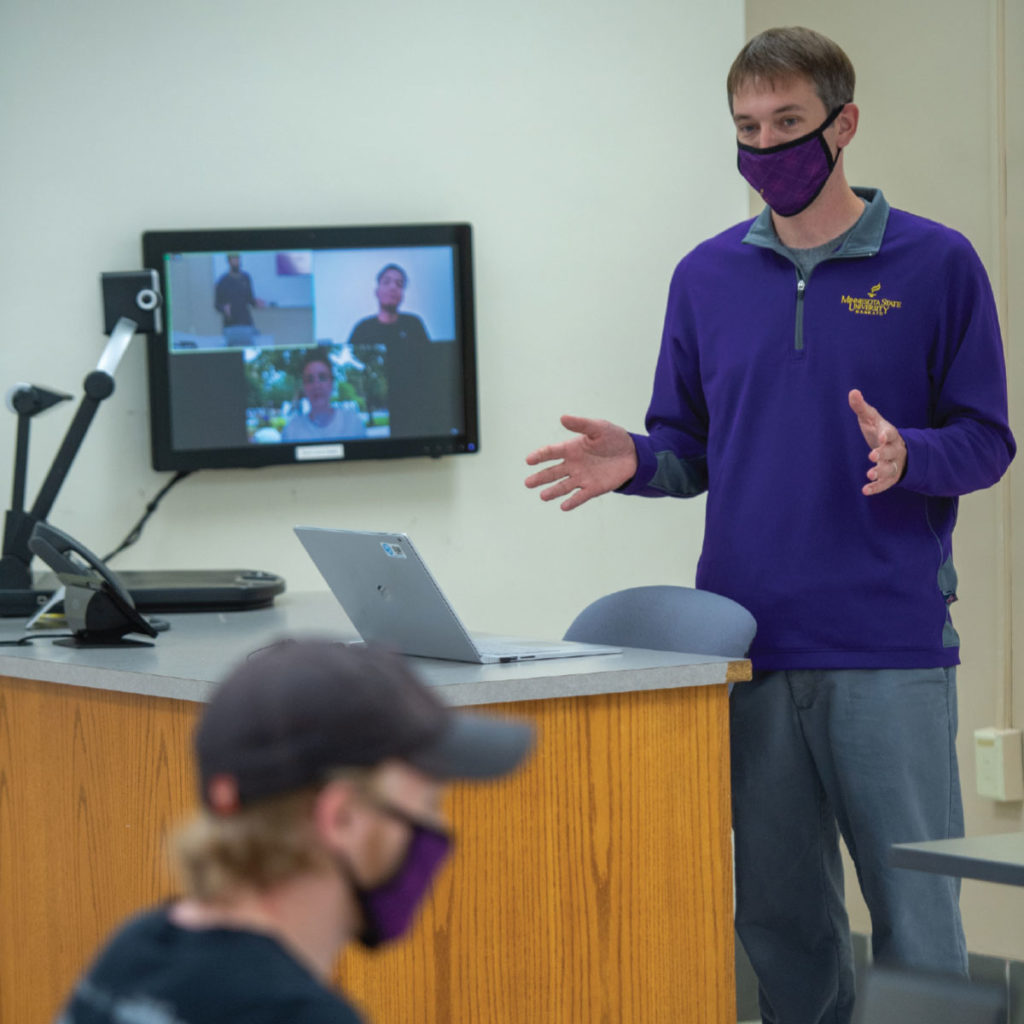
At Minnesota State University, Mankato, classrooms equipped with monitors, microphones, and speakers allow students to participate both in person and remotely.

Upgrading virtual business courses 

Graduate-level business education programs also have adjusted their modalities for MS and MBA students. Again, many of these programs have been offered online for some time, but university business schools are incorporating what they’ve learned during the pandemic into new approaches to delivering education. 

Case in point: Deploying Zoom, the platform that became the short-hand term for pandemic communication. “We all had to learn how to use [Zoom’s] breakout rooms and the annotation tools,” says Patricia Hedberg, associate dean of the University of St. Thomas’ Opus College of Business. “We expanded our understanding of the technology and are using it deeper than we had before.” 

Hedberg says that St. Thomas invested a great deal in remote learning during the pandemic, and university faculty learned how to effectively present instruction online. “We’re seeing that pay off now—that we can offer that flexibility,” she says. 

“We want that online experience to be similar to the learning experience you’d get in person,” Hedberg says. The St. Thomas online instructional group combines pedagogy with technology, and it works with faculty to “have the right tools to accomplish the same learning outcome [virtually] and a similar type of engagement with students.” 

For instance, the group added more screens in university classrooms to allow online and in-person students to be together and interact. For such mixed classrooms, St. Thomas has added several tech enhancements. These include using a stylus “to scribble on the screen,” which shows up on the PowerPoints projected both online and in person. 

Read more from this issue

Cover of Twin Cities Business magazine's December 2021/January 2022 issue

For faculty, Hedberg says, this means more choices. “You have more opportunities to think about what you want the outcome to be for students,” she says. “What’s the best way to share information? What’s the best way to have some kind of interaction and discussion about the information?” In other words, St. Thomas believes that online education tools and platforms can actually enhance education. Opus is now looking at technologies that would allow its students to do projects with businesses across the world.

Phil Miller, assistant dean of MBA and MS programs at the University of Minnesota’s Carlson School of Management, notes that Carlson had been building its online capacity before the pandemic hit. “Our capabilities and our facilities have evolved to meet that changing landscape,” he says. During the pandemic, Carlson School Dean Sri Zaheer “made a commitment to make sure that students could participate whatever way they chose, as could faculty.” In the summer of 2020, Carlson made “a massive push” to make sure every classroom had a rear-mounted HD camera and ceiling mics. “At a minimum, every class can stream,” Miller says. 

 When it comes to how a hybrid course runs, Miller says “there’s a whole stack of tools that are embedded in Canvas,” an LMS that Carlson began using about five years ago. Now instructors are adding more technology to that toolbox. 

Miller, for instance, teaches a problem-solving class at the MBA level that includes collaborative projects. To enable the professor and students to interact virtually, he began using a platform called FeedbackFruits, which allows participants to “cross-comment” on projects online. “It very easily allows me to structure that whole engagement so that you can post your deliverable and I can comment,” Miller says. Tools like FeedbackFruits have become an important part of delivering virtual education, he says.

The lessons of the pandemic also have influenced the way the Carlson School offers its non-degree leadership programs for business executives. Nora Anderson, executive director for executive education, introduced completely online leadership courses with the arrival of the coronavirus.

Carlson has created a new kind of online program. Instead of participants meeting on Zoom for four days straight, it extended the program across six months with regular two-hour online sessions. “We had leaders from Europe, Asia, and the U.S. all going through this learning experience together,” she adds. The Carlson School is now launching a second cohort of this program. 

“I’d venture to say that we would not have designed the program this way before the pandemic,” Anderson says. 

‘Hyflex’ higher education

This past summer, the Carlson School introduced what Miller characterizes as “the next evolution,” called hybrid flexible, or “hyflex.” Eight Carlson classrooms were fitted with “a higher degree of technology and integration,” including tracking cameras and large, prominent monitors. The result, Miller says, is “an immersive room that allows virtual and in-person participants to fully integrate in a class [at the same time]. We see a lot of our working professional programs evolving in that direction.” 

Minnesota State senior vice chancellor Ron Anderson believes that hyflex has the potential to significantly impact the way his system delivers education. He distinguishes hyflex from hybrid, where a class meets in person once or twice a week, then online at other times.

Anderson also says that students will “move seamlessly between delivery modes depending on their needs.” Minnesota State is “seeing a lot of interest in this increasing flexibility for scheduling and juggling other commitments.”

“I would estimate about half of our non-credit offerings this current semester are being offered in an online modality,” he says. There are limitations—some courses still need to be hands on, such as those in which students handle industrial equipment. But even some of those courses “are now being coupled with some components being delivered online or via Zoom.” 

Larry Lundblad, Minnesota State’s executive director of workforce and economic development, notes that “what we were doing on campus was paralleled by business and industry. They were getting used to Zoom and other distance formats. Everyone had to learn at once.”

With the persistent labor shortage and companies needing every hour of labor they can get from their current workforce, “many employers are reluctant to let employees participate in training,” Lundblad says. “These alternative ways of delivery are meeting a need where workers can stay in place for at least a portion of the training.”

Like nearly all educators, Lundblad doesn’t see a full return to the old normal. “This is a permanent shift,” he says. “The employers, the students, and the instructors are all saying that the flexibility can be a good thing. Now the emphasis is on, ‘How can we make this work better?’ ’’ 

Mining safety instructor Lund has seen a “generation gap” in terms of preferences for online and in-person instruction. Younger workers, he says, are quite comfortable with digital learning. And like many higher-education faculty members, he believes that the demand for online courses will continue to be strong, particularly because companies and students have gotten accustomed to it. It’s not yet known whether MSHA will allow some form of virtual learning to continue. “If they do,” Lund says, “it’s probably here to stay.” 

10 tips for child’s well-being in today’s age of online learning

10 tips for child’s well-being in today’s age of online learning

A little more than a year ago, the world changed dramatically. Education moved online, with digital learning helping to ensure learning continues uninterrupted.

However, one important change for young learners was the lack of face-to-face interactions. It is critical that children are happy, healthy, and motivated to make the most of online learning, and the responsibility of ensuring this falls on parents.

Hands-on learning experience is a significant part of the socio-emotional development of the child.

Here are some easy pointers you can practice:

1. Set a daily schedule

Help guide your child’s learning by creating a daily schedule that embraces online learning and follow-up self-learning.

Any senior family member, such as a parent or elder sibling, can help reinforce this. It is critical to continue the discipline of daily scheduled sessions similar to that in schools.

2. Encouraging social interactions

We can continue to stimulate our child’s development by creating small contact groups with classmates or friends.

While the focus might vary from simple discussions to social gatherings, such as online birthday celebrations, the idea is to encourage social interaction at all times.

3. Manage screen time

It is too easy for our little ones to immerse themselves in their gadgets. Thus, it is a parent’s responsibility to limit screen-time to productive activity, such as online schooling or connecting with friends and relatives.

Be selective with the online content that your child indulges in, and choose educational content and apps carefully.

4. Engage in physical activities

Your collection of old board games, art sheets, paintings, and puzzles can play a key part in your child’s learning process.

Use them to engage your child in more hands-on activities on a weekly basis.

Not only does the child learn to associate learning with fun, but it also helps build happy and lasting memories for the child as the family bonds over a game of Scrabble!

5. Learn something new

Children are naturally curious, so make the most of this by getting them to learn a new skill or a new language during their extended stay at home.

This will help them to create positive associations with this period of lockdown.

6. Explore the outdoors

As restrictions get eased, make the most of this opportunity to explore outdoor areas with your kids, such as parks or other play areas.

You will, of course, need to keep in mind that children observe Covid-19 appropriate behaviour at all times.

7. Pick up a book

With video and audio content on the rise, it is all too easy to forget the role reading plays in a child’s development.

Sign them up with a library, or create a book exchange club with close friends and relatives to encourage them to read more.

8. Help them practice writing

While online learning has been greatly beneficial in keeping education ongoing, it has taken away some of the more tactile aspects of learning, such as the skill of writing.

Make sure to set aside 20-30 minutes every day to help children write. Start with simple copy-writing exercises and gradually encourage the child to write creatively.

9. Be emotionally supportive

With lockdown and the transition to online learning, it is normal for children to feel a little lost, experience bouts of frustration, or even depression.

Let children express themselves freely, including through positive mediums such as art, poetry, or by maintaining a daily diary.

10. Prepare children for a return to school

As schools reopen, it is important to prepare students to return to classrooms. The transition may not be an easy one, given that online learning has its own perks of a shorter learning day and no direct supervision, but it is essential that children be ready for physical formats of learning.

While incorporating each idea mentioned here might be challenging, keeping them in mind will surely enrich each child’s learning experience, and help you better support them along their respective learning journeys.

Read: 10 most difficult courses in the world you need to know

Read: 10 toughest places for a girl to get education

Access to online education can lead to better future

Access to online education can lead to better future

While travelling across the country by road, the extent to which we benefit from investment in infrastructure becomes apparent. Road travel has become a pleasant experience because of the vast network of well-maintained highways, connecting the country. This feat has enabled trade, encouraged tourism, boosted the automotive market, and created livelihood opportunities in remote villages by way of toll booths or highway restaurants. The infrastructure provided a conducive environment to realise India’s potential.     

Efforts and investments are ongoing to build the infrastructure that creates the potential for growth and development including roads, ports and airports, utilities like power, water and internet. India’s 5.98 million kilometres of roadways make it the second-largest road network in the world. In the last year alone, 13,298 km of highways were added. The government has also fast-tracked reforms in the telecom sector, enabling widespread internet penetration. The world’s second-largest telecommunications market, India is on track to reach 900 million internet users by 2025.

The true potential of the nation, however, is in empowering its youth through access to education. When people benefit from infrastructure investments to build financial security, pursue learning and career opportunities, and raise the standard of living, they achieve progress. The education sector is ready for reforms and investments. The pandemic has demonstrated a critical need to prioritise the digitalisation of education and learning. The low cost of smartphone devices and internet penetration present an opportunity that policymakers and educationists cannot afford to ignore. In 2020, when schools were closed, the digital divide only peaked; a very small minority of students were able to benefit from online classes, as it required additional spending from parents and schools.   

What does it take to enable access to education digitally? A smartphone or device in every student’s hand, affordable internet connection and customised content and learning delivery. While this seems simple, the  NCERT survey showed that at least 27{e4f787673fbda589a16c4acddca5ba6fa1cbf0bc0eb53f36e5f8309f6ee846cf} of students do not have access to smartphones or laptops to attend online classes, while 28{e4f787673fbda589a16c4acddca5ba6fa1cbf0bc0eb53f36e5f8309f6ee846cf} of students and parents believe that lack of electricity is one of the major concerns. For children who are from poor or disadvantaged circumstances, a device and internet connection can include them in mainstream education. Online education can also streamline the quality of education, with access to standardised or diverse content in various languages.  

The National Education Policy (NEP) envisions technology integration in online and digital education to ensure equitable use of technology. This will play out in the coming years. It is time for government, educationists and corporates to collaborate in creating the new digital order of education for all. Basic enablers such as the internet and devices can attract CSR funding. Re-inventing the method of instruction to make it suitable for online learning delivery needs thoughts on skills and curriculum. Teachers need to adapt and evolve new instructional methods, as well as acquire new skills and content creation capabilities. Schools will need the ability to invest in new systems and apps that are secure and designed for education, as well as capacity building for teachers. Evaluation criteria and exams will need to be re-imagined as well, with a collaboration between technology experts, industry, educationists, policymakers, teachers and parents.

For now, the simplest way to start is often the best — find a way to get smart devices and the internet to every student, so that no one is left behind. 

Just as the highway network had an exponential effect on livelihood and economy, the infrastructure and investments made in enabling digital education will allow India to extract the maximum potential from the large young population. India’s hope to be a world superpower is in its young population. The ‘demographic dividend’ window opened in 2018. Purported to be a 37-year period where India will have more working population than dependent population, investments in digital education will have the same exponential effect on the nation’s economy.   

Imagine the impact we can create if kids across the country could learn at their pace from free content available all across the internet. Some of these self-taught kids may end up building the next Google and Apple of the world! 

(The writer is the founder of an online learning platform)

Check out the latest videos from DH:

HGSE Launches Online Education Leadership Master’s Program Targeting Mid-Career Professionals | News

HGSE Launches Online Education Leadership Master’s Program Targeting Mid-Career Professionals | News

The Harvard Graduate School of Education plans to launch a fully-online master’s program in Education Leadership as part of its efforts to increase access for mid-career professionals, HGSE Dean Bridget Terry Long said in an interview Wednesday.

The new program is an outgrowth of an online, part-time cohort the school accepted through a one-time summer admissions cycle in 2020.

“When we went remote, we realized just how many talented, dedicated people are out there who want a master’s degree in education, who are not able to move to Cambridge, and so we’ve launched an online master’s degree,” Long said.

“[The program is] really focused on that group of people who would not otherwise be able to come to Cambridge, so it’s really about access, and new populations of students who want to benefit from Harvard,” she added.

Long said the program’s first cohort will arrive in summer 2022, and that the school will likely give students the ability to “come to campus for short periods of time” during the two-year duration.

Students currently enrolled in the remote, part-time program have voiced frustruations over remote course offerings and their lack of access to campus. In the interview, Long acknowledged those frustrations and said HGSE remains committed to accommodating remote students.

“When we committed to saying you could take the degree online, we wanted to guarantee for students who don’t have the ability to move to Cambridge that we could support them to degree completion and they wouldn’t have to come,” Long said.

Long defended the school’s remote learning offerings.

“We decided to have half of our courses online because we were so committed to the online students, and in some ways that was safe for us, given the fact that the Delta variant and Covid hurt so much,” she said.

“But this is the difficulty of being in a complex university with every tub on its own bottom — you try to maximize the opportunities, but you can’t quite control,” Long added.

In addition to increasing access through online programming, Long said the school is working toward creating a more engaging student experience in its newly-redesigned master’s curriculum.

The restructured program will graduate its first cohort in spring 2022. It features new Foundations courses held prior to fall term — which will become mandatory for future cohorts after this year — that Long said are an opportunity to “build a relationship with faculty, with teaching fellows” before starting at HGSE.

“We’re hearing a lot about the benefits of that — about how it reduced levels of anxiety, how it helps people feel part of the community and feel included, again, before they had even started,” she said.

Despite ongoing uncertainty over the Omicron variant, Long said the school is working to provide current and recently-graduated students with opportunities to visit campus through “homecoming” events in January and May 2022.

“[These] would be concentrated weekends to invite both those who graduated in spring 2021, as well as those who are continuing in the online program, [to] just have a chance to come to campus, to have some faculty lectures, to have social networking events,” she explained.

Those events would complement the joint commencements in May for the Classes of 2020 and 2021, which the University announced in November.

“The cohort that started fall 2020, as well as the ones that are continuing to this year, they never had a chance to come to campus,” she said. “We know that was a huge desire at some point to come, not just to come to campus, but to also meet their faculty, to meet each other in person.”

—Staff writer Omar Abdel Haq can be reached at [email protected].

UNC system to launch ambitious $97 million ed-tech start-up

UNC system to launch ambitious  million ed-tech start-up

The University of North Carolina system is leveraging $97 million in pandemic recovery funding to launch a nonprofit ed-tech start-up intended to bolster adult online education in a state with a looming need for more skilled workers.

Project Kitty Hawk is named after the North Carolina beach town the Wright brothers returned to repeatedly before achieving their dream of flight, an apt metaphor for an undertaking that UNC leaders herald as a transformative effort to reach the state’s estimated one million working adults who have some college education but no degree. Sweeping in its ambition, Project Kitty Hawk’s five-year financial plan projects 120 new online program launches and 24,000 net new enrollments across the system’s 16 university campuses by the 2026–27 academic year, according to working papers project leaders shared with Inside Higher Ed.

Half of the state’s workers are eligible for employer education benefits, which UNC system leaders hope to capture by doing a better job of keeping adult learners in the state. As of fall 2019, Liberty and Strayer Universities topped the list of most popular online offerings sought by North Carolina students, more than 60,000 of whom are enrolled in what the working papers called “high-cost, out-of-state programs.” UNC leaders say they want to draw those students into the state system, but in order to succeed, they must better tailor online services and infrastructure to working adults.

Project Kitty Hawk will officially launch after the new year. System leaders plan an equitable revenue share between participating campuses, which will be “well below the rate typically charged by third-party providers.”

By effectively creating its own nonprofit online program manager, UNC is trying to avoid the expense of the profit-driven OPM model for building online education programs. OPMs are increasingly under fire from educators and outside experts who believe the companies’ business models prioritize profits over educational outcomes and learning. Leaders at UNC assert that by forgoing an outside OPM—which they point out can take as much as 60 percent of revenue in exchange for covering up-front costs—Kitty Hawk will be self-sustaining by 2026 and will rely on what the working papers call a “private sector–like approach ​on behalf of a tremendous public good.”

The working papers depict a system with a uniquely ambitious vision for Kitty Hawk, which they say will provide “end-to-end support to help universities rapidly design and take workforce-aligned programs online as well as attract, enroll and support learners through graduation.” Kitty Hawk will rely on “a central technology and service infrastructure” to help UNC campuses reach working adults, in part, the working papers say, because it will be “less expensive than the traditional approach of more buildings, more personnel, and more programs … or [campuses] doing it themselves.”

While a handful of the system’s campus leaders hailed the initiative and said they weren’t worried about losing revenue or students to a competitive new systemwide hub, outside experts said UNC’s plans are at least partly reminiscent of systemwide online efforts elsewhere that struggled to get off the ground, partially because of such competition. They also questioned what they characterized as an overly ambitious goal to enroll 24,000 net new students in 120 programs with only $97 million in seed money across five years.

“Ninety-seven million is a lot, but not when you hear that they’re talking about 120 programs—that’s less than a million dollars a program,” said Phil Hill, an educational technology consultant and blogger. “The OPMs quite often invest several million per program … They might be biting off more than they could chew. They might not realize just how much time and effort and money is needed to really get these programs running.”

Richard Garrett, chief research officer at the higher education advisory firm Eduventures, called the effort “unprecedented.” But he added that while the system’s effort to centralize rather than create 16 separate online models may seem logical, the track record for doing so has not been good elsewhere.

“The culture of higher ed is decentralized, even among state systems,” Garrett said. “There’s a lot of pitfalls ahead … It’s hard to point to system-level initiatives like this in the online sphere that have thrived as opposed to struggled or been diluted … or, in some cases, failed.”

Competition for the Campuses

Administrators at the system’s campuses may see the initiative as competing with successful online programs they’ve already built at their universities, Garrett said.

Just a handful of representatives of the various campuses contacted about the initiative replied. Many of the more than a dozen queried did not return emails and calls seeking comment.

University of North Carolina at Greensboro provost Debbie Storrs’s response was emblematic of the overall reticence to discuss the initiative. Storrs said in a text message that the system was “in the best position to speak about this initiative.”

Allen Guidry, interim vice provost for academic affairs​ at East Carolina University, said via email that his campus has been “working for some time” to reach adult online learners and offers over 100 undergraduate, graduate and certificate programs online. He said that nearly half of ECU’s 28,000 students took at least one online course in fall 2021, and 8,261 took exclusively online courses. About 5,700 of the 8,261 exclusively online learners were 24 or older.

“With our history and success in online learning at ECU, we have certainly watched the development of Project Kitty Hawk with great interest,” Guidry said in his email. “We are eager to explore how this entity could add further value to our efforts to scale online learning at ECU.”

Asked about the potential for competition as institutions vie for students and revenue, Guidry said that because UNC Online now allows students to access resources across the system, “we really have joined hands in our efforts.” UNC Online currently enables students to register for thousands of online courses from the various UNC institutions but is distinct from Kitty Hawk, which will operate as an affiliated nonprofit OPM.

Chancellor Darrell Allison of Fayetteville State University, a historically Black college where about half of the 5,661 undergraduates are 25 or older, said Project Kitty Hawk will be an important addition to the system, which he said must adapt to changing demographic trends.

“We don’t have an option—this is the new reality,” Allison said. He added that the days of counting on recent high school graduates to populate a freshman class “are long gone.”

Only 9 percent of UNC system undergraduates currently learn exclusively online, and just 13 percent are over the age of 25. UNC leaders believe these statistics underscore the need for a more robust adult online offering.

System planning documents show the statewide growth rate for 18- to 24-year-olds is forecast to be 8 percent through 2029 and just 1 percent from 2029 to 2039, a radical slowdown that system leaders say is in part fueling their work.

UNC system president Peters Hans said he is determined to win back adult online learners who now turn to outside online education providers, many of whom he called “bad actors.”

“I think about those adults and the chance for them to get ahead in their jobs, or perhaps start a new career, [and] what a difference we can make towards hitting our state’s ambitious educational attainment goals,” Hans said. “We set the goal of two million more North Carolinians with high-quality credentials by 2030, and we see [Project Kitty Hawk] playing a critical role.”

Hans added that while some of the system’s universities already offer online programs targeted to adult learners, the current offerings do not engage them “nearly to the extent I think that we could and should be.”

He said Kitty Hawk classes will be high quality and more than “basically Zoom classes.” He hailed his senior vice president for strategy and policy, Andrew Kelly, who helped create the blueprint for Kitty Hawk after meeting and speaking with other system leaders and educational technology experts across the country about lessons learned from prior efforts. 

The plan “was to create an OPM-like nonprofit,” Kelly said, “thereby enabling our universities to build more of those undergraduate programs that can really serve those 25-plus working adults.”

He added that Kitty Hawk’s nonprofit status will give new programs “more latitude” to merely break even.

But even if programs are allowed to break even, UNC has a tough road ahead, said Iris Palmer, a deputy director with the education policy program at the center-left think tank New America who has studied other state university systems’ online education models. Palmer said her research has focused on adult learners and the difficulties many have faced. 

How Others Have Targeted Adult Students Online

Many state systems and individual universities have long viewed adult students as an important population to cultivate and have created or expanded online programs to appeal to the demographic. Strategies for building these programs have varied, with some systems electing to take over an existing university to lay a foundation for their efforts and others building a new internal unit, as UNC is doing. Still others have created entirely new institutions, as the California Community Colleges opted to do with their Calbright College effort.

Purdue University, the University of Arizona and the University of Arkansas and University of Massachusetts systems are among the most notable examples of institutions that have bought existing online programs. The model typically requires relying on external—and expensive—OPMs. These attempts to co-opt existing online universities are broadly seen as risky and have at times been riven with controversy.

Purdue’s acquisition of the for-profit Kaplan University, for example, spurred an outcry from faculty members who worried about lower educational quality and blurred lines between the university and its online counterpart, Purdue University Global. While many of these new efforts are still too nascent to judge, institutions have faced tough questions about how they intend to achieve their vision for massive new online efforts without sacrificing quality or introducing a troubling profit motive to nonprofit state systems.

An important precursor to the UNC effort can be found at the University of Missouri, which in March united the online programs offered by its four system universities under one umbrella, Missouri Online. The new online platform debuted with 260 degree and certificate programs, and officials promised an additional 22 programs by next year. System leaders spearheading the Missouri effort said the consolidation would increase collaboration and efficiency, though whether that prediction will prove true remains to be seen.

The California Community Colleges’ Calbright initiative has posted clearer results—and they are disheartening. Calbright was launched in late 2019 to great fanfare, but it is now under threat of being closed, with a recent state audit finding the online-only institution graduated merely 12 of more than 900 enrolled students in its first year. Calbright leadership was blasted by auditors for making poor strategic choices even when armed with a staggering $175 million in state funding promised through June 2025.

Palmer said her research findings make clear why programs like Calbright have struggled: adult learners often strain to learn online, particularly given the competing pressures they face at work and home. She said faculty mentorship and significant engagement with professors has proven to be vital for these students. Palmer worries that an online-only model could be challenging for UNC, since it is difficult for all but the most self-directed students to stay motivated when learning exclusively online.

Kelly said student success coaches are central to the Kitty Hawk model and that he foresees in-person support to complement the online instruction once the pandemic ends.

Project Kitty Hawk leaders say campuses will be able to opt out of participating, and they made clear they view their organization as a source of support for individual institutions. But competition dynamics are nonetheless a problem embedded in these efforts, Palmer said. With Kitty Hawk anticipating 24,000 new enrollees in five years—which Palmer said in an email is “very ambitious”—the 16 university campuses inevitably will be vying for the same students and revenue.

“Once you start to have centralized online programming,” Palmer said, “it can be seen as competition; it can be seen as the beginning of some kind of regulation, or throttling, of the online programs that are offered at each individual campus. It’s a very difficult thing to pull off.”

UNC leaders seemed to anticipate Palmer’s line of reasoning; the working papers assert that the organization will not support any institution’s plans for new programs without an attempt to “validate market demand.”

“New program opportunities can originate from Kitty Hawk’s own market intelligence function, emerge from the universities, or be solicited directly from employers and education benefit providers,” the documents say. 

Kelly emphasized the autonomy individual campuses will have to execute programs. He said the individual institutions will award degrees, offer the instruction and make assessments.

Hill reviewed the working papers and said he came away with the impression that the system hasn’t yet “done the hard work” of consensus building.

“They make a compelling argument why we need to invest internally, as in UNC system capabilities,” Hill said. “But it raises the question … ‘Are we building up capabilities just within this Kitty Hawk initiative? Or are we going to do it as a way of making each of the … campuses better?’ And I don’t think they’ve figured it out.”

The case for combining synchronous and asynchronous online learning

The case for combining synchronous and asynchronous online learning

There has been much debate in recent years on whether educators, trainers or L&D managers should focus on delivering synchronous or asynchronous online learning experiences.


What is the difference between synchronous and asynchronous learning?

In the context of online education, synchronous learning experiences are those delivered live with an educator or trainer facilitating a learning session. There are a variety of tools that can be used in synchronous learning such as live meetings or virtual classrooms where educators and learners meet virtually in real-time (by means of a device over a network) and communicate and collaborate through video, chat, whiteboard and other synchronous tools. In contrast, while also requiring a device, asynchronous learning is a student-centred method usually delivered via a learning management system (LMS) that allows learning to occur in different times and spaces particular to each learner. In asynchronous learning, educators set up a learning program or course that students engage with at their own pace.


Social constructionism – learning as a social context

As many readers will be aware, Moodle is based on social constructionism, which is the understanding that people develop knowledge in a social context. Moodle advocates for, and supports, the importance of creating a collaborative community of learners where learners learn “by doing” and by observing their peers. A community where educators and trainers understand the context of learners so that they can customise the language and expression of concepts in ways that are best suited to the audience. And, where teachers or trainers recognise themselves as learners and are willing to collaborate, listen and share ideas in order to improve their own understanding and ultimately inform improvements to the learning program.


So, synchronous is better, right? Wrong.

This grounding in social constructionism could lead readers of this blog to think that Moodle would advocate for synchronous over asynchronous delivery. But to presume so would be wrong because asynchronous delivery also supports the theory of social constructionism. In order to create truly engaging learning experiences, it is equally important that asynchronous activities provide opportunities for learners to learn by doing and through relationships with each other and their teachers.

This does not mean that asynchronous instruction should replace the opportunity for educators, trainers and their learners to meet in real-time through virtual classrooms with live video and messaging functionality. Indeed, this modality of online synchronous delivery mirrors good traditional classroom instruction where a teacher or instructor supports students to become actively involved in their learning through interaction with each other and their teacher as they complete tasks or activities. 


Together is better

The issue is not whether asynchronous or synchronous delivery is better, but how both can be used to support the theory of social constructionism, accommodate different learning preferences and ultimately the engagement of learners through interaction with each other and their teacher.

Some face to face interaction is an essential component of good quality online instruction. That is why BigBlueButton, the open source web conferencing solution providing real-time sharing of audio, video, slides, whiteboard, chat and screen, will be incorporated into Moodle 4.0 as a standard feature. Currently available as a Moodle plugin, BigBlueButton, allows educators trainers to use breakout rooms, polls, multi-user whiteboard, and shared notes to engage learners in real-time. However, it is worth recognising that streaming video and connecting to online meetings use a lot of data and require fast internet connections, which not all learners may have at the same time. Even where connectivity is not an issue, technical issues can affect the quality of live interaction. These issues can be mitigated by using a combination of synchronous and asynchronous delivery methods.

More importantly, learners differ in the way that they perceive and comprehend information that is presented to them. For instance, some learners will understand content more quickly through visual or auditory means rather than printed text. Other learners with sensory disabilities or learning difficulties will have specific needs. To accommodate all learners’ preferences, it is important that educators create asynchronous Activities and Resources in a variety of modalities that learners can interact and engage with.

Online collaboration and group work can also be done well asynchronously. As an example, educators and trainers can use Moodle’s many standard features to encourage learner interaction and experimentation. For instance, they can invite personal response through Moodle Forum, create learner Groups, set Assignments, encourage collaboration through peer assessment with Workshops and allow students to create collaborative project plans and documents through Wiki. Asynchronous courses also accommodate more introverted students who may struggle to interact with other learners and their teacher or instructor in a live setting.

Both synchronous and asynchronous delivery has benefits for educators, trainers and learners:


Moodle was designed for ultimate flexibility, a toolbox that accommodates both synchronous and asynchronous delivery to empower educators and trainers to build their own education platform that is appropriate to their learners.

Find out more about our online learning platforms Moodle LMS or Moodle Workplace. Or, contact a Moodle Certified Service Provider who can help you with learning design, custom development, hosting, onboarding, installation and integrations.


References:

https://elearningindustry.com/blending-asynchronous-and-synchronous-digital-learning-modalities-part-5
https://www.brynmawr.edu/blendedlearning/asynchronous-vs-synchronous-learning-quick-overview
https://elearningindustry.com/right-learning-modalities-asynchronous-and-synchronous-interactions
https://elearningindustry.com/asynchronous-and-synchronous-modalities-deliver-digital-learning
https://educationrickshaw.com/2020/03/30/the-unproductive-debate-of-synchronous-vs-asynchronous-learning/