Parent-teacher ties vital to home schooling during lockdown

Parent-teacher ties vital to home schooling during lockdown

A recent research has emphasised the importance of the relationship between parents and teachers during the lockdown to provide academic assistance to the students as well as practical and emotional support.

The findings of the study were published in the journal ‘Educational Review’.

With schools closed from March 2020 until the end of the academic year and again from January 2021, pupils were taught online. This put an expectation on parents to shoulder some of the responsibility in ensuring pupils were engaged in their learning and to try and minimise some of the disadvantages faced by pupils from lower-income families who may not have had access to the same learning equipment or facilities as others.

Academics from Anglia Ruskin University (ARU) led a team of researchers who surveyed 271 primary school teachers from across the country during June and July 2000 and also carried out follow-up interviews with a smaller cohort in April this year to compare the second round of school closures from January 2021.

Participants worked in schools with differing levels of pupil premiums, with funding provided by the Government to schools based on the number of pupils in a school deemed to be at an economic or social disadvantage. Lower pupil premium schools had fewer children considered to be at a disadvantage, while higher pupil premium schools had more.

Also Read: Pre-schools reopen but home tutors stay with students

The vast majority (84 per cent) of teachers felt some pupils had been disadvantaged by school closures due to their home circumstances.

The researchers found that all teachers provided resources for parents to use at home, either created by them or using other sources. However, while pupils from schools with a lower pupil premium number were significantly better able to access all resources than those from schools with higher pupil premium numbers, middle-income families struggled to find the time to engage with homeschooling, with many working from home in white-collar professions during the pandemic.

The study highlighted the broad range of support that primary teachers gave to children and their parents during the pandemic, not only academically, but also practically and emotionally. Teachers kept in touch with parents more regularly, either through online calls or home visits, and as a result felt they gained a greater understanding of children’s home lives, which helped build trust.

Many gave examples of ways they supported families through other means, such as organising collaborations with charities to provide breakfasts for children, whose families were struggling to afford food, making up food hampers, and even providing loans. Some teachers provided specific sessions for parents to guide them through some of the teaching materials, or to boost their confidence.

Lead author Dr Sara Spear, Head of the School of Management at ARU, said, “The COVID-19 pandemic was a difficult and stressful time for many people, and for some families, it caused or exacerbated socio-economic difficulties. Our results showed that parental participation in schooling in middle-income families was predominantly impeded by parents’ work responsibilities, with one or both parents likely to be working, and long hours and high-pressured jobs leaving little time for supporting children’s home learning.”

“This was exacerbated in the second closure period, with more parents working, and increased expectations for children’s learning. Only the richest families had access to resources, such as private tuition and intensive private schooling that alleviated these pressures,” she added.

“It was clear from our research that a closer relationship between teachers and parents meant a greater understanding of the difficulties faced by some parents, and as a result teachers went above and beyond to try and make sure no child was left behind. Teachers are hopeful that this stronger relationship will lead to better engagement in future, with things like parents’ evenings being held online to encourage better attendance,” she stated.

“In the event of future school closures, schools should consult with parents when determining any requirements for learning at home, to ensure that this is inclusive for the families in their community. Schools should pay particular attention to access to technology, and consider parents’ ability and capacity to participate in schooling,” she concluded. 

Also Read: What working parents gained during covid

Relationship between parent-teacher important for home schooling during lockdown

Relationship between parent-teacher important for home schooling during lockdown


ANI |
Updated:
Dec 04, 2021 22:46 IST

Cambridge [UK], December 4 (ANI): The importance of the relationship between parents and teachers during the lockdown to provide academic assistance to the students as well as practical and emotional support has been emphasised upon in a recent study.
The findings of the study were published in the journal ‘Educational Review’.
With schools closed from March 2020 until the end of the academic year and again from January 2021, pupils were taught online. This put an expectation on parents to shoulder some of the responsibility in ensuring pupils were engaged in their learning and to try and minimise some of the disadvantages faced by pupils from lower-income families who may not have had access to the same learning equipment or facilities as others.
Academics from Anglia Ruskin University (ARU) led a team of researchers who surveyed 271 primary school teachers from across the country during June and July 2000 and also carried out follow-up interviews with a smaller cohort in April this year to compare the second round of school closures from January 2021.
Participants worked in schools with differing levels of pupil premiums, with funding provided by the Government to schools based on the number of pupils in a school deemed to be at an economic or social disadvantage. Lower pupil premium schools had fewer children considered to be at a disadvantage, while higher pupil premium schools had more.
The vast majority (84 per cent) of teachers felt some pupils had been disadvantaged by school closures due to their home circumstances.

The researchers found that all teachers provided resources for parents to use at home, either created by them or using other sources. However, while pupils from schools with a lower pupil premium number were significantly better able to access all resources than those from schools with higher pupil premium numbers, middle-income families struggled to find the time to engage with homeschooling, with many working from home in white-collar professions during the pandemic.
The study highlighted the broad range of support that primary teachers gave to children and their parents during the pandemic, not only academically, but also practically and emotionally. Teachers kept in touch with parents more regularly, either through online calls or home visits, and as a result felt they gained a greater understanding of children’s home lives, which helped build trust.
Many gave examples of ways they supported families through other means, such as organising collaborations with charities to provide breakfasts for children, whose families were struggling to afford food, making up food hampers, and even providing loans. Some teachers provided specific sessions for parents to guide them through some of the teaching materials, or to boost their confidence.
Lead author Dr Sara Spear, Head of the School of Management at ARU, said, “The COVID-19 pandemic was a difficult and stressful time for many people, and for some families, it caused or exacerbated socio-economic difficulties. Our results showed that parental participation in schooling in middle-income families was predominantly impeded by parents’ work responsibilities, with one or both parents likely to be working, and long hours and high-pressured jobs leaving little time for supporting children’s home learning.”
“This was exacerbated in the second closure period, with more parents working, and increased expectations for children’s learning. Only the richest families had access to resources, such as private tuition and intensive private schooling that alleviated these pressures,” she added.
“It was clear from our research that a closer relationship between teachers and parents meant a greater understanding of the difficulties faced by some parents, and as a result teachers went above and beyond to try and make sure no child was left behind. Teachers are hopeful that this stronger relationship will lead to better engagement in future, with things like parents’ evenings being held online to encourage better attendance,” she stated.
“In the event of future school closures, schools should consult with parents when determining any requirements for learning at home, to ensure that this is inclusive for the families in their community. Schools should pay particular attention to access to technology, and consider parents’ ability and capacity to participate in schooling,” she concluded. (ANI)

Parent-teacher relationship vital to home schooling during lockdown

Parent-teacher relationship vital to home schooling during lockdown


ANI |
Updated:
Dec 03, 2021 12:04 IST

Cambridge [UK], December 3 (ANI): A recent research has emphasised the importance of the relationship between parents and teachers during the lockdown to provide academic assistance to the students as well as practical and emotional support.
The findings of the study were published in the journal ‘Educational Review’.
With schools closed from March 2020 until the end of the academic year and again from January 2021, pupils were taught online. This put an expectation on parents to shoulder some of the responsibility in ensuring pupils were engaged in their learning and to try and minimise some of the disadvantages faced by pupils from lower-income families who may not have had access to the same learning equipment or facilities as others.
Academics from Anglia Ruskin University (ARU) led a team of researchers who surveyed 271 primary school teachers from across the country during June and July 2000 and also carried out follow-up interviews with a smaller cohort in April this year to compare the second round of school closures from January 2021.
Participants worked in schools with differing levels of pupil premiums, with funding provided by the Government to schools based on the number of pupils in a school deemed to be at an economic or social disadvantage. Lower pupil premium schools had fewer children considered to be at a disadvantage, while higher pupil premium schools had more.
The vast majority (84 per cent) of teachers felt some pupils had been disadvantaged by school closures due to their home circumstances.

The researchers found that all teachers provided resources for parents to use at home, either created by them or using other sources. However, while pupils from schools with a lower pupil premium number were significantly better able to access all resources than those from schools with higher pupil premium numbers, middle-income families struggled to find the time to engage with homeschooling, with many working from home in white-collar professions during the pandemic.
The study highlighted the broad range of support that primary teachers gave to children and their parents during the pandemic, not only academically, but also practically and emotionally. Teachers kept in touch with parents more regularly, either through online calls or home visits, and as a result felt they gained a greater understanding of children’s home lives, which helped build trust.
Many gave examples of ways they supported families through other means, such as organising collaborations with charities to provide breakfasts for children, whose families were struggling to afford food, making up food hampers, and even providing loans. Some teachers provided specific sessions for parents to guide them through some of the teaching materials, or to boost their confidence.
Lead author Dr Sara Spear, Head of the School of Management at ARU, said, “The COVID-19 pandemic was a difficult and stressful time for many people, and for some families, it caused or exacerbated socio-economic difficulties. Our results showed that parental participation in schooling in middle-income families was predominantly impeded by parents’ work responsibilities, with one or both parents likely to be working, and long hours and high-pressured jobs leaving little time for supporting children’s home learning.”
“This was exacerbated in the second closure period, with more parents working, and increased expectations for children’s learning. Only the richest families had access to resources, such as private tuition and intensive private schooling that alleviated these pressures,” she added.
“It was clear from our research that a closer relationship between teachers and parents meant a greater understanding of the difficulties faced by some parents, and as a result teachers went above and beyond to try and make sure no child was left behind. Teachers are hopeful that this stronger relationship will lead to better engagement in future, with things like parents’ evenings being held online to encourage better attendance,” she stated.
“In the event of future school closures, schools should consult with parents when determining any requirements for learning at home, to ensure that this is inclusive for the families in their community. Schools should pay particular attention to access to technology, and consider parents’ ability and capacity to participate in schooling,” she concluded. (ANI)

New study reveals extent of practical and emotional support offered by teachers — ScienceDaily

New study reveals extent of practical and emotional support offered by teachers — ScienceDaily

A research survey of primary school teachers in England has emphasised the importance of the relationship between parents and primary schools during lockdown school closures, with teachers providing a range of practical and emotional support alongside academic assistance to parents to try and negate perceived disadvantages in home circumstances.

With schools closed from March 2020 until the end of the academic year and again from January 2021, pupils were taught online. This put an expectation on parents to shoulder some of the responsibility in ensuring pupils were engaged in their learning and to try and minimise some of the disadvantages faced by pupils from lower income families who may not have had access to the same learning equipment or facilities as others.

Academics from Anglia Ruskin University (ARU) led a team of researchers who surveyed 271 primary school teachers from across the country during June and July 2000, and also carried out follow-up interviews with a smaller cohort in April this year to compare the second round of school closures from January 2021.

Participants worked in schools with differing levels of pupil premiums, which is additional funding provided by the Government to schools based on the number of pupils in a school deemed to be at an economic or social disadvantage. Lower pupil premium schools had fewer children considered to be at a disadvantage, while higher pupil premium schools had more.

The vast majority (84{e4f787673fbda589a16c4acddca5ba6fa1cbf0bc0eb53f36e5f8309f6ee846cf}) of teachers felt some pupils had been disadvantaged by school closures due to their home circumstances.

The researchers found that all teachers provided resources for parents to use at home, either created by themselves or using other sources. However, while pupils from schools with a lower pupil premium number were significantly better able to access all resources than those from schools with higher pupil premium numbers, middle income families struggled to find the time to engage with home schooling, with many working from home in white collar professions during the pandemic.

The study highlights the broad range of support that primary teachers gave to children and their parents during the pandemic, not only academically, but also practically and emotionally. Teachers kept in touch with parents more regularly, either through online calls or home visits, and as a result felt they gained a greater understanding of children’s home lives, which helped build trust.

Many gave examples of ways they supported families through other means, such as organising collaborations with charities to provide breakfasts for children whose families were struggling to afford food, making up food hampers, and even providing loans. Some teachers provided specific sessions for parents to guide them through some of the teaching materials, or to boost their confidence.

Lead author Dr Sara Spear, Head of the School of Management at ARU, said: “The COVID-19 pandemic was a difficult and stressful time for many people, and for some families it caused, or exacerbated, socio-economic difficulties.

“Our results showed that parental participation in schooling in middle income families was predominantly impeded by parents’ work responsibilities, with one or both parents likely to be working, and long hours and high-pressured jobs leaving little time for supporting children’s home learning.

“This was exacerbated in the second closure period, with more parents working, and increased expectations for children’s learning. Only the richest families had access to resources, such as private tuition and intensive private schooling, that alleviated these pressures.

“It was clear from our research that a closer relationship between teachers and parents meant a greater understanding of the difficulties faced by some parents, and as a result teachers went above and beyond to try and make sure no child was left behind. Teachers are hopeful that this stronger relationship will lead to better engagement in future, with things like parents’ evenings being held online to encourage better attendance.

“In the event of future school closures, schools should consult with parents when determining any requirements for learning at home, to ensure that this is inclusive for the families in their community. Schools should pay particular attention to access to technology, and consider parents’ ability and capacity to participate in schooling.”

Reader grateful for home school education

Reader grateful for home school education

To the editor:

Harvard Law School’s Professor Elizabeth Bartholet has been a major opponent of homeschool education lately. In an interview with the Harvard Gazette last year, Bartholet outlandishly claimed that homeschoolers are “socially awkward” and “in danger of maltreatment.”

Bartholet gives absolutely no statistical evidence to support her conclusions. Surely someone as highly educated as an Ivy League university professor has the ability to cite studies to reinforce their claims. In my opinion, Bartholet’s lack thereof is suggestive of her failure to find any such evidence.

Bartholet also makes allegations that are simply untrue. For instance, she said in an article for the Arizona Law Review that we have zero evidence that homeschoolers are successful. A study released this year by two of Bartholet’s colleagues at Harvard, Brendan Case and Ying Chen present very different findings. The scholars’ results showed not only that homeschooled students are on a higher level as other students academically, but that they actually have thirty-percent advantage over their peers in terms of social and financial success. With more than 12,000 students participating in this 11-year study, Case and Chen present much more statistical evidence than Bartholet. According to the Business Insider, sixty-nine percent of homeschooling graduates finish high school, meanwhile only fifty-nine percent of other students do so.

The stereotypes Professor Bartholet pushes on homeschooled students like me are false and grossly unfair. We are not socially awkward or ignorant in any way. The skills needed for our non-traditional learning actually enhance our social aptitude and entrepreneurial spirit. For these reasons, it is not surprising that studies are putting us at the top of our generation in terms of achievement. Recently, institutions of higher education have come this realization. At this point, many colleges and universities across the nation (including Harvard) have begun strategic enrollment practices of homeschooling graduates.

Unjust allegations have been, and will continue to be brought against homeschoolers, but these unfounded claims will never speak as loud as the overwhelming evidence in our favor. I will always be proud of my education, and forever thankful to my family for making it possible.

Bowser Administration Releases Preliminary DC Enrollment Numbers for the 2021-22 School Year

Bowser Administration Releases Preliminary DC Enrollment Numbers for the 2021-22 School Year

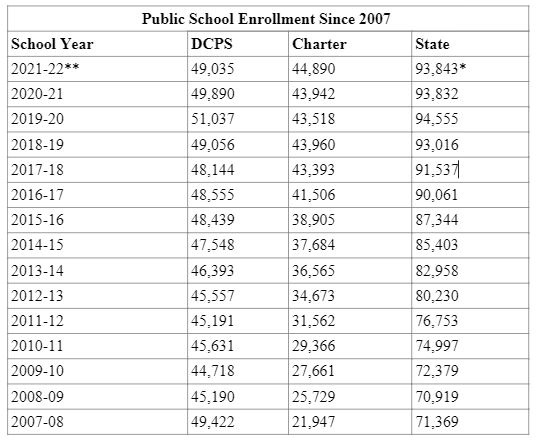
(WASHINGTON, DC) – Today, the Bowser Administration announced that the number of students enrolled in public schools in Washington, DC in the 2021-22 school year increased slightly compared to 2020-21 enrollment, with 93,843 students enrolled in District public and public charter schools according to preliminary data released by the Office of the State Superintendent of Education (OSSE). These unaudited numbers show a less than 1{e4f787673fbda589a16c4acddca5ba6fa1cbf0bc0eb53f36e5f8309f6ee846cf} increase overall across DC – or 11 more students – compared to last school year’s count. 


Enrollment at DC Public Schools (DCPS) saw a second year of enrollment declines from 49,890 students in the 2020-21 school year to 49,035 students in the 2021-22 school year, a 1.71{e4f787673fbda589a16c4acddca5ba6fa1cbf0bc0eb53f36e5f8309f6ee846cf} decrease compared to final, audited numbers released in early 2021. Enrollment at DC’s public charter schools saw a second year of increases, from 43,942 students in the 2020-21 school year to 44,890 students in the 2021-22 school year, a 2.16{e4f787673fbda589a16c4acddca5ba6fa1cbf0bc0eb53f36e5f8309f6ee846cf} increase over final, audited numbers for last school year released in early 2021. 


While early childhood education programs saw decreases, the number of students in homeschooling programs approved by OSSE increased in the 2021-22 school year, compared to 2020-21. OSSE reports a preliminary number of 959 students registered for home schooling in 2021-22, compared to 602 in the previous year. All families of compulsory aged students who wish to home school must register with OSSE and meet certain standards by submitting an application, which OSSE reviews and approves. OSSE will report final home school numbers along with the final enrollment audit numbers in early 2022. 
 
Bowser Administration Releases Preliminary DC Enrollment Numbers for the 2021-22 School Year


As the District’s state education agency, OSSE conducts an annual enrollment audit of public schools. The preliminary numbers above are based on a snapshot of data certified by local education agencies in October. This marks the beginning of an enrollment audit and certification process that takes several months and is conducted in collaboration with an independent auditor. The chart below tracks enrollment trends since 2007 with preliminary unaudited numbers for the 2020-21 school year. Final, audited enrollment figures will be published by OSSE in early 2022. 


*Note: State-level enrollment subtotal does not equal DCPS + Charter totals due to student duplications. Duplications have been removed from the state level numbers but may still exist at the sector level in these preliminary, unaudited figures. 


**These figures represent preliminary data. Final audited enrollment figures will be published by OSSE in early 2022.