What is worldschooling? ‘Like homeschooling, without the home.’

What is worldschooling? ‘Like homeschooling, without the home.’
The Almond family left Colorado in June to worldschool their kids for a year. Here, their daughter cliff jumps on Paros Island, Greece.
The Almond family — whose daughter Aria is seen here cliff jumping on Paros Island in Greece — left Colorado in June to worldschool their kids for a year. (Instagram/4almondsabroad)

Back-to-school season, for Andi Almond and her family, has looked very different than for most kids in their home state of Colorado. That’s because when the other parents were sending their teens and tweens off to a new year of classes in late August, the Almonds were in Botswana, watching elephants and giraffes romp through watering holes in a national park.

Since then they’ve been, among other things: fishing in Namibia, hiking the rim of Victoria Falls in Zimbabwe, touring Johannesburg to learn about the lingering effects of apartheid, visiting Peloponnese ruins, rock climbing in Meteora and cliff jumping on Paros.

“I really do think that travel changes us for the better,” Almond tells Yahoo Life, on the phone from Athens. She and her family are three months into their gap year, documenting it all on Instagram. To make it happen, her husband quit his job as chief revenue officer at a tech company and Almond took a sabbatical from a global strategy consulting firm following five years of planning and saving and working with a financial adviser. Now their kids, Aria, 11 and Finn, 13, are learning everything from history to science and literature through travel — something a long-simmering and now seemingly exploding community of parents are trying, with many calling it “worldschooling.”

“The way I’ve been defining it is an alternative approach to education — like homeschooling, without the home,” Almond says.

While there are no official statistics about how many families are using global travel as their children’s classroom — partially because the approach to how it’s done and defined can vary so greatly, but also because no one seems to be keeping track — the practice, at least anecdotally, seems to have only grown since the start of the COVID-19 pandemic. On Instagram, there are over 258,000 posts with the “worldschooling” hashtag; Facebook has a range of private groups for worldschoolers, the biggest with 56,000 members.

“We’ve gotten a new group of people, since the pandemic started, that are recognizing they can live and work nomadically … and who maybe didn’t have a desire to detach from conventional life before but were sort of forced to,” says Lainie Liberti, now a de facto expert on worldschooling after finding herself in a similar position back when the U.S. economy crashed in 2008.

Lainie Liberti, right, and her son, Miro, earlier this year.

Lainie Liberti and her son, Miro, earlier this year. (Instagram/Ilainie)

That’s when she, a single mom, took her then-9-year-old son Miro out of school to embark upon a global-nomad existence that, despite generally staying put in Guanajuato, Mexico, since the start of the pandemic, has never quite ended. Liberti, who gained a massive following by blogging about her globe-trotting parent life with Miro, and by growing a huge Facebook community (as well as giving a TedX Talk with her son in 2016) now makes her living by helping others worldschool, and to foster that community, through companies and projects including We Are Worldschoolers, Project World School, Project World School Family Summit and Transformative Mentoring for Teens. Miro, now 23, teaches kids virtually, from Guanajuato, through a D.C.-based self-directed learners group.

“I was pretty miserable with my schooling experience [in L.A.] — it didn’t work for me — and the contrast couldn’t have been any bigger,” Miro says today about learning through traveling to about 40 countries with his mom. “I was pretty engaged in my own education,” he says. “Travel really exposes you to a lot of things, and I became passionate about history, politics, economics, politics, literature … Having seen so much of the world, I better understand my place in it.”

It’s important for families trying out the lifestyle to understand that it won’t always be easy, Liberti stresses — something that Almond confirms, noting that there has already been an “epic” family meltdown, plus stomach bugs and a dental emergency — but that, with clear communication and open minds, it will be worth it.

How — and why — families are worldschooling

When Liberti dropped her conventional lifestyle and began globe-trotting with Miro, she did it by quitting her marketing job with enough savings to travel for one year. When neither wanted to go back once the year was up, Liberti began to monetize her blog, though the income was admittedly low in the beginning.

“We made about $1,000 a month, and we lived off of that,” she says. “We really shifted what was important to us, though we struggled sometimes, going from making in one year what I used to make in one month.”

The Almonds — who were inspired to give the lifestyle a try after Andi came across a book that reminded her and her husband how valuable their own gap year, taken pre-kids and in their 20s, had been — also took off with savings for one year. But others try to balance their travel with a job that’s ongoing, either virtually or otherwise.

For Jubilee Lau, a former wedding planner who quit her job three years ago to worldschool her daughter Bridgette, now 15, maintaining this lifestyle has meant leaving her husband Alan home much of the time, so he can continue to earn the family income as a tech consultant in the San Francisco area.

The mother-daughter trips range from two to four weeks at a time, with two-week returns home to see family and friends, and with Alan joining about three trips a year. Currently all three are in South Korea after a jaunt in Thailand.

“What we enjoy most is the cultural immersion. We do some touristy stuff but often try to immerse in local culture,” Jubilee tells Yahoo Life. “One trip that stood out was our trip to Kenya last year — we spent a week on a safari but then told the guide, ‘No more animals; let’s get to know people in the villages.'” The guide wound up taking them to his own village, where the family volunteered at the local school, attended church with the residents and was invited into people’s homes. “I think those are the most memorable experiences,” she says. “It’s really humbled us to see how others live in this world.”

In the past six months, Jubilee and Bridgette have been to Croatia, Montenegro, Iceland and Norway, all documented on their Instagram — and over the past seven years, they’ve been to 41 countries.

To them, worldschooling means “schooling, but in the context of this world,” Jubilee says, and “what people understand as homeschooling, but as you travel, and learning in the context of where we’re at.”

Though the approach, for them, mostly eschews any structured curriculum, Bridgette sticks to stable, online courses for core subjects, such as math and English, that follow state curriculum, now that she’s in high school. “She does want to apply to college,” Jubilee says. “But we’re trying to keep true to why we started.”

They were inspired by the drudgery of standardized testing, which started in third grade. “From that point forward, we saw that the intensity of academics, and the curriculum, overshadowed the love of learning Bridgette had,” Jubilee recalls. “Keeping her in the school system wasn’t a good fit for her learning style or personality, so we looked into alternate education, decided to try homeschooling and started exploring different methods. … We also took advantage of the homeschooling schedule to start traveling.” That’s when, as Bridgette reached seventh grade, it all clicked.

Similarly, for Heleen Van Assche, her husband, Jurgen, and their two daughters, 10 and 12, who share their travel adventures with their 28,500 followers on Instagram, their nomadic lifestyle began with the idea of taking a gap year after selling the children’s clothing and toy store they owned in their home country of Belgium. That was in 2018.

“We rented our house, took the kids out of school and traveled the world for a year. My husband started [doing] web development, and I started to learn about blogging and Instagram,” Heleen tells Yahoo Life. But it wound up being just the beginning.

“When we returned mid-2019, we immediately felt we couldn’t go back to our ‘normal’ lives,” she says. “While the kids were back in school, we decided to sell our house and leave again by the end of the school year. Then COVID hit. But we went on with the plan anyway. So since mid-2020, we’re traveling full-time, the kids are homeschooled, and we work online.”

Jurgen still does web development, and Heleen is a photographer and brings in family income through side hustles of Instagram collaborations, passive blog income and online photography courses. But, she admits, “The financial part has definitely been our biggest struggle and is slowly becoming better. We work hard to make it sustainable so we can continue this lifestyle in the future.”

It’s important to keep living this way, because “we love the freedom,” Heleen explains. “We left the rat race, aren’t slaves to our schedules and have the option to be together way more than normal.” Also, she says, “we believe the kids learn a lot from meeting other people, other cultures. … The fact that they learn it from real life and not out of books is something we cherish a lot.”

Together they’ve visited over 15 countries and make regular trips back to Belgium to stay with her mother. Next up: Morocco.

As for schooling, they don’t really have a schedule. “Days that they are very focused, we do a lot. When they have a hard day or we have a busy travel schedule, we don’t do anything. … For math, science and languages, we use books and online platforms. For other general knowledge, we rely more on our travels and visiting museums.” Last year, when the family returned to Belgium for nearly three months, the girls had no problem with a temporary drop-in at the school and “even were a bit ahead of their classmates.”

As for the Almonds, Andi and husband Randy split teaching duties: He’s in charge of math, science and history, relying on guidance about online resources collected from teachers ahead of time, and she’s got literature, writing, languages and civics/volunteering. For literature especially, Almond tries to choose books that match their locations — Trevor Noah’s memoir while they were in South Africa, for example. For her son, who’s been taking Mandarin, they’ll eventually live with a local family in China and enroll both kids in an immersion school for three weeks. Figuring it all out as they go, Almond admits, “is not without its challenges.”

Others do what they can to worldschool while still keeping one foot in a home base with steady employment — like Iliah Grant Altoro, who is just about to get back into frequent traveling with her kids post-pandemic. Based in Minneapolis, the single mom of three maintains a part-time job with an airline while also doing freelance writing, leveraging both to take her kids to far-flung countries as frequently as possible.

“We backpacked across Southeast Asia when the kids were little for four months,” Altoro tells Yahoo Life. While she’s mostly homeschooled her kids — now 6, 12 and 14 — this year “is a little unique,” she says, because her oldest is giving public high school a try, and her youngest is going to a Montessori school for first grade (her middle child is still homeschooled). They’ve visited 30 countries together, were most recently in Guatemala and Greece, and plan to hit Vietnam, Tunisia and Turkey in the very near future.

Altoro says that, as a woman of color with children of color, seeing the world feels vital.

“I call it a revolutionary act of resistance, because it’s teaching my children that they belong,” she says. “In a country that’s supposed to be their own, they don’t fully belong … so to take them and put them in places where they just get to belong or feel a part of something, to be true global citizens, they then build an identity of ‘I belong … there is a world that accepts me as I am.'”

It’s also helped build empathy and character in all three, she’s found, adding, “My kids are so comfortable in uncomfortable situations.”

But she also stresses, for those who cannot take the plunge but are tempted, that it’s possible to “build global bridges even without travel,” once you’ve opened your mind to it. Because, Altoro says, you can travel but “be with expats, be at a resort, do everything that’s comfortable for you,” and stay at home while taking advantage of the diversity — through food, culture, language — that’s around you.

“Sometimes we think the only way this can happen is through travel, but I raise my kids to be authentic global citizens everywhere,” she says.

While there is no apparent body of research on worldschooling, untraditional approaches to education rose significantly during the pandemic.

U.S. Census information shows that homeschooling — which comes with various legal requirements that vary by state and does not take worldschooling into account — doubled during start of the 2020-21 school year.

“It’s clear that in an unprecedented environment, families are seeking solutions that will reliably meet their health and safety needs, their child care needs and the learning and socio-emotional needs of their children,” the report stated. As for the results of such an approach, a recent Harvard University analysis found that homeschooled children were more likely to engage in volunteerism and be forgiving in early adulthood than those who attended public schools; it also found homeschooled kids were less likely to attend college but noted it could be due to a variety of factors, such as choosing alternatives and being hampered by unfair admissions standards.

Still, for those who have been able to make worldschooling happen, even for a short time, the rewards are powerful.

“We have always traveled with the kids, since they were babies,” Almond says, “and our [early-20s] gap year really shaped us into the people we are — hopefully globally minded, inclusive people.”

Now, by exposing their kids to a wide range of cultures and languages, and by living with local families and doing volunteer work, she says, “I hope it gives them a unique worldview and opens their eyes to a diverse set of experiences about the world — and how they can help shape it into a better place.”

Wellness, parenting, body image and more: Get to know the who behind the hoo with Yahoo Life’s newsletter. Sign up here.

Education Freedom Accounts Are Just the Beginning

Education Freedom Accounts Are Just the Beginning

By GARRY RAYNO, InDepthNH.org

The new schooling flexibility account plan is a accomplishment judging by the number of college students participating in the first year.

Far more pupils are anticipated to participate in the next year and condition schooling officials forecast it will carry on to increase into the long term.

A single of the most expansive university alternative courses in the nation, it was offered as a way for learners and mother and father to find the finest academic avenues to match their student’s unique finding out desires.

That would be amazing and would fulfill the education department’s very long-standing objective of individualized scholar pathways, but that is not what occurred for a bulk of students.

Alternatively the software has amplified the state’s instruction paying out even though couple of learners changed their understanding environment.

The extensive greater part of students — all around 85 percent — participating in the 1st calendar year, did not show up at general public educational facilities the calendar year in advance of. In its place they were being in non-public or spiritual schools, or property schooled, or much too young for university.

That does not improve the mastering surroundings for that 85 per cent of students.

What did transform beneath the application was the parents’ economical obligations, which had been lowered many thanks to the inflow of condition taxpayers’ money.

Division of Training Commissioner Frank Edelblut, a application advocate, instructed lawmakers the very first 12 months of flexibility accounts would price the state’s Education and learning Have faith in Fund about $300,000 and the second year about $3.2 million. As an alternative the value was near to $9 million this year.

Why the maximize? Edelblut’s estimates were being for learners leaving conventional general public educational facilities to take part in different packages, not for these already in other systems implementing for state enable to address the charges of private and spiritual educational institutions, or household schooling.

Essentially most of the state funds flowed through the mom and dad to private and spiritual faculties and for homeschooling charges all formerly paid out for by the moms and dads or religious institutions.

When the system was initial debated this time period, the nonpartisan Legislative Spending plan Assistant’s business office approximated the state’s exposure could be as large as $70 million if all the college students in personal or religious schools applied for grants.

The software supplies grants to parents of pupils who get paid no more than 300 percent of the federal poverty stage or about $80,000 a yr for a spouse and children of four.

You only have to qualify the moment, so if the next yr your family members helps make $125,000, you nevertheless qualify and if you double that the upcoming year, you still qualify.

Grants variety from about $4,500 to $8,000 per pupil with the ordinary the initial yr a small below $5,000 for every university student.

The income can be put in in any variety of techniques, for tuition, textbooks and tutorial systems, provides, computers, unique instruction on a musical instrument, etcetera.

The income to pay for the independence accounts arrives from the Education Belief Fund established much more than 20 yrs ago when the point out overhauled its funding process following the Claremont II Supreme Court docket conclusion declaring the then latest system of relying on neighborhood home taxes with broadly various fees to spend for general public instruction was unconstitutional mainly because it violated the proportional and acceptable clause of the condition constitution.

For most of its early several years, the have confidence in fund ran a deficit and state general fund money had to be added to fulfill the state’s  education help obligations.

In latest many years the fund has experienced a surplus such as this biennium. The state funds handed final year estimates a $54.4 million surplus at the finish of very last fiscal calendar year June 30 and a $21 million surplus at the conclusion of the 2023 fiscal calendar year.

The surplus at the close of past fiscal yr is a lot much larger than that as the general point out earnings surplus is far more than $400 million, but most of that has presently been invested via legislation this 12 months these as the $100 million settlement fund for the young children abused at the Youth Detention Center.

The legislation creating the flexibility accounts has a provision if the schooling fund does not have sufficient dollars to protect the charge of the grants, the desired income will be withdrawn from general fund income with no any action wanted from the legislature or the governor.

These types of a provision is very rare as lawmakers like to be ready to decide how typical funds are used.

The variety of pupils participating in the plan the 1st year would probably not be so massive if not for the American for Prosperity, an “education organization” funded by the Koch community and other like imagining libertarians who have longed advocated that public training tax revenue also shell out for personal and religious universities, homeschooling and constitution faculties.

The New Hampshire affiliate experienced a campaign all set to go when the liberty account laws handed as portion of the spending plan package final yr. The group served moms and dads enroll their pupils in the method, quite a few who had been in personal or spiritual faculties or property schooled.

Last week the same group held an “education fair” for mom and dad to fulfill associates of some of the organizations and groups authorised to other option training programs below the liberty account method.

The good was promoted by Education Commissioner Frank Edelblut who tweeted a photograph from the honest, and the division had a booth there to boost its 603 Instant marketing campaign on social media.

Other folks touting the honest integrated users of the Residence liberty caucus and others in the absolutely free condition/libertarian wing of the GOP.

The honest is meant to assistance grow the plan, this means more condition dollars will be drawn from the Training Believe in Fund and finally the state’s normal fund.

This is a perfectly planned procedure that only necessary the state to agree to a faculty selection application with couple guardrails to commence using the point out down the road to higher academic “freedom” and considerably less regular community instruction.

The Koch network has not too long ago produced a proposal to “reform” general public instruction with 1 of its officials calling community education the “low hanging fruit.”

The reform would search a great deal like what the independence account method looks like and would change methods as it does away from conventional public instruction to different pathways.

As the independence account program grows, observers of the legislature know what will come about inevitably.

As additional and much more instruction trust fund cash is allocated, there will be strain to decrease the volume of funds going to regular community instruction and, relying on which bash is in management, to charter universities.

That is how community instruction turns into the lower hanging fruit.

The instruction commissioner and others talk about the accomplishment hole among pupils from effectively off spots and minority students and these from low-money households.

Edelblut maintains that gap has not transformed in 50 yrs in spite of numerous endeavours on the federal and point out stage and states that is why education requirements to adjust.

He downplays what the modern education funding commission built the centerpiece of its perform, that the accomplishment hole is thanks to the sources out there to students.

College students from house lousy communities perform beneath college students from residence wealthy communities.

The financial disparity gap involving college students from assets wealthy and property very poor communities is more substantial now than it was when the Claremont lawsuit was filed 30 many years in the past.

Proponents of choice training packages say it is not about expending more funds, and the schooling funding commission said the similar thing.

But the fee claimed the means necessary to be dispersed in another way, though the advocates for liberty accounts say it is about finding the correct match for a scholar.

These advocates are indicating the concern is not financial disparity.

Eventually their goal is to make authorities more compact and they can execute that by disrupting regular public training with reduced price, significantly less controlled choice programs.

Sooner or later traditional schooling will be small plenty of to be just one particular more option pathway for learners amongst lots of.

That is why community instruction is the low-hanging fruit and liberty accounts are just the starting.

Garry Rayno could be attained at [email protected].

Distant Dome by veteran journalist Garry Rayno explores a broader viewpoint on the State Household and condition happenings for InDepthNH.org. More than his 3-10 years job, Rayno included the NH Condition Household for the New Hampshire Union Chief and Foster’s Day by day Democrat. In the course of his occupation, his protection spanned the information spectrum, from local scheduling, university and find boards, to countrywide concerns these kinds of as electric powered market deregulation and Presidential primaries. Rayno lives with his wife Carolyn in New London.

State says Alaska homeschooling families can use public funds for some private school classes, but not full tuition

State says Alaska homeschooling families can use public funds for some private school classes, but not full tuition

The Alaska Point out Capitol on April 22, 2022, in Juneau, Alaska. (Rashah McChesney/KTOO)

People enrolled in point out-funded homeschool applications in Alaska can use their scholar funding allotments to spend for some private college classes, in accordance to an opinion launched Monday by the point out Office of Legislation. 

That general public revenue, nevertheless, can not be utilised to pay out full-time tuition at a personal or spiritual faculty, suggests the 19-website page opinion written by Deputy Lawyer Typical Cori Mills. 

“The additional it seems like you’re just striving to send out your kid to personal school and get backed by the condition, I think, I consider which is when you get started acquiring into unconstitutional territory,” Mills said at a news conference Monday.

There are additional than two dozen general public, condition-funded correspondence universities for homeschool people in Alaska. The condition Legislature very first allowed the systems to give allotments of public revenue to enrolled people in 2014. Family members can expend the revenue on guides, college provides, tutoring and classes. 

Mills claimed the intention of college student funding allotments is to dietary supplement general public instruction, not to replace it with personal school. For example, a homeschool scholar whose district does not offer you Latin may possibly get it at a private school.

Her opinion outlines what’s probably constitutional and most likely unconstitutional.

“Things like private tutoring, general public or personal college or university courses, extracurricular courses or sports activities, specified instructional elements that meet up with the demands of the allotment plan, are all incredibly probable constitutional, even if they may possibly present an incidental reward to personal faculty,” she explained.

Mills also emphasized that there is a large amount of gray region when it arrives to the constitutionality of allotment paying out. She explained it’s up to personal school districts to operate with the condition Section of Schooling and Early Development when questions crop up.

“Constitutional issues are often murky,” she mentioned. “We’re striving to offer at the very least the complete yeses and certainly nos, and then what framework can you do the job inside of in those people gray places. Ultimately we just want to enable university districts and the division best implement this application.”

Opponents have argued that the allotment program violates part of the state structure that claims general public cash can not instantly reward a religious or other personal instructional establishment. But Mills said, on its experience, the allotment software is not unconstitutional. 

Mills explained quite a few factors prompted the law department to critique the allotment application this summer. A person was the Supreme Court’s evaluate of two education and learning funding cases, while she mentioned the the latest rulings really don’t affect Alaska’s allotment application. A further was an op-ed written by Jodi Taylor, spouse of Legal professional Common Treg Taylor, in assistance of utilizing allotment funds for personal school lessons. Legal professional Normal Taylor recused himself from examining the system. 

[Sign up for Alaska Public Media’s daily newsletter to get our top stories delivered to your inbox.]

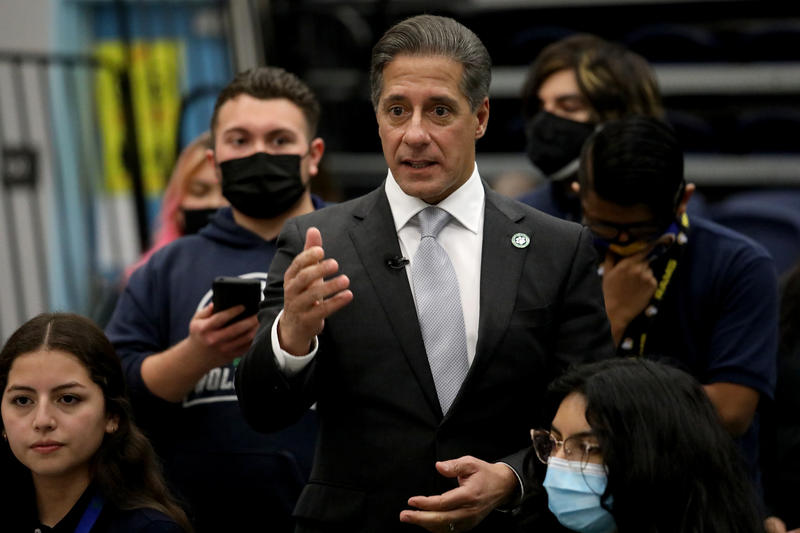
Enrollment decline: LAUSD’s Carvalho says families leaving the state or choosing to home-school

Enrollment decline: LAUSD’s Carvalho says families leaving the state or choosing to home-school
Credit history: Gary Coronado / Los Angeles Situations/Polaris

LAUSD Superintendent Alberto Carvalho.

The place have all the students absent?

California’s K-12 enrollment decrease of a lot more than 270,000 pupils considering that the pandemic commenced is mostly attributable to persons leaving the point out, not enrolling little ones in transitional kindergarten or kindergarten, or selecting to residence-school their children but failing to file the paperwork to account for them, the head of the state’s most significant school district and other gurus reported Sunday. 

“In Los Angeles, in a really, really noticeable and obvious way, the greatest decline was in (transitional) kindergarten and kindergarten pupils,” LA Unified School District Superintendent Alberto Carvalho advised a gathering of education journalists.  “You have to truly acknowledge that dad and mom made a selection, ‘I’m not going to mail my kid to pre-k or kindergarten.’”

No matter of the place the college students finished up, their finding out has been harmed, Stanford University education professor Thomas Dee claimed. Dee’s exploration explained how the youngest pupils were most afflicted by not returning to university next Covid. His perform was highlighted in a collaboration report that bundled EdSource, The New York Occasions and Significant Local Information, a knowledge journalism project at Stanford.

“Enrollment information displays a disruption that college students are encountering, and those disruptions make any difference since research literature displays switching educational institutions, especially in a reactive way, impacts development,” Dee said.

And “missing out on early childhood academic activities can be really consequential,” Dee added.

Throughout California, the number of students enrolled in the public college system dropped underneath 6 million this 12 months for the 1st time in two decades. As districts navigated the sudden shift to digital finding out amid the pandemic, declines steepened as quite a few people faced excess boundaries, regarded alternate options to the general public university program or selected to hold off enrollment for their youngest learners.

The enrollment declines, both in California and nationally, are heading to lead to fiscal impacts and school closures in the many years ahead, claimed Daniel Domenech, govt director of the American Affiliation of School Administrators.

“You’re going to have to market properties when they develop into empty. You are likely to have to exit personnel since you won’t want the amount of academics that you have,” Domenech claimed. “Parents did not want their small children in school simply because they were being worried.”

But, he included, the impression of the pandemic on learners is profound.

“The whole digital mastering expertise was a fiasco since school districts have been not prepared for virtual discovering,” Domenech mentioned. Nationally, there’s “a pulling away of learners from the general public school method because of the impact of Covid.” But he stated it is unclear how several of the learners will return. 

The three males spoke Sunday afternoon at the countrywide conference of the Schooling Writers Affiliation in Orlando, Florida.

In Los Angeles, enrollment has been steadily declining for two decades. The district has 58{e4f787673fbda589a16c4acddca5ba6fa1cbf0bc0eb53f36e5f8309f6ee846cf} of the college student populace it had at its peak in the early 2000s, now at 430,000 learners.

But details demonstrates these learners did not migrate in massive figures to personal and charter universities, the superintendent stated. Constitution universities in the district also experienced an enrollment drop of about 2{e4f787673fbda589a16c4acddca5ba6fa1cbf0bc0eb53f36e5f8309f6ee846cf} during the pandemic, he stated.

LAUSD’s enrollment decrease has only greater given that the pandemic hit. The district misplaced “9,000 kindergartners when the pandemic hit,” Carvalho reported. “That’s a enormous, a large range.”

The district has hired persons to go into neighborhoods to try to keep track of down missing learners and interview their mom and dad, he explained, describing a large thrust in which he and other top rated directors have joined others to check out to hold monitor of 30 young children just about every.

In some conditions, he mentioned, district employees have observed that undocumented people left the nation in the course of the pandemic “because there was no opportunity to perform. The young children remaining with the family members. And they remaining by the hundreds.”

In other cases, he additional, households still left California for other states such as Florida “because of political ideology and lower taxes. If they had the indicates, mother and father made conclusions.”

They went to yet another point out where “their child could go to a college that was far more aligned with their individual beliefs in terms of medicine and in terms of education.”

Perhaps the greatest dilemma in figuring out the drop student by student is the lag in mothers and fathers allowing the district officially know they have decided to home-school their young children by submitting an affidavit with university officials. 

“Parents are taking their time to file the files,” he stated.

Statewide, throughout the height of the pandemic, a file 35,000 families had submitted an affidavit with the condition to open up a private household college, but the quantities dropped the next calendar year, in accordance to California Department of Training information. That degree is nevertheless substantially increased than the 15,000 affidavits filed in the yrs prior to the pandemic.

In accordance to LAUSD’s enrollment analysis conducted as a portion of Carvalho’s 100-day approach that released when he grew to become superintendent in February, LAUSD has witnessed the most important declines by grade at the elementary faculty degree and the most significant declines geographically amongst west and central area districts around the last six many years.

The district has also discovered that the major drops have been among the center-course family members, but that investigation does not just take into account the learners who still left to go to the Metropolis of Angeles virtual faculty in the course of the pandemic.

LAUSD doesn’t consider personal universities a big variable in its enrollment decrease for the reason that neighborhood personal university enrollment has also been on the decline for the past several years, dropping far more than 6{e4f787673fbda589a16c4acddca5ba6fa1cbf0bc0eb53f36e5f8309f6ee846cf} because 2017. Reflective of the national pattern, homeschooling in the Los Angeles-Extended Beach-Anaheim metropolitan statistical spot doubled to 8{e4f787673fbda589a16c4acddca5ba6fa1cbf0bc0eb53f36e5f8309f6ee846cf} in 2020.

EdSource reporters Kate Sequeira and Diana Lambert contributed to this report.

To get additional reviews like this a person, click on below to indicator up for EdSource’s no-price day-to-day email on most current developments in education.

Homeschooling: An alternative is going mainstream

Homeschooling: An alternative is going mainstream

Kristina Madrid’s kids on their initially day of homeschooling, 2021-22. (Courtesy picture)


“Homeschooling is turning into additional well-liked each individual working day, with a growth amount of 7 to 15 per cent for every yr. There are about two million little ones currently understanding at residence. Homeschooled little ones do well on standardized exams, are welcome at schools and universities, and as older people, have a reputation for remaining self-directed learners and responsible workers.” —   familyeducation.com


Homeschooling, specifically all through the pandemic when colleges were being shut down and mastering went remote, is getting in popularity.

Commonly, the strengths for those people homeschooling their small children include: academic flexibility, bodily independence, psychological independence, spiritual independence, nearer family interactions, steadiness all through hard situations (the pandemic is a fantastic illustration of this), perfectly-rested young children, no busywork – and when you will need a hug, there’s normally a single nearby.

Drawbacks are time restraints, financial restraints, becoming with those people youngsters 24/7, confined team sports and living exterior the so-called norm.

The Observer desired to know why so many moms and dads opt to instruct their possess little ones — numerous of them undertaking so for the very first time when the pandemic strike and on the net learning grew to become a chore for numerous children — forsaking training systems already in place,

“I truly feel strongly that our educators check out their ideal, and are accomplishing astounding work in classrooss, but truly feel caught in between a rock and tricky place because of class size and (essential jobs),” reported Sarah Candelaria, a previous educator and just one-time kindergarten trainer at Enchanted Hills Elementary in Rio Rancho,

Candelaria is a homeschooling advocate and wonderful source for other folks thinking of that alternate to personal/general public schooling their children. She was a pre-kindergarten guide at UNM, where she experienced new teachers on most effective methods in the classroom. Candelaria is the youth application director for Character Niños, which supplies summer months programming and is a fantastic location for field trips.

Her eldest child, homeschooled the past 15 yrs, is now 17 and enrolled at CNM. She has two other kids remaining schooled at house.

“Tweaking” the curriculum has been important, Candelaria said, “(and it is) the attractiveness of homeschooling.”

Eight community homeschooling mothers, each and every educating her have little ones from 3-18 decades, were despatched seven thoughts about homeschooling.

Right here are some of their responses.

Observer: What designed you choose homeschooling was desired or a better technique for your child(ren) than public or private schooling?

Mikayla Weston: “I imagine the biggest advantage was observing my youngsters expand in a tranquil environment. To be in a position to give them time with pals which is not just a 30-moment lunch split. To know when we will need to gradual down the pace of our curriculum or push on for the reason that we have mastered one thing faster than prepared. When a issue pops up, I can pause all the things and we can dive deep into discussion. My daughter is in kindergarten now and it is a wonderful present to be asked a concern and be in a position to get a book and research it together. It’s astounding to see that there is a cultural pageant going on and make our scientific studies about that in advance of we go. Not only is my kid finding out, but I’m mastering correct together with them sometimes.”

Observer: What are the positive aspects, as you have noticed them?

Mona Koerner: “A adaptable agenda, so we can vacation and do schoolwork on the road, thrives in this setting. The No. 1 advantage was getting ready to personalize the mastering to our scholar. We selected a university product college to begin with, because they advertised the capability for a university student to entry distinct concentrations of discovering (i.e., distinct grades) in each and every subject matter. So, presumably a person that was good at math could be in a higher quality than their age or other topics. My daughter begun her kindergarten year likely to to start with grade math. Nevertheless, by very first quality the second-grade math was too gradual and there was not the option to bounce to 3rd grade. Other problems arose causing us to question some of the written content that was being taught. Getting equally existence-lengthy learners we uncovered it unacceptable that they taught incorrect details and that the worldview/beliefs did not line up with ours. … constitution colleges and the area public faculty all educational institutions are focused to the masses and not to people today.”

Observer: What are the drawbacks?

Debbie Bonzon: “It does not final without end. The comments we’d get from persons, at instances, had been a reminder we were executing one thing ‘different’ and we’ve experienced some unkind matters claimed and attitudes toward us from ‘suspicious’ and ‘well meaning’ individuals. But that is no distinct than general public university or life in normal. People can say mean factors, but I had the possibility to speak with my young children in how to reply with grace and to not maintain a grudge. So, even disadvantages became an option for instructing.”

Observer: Have you experienced any troubles obtaining a curriculum or resources even though homeschooling?

Kristina Madrid: “Not at all! There are so several veterans of homeschooling and resources that can be identified by CAPE-NM (Christian Affiliation of Mum or dad Educators, New Mexico) HSLDA (Household University Lawful Defense Association) and even Fb teams for homeschooling that can assist stage you in the proper way. A ton of seasoned homeschool parents can share which curriculum labored best in their view for the distinctive kinds of learners in their household. … There are homeschooling curricula obtainable for checkout at Rio Rancho libraries and the Dwelling-Education and learning Useful resource Middle in Albuquerque. Routinely, you can even get hand-me-down merchandise from the homeschool teams for free of charge. There are also co-ops available, so that other dad and mom who have encounter in or working experience educating a particular subject matter can assistance. The homeschool neighborhood is exceptionally handy and will do what they can to help homeschooling go well for you if that is what you select to do. There are a whole lot of easily available options to fit the desires of a family.”

Observer: How do you measure your boy or girl(ren)’s success?

Mikayla Weston: “I evaluate their results by progress. It can be difficult to find out a new ability, but to look at your little ones push on to achieve this talent is achievements. We see it in a assortment of strategies, but my favored is software. We find out things in faculty that we can utilize to the authentic entire world. It is tiny, but it’s wonderful to see my daughter remember phonics through her looking through journey. It’s wonderful to see my son be ready to converse to other young children about the issues he acquired on a vacation to a further state mainly because we had the time. Understanding arrives from everywhere and possessing little ones who see that is success.”

Observer: What do you believe that you can do greater than a accredited educator?

Amy Fletcher: “I am able to expend the one-on-a person time my baby was needing at to start with. In a community faculty, he didn’t get that way too usually mainly because there are a great deal of little ones in a single classroom. He wanted (to be) redirected normally considering the fact that he is a special wants child. I was in a position to maintain him on observe.”

 Dr. Shelly Gruenig: What else would you like to add to this tale?

Dr. Shelly Gruenig: “Homeschooling is a way of life, not simply just an instructional selection for families. You see this represented as homeschool dad and mom not only teach their youngsters, but also provide our neighborhood by support companies, church buildings and far more. Just one example is in 2005, I established a robotics software, R4Developing, to serve my youngsters and their pals. Seventeen yrs later on, R4Building is a nonprofit that continues to serve the community and 1000’s of young ones have participated in the application over the many years. … The students associated in the application figured out about the many sides of entrepreneurship and leadership by commencing a STEM education business alongside me that proceeds to serve tens of countless numbers of college students and educators in our state even though shaping their occupations and everyday living start strategies. These encounters facilitate better choice-making and problem-solving skills, while giving an awareness of the environment that finally builds a student’s aggressive advantage.”

Just as community or non-public universities are not for everybody — and homeschooling has become a well-known different currently — not just about every guardian has the time and means to educate their boy or girl(ren) at home.

“Parents ought to make choices primarily based on what is finest for their little ones and family members,” claimed RRPS Superintendent Sue Cleveland.

“Rio Rancho Public Schools provides a high-quality option for mother and father seeking for an natural environment that supplies various chances for all college students which includes arduous lecturers, award-winning fine arts applications and condition championship sports programs.” she reported. “In fact, a selection of homeschool learners in Rio Rancho take part in more or co-curricular plans and even some classes made available by RRPS. If homeschool family members are interested in learning additional about how they can take part in our applications, we really encourage them to give us a get in touch with.”


A new Indiana law targets enrollment incentives. What effects will it have?

A new Indiana law targets enrollment incentives. What effects will it have?

A new Indiana law strengthens past bans on educational facilities offering presents or perks to moms and dads in trade for enrolling their pupils. But so considerably, officers do not show up to be imposing the stricter provision at educational institutions that acquire community money.

The omnibus Property Enrolled Act 1093, which Gov. Eric Holcomb signed in mid-March and went into effect July 1, tightens a preceding rule that bans educational facilities and their associates from giving “any product that has financial benefit, including hard cash or a reward card” as an incentive to enroll. 

The bill arrived about adhering to a Chalkbeat report on the rising criticism of a digital college that first presented homeschooling mom and dad cash, and then a debit card-like details procedure, to purchase academic components that consist of textbooks, Netflix, instructional toys, and museum memberships.

The university, Tech Trep Academy, even now works by using its details method, indicating it’s not an enrollment incentive. 

Rep. Bob Behning (R-Indianapolis), the new law’s author, declined to comment. But he earlier advised Chalkbeat that Tech Trep’s details system nonetheless represented an incentive simply because all college students acquired a established sum of factors upon enrollment. 

Months after the regulation went into result, the Indiana Department of Training hasn’t reached out to any educational institutions about changing their insurance policies, explained spokesperson Holly Lawson. But Lawson mentioned the office did achieve out in May possibly to Cloverdale Community Educational institutions, which oversees Tech Trep, about concerns about the system. 

“With the enactment of this new law this thirty day period, IDOE will keep on to do the job with all faculty districts to help them manage compliance with point out regulation,” Lawson said in a assertion.

It’s unclear how widespread enrollment incentives are in Indiana, but household university constitution plans in other states have appear below fireplace for similar methods. 

University buys wishlist objects for mothers and fathers

Tech Trep Academy is a virtual faculty operated by a Utah-primarily based corporation by way of Cloverdale Community Faculties, which keeps a portion of the point out funding for every single Tech Trep pupil. 

The school allows dwelling-schooling mom and dad to pick their own curriculum and attain supplemental materials, as perfectly as take virtual lessons from instructors, all applying factors. Students have accessibility to a homeroom trainer, take condition tests, and obtain pass/fall short grades.  

An on the web FAQ claims parents can expend up to 850,000 factors per semester on courses and electives straight by way of Tech Trep, as effectively as outdoors curriculum. Other examples on the FAQ incorporate on the net subscriptions, computers, tablets, and other tech objects, world wide web charges, extracurricular classes, tutoring, and museum passes. 

The college switched to the points program just after coming underneath hearth in 2020 for to begin with offering mom and dad a $1,700 stipend to invest on property-schooling resources. 

Orders employing the points technique are now performed through the school. Family members make would like lists on Amazon or RainbowResources.com, then meet up with with the school’s direct buying group to have the college invest in the things. 

A list of products not suitable for the points system is out there to moms and dads following learners enroll in Tech Trep, in accordance to the FAQ. The school did not offer an example of products not suitable for the points technique to Chalkbeat by deadline.

Lauren Bailey, Tech Trep Academy’s assistant director, mentioned there are numerous factors why means may be ineligible for reimbursement with points.

“Numerous safeguards and procedures are in location to ensure that any supplemental content aligns with substance that is out there to pupils who attend Cloverdale’s traditional brick and mortar schools,”  Bailey claimed. 

But are the points them selves an incentive? The university states no. 

“The point process is not an enrollment incentive since it provides (1) product instantly relevant to a student’s curriculum, which is designed by the certified Indiana teacher and (2) educational means that students want for their personalized understanding,” Bailey explained. 

She added that when “something different and impressive can make persons unpleasant,” the university shown creative imagination when continue to subsequent point out legislation and state schooling expectations.

Kylene Varner, an advocate with the Indiana Affiliation of Household Educators who testified in aid of Dwelling Enrolled Act 1093, mentioned the Tech Trep method to start with arrived to her attention soon after some families questioned about most likely obtaining point out funding to household faculty. 

“There’s no law that says it is alright for the state to hand around community resources to a mum or dad to commit how they want,” Varner claimed.

Varner stated a points procedure functions as a different kind of forex. She explained 1093 designed the previous provisions of Indiana code crystal obvious — but that enrollment incentives have lengthy been illegal in the point out. 

Right before 1093, Indiana code banned universities from supplying learners “any product that has financial benefit, including cash or a reward card that may possibly be used at a retail retail outlet, grocery retail store, online retail store, or other business enterprise.”

The new legislation removes language about where the monetary incentive can be expended, and clarifies that particular college associates can not give incentives. 

A short-lived modification to the invoice that became 1093 would have excluded curricular resources from the ban on incentives — but the language was taken out of the remaining invoice. 

“State businesses have not been performing what they need to have to do to secure taxpayers,” Varner explained. “Any method that is hoping to occur into our condition desires to stick to the guidelines.”

This story has been up-to-date soon after publication to clarify a description of Tech Trep Academy.

Aleksandra Appleton handles Indiana training coverage and writes about K-12 educational facilities across the state. Speak to her at [email protected].