
InCorporatED – Parents Defending Education

InCorporatED – Parents Defending Education

Corporate America has leveraged ESG to turn K-12 students into activists.

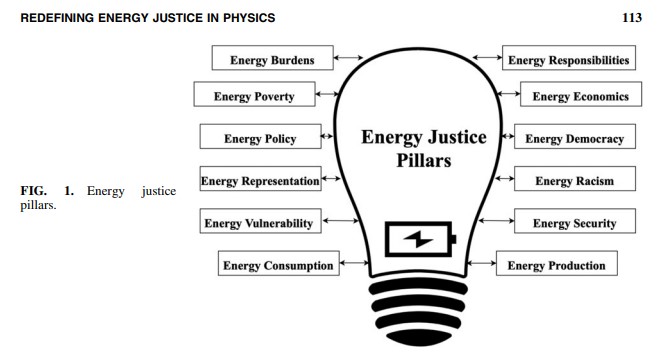
In the summer of 2020, the University  of Washington, using $1,336,657 in funding from the National Science Foundation, ran a professional development for high school physics teachers. The report, titled “Redefining Energy Justice in Physics Classrooms,” focused on training teachers to integrate discussions around “energy justice” into existing physics curriculum. The authors stated the “original purpose of the energy concept was to improve factories and steamships in the British Industrial Revolution and advance capitalism and colonialism.” They also claimed the traditional method of teaching upholds capitalism and the use of fossil fuels and is responsible for “energy injustices” and “environmental racism.” Upon completion of the training, participants concluded that equity, social justice, and physics are inseparable because “there are inequities and injustices present in physics.”
K-12 classrooms are being used by corporations to advance political ideologies such as critical race theory, queer theory, and environmental racism. These destructive ideas are foundational to new policies being implemented in schools. Examples include students being segregated by race, gender transitions without parental consent, and using discussions on the environment to shame white students.

In 2021, Parents Defending Education released the Consultant Report Card, highlighting how much money education consultants were being paid to introduce controversial ideologies such as critical race theory into schools. Our Cracked Foundations report exposed how philanthropic foundations are using large grants to advance woke ideology through K-12 classrooms. In the same vein, corporations are seizing the opportunity to use environmental, social, and governance (ESG) standards to further the encroachment of critical race theory, queer theory, and climate activism into school systems.

As companies adopt ESG standards, the discussion about how to integrate education into an organization’s ESG focus has become increasingly robust. Businesses are seeking ways to boost their own ESG corporate rating, which benefits from investment in K-12 education. Companies also view involvement in education as a long-term net benefit by ensuring that future employees are ESG- and UN Sustainable Development Goals-oriented. They also see it as an opportunity to generate revenue.

ESG is a set of operating principles that prioritizes a stakeholder-centric, public-private partnership, approach to solving alleged systemic inequities and the “climate crisis.” It determines the value structure around an organization’s or school district’s commitment to advancing “sustainability” and social justice issues in place of a traditional academics focus.

Additionally, investment firms are advocating that school districts adopt ESG standards and policies to boost interest from investors when it comes to bond initiatives. Municipal bonds are considered “low risk investments,” and are a tax-free way for a district to “spread debt repayment over an extended period.” The more ESG-compliant the policies, lessons, and activities a school district implements, the better it looks to banks and firms that service municipal bonds.
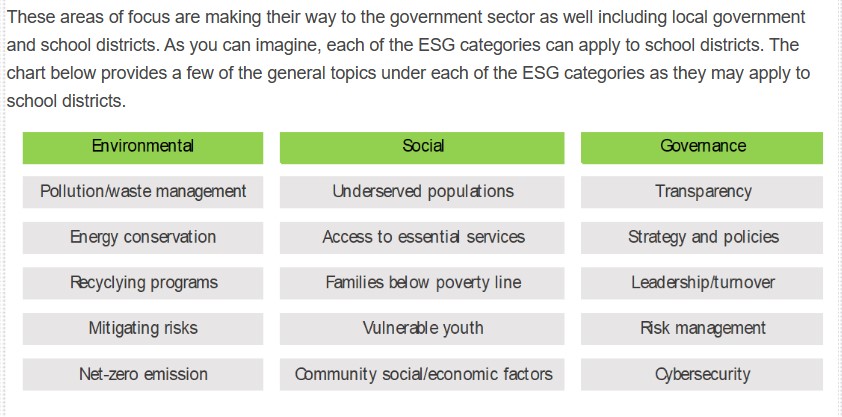
Source: Environmental, Social, & Governance – What It Is & Why It’s Important To School Districts (oasbo-ohio.org)

Key Takeaways:

  • Environmental: focuses on advancing ideas such as environmental racism, net zero and climate crisis policies
  • Social: focuses on advancing ideas such as critical race theory, queer theory, and equity policies
  • Governance: focuses on the policies put in place to realize and advance the environmental and social factors

WHAT IS ESG?

ESG stands for Environmental, Social, Governance – and each of the three focuses breaks down issues by category, such as how a school district is teaching and tackling climate change (environmental), a district’s diversity, equity, and inclusion efforts (social), and hiring practices and bid allocations toward “marginalized groups” (governance).

Environmental factors indicate how an entity operates in relation to topics such as climate, energy consumption, pollution, and other environmental risks. Social incorporates values and relationships of those people involved in the organization. Factors of social include racial justice, diversity and inclusion efforts, and the application of equity policies.

According to the World Economic Forum, governance includes factors such as “corporate structure, board composition, business ethics and anti-corruption.” The WEF also adds that besides governance being “one-third of the ESG equation, the G is also foundational to the realization of both the E and S.

ENVIRONMENTAL, SOCIAL, AND GOVERNANCE IN K-12 SCHOOLS

ENVIRONMENTAL

The “Environmental” component of ESG directs how a school district puts into action governance policies centered around focuses such as environmental racism and the “climate crisis.” This includes lessons and discussions focused on privilege, student climate activism, and professional development.

In November 2022, an external review performed for Weston Public Schools’ social studies and history education program highlighted a fifth-grade class discussion that focused on “environmental racism.” The document states that the observers noticed “considerable comfort and sophistication among (white) students discussing racism and how environmental policies often advantage white communities.” Review of the district’s social studies and science curriculums reveal “environmental racism” is absent in the documents. However, a self-study done by the district in 2021 shows that Weston Public School teachers “made a commitment to active antiracism” including professional development on the topic.

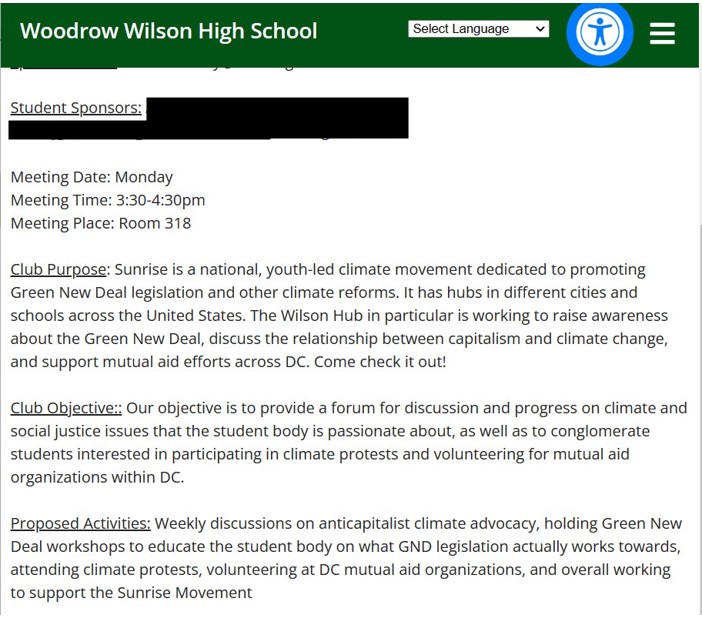
Another aspect of the environmental component is student activism. Jackson-Reed High School (formerly Woodrow Wilson) in Washington, D.C., offers its students the opportunity to be part of the Sunrise Movement Club. According to its webpage, the Sunrise Movement is a “national, youth-led climate movement dedicated to promoting Green New Deal legislation and other climate reforms.” It goes on to state that the club “raise awareness about the Green New Deal” and “discuss the relationship between capitalism and climate change.” Club activities include “participating in climate protests,” “weekly discussions on anticapitalist climate advocacy,” and “working to support the Sunrise Movement.”
Below are additional examples of how Environmental policies are integrated into K-12 schools.

  1. Educational Service District 112 (WA): Climate Justice League Inspires Action
  2. Journal of Science Teacher Education: Exposing and dismantling systemic racism in science education
  3. Los Angeles Unified School District (CA): School Board Approves Transforming Teaching of Climate Change
  4. National Education Association: Climate Change Education in Every Subject
  5. Northshore School District (WA): Rantz: Teacher uses science class to label white middle schoolers privileged oppressors
  6. Portland Public Schools (OR): Portland Public Schools science courses in high school focus on ‘climate justice’ and ‘social justice’
  7. San Francisco Unified School District (CA): SFUSD Teaches Environmental Literacy and Climate Justice to All K-12 Students
  8. San Mateo County Office of Education (CA): San Mateo County Office of Education provides ‘Environmental and Climate Justice’ resources

SOCIAL

The “Social” component of ESG focuses on a school district’s values and relationships in accordance with the policies laid out through governance. This includes diversity, equity, and inclusion efforts; social justice activism; culturally responsive teaching; social and emotional learning; racial affinity groups; access to health clinics; data privacy and technology; and equitable practices.

One aspect of the social component in ESG is a district’s advancement of racial and social equity through activities and curriculum. For example, districts have enacted resolutions or policies (governance) recognizing Black Lives Matter at School Week of Action. The BLM-focused lessons are incorporated into K-12 schools as part of its Black History Month programming. The weeklong curriculum is based on the Black Lives Matter 13 principles, which include “disrupting the Western prescribed nuclear family” and freeing society of “heteronormativity” and “ageism.”

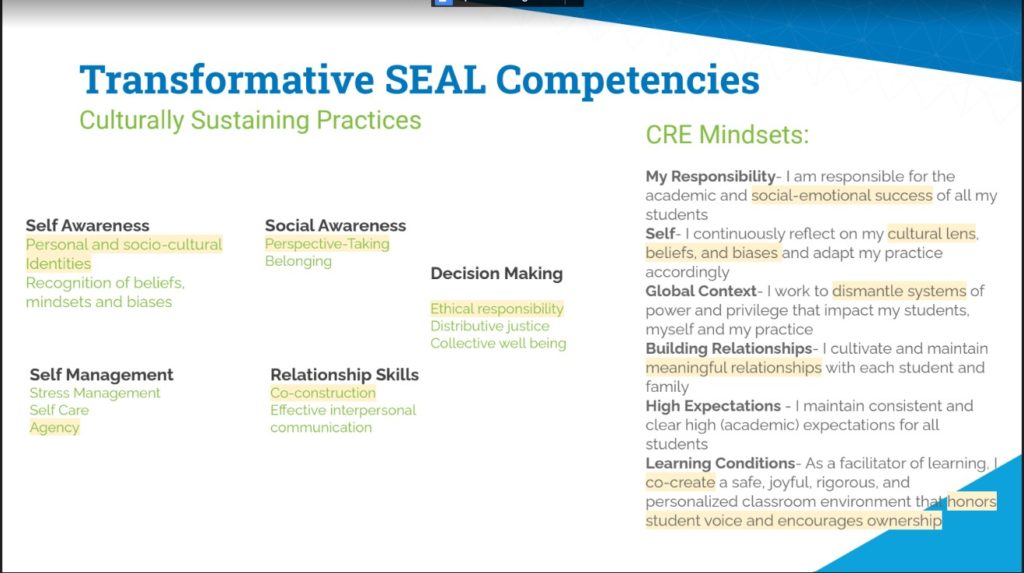
A school district’s commitment to “wellness,” as defined by the World Economic Forum and UN, affects its overall rating. For example, Denver Public Schools, through a grant from the Wallace Foundation, advances the ESG agenda through its Transformative Social Emotional Learning (TSEL) programming. The SEL variant is intended to use the classroom to redistribute “power to promote social justice.” The TSEL framework seeds a racial justice and equity lens into the minds of young learners through lessons and curriculum. One of its top proponents, Dena Simmons, states in a tweet that “without racial context, SEL is white supremacy with a hug.”
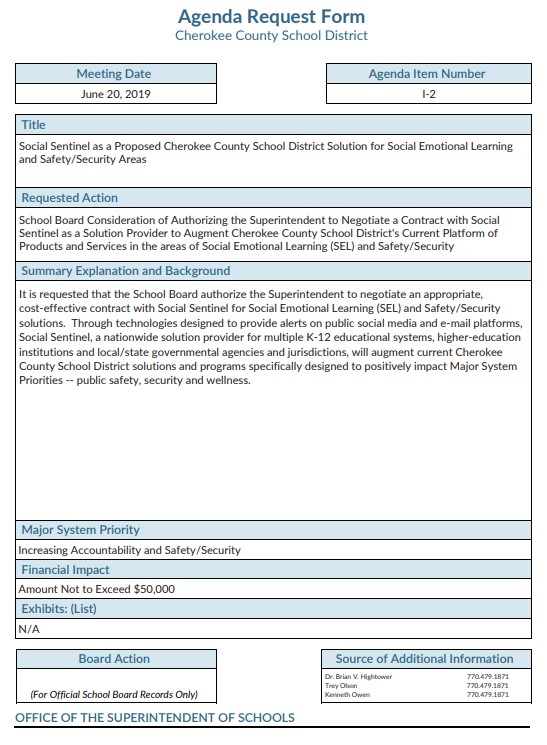
Additionally, school districts are utilizing educational technologies to monitor for online harassment and bullying, and to track student use of social media under the guise of SEL. For example, Cherokee County School District in Georgia contracted with Social Sentinel (now part of Navigate360) in 2019 to “provide alerts on public social media and e-mail platforms.” The district sought out the services to “augment” its “Social Emotional Learning (SEL) and Safety/Security” including “public safety, security and wellness.”
Below are additional examples of how Social policies are integrated into K-12 schools.

  1. Boston Public Schools (MA): Boston Public Schools’ ethnic studies curriculum focuses on oppression and ‘Pillars of White Supremacy’
  2. Chicago Public Schools (IL): Chicago Public School student protest in-person learning with district-wide walkout
  3. Lower Merion School District (PA): Lower Merion School District uses race-based affinity groups for students as young as fourth grade, claims 7 month olds can ‘discern race and show preferences.’
  4. NASA: GBH “Framework For Diversity and Equity in K-12 Science Educational Media”
  5. Norwalk-La Miranda Unified School District (CA): California School Board May Open Planned Parenthood Clinic at LA High School
  6. Parkway Schools (MO): Transgender Center Staffers at Washington University of St. Louis and St. Louis Children’s Hospital Advise Parkway Schools Not to Tell Parents About Child Chest Binder Use
  7. Phillips Exeter Academy (NH): Phillips Exeter Academy courses include ‘Mathematics of Social Justice’ and ‘Science Health and Race in America’
  8. Topeka Public Schools (KS): Middle school staff coordinates with GSA club to facilitate student walkout; district policy is to hide students’ gender transition from parents

GOVERNANCE

The “Governance” component is implemented through the school district’s purpose, the demographic makeup of the personnel (such as gender and racial diversity), how staff are contracted and paid, and how policies affect all stakeholders. It prioritizes the impact decisions have on all stakeholders, not just the parties involved. It is through governance that ESG complaint policies are created at the administrative level, and then put into action in the social and environmental factors.

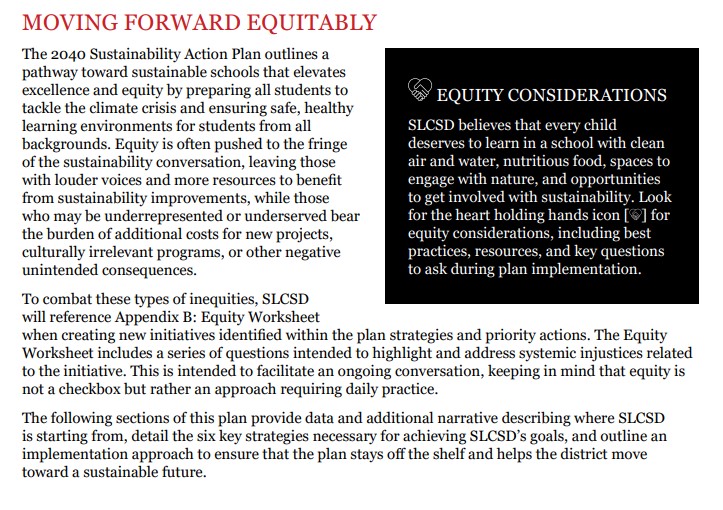
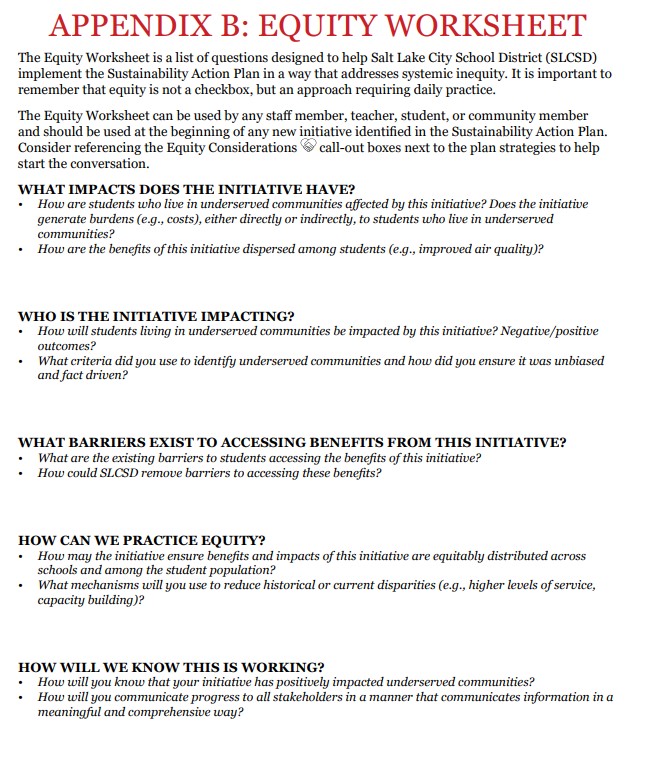
In 2021, the Salt Lake City School District produced its “2040 Sustainability Action Plan” that set goals to go full green energy by 2030, as well as to eliminate all fossil fuel use by 2040. The plan claims that when pursuing sustainability, those with “more resources” benefit the most. Therefore, it aims to combat “inequities” by centering “underserved communities” in all decisions. The district provides an “equity worksheet”to aid in the process. “The Equity Worksheet is a list of questions designed to help Salt Lake City School District (SLCSD) implement the Sustainability Action Plan in a way that addresses systemic inequities.”
For example, the Dallas Independent School District bidding process for outside contractors and consultants includes a 20-point category (out of a total 100 points) that prioritizes a “marginalized” or minority status of the bidding company’s leaders or ownership. In other words, the district uses the skin color and gender of the applicants as part of the overall scoring method when determining the worthiness of a contract.

In Maine, the Kennebec Intra-District Schools policy for “Students Who Are Transgender and Gender Expansive” gives authority to the school district and staff to withhold notification to parents should a student reveal they are transgender. The policy declares that a student’s ”health and safety” is its top consideration. The document states that the “principal and/or school counselor will continue to work through family issues with the student with a goal of acceptance by all.”

Districts also utilize student and staff surveys to craft and enact new policies. The Austin Independent School District used a 2017 student survey as the driver to craft its district wide LGBT policies and curriculum. The survey for students able to “select ‘boy,’ ’girl,’ or ‘I’d prefer to self-identify.’” Pulling out the data from students who chose to “self-identify,” the district concluded that those students had a higher amount of mental health issues compared to their peers. The solution was to develop a more “inclusive” school environment and curriculum that would prioritize the specific sub-group of students.

Below are additional examples of how Governance policies are being integrated into K-12 schools.

  1. Albermarle County Public Schools (VA): Albemarle County Public Schools assistant superintendent appears to tell staff to quit if they disagree with district’s “Anti-Racism Policy”; middle school principal hosts training session for faculty with presenter encouraging adults to allow toddlers to “explore” their gender identity
  2. Eau Claire (WI): Eau Claire Area School District provides school staff with “Administrative Guidance” to support transgender students; appears to support students using “medical” and “surgical” procedures to transition to another gender
  3. Fairfax County Public Schools (VA): Fairfax County Public Schools seeks to pay up to $200,000 for ‘social media management’ and surveillance
  4. Jefferson County Public Schools (KY): Racial Educational Equity Plan
  5. Knox County Schools (TN): Vice Chair of Knox County Schools Board is member of consultant group hired to do equity audit; consultant advocates for teacher affinity groups
  6. Okemos Public Schools (MI): Okemos Schools’ DEI director warns that teachers who don’t use students’ preferred pronouns’—even behind parents’ backs—”could potentially fall under our harassment policy”
  7. Prince Georges County Public Schools (VA): Climate Change Action Plan
  8. Portland Public Schools (OR): Portland Public Schools ‘Climate Crisis Response’ policy centers ‘racial equity’ and ‘climate justice’

Online Education Market in India to grow at a CAGR of 19.9{e4f787673fbda589a16c4acddca5ba6fa1cbf0bc0eb53f36e5f8309f6ee846cf} from 2022 to 2027, Driven by skill development and employment- Technavio

Online Education Market in India to grow at a CAGR of 19.9{e4f787673fbda589a16c4acddca5ba6fa1cbf0bc0eb53f36e5f8309f6ee846cf} from 2022 to 2027, Driven by skill development and employment- Technavio

NEW YORK, March 6, 2023 /PRNewswire/ — According to Technavio, the online education market size in India is estimated to grow by USD 3,461.93 million from 2022 to 2027. The market is estimated to grow at a CAGR of 19.9{e4f787673fbda589a16c4acddca5ba6fa1cbf0bc0eb53f36e5f8309f6ee846cf} during the forecast period. The growing focus on skill development and employment is notably driving the demand for the market. Working professionals across various domains focus on skill development for value addition and career growth. This is a trend that is followed by all age groups of working professionals. Working professionals prefer picking up courses on digital platforms over traditional classes due to factors such as convenience and flexibility. This trend, especially in tier 1 cities is expected to fuel the growth of the online education market in India during the forecast period.For more insights on the historic (2017 to 2021) and forecast market size (2023 to 2027) – Request a sample report

Technavio has announced its latest market research report titled India Online Education Market 2023-2027

Technavio has announced its latest market research report titled India Online Education Market 2023-2027

Leading trends influencing the market 

  • The emergence of cloud computing is a major trend driving the demand for the market in focus. This technology has helped players save significant content, data, and information on a single platform. This has also helped users to process, procure and access information at their convenience.

  • Cloud computing has also helped vendors reduce capital expenses and improve the speed of implementing SaaS-based solutions like ERP and LMS.

  • Vendors in the market are collaborating with central and state governments to popularize cloud platforms. For instance, the government has taken initiatives like the National Digital Library and the National Academic Repository to promote e-learning in institutes.

  • Hence, adopting cloud-based learning platforms in online education helps resolve several issues, thereby fueling the growth of the market in the country.

Major challenges hindering the market growth

  • The lack of infrastructure like high-speed internet, and optical fiber communication in many regions of the country may impede the growth of the market. This issue can make an otherwise economically efficient model essentially ineffective.

  • Lesser developed states and remote places in the country suffer from either lack of connectivity or are economically backward to afford the technology. Moreover, for services that offer classroom training along with e-learning, basic infrastructure like advanced hardware, software, and data centers are unavailable.

  • Hence, despite the high adoption of the internet and smartphones, insufficient infrastructure challenges the growth of the market.

Insights on Market Drivers, trends, & Challenges, historic period(2017 to 2021) and forecast period(2023 to 2027)- Request a sample report!

What’s New?

  • Special coverage on the RussiaUkraine war; global inflation; recovery analysis from COVID-19; supply chain disruptions, global trade tensions; and risk of recession

  • Global competitiveness and key competitor positions

  • Market presence across multiple geographical footprints – Strong/Active/Niche/Trivial  – buy the report!

Online Education Market in India – Segmentation Assessment
Segment Overview
Technavio has segmented the market based on End-user (Higher education and K-12), and Product (Content and Services).

  • The higher education segment is prominent in the growth of the online education market in India during the forecast period.

  • Online higher education enables time and location flexibility as well as affordability to the end-users. This has led to many ed-tech companies investing and witnessing an increase in the adoption of courses for higher education preparation.

  • For instance, Unacademy launched a dedicated platform for JEE (Joint Entrance Examination) preparation, which is one of the most competitive engineering entrance exams in India.

  • The Government of India (GoI) is further promoting online education through its Digital India initiative under the National Mission on Education through Information and Communication Technology (NMEICT).

Insights on the market contribution of various segments, historic (2017 to 2021) and forecast market size (2023 to 2027) – Download a Sample Report

What are the key data covered in this Online Education Market in India report?

  • CAGR of the market during the forecast period

  • Detailed information on factors that will drive the growth of the online education market in India between 2023 and 2027

  • Precise estimation of the size of the online education market in India size and its contribution to the market in focus on the parent market

  • Accurate predictions about upcoming trends and changes in consumer behavior

  • Growth of the online education market across India

  • A thorough analysis of the market’s competitive landscape and detailed information about vendors

  • Comprehensive analysis of factors that will challenge the growth of the online education market in India vendors

Gain instant access to 17,000+ market research reports. 

Technavio’s SUBSCRIPTION platform

Related Reports:

The online photography education market in the higher education market size is expected to increase by USD 655.08 million from 2021 to 2026, and the market’s growth momentum will accelerate at a CAGR of 7.08{e4f787673fbda589a16c4acddca5ba6fa1cbf0bc0eb53f36e5f8309f6ee846cf}. The growing advantages of online learning are a major factor driving the global online photography education market in higher education market share growth.

The nursing education market size in the US has the potential to grow by USD 45.97 billion during 2021-2025, and the market’s growth momentum will accelerate at a CAGR of 21.72{e4f787673fbda589a16c4acddca5ba6fa1cbf0bc0eb53f36e5f8309f6ee846cf}. The growing aging population leads to an increase in the retiring nursing workforce. The retirement of trained nurses will give rise to the need for training, educating, and hiring new nurses.

Online Education Market In India Scope

Report Coverage

Details

Base year

2022

Historic period

2017-2021

Forecast period

2023-2027

Growth momentum & CAGR

Accelerate at a CAGR of 19.9{e4f787673fbda589a16c4acddca5ba6fa1cbf0bc0eb53f36e5f8309f6ee846cf}

Market growth 2023-2027

USD 3,461.93 million

Market structure

Fragmented

YoY growth 2022-2023 ({e4f787673fbda589a16c4acddca5ba6fa1cbf0bc0eb53f36e5f8309f6ee846cf})

18.7

Regional analysis

India

Competitive landscape

Leading Vendors, Market Positioning of Vendors, Competitive Strategies, and Industry Risks

Key companies profiled

Aeon Learning Pvt. Ltd., AnalytixLabs, Coursera Inc., Educomp Solutions Ltd., Excelsoft Technologies Pvt Ltd., Indira Gandhi National Open University, Intellipaat Software Solutions Pvt. Ltd., Jigsaw Academy, Khan Academy Inc., MPS Ltd., NextEducation India Pvt. Ltd., NIIT Ltd., Reliance Industries Ltd., Simplilearn Solutions Pvt. Ltd., SMU DE, Think and Learn Pvt. Ltd., Udemy Inc, upGrad Education Pvt. Ltd., Vedantu Innovations Pvt. Ltd., Zeus Systems Pvt. Ltd., and Sorting Hat Technologies Pvt. Ltd.

Market dynamics

Parent market analysis, Market growth inducers and obstacles, Fast-growing and slow-growing segment analysis, COVID-19 impact and recovery analysis and future consumer dynamics, Market condition analysis for the forecast period

Customization purview

If our report has not included the data that you are looking for, you can reach out to our analysts and get segments customized.

Table of Contents

1 Executive Summary

2 Market Landscape

3 Market Sizing

4 Historic Market Size

5 Five Forces Analysis

6 Market Segmentation by End-user

7 Market Segmentation by Product

8 Customer Landscape

9 Drivers, Challenges, and Trends

10 Vendor Landscape

11 Vendor Analysis

12 Appendix

About Us
Technavio is a leading global technology research and advisory company. Their research and analysis focuses on emerging market trends and provides actionable insights to help businesses identify market opportunities and develop effective strategies to optimize their market positions. With over 500 specialized analysts, Technavio’s report library consists of more than 17,000 reports and counting, covering 800 technologies, spanning across 50 countries. Their client base consists of enterprises of all sizes, including more than 100 Fortune 500 companies. This growing client base relies on Technavio’s comprehensive coverage, extensive research, and actionable market insights to identify opportunities in existing and potential markets and assess their competitive positions within changing market scenarios.

Contact
Technavio Research
Jesse Maida
Media & Marketing Executive
US: +1 844 364 1100
UK: +44 203 893 3200
Email: [email protected]
Website: www.technavio.com/

India Online Education Market 2023-2027

India Online Education Market 2023-2027

Cision

Cision

View original content to download multimedia:https://www.prnewswire.com/news-releases/online-education-market-in-india-to-grow-at-a-cagr-of-19-9-from-2022-to-2027–driven-by-skill-development-and-employment–technavio-301762043.html

SOURCE Technavio

Patton College’s health and physical education students give standout presentation at state convention

Patton College’s health and physical education students give standout presentation at state convention

Twelve students from the Patton College or university of Education’s Recreation, Activity Pedagogy, and Consumer Sciences division PETE3700 Secondary Solutions training course gave a incredibly effectively been given presentation at the 2022 Ohio Association for Health, Bodily Instruction, Recreation and Dance (OAPHARD) condition conference on Dec. 2, 2022, at the Kalahari Vacation resort & Convention Heart in Sandusky, Ohio.

“Our presentation, Health Fun, focused on generating revolutionary strategies to teach health and talent-linked health and fitness concepts in a way that is enjoyable for learners. Jointly, we made four unique sample routines that can be utilized at any age level to support students attract connections between bodily exercise and overall health,” reported overall health and bodily training important Isabella Hauler.

“Specifically, my group put together two well-known games into one particular to function on cardiovascular endurance and velocity, making tic-tac-toe seize the flag. Individuals had the option to interact in the exercise,” continued Hauler.

Alexander Elementary Faculty Actual physical Training Instructor Natalie Lucas attended the session and observed the students’ degree of professionalism.

“Typically when pupils get in entrance of a massive group you can explain to that they are nervous, however, the Ohio College presentation was carried out with self-confidence and was delivered in the identical fashion as other presenters that have been training for a long time.  You would in no way know that they ended up learners if you hadn’t been instructed,” mentioned Lucas.

According to Dr. Annie Olcott, the PETE3700 Secondary Strategies instructor, learners are essential to get the job done by means of numerous assignments prior to the event in get to get ready.

“During this course, wellbeing and physical schooling majors discover about wellness-similar conditioning and techniques-related fitness components by means of a nationwide bodily exercise evaluation termed Fitnessgram tests. Students then use acquired understanding to the enhancement of exciting physical fitness-dependent motion actions that instruct students about just about every of these factors. Students then have the option to existing these lesson strategies to peers, followed by feed-back and any revisions to finding out pursuits. Then they existing these lesson concepts to learners in conditioning-primarily based Physical Activity & Wellness (PAW) programs at Ohio University, followed by responses. This procedure permits pupils to perform via any tutorial kinks since this is an early encounter in sensible software for them,” said Olcott.

The OAPHARD state conference and session presentation offered college students relevant encounters as well as encouraged them to engage with other pros to aid their future careers. 

“At OAHPARD, we were ready to show up at a lot of distinct periods concerning unique features of actual physical training. It was fascinating to be all around so many that are just as passionate about PE as I am,” reported well being and physical education main Kam Siewny.

“However, I discovered how crucial it is to make connections with colleagues in the actual physical instruction field. It is regularly increasing, and we are understanding much more and additional just about every day. There will always be new methods, tactics, and online games to discover. Obtaining as numerous connections as achievable is how we are heading to continue to be up to date,” stated Siewny. 

Reflecting on her participation at the conference, Hauler found the knowledge to be affirming.   

“My most important takeaway from the knowledge is to have self-assurance in myself as an educator. It was the to start with time any of us had offered to a group of that magnitude. However, the first nerves subsided as soon as I observed the individuals really enjoying every exercise, and I felt a sense of pleasure for my friends as they just about every led a component of the session. It was exceptionally satisfying to see many others love our things to do and complimenting our work. For me, it solidified my belief that I am truly in the ideal career route,” explained Hauler. 

Mainly because it is these a valued practical experience for wellness and bodily schooling pupils, participation in the OAPHARD state conference is planned to continue remaining built-in into the training course curriculum for PETE3700 Secondary Solutions for the 2023 Fall semester. Any person fascinated in learning much more about this instructional expertise can get in touch with Olcott at [email protected].

Virtual Learning a “Critical Tool” in a Changing World

Virtual Learning a “Critical Tool” in a Changing World

During the pandemic, K-12 schools endured withering criticism for their inability to effectively educate students remotely, with many parents and lawmakers demanding a speedy return to in-person learning.

In October 2020, for instance, a Pew Research survey found that parents whose kids attended school in-person were far more likely to say they were “very satisfied” with the way school was handling instruction: 54{e4f787673fbda589a16c4acddca5ba6fa1cbf0bc0eb53f36e5f8309f6ee846cf} vs. just 30{e4f787673fbda589a16c4acddca5ba6fa1cbf0bc0eb53f36e5f8309f6ee846cf} whose kids received online instruction only.

But Patricia Brantley, who leads the 15-school network of Friendship Charter Schools in Washington, D.C., said developing and maintaining virtual learning systems will be critical to public schools going forward. Friendship began investing in virtual learning before the pandemic and has actually expanded its virtual offerings since 2021.

Related: South by Southwest Education Cheat Sheet: 23 Panels, Workshops and Screenings to See at SXSW 2023

The move is largely driven by parents, she said, who see the value of virtual learning for their kids. She noted one parent who wrote that her child requires a wheelchair to attend “a fair amount of medical appointments.” Online learning works in large part because classes are recorded for later viewing. The woman’s son, once an average student, is “now above grade” level, she wrote. Brantley also said the move has fostered “incredibly strong connections between families and with the faculty.”

Three years after the first pandemic closures, Brantley said virtual learning will also be key to attracting young teachers to the profession as other white-collar industries offer the option to work remotely. She’ll be talking about her experiences this week at South by Southwest Edu, part of a panel that explores the possibilities of online learning.

The 74’s Greg Toppo, who will be moderating the session, caught up with Brantley by email in advance of the session.

The interview was edited for length and clarity.

The 74: The panel at South by Southwest Edu asks “Is Virtual Learning the Disruptor Teaching Needs?” What’s your short answer to this question?

Patricia Brantley: Virtual learning is the solution teaching needs. There’s an age-old question: How do we best educate our young and prepare them for the world? Assuming that we can do it in the same way that it’s been done for 100 years or more, when the world has changed, is worse than naive. It is failing generations of students in ways that we may not recover.

In my opinion, the true disruptor isn’t the availability of virtual learning, it’s the convergence of factors illuminated by the pandemic. Those factors include the rise of parent-driven schooling through pods and micro schools that often rely partially on online delivery; the decline of traditional enrollment and rise in private, homeschool, online and charter options, and the flexibility now being given in other professions that make them more attractive to young college graduates than teaching. I see these factors converging in a way that is ultimately forcing changes in the way we historically have approached schooling, especially in traditional settings. Virtual learning isn’t the disruptor. It is a critical tool to support the way education must adapt to a changing world.

Friendship is D.C.’s first public, tuition-free online education provider. Can you talk a little about what you’ve built and what your enrollment trends are?

We began investing in online education years before the pandemic, opening Friendship Online Academy in 2015 for grades K to 8 and expanding to high school in 2019. Our original families knew that traditional settings weren’t serving their children well. The truth is we followed them to online learning as the solution. We were proud of our very specialized, small virtual community that featured incredibly strong connections between families and with the faculty.

Inline pull quote: “You can’t lose human relationships in the shift to online learning. Despite what some may think, a high-quality online learning environment is still centered on people and relationships, not technology.” — Patricia Brantley

Then, as many families were hesitant or unable to return to in-person schooling during the 2021-2022 academic year, our enrollment exploded. We went from barely 200 students to 700. Our staff grew from four full-time teachers to a staff of 40, with a faculty that includes master teachers, guidance counselors, social workers, parent liaisons and resident artists that are leading students through deep experiences in the fine arts. Our growth is an indication of the effectiveness and appeal of online learning environments.

Part of our success here is likely due to our intentional approach to design. Since 2015, our priority has been to design an online program with the learner at the center.  Interestingly, by centering the learner, we also designed a new experience for the teacher, one that creates flexibility and evolves the profession. By doing this, we saw significant interest from teachers to take on this role and high satisfaction rates from those who did. This experience gives us reason to question the prevailing idea that there is a shortage of people who want to teach. Rather, what we see is that many teachers want the freedom and flexibility to evolve. In that way, virtual learning can be as attractive and impactful for educators as it is for students and families.

Related: Many Remote Learning Options Shutting Down as School Reopens for Fall 2022

What have some of your early successes been?

While our enrollment trends are strong indicators of our program’s success, I’m even more pleased with the academic results we continue to achieve. Ensuring access to effective small learning environments and robust online options for students and families are absolute priorities for us. That’s why we are so proud to see results like those from the spring 2021 study from (educational consultants) EmpowerK12, which found that Friendship Online students previously deemed “at-risk” for academic failure outpaced citywide growth in both English and Math during the pandemic.

I also consider it a success that we haven’t gotten locked into one way to meet families’ needs. As we’ve continued to grow and learn, we’re piloting other learning environments that push the limits on traditional school. Our microschools and hubs, which also emerged as part of the need created by the pandemic, were a game changer for many of our families. When we looked at the data, kids who were in those pods achieved larger academic gains than their peers who were not. Some even progressed faster than they did before the pandemic.

I understand you’re using an AI system that listens to kids’ reading and reports back to teachers. What other innovations are you able to bring to the table?

We are constantly driven by the question: “What do families, students, and teachers need right now, today?” We are always asking ourselves this question and we push ourselves to remain open-minded about where the answers might lead us. Over the course of the past few years, this has certainly included expanding our online options and microschools, but it’s also included innovations that aren’t necessarily connected to technology.

For example, since the pandemic taught us that learning can happen anywhere, we’ve made investments in more experiential learning for our students. Partnering with Capital Experience Lab at Friendship Blow Pierce Academy has made the entire city part of our students’ learning journey. We’ve also developed a career coaching program for students to help them prepare for the future and discover career paths they never knew existed. In addition to their teachers and peers, our students are also learning from members of their community.

Friendship Charter Schools CEO Patricia Brantley said the small network is expanding its virtual options at the request of families. (Courtesy of Friendship Charter Schools)

Friendship Charter Schools CEO Patricia Brantley said the small network is expanding its virtual options at the request of families. (Courtesy of Friendship Charter Schools)

During the pandemic, we heard so much about how online learning was problematic. Yet your work suggests there’s huge interest from families. What does the conventional wisdom miss about online learning in 2023?

The first thing that’s missed is the idea that you can paint family and student needs with a broad brush. Does online learning work for everyone? Certainly not. But for those families and students who gravitate towards online learning, it can be a game changer. The pandemic forced all of us to adopt online learning, so of course there were going to be plenty of situations where that wasn’t the ideal learning environment. Now that we can integrate choice into the equation, you start to see that those families and students who opt in to this kind of learning are usually the ones who have great success with it. The idea here is that families need to be empowered to choose the best learning environment for them and we need to be prepared with diverse options to meet their needs.

“Does online learning work for everyone? Certainly not. But for those families and students who gravitate towards online learning, it can be a game changer.”

Patricia Brantley

The other thing that was missed in the urgency created by the pandemic is that you can’t lose human relationships in the shift to online learning. Despite what some may think, a high-quality online learning environment is still centered on people and relationships, not technology. If you leverage technology — and the flexibility it affords — to allow the student-teacher relationship to thrive, that’s when you see the kind of success we’ve been able to achieve over time.

Fond Farwell: Physical Education Professor Emeritus Betty Best

Fond Farwell: Physical Education Professor Emeritus Betty Best

Betty Most effective, professor of bodily education for extra than 3 a long time, extended-time Chico Point out tennis coach, and important supporter of area athletics, passed absent January 6. She was 87.

Ideal taught at Chico State for 34-and-a-half decades and coached the tennis crew for 9. She’s remembered by her learners and friends as a gifted educator, faithful friend, and talented competitor.

Born August 26, 1935, in Vancouver, British Columbia, Best was a the natural way impressive athlete. When the first Canadian Nationwide Discipline Hockey Staff was assembled to take element in the 1956 Global Women’s Event in Australia, Best was the next youngest member chosen. She returned to Australia several years later as a consultant of the United States Subject Hockey Association’s Pacific Southwest Staff, which she was selected for 10 occasions involving 1960 and 1972.

Finest was also a renowned runner and tennis participant. In the 1960s, was chosen to participate in on the Pacific Northwest Tennis Tour. In 1976, Very best was the No. 10 rated masters amount runner in the nation and experienced for the Boston Marathon.

“Everybody imagined of her as ‘Sweet Betty Jean,’ but she was fiercely aggressive as properly as fiercely humble,” mentioned former Chico Condition Observe and Field Mentor Deanne Vochatzer. “She was a phenomenal athlete. She was tenacious. There was under no circumstances ‘quit’ in Betty Jean Finest. Never. At the time she started off anything she was all in.”

Most effective started her job in schooling as a higher college counselor and teacher. Requested by the principal to mentor the boys’ tennis group, she certain him to get started a girls’ program as well.

Best in no way stopped beginning programs. She released just after-school athletics to Chico’s elementary colleges in 1967 and received related systems off the ground in the junior large faculties quickly following. In 1969, Ideal represented Chico Condition on the Northern California Women’s Intercollegiate Council, a catalyst in the formation of intercollegiate athletics for girls at Chico State and all through the nation. Greatly included in the area tennis community and a member of the Chico Racquet Club, Ideal is credited with launching several tennis tournaments in the space for all ages.

Employed September 1, 1965, as an associate professor at Chico Condition, Greatest was promoted to professor on August 28, 1979. She retired on May 29, 1998, and participated in the School Early Retirement Program right up until January 20, 2000. She coached the women’s tennis application from 1965–1974.

Vochatzer and Patricia Smiley benefitted from Best’s instructing and mentorship initial as learners and later on as fellow school customers. They both equally described her as generous and type.

“I listen to her title and it places a smile on my facial area,” reported Vochatzer. “As a young woman pupil-athlete in the late 60s, there weren’t a great deal of opportunities for me. Then I took a tennis class from Betty and discovered another person who would usually really encourage and support me.”

Vochatzer competent for the track and field nationals as a senior but did not have the funding to go. Ideal and her tennis group took coffee cans to the espresso house on campus and elevated revenue for her vacation.

“It was some thing I’ll by no means forget about,” Vochatzer reported. “She was normally beneficial. She would not allow people be detrimental. That was her awesome grace.”

Smiley was impacted by Best’s teaching acumen and her empowering fashion of mentorship.

“It was remarkable to enjoy her educate. She was always incredibly generous, handy, and very good-spirited,” Smiley claimed. “I was fortunate to have a range of incredible women mentors when I started out, and Betty was 1 of them.”

Sam Simmons took Best’s badminton class as soon as, twice, and then a third time.

“She was a terrific instructor. The way she could clarify the sport you were playing was specific, educating theories and lessons alongside the way,” Simmons reported. “She was so clever and perfectly-versed in detailing angles and what you were being trying to do. I under no circumstances did beat her in badminton, even though I tried using. I tried out all the time.”

Most effective was inducted into the Chico State Athletic Corridor of Fame in 1997 and the Chico Local community Tennis Affiliation Corridor of Fame in 2014. In 2021, Very best and her teammates from the 1956 Canadian Countrywide Staff ended up inducted into the Area Hockey Canada Corridor of Fame.

No expert services are now planned. The College flag will be lowered in her memory Thursday, February 2. Examine a lot more about Betty Greatest via the words and phrases of individuals who knew her.

The 10 most innovative companies in education of 2023

The 10 most innovative companies in education of 2023

After the upheaval of the pandemic—and the sweeping experiment in online learning that it forced on schools—this year’s most innovative education companies are finding new, inventive ways to build on the explosive growth of online education. Companies like edX and Multiverse are focused on making tech bootcamps and apprenticeships more accessible to underrepresented communities, while InStride is creating customized workforce development initiatives alongside corporate partners such as Amazon. Purdue University is tackling the nationwide shortage of semiconductor engineers head-on, by creating a suite of dedicated degrees and partnering with executives from leading chip companies.

Other companies are looking to empower educators as they navigate a crowded landscape of ed tech solutions: LearnPlatform runs evaluations for schools and districts that are trying to evaluate the efficacy of their digital tools and now works directly with ed tech companies as well. TPT (formerly known as Teachers Pay Teachers) continues to be a resource for more than seven million educators across the world and is doubling down on content moderation to ensure quality and cultural competency in its teaching materials.

1. Purdue University

For training the next generation of semiconductor engineers

2. LearnPlatform

For making it cheaper and faster for edtech companies to prove their products work

As schools have adopted more and more edtech products during the pandemic, educators are looking for evidence that they actually work. LearnPlatform is helping administrators and districts do just that, by analyzing the efficacy of their edtech tools and conducting evaluations more quickly and at a lower price point. As of last year, LearnPlatform had run more than 1,200 evaluations for its school customers, who serve nearly 10 million students and teachers.

With the launch of its new evidence-as-a-service subscription program in February 2022, LearnPlatform is also enabling edtech companies to prove their products are effective—and that they comply with the requirements outlined by the Every Student Succeeds Act, which mandates that federal funding is used for “evidence-based services.” More than 60 companies now use LearnPlatform’s subscription service, including such popular edtech providers as Age of Learning and Varsity Tutors. In December 2022, LearnPlatform was acquired by Instructure, the $3.6 billion market-cap maker of digital learning and assessment systems.

Read more about LearnPlatform, honored as No. 38 on Fast Company’s list of the World’s 50 Most Innovative Companies of 2023.

3. edX

For making tech bootcamps low-cost and accessible to underserved communities outside of tech hubs

Originally a joint venture between Harvard and MIT to host online courses, edX grew to attract 45 million learners and was acquired by edtech giant 2U in 2021. 2U has largely bet the company’s future on the edX platform, investing heavily in edX tech bootcamps that run the gamut from web development to cybersecurity. In October 2022, edX partnered with Google Cloud to introduce a cloud-computing professional certificate. In December, it teamed up with UC Davis to offer one in search engine optimization.

In an effort to better reach underserved communities, edX also introduced the Access Partnerships program, which brings together local workforce organizations and educational institutions to offer those bootcamps for a nominal fee—or free of charge—and also provide financial support for wraparound services like childcare and transportation. After pilot programs with the University of Oregon and the University of Birmingham in the U.K., edX expanded in 2022 to eight additional states and Canada, with a focus on burgeoning tech hubs such as Denver, Orlando, Tulsa, and Utah’s Silicon Slopes region.

Access Partnerships have already shown signs of success: Graduates in Oregon secured jobs at Microsoft and Nike—with a majority of students finding jobs within 30 days—while the U.K. program saw high rates of enrollment from women and non-white students, who made up well over 40{e4f787673fbda589a16c4acddca5ba6fa1cbf0bc0eb53f36e5f8309f6ee846cf} of bootcamp participants. In the fourth quarter of 2022, 2U introduced more than 150 new edX courses from 57 distinct institutions, and the company credits edX with driving 37{e4f787673fbda589a16c4acddca5ba6fa1cbf0bc0eb53f36e5f8309f6ee846cf} of organic leads, lowering the company’s cost of acquiring new customers.

4. Babbel

For expanding its language-learning empire

Since getting its start in Berlin, the language-learning app Babbel has gone global, racking up 10 million paid subscriptions. In 2022, Babbel made significant inroads into the United States—selling more than 1 million subscriptions during Q1—while bolstering its app-based language lessons with new offerings, including live classes and B2B services. Babbel for Business, which has 1,000 corporate partners across the world, launched in the U.S. in 2022 and already counts companies like Airbnb and McDonald’s as clients.

In response to the war in Ukraine, Babbel created free language courses in Polish, German, and English for people who were displaced, along with resource guides to help refugees and hosts communicate. More than 400,000 Ukrainians are now learning a language through Babbel.

5. InStride

For enabling employers to invest in their workers

Since launching in 2019, InStride has served more than 57,000 employees through 2,300 workforce education programs designed alongside corporate partners and academic institutions. Employees who participate in InStride’s programs have a retention rate of 92{e4f787673fbda589a16c4acddca5ba6fa1cbf0bc0eb53f36e5f8309f6ee846cf} (compared with 63{e4f787673fbda589a16c4acddca5ba6fa1cbf0bc0eb53f36e5f8309f6ee846cf} for those who don’t), and they’re also three times as likely to be promoted. In 2022, InStride partnered with Amazon to create the Next Mile program, a $19 million investment from the tech giant that gives 275,000 eligible delivery partners—who are third-party contractors—the opportunity to participate in employer-sponsored upskilling programs. Other companies such as Labcorp have created programs that aim to help frontline workers move into more senior roles. Beyond its work with corporate partners, InStride has also introduced ancillary services like the Career Education Paths program, which maps out the courses and degrees that employees need to qualify for specific tech jobs.

6. One League

For democratizing access to a top business school

One League was founded by Umaimah Mendhro, a Harvard Business School alum who grew up in Pakistan and Saudi Arabia with limited access to formal education. Mendhro’s goal was to make a top business school education more accessible to people from different countries and underrepresented backgrounds. One League, a part-time digital MBA program inspired by Harvard Business School’s curriculum, was developed in partnership with Harvard, and many of its instructors previously taught there.

In 2022, One League launched with a 60-person group of fellows who received full scholarships. (The fellows hailed from 30 different countries and included refugees and first-generation college graduates.) One League has introduced tracks focused on data science as well as innovation and entrepreneurship with MIT and Stanford, respectively, for fellows who’ve completed its core MBA curriculum. The organization’s mentorship board includes more than 50 industry leaders from Harvard and other top institutions, to help graduates of the program establish a network and find work opportunities.

7. SchooLinks

For taking aim at the college and career readiness market

As a college and career-planning platform for students, SchooLinks is betting that it can improve upon existing solutions in the college readiness space. Over one million students are now using SchooLinks, along with 150 schools and districts, and a number of its clients have switched over from Naviance, the major player in the space. Alongside career exploration and internship listings, SchooLinks offers features such as virtual-reality campus tours and financial-aid calculators. For counselors, SchooLinks provides a suite of administrative tools to track applications and oversee course planning.

In 2022, SchooLinks introduced career exploration tools for elementary students, expanding on its use as a K–12 tool. Through its industry partner portal, the company is helping local businesses reach high school students to offer internships and other opportunities. SchooLinks also recently launched the Pulse program, which seeks to give counselors a more well-rounded view of their students by collecting social-emotional data across schools and districts.

8. Multiverse

For using salaried apprenticeships to give underrepresented tech workers a foot in the door

Multiverse is positioning its apprenticeships—which have placed more than 10,000 students in salaried tech roles at such companies as Cisco, Citi, and Verizon—as a proxy for a traditional college degree or workplace training (and a tuition-free one at that). The U.K.-based company, which was founded in 2016 by Euan Blair, entered the U.S. market in 2021 after a rebrand and now boasts a roster of more than 500 employers, who foot the bill for its services. (Even amid the pandemic and layoffs across the tech industry, Multiverse has seen its client base increase ninefold since 2020.) Nearly all Multiverse apprentices—more than 90{e4f787673fbda589a16c4acddca5ba6fa1cbf0bc0eb53f36e5f8309f6ee846cf}—end up staying with their employers, and a majority of them identify as women or BIPOC.

In September 2022, Multiverse formalized a partnership with the OneTen coalition of Fortune 500 CEOs, committing to place thousands of Black workers without four-year degrees into apprenticeships at OneTen companies such as Cisco and Intermountain Health. The company is also reimagining how to assess and train prospective apprentices to make the application process more equitable, rather than relying solely on grades or other traditional criteria. With an additional $220 million in funding last year, Multiverse is expanding its footprint in the U.S., where the company already receives about 5,000 apprentice applications each quarter.

9. TPT

For helping teachers adapt to digital classrooms through peer-to-peer exchange

Since its humble origins as the brainchild of a New York City public school teacher, the online marketplace TPT (formerly Teachers Pay Teachers) has become a hub for millions of educators who rely on it to exchange—and monetize—their instructional content. Its user base of 7.5 million now includes 85{e4f787673fbda589a16c4acddca5ba6fa1cbf0bc0eb53f36e5f8309f6ee846cf} of teachers in the U.S. and educators across 170 countries. As downloads on TPT have crossed one billion, with teachers having earned a cumulative total in excess of $1.5 billion, the platform has faced challenges with quality control and plagiarism. To address those issues, in April 2022, TPT created the Content Moderation Advisory Board, a group of third-party experts who advise the company on diverse imagery, historical accuracy, and cultural competency in its teaching resources. As schools were forced to adapt to remote and hybrid models, TPT introduced Easel, a collection of interactive digital tools. The company added Easel into its subscription offering for schools in 2022. Since launching last year, Easel has been adopted by 1.4 million teachers and nearly 5 million students.

10. Disco

For giving industry experts an easy way to build live learning communities

Disco is courting creators and industry experts with a platform that makes it easy for them to build and monetize live online courses and foster community-based learning. Since launching in 2021, Disco has attracted such notable instructors as author Margaret Atwood and renowned strategic advisor and author Roger Martin, whose course had been on pace last fall to generate seven-figure revenue in 2022. In March 2022, Disco raised a $15 million series A round led by edtech investor GSV Ventures. A key differentiating aspect of Disco is that it serves not only individuals but also communities that want to take advantage of Disco’s tools to run their own online academies. Examples include the design portfolio platform Dribbble, the entrepreneurial incubator On Deck, and the battery sciences–focused BatteryMBA. In keeping with its mission, Disco is investing in its own live learning community, DiscoU, and an accelerator program to help its creators most effectively use the platform.