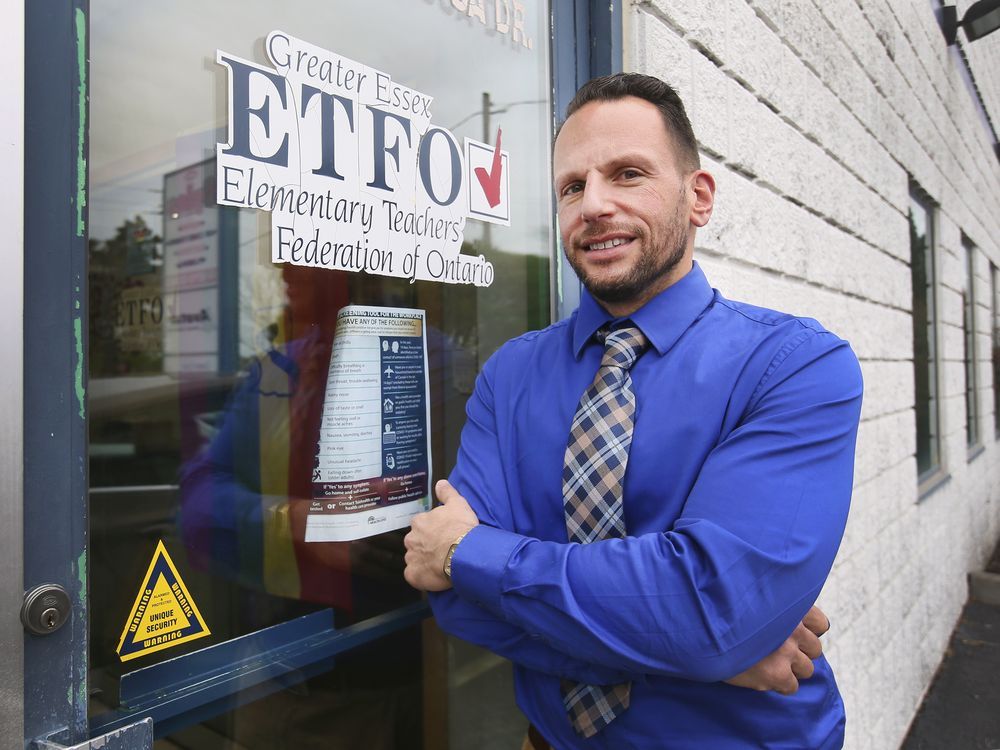
Mario Spagnuolo, president of the Greater Essex chapter of the Elementary Teachers’ Federation of Ontario is shown at his Tecumseh office on Wednesday, December 15, 2021.Photo by Dan Janisse /Windsor Star
Article content
The scramble to arrange child care and technical support is on as students and families just learned Monday that the Ontario government was pushing education back to online only for at least the next two weeks.
Advertisement
This advertisement has not loaded yet, but your article continues below.
Article content
Facing a vertical surge of COVID-19 cases fuelled by the Omicron variant, Premier Doug Ford announced the delay to in-person learning along with a number of other virus-related restrictions Monday, just 48 hours before K-12 schools were scheduled to reopen.
This will give us time to get some of those safety measures in place
Last Thursday, the Ford government said in-person learning would only be delayed two days, with a post-holiday restart planned for this Wednesday.
“Parents are frustrated, teachers are frustrated and our kids are frustrated, they really wanted to go back to school,” said Mario Spagnuolo, the local Greater Essex president of the Elementary Teachers’ Federation of Ontario. “We do believe the decision today is much safer than the decision made on Thursday.”
Advertisement
This advertisement has not loaded yet, but your article continues below.
Article content
Mario Spagnuolo, president of the Greater Essex Elementary Teachers’ Federation of Ontario, stands outside ETFO offices in Tecumseh on Dec. 15, 2021.Photo by Dan Janisse /Windsor Star
Spagnuolo said a two-day delay to in-person learning wasn’t sufficient for the safety of educators and students.
“That’s just not reasonable without having N95 masks, HEPA filters and there are no rapid tests for staff,” Spagnuolo said. “And many of our educators have not been able to get a booster shot. They’re still in line waiting because there’s such a backlog. This will give us time to get some of those safety measures in place.”
The government had previously announced it would supply N95 masks to educators in the face of a much more transmissible variant and an additional 3,000 HEPA filters for schools across the province.
The Windsor-Essex Catholic District School Board expected a shipment of N95 masks Tuesday and they’ll receive an additional 30 HEPA filters. The Greater Essex County District School Board expected N95 masks for staff to arrive by Friday, if not sooner according to director of education Erin Kelly.
Advertisement
This advertisement has not loaded yet, but your article continues below.
Article content
Kelly said the board had also been allocated additional HEPA filters. She noted Monday’s announcement was made out of “alarm and concern with the spread of this variant.”
Ford said students would be online until at least Jan. 17 when the stability of the health-care system would be reassessed.
“I know online learning is not ideal,” Ford said. “We want to protect students and teachers.” Emelda Byrne, the director of education for the Catholic board, called the switch to remote learning “prudent and cautious.”
“It’s a decision that is in the best interests of staff, students and families,” Byrne said. “Hopefully remote learning is only for this short time.”
Byrne noted that due to the dramatic increase in case counts “I feel it would have become an operational issue for our board to adequately staff our classrooms due to increased absenteeism,” if in-person learning resumed this week.
Advertisement
This advertisement has not loaded yet, but your article continues below.
Article content
Administration from both boards met with principals Monday.
“One of the things we have to do is communicate with parents and staff about processes and ensure people have the necessary devices for remote learning,” Kelly said.
NDP leader Andrea Horwath quickly slammed Ford’s latest pandemic plan.
“Parents are horrified — another school shutdown is a massive blow to kids’ wellbeing,’ Horwath said in a statement.
This marks the third time students have been driven to online learning since the pandemic began in March 2020.
The Elementary Teachers’ Federation of Ontario advocated for a short delay to in-person learning but noted “this shift to remote learning is frustrating because we know it could have been avoided had the province funded and implemented safety measures at the onset of the COVID-19 pandemic, not half measures,” said President Karen Brown.
Advertisement
This advertisement has not loaded yet, but your article continues below.
Article content
Ford didn’t answer a reporter’s question Monday about whether he would fortify safety measures in schools during the ensuing two-week period.
Barb Dobrowski, the President of the Ontario English Catholic Teachers’ Association, called on the government to use these next weeks to prioritize boosters for educators, get rapid tests in schools, provide N95s for all, reinstate case counting and hold student vaccination clinics.
“Throughout the pandemic, the Ford government has opted for a wait-and-see approach to COVID-19, and then scrambled to make last-minute decisions that offer little more than half-measures,” Dobrowski said in a statement. “Today’s decision, coming just four days after their last ‘plan’ was announced, was entirely avoidable. This is yet again another reactionary measure in a long list that stems from this government’s abdication of leadership, which has repeatedly failed students, parents, teachers, education workers, and all Ontarians.”
Advertisement
This advertisement has not loaded yet, but your article continues below.
Article content
Windsor-Essex families told to prepare for possible post-holiday virtual school
Parents and students fear potential return of remote learning
St. Clair College, UWindsor adjust plans for winter semester
Annie Kidder, the executive director for People for Education, took to social media to encourage vaccine mandates for staff and students and the establishment of a COVID education advisory committee comprised of health and education experts.
Both St. Clair College and the University of Windsor had previously announced a delay to in-person learning until later in January.
mcaton@postmedia.com
Share this article in your social network
Sign up to receive daily headline news from the Windsor Star, a division of Postmedia Network Inc.
By clicking on the sign up button you consent to receive the above newsletter from Postmedia Network Inc. You may unsubscribe any time by clicking on the unsubscribe link at the bottom of our emails. Postmedia Network Inc. | 365 Bloor Street East, Toronto, Ontario, M4W 3L4 | 416-383-2300
Thanks for signing up!
A welcome email is on its way. If you don’t see it, please check your junk folder.
The next issue of Windsor Star Headline News will soon be in your inbox.
We encountered an issue signing you up. Please try again
Oregon’s education and learning and health leaders say if schools keep on to host extracurricular pursuits, “they really should count on speedy transmission of COVID-19″ that could reduce college students from remaining capable to attend class in-person due to isolation and quarantine periods.
Oregon’s schooling and overall health leaders place out that warning in an advisory Monday. The organizations say colleges and businesses need to possibly pause extracurricular activities or make sure they adhere to specific COVID-19 basic safety protocols.
If educational facilities decide on to go on extracurriculars, the agencies mentioned they need to have to obviously communicate the opportunity challenges to people.
The concept from the Oregon Section of Training and Oregon Wellness Authority comes as educational institutions about the state start out their new terms and the omicron variant of the coronavirus continues to spread.
“It’s all about seeking to carry on to assure that our pupils can show up at university in-particular person each individual day,” ODE Director Colt Gill told OPB Monday.
Gill reported that consists of schools continuing to implement the mitigation initiatives they have now been using — together with putting on proper confront coverings, next physical distancing pointers, recurrent hand washing and use of air flow methods.
The new advisory inspired educational facilities to put into action free of charge COVID-19 screening applications.
The ODE and OHA advisory also encouraged colleges to retrain college staff members on security protocols, as well as teach personnel, students and family members about COVID-19 indications. But the major transform advised in the advisory has to do with things to do outside of the university working day.
“[W]e have seriously questioned our schools and other organizations that serve college students to really be considerate about their extracurricular routines,” Gill reported.
Kellogg Center College principal Richard Smith greets college students on the initial working day of university back again on Sept. 1, 2021.
Elizabeth Miller / OPB
That features both pausing extracurricular things to do or making certain they use the same security protocols that are in location for the duration of the college working day, such as encounter coverings.
“We know those people mitigation efforts work and they have been protecting against the distribute of COVID-19, but we do not generally use those in extracurricular actions such as sports, and we’re actually nervous we’ll see fast transmission in these settings except communities appear jointly and use the same forms of protocols we use all through the faculty working day immediately after the university day,” Gill said.
The companies are also inquiring households and group associates to do their portion in supporting assure faculties can continue in-human being teaching and finding out. Namely, ODE and OHA are urging mothers and fathers to maintain college students house if they have COVID-19 indications. The companies are also encouraging family members and small children to get vaccinated and get COVID-19 booster pictures, and to restrict non-vital actions and gatherings.
“Spread in the community is what could cause a school sooner or later to shut to in-person instruction and go back to on line understanding for a shorter interval of time,” Gill explained. “The extra communities can do to make sure people today are vaccinated and boosted so there is fewer likelihood that they are spreading COVID-19 from 1 individual to yet another, or significantly less probable that they may possibly will need the solutions of a clinic and actually tax that procedure — that will enable keep our school personnel safe and sound and our pupils protected and keep them in in-human being instruction.”
ODE Communications Director Marc Siegel explained the agency is not setting up a statewide return to length studying, like what took place at the beginning of the pandemic in March 2020. But, individual school districts will be in a position to make that connect with themselves if essential.
“For just about every faculty district, that’s a regional faculty district determination, manufactured in coordination with local well being authority,” Siegel told OPB.
The very same quotation has been sitting down on Rymfire Elmentary School P.E. instructor Robert Cerasi’s desk for 20 years. “A hundred many years from now it will not matter what my bank account was, the kind of home I lived in, or what sort of auto I drove. … But the globe may possibly be diverse simply because I was critical in the lifetime of a little one.”
“From my struggles, I have always required to give back again. … I really feel that each university student has price, and it has been my quantity one objective to make a favourable effects on just about every scholar that I instruct.”
— ROBERT CERASI, Rymfire Elementary Faculty Teacher of the Yr
As a P.E. teacher, Cerasi has an advantage that most other teachers will not: He sees every single scholar every faculty day.
“I am equipped to touch the life of all of my pupils each and just about every day,” he wrote in his software resources for the Trainer of the Year award. “I think in setting up strong relationships. … I want them to be effective, and it is my job to make them truly feel cared for and appreciated, and to enable them know that they have worth.”
Cerasi has been training at Rymfire given that it opened in 2006 and is head coach and director for the Rymfire Elementary Managing Club. He is been training for 23 yrs, and created Rymfire’s bodily schooling curriculum.
University hadn’t come easy for him when he was a boy.
“I experienced to operate very tricky to overcome my struggles,” he wrote. “From my struggles, I have always required to give again. … I really feel that every single pupil has worth, and it has been my range a person intention to make a good affect on each and every student that I teach.”
To make sure students are progressing, he has his younger students demonstrate skills like galloping, hopping, skipping and functioning at established intervals through the 12 months, while more mature college students are assessed in functioning, pushups, sit-ups and agility. More mature college students also master sporting activities like floor hockey, basketball, soccer and pickleball.
To integrate broader learning into his lessons, he is worked along with a health trainer and partnered with nurses at AdventHealth to build a “Mission Fit” method training next-quality and a fourth-quality pupils about diet, workout and healthful lifetime possibilities.
He’s spearheaded the school’s area days, which have associated extra than 1,000 college students.
“My greatest strength is how I am ready to motivate my learners to work as tough as they can, even though pupils however have an fulfilling practical experience,” he wrote. “My higher power and passion is contagious, and it encourages my learners to do their very ideal.”
As the pandemic rages on, there is no conclude to climbing pendency of scholar visas in Punjab. There was a temporary maximize in pupil visas currently being granted by Canada just lately, but the Omicron threat has reversed the craze. And it is the non-SDS (Student Immediate Stream) group college students who are suffering the most as the number of these approvals have been slashed down majorly.
There are two classes less than which the pupils can apply for learning in Canada and these include things like SDS (Student Immediate Stream) and non-SDS. SDS was released in 2018 as just before this students ended up applying underneath College student Lover Programme (SPP). Non-SDS is a normal visa software class below which also pupils can utilize.
Several educational consultants working in Canada analyze visas mentioned that rate of clearance of non-SDS visas right before the pandemic was high.
In SDS, mostly four ailments are required to be fulfilled by the learners including IELTS with least 6 bands in all classes of testing, provide letter from the Specified Finding out Institute (DLI) slipping under SDS record of faculties, Certain Financial investment Certificate (GIC) to go over the price tag of living and advance payment of the a single year fee.
Below non-SDS category, students with 5.5 bands in a person of the 4 spheres, but general 6 bands can implement and also they will need to demonstrate sufficient money in their accounts for their dwelling costs for one particular calendar year as an alternative of depositing the similar.
“Due to lockdowns, there was substantial pendency in clearing the visa purposes of the pupils, who have applied in both SDS and non-SDS classes, and from India itself it is amongst 3 to 3.5 lakh apps in these two decades of pandemic. Canada now prefers SDS group 1st simply because of which non-SDS candidates are struggling with hefty refusal,” explained Hardeep Singh, Harnidh Overseas Pathway Education, a advisor, adding that considering the fact that 2018 when the variety of schools which can give review permits to the pupils have absent up from 47 to all-around 500, the selection of purposes have also improved manifold.
“With the introduction of SDS, now the apps numbers are heading up. But for the reason that of Covid constraints, Canada is looking at only those who acquired significant bands in the IELTS and are making use of beneath SDS class,” he stated. Narpat Singh Babbar of Jupiter Academy, who is a Canadian Schooling Marketing consultant, claimed that earlier if they employed to implement 10 applications under non-SDS group then 9 got a nod, but now it is other way spherical.
He also educated that 35 to 50 for every cent of the full variety of college students showing up for IELTS in Punjab are clearing IELTS with six and over bands in the 1st attempt and the remaining either choose repeat test of IELTS or desire to utilize beneath non-SDS class if their over-all rating in 6 bands which includes 5.5 bands in a single out of the four spheres.
“That indicates all-around 50 to 60 for each cent students are continue to implementing less than non-SDS category for researching in Canada although they have choices for other locations like in the United kingdom. But bulk such pupils like Canada only simply because of excellent Everlasting Residency (PR) programmes of the Canada,” he mentioned.
“When the applications in non-SDS category are large, then the refusal price of visas would also be higher in this class,” reported Babbar.
He knowledgeable that there are numerous SDS schools which also settle for learners below non-SDS group, while most students are less than the effect that they are unable to apply for SDS stated colleges.
He added that there are numerous spots and programmes of the Canadian government underneath which the students applying less than non-SDS can be benefitted.
“There are locations which Canadian government wishes to create beneath Rural and Northern Immigration (RNPI) Pilot programme and experienced workers can apply right here by meeting the needed requirements.”
For Isabel Bishop, 12, and her 8-year-old brother, Bodhi, school might mean a trip from their home in Fairfax County to the Harriet Tubman Museum in Maryland to learn about slavery and the underground railroad.
For Mali Holmes, 7, of Richmond, school might mean playing chess with friends and developing critical thinking and problem-solving skills.
For Tera Thomas’ sons – Noah, 10; Jude, 8; and Elias, 7 – school might mean baking Christmas cookies. “Lots of math and instruction following,” the boys’ mother said.
Those children are among the approximately62,000 home-schoolers in Virginia – a number that has doubled over the past decade and is up 40 percent since fall 2019.
Experts say home schooling has grown in popularity across the socio-political spectrum, from the religious right to the humanist left, driven in recent years not only by the COVID-19 pandemic but also by the culture wars being waged in many school districts.
“I think it will permanently change the landscape of education,” said Yvonne Bunn, director of government affairs for theHome Educators Association of Virginia, or HEAV. “I don’t think it will ever go back to the way it was before.”
Bunn said home schooling lets parents “individualize the curriculum to fit the needs of their children.”
Nikiya Ellis, Mali’s mother, agreed.
Mali Holmes holds a drawing at an art class at the Cultural Roots Home School cooperative. (Photo courtesy of Nikiya Ellis)
“Our children learn from us in different ways,” she said. “And it doesn’t have to be this academic way of learning all day, every day. They learn from watching us cook, watching how we treat each other. It doesn’t have to be sitting down at a table with pen and paper.”
Over the past two years, home schooling hasincreased in 120 of Virginia’s 132 school divisions, including inall but one of the 15 largest districts. If home-schoolers were a division unto themselves, it would be thesixth-largest in the commonwealth – with about as many students as the public schools of Virginia Beach or Chesterfield County.
COVID-19 was the main trigger. When the coronavirus prompted schools to move instruction online in spring 2020, many families created “pandemic pods“ to home-school their children: A handful of students, often from the same neighborhood, would study together, led by parents or a hired teacher.
As a result, the number of home-schoolers in Virginia spiked from about 44,000 before the pandemic tomore than 65,500 for the 2020-21 academic year, when instruction remained virtual in most communities.
Tera Thomas’ children were part of that initial exodus from the public schools.
“We knew there was no way our kids were going to enjoy being on a computer all day,” said Thomas, a former high school English teacher who lives in Louisa County. “I don’t even want to be on a computer all day.”
Adah Thomas, 3, creates pictures by arranging tiles of different shapes and colors. (Photo courtesy of Tera Thomas)
When public schools resumed in-person classes this fall, some home-schoolers returned to campus, but most continued their studies at home. They were joined by children like Isabel and Bodhi Bishop.
Their mother, Carlea Bauman, said home schooling not only makes learning fun and interactive but also helps her forge “deeper relationships with my kids.”
With the sharp spike when COVID-19 emerged and then a slight dip this fall, home schooling in Virginia has seen a net gain of about 18,000 students over the past two years.
“That’s amazing to us,” Bunn said.
The number may continue to grow. Since September, Bunn said, HEAV has handled more than 21,000 phone calls for advice about home schooling. “It’s been unbelievable the surge in parents just wanting to know what they need to do and how they could do it.”
Andrea Cubelo-McKay, president of theOrganization of Virginia Homeschoolers, said many families that turned to home schooling early in the pandemic thought it would be a temporary move. But they “decided to continue home schooling because it was a really positive experience for them.”
Isabel Bishop sitting next to a statue of Harriet Tubman at the Harriet Tubman Underground Railroad National Historical Park in Maryland. (Photo courtesy of Carlea Bauman)
Why the increase? Zoom, masks, CRT and Billie Eilish
At the start of the COVID-19 pandemic, Cubelo-McKay said, two factors boosted home schooling:
When public schools moved online, many students experiencedZoom fatigue,failing grades and other trouble learning in a virtual environment. They wanted an alternative.
At the same time, more parents were working from home, had flexible schedules or were furloughed from their jobs. That made them more available for home schooling.
When school doors re-opened for the 2021-22 academic year, numerous parents and studentsopposed mask requirements, social distancing and other measures adopted by school boards to curb the spread of the virus.
In addition, some home schooling advocates have circulated misinformation that the coronavirus vaccines are dangerous and that public schools are forcing students to get them. Such misinformation may have scared some parents about sending their children back to school.
For example, in anonline interview with The Virginia Mercury, J. Allen Weston, executive director of theNational Home School Association, said some parents fear “that their children will be bribed or coerced into getting injected with a ‘so-called’ vaccine that has been proven to be damaging and even deadly to many who get it.” (In fact,scientists agree that the COVID-19 vaccines approved for children by the U.S. Food and Drug Administration are safe and effective.)
But it wasn’t just COVID-19 that spurred home schooling.
In Loudoun County, where Cubelo-McKay lives, angry parents disrupted school board meetings over the role of critical race theory in teacher trainings and education more broadly (school officials insisted that it is not part of the curriculum) and byprotesting a policy requiring teachers and staff to refer to transgender students by their chosen pronoun.
Conservative commentatorshave speculated that those controversies prompted politically conservative families, especially Whites, to pull their children from the public schools.
At HEAV, which espouses a “biblical worldview,” Bunn said parents may have turned to home schooling because “they feel like they’re not being heard” – a theme that Republican Glenn Youngkin struck in his winning campaign for governor in November.
“The children don’t belong to the state. I think parents really want to impart their own values to their children – their values and beliefs and their own worldview. And that is a major reason parents are home schooling,” Bunn said.
At VaHomeschoolers, whichcalls itself an inclusive alternative to “Christian conservative home-school organizations,” Cubelo-McKay said the rancor over social issues in the public schools had a different effect: It drove more Black and LGBT students to try home schooling.
“They didn’t feel safe with the level of hostility” toward racial equity iniatives and transgender rights, she said.
Beyond public school policies, recent buzz overcelebrity home-schoolers has energized the home-schooling movement. Grammy Award winnerBillie Eilish has attributed her success as a singer and songwriter to her years of being home-schooled. And Zaila Avant-garde, a 14-year-old home-schooler from Louisiana,won the 2021 Scripps National Spelling Bee.
Virginia is among top states for homemschooling
Home-schoolers represent about5 percent of Virginia’s total public school enrollment. That is among the highest proportions in the United States, according to theNational Home Education Research Institute.
Fifteen states publicly report their home-schooling numbers, the institute said.Only two – North Carolina and Montana – had a greater percentage of home-schoolers than Virginia.
The proportion of home-schoolers varies widely among the commonwealth’s school divisions. It ranges from less than 1 percent in Arlington County and the city of Norton to more than 15 percent in eight mostly rural counties. In Franklin and Highland counties, nearly one of every five students is home-schooled.
The law on home schooling, and a call to ban it
The Home School Legal Defense Association, based in Loudoun County,considers Virginia a “moderate regulation” state in terms of home schooling.State law has two main requirements:
By Aug. 15 of each year, parents must file a notice with their school district that they plan to home-school their children. The notice must list the subjects each home-schooler will study.
At the end of the school year, parents must submit “evidence of the child’s academic achievement.” That can be a standardized test score or an evaluation by a licensed teacher or “a person with a master’s degree or higher in an academic discipline.”
In Virginia, parents generally need only a high school diploma to oversee their child’s home schooling. Even then, there’s an exception: Parents who didn’t graduate from high school can home-school their children if they use “a program of study or curriculum,” such as correspondence or distance-learning courses.
A Harvard Law School professor recently created a stir among home-schooling advocates when she criticized such laws as too lax and said home schooling should be closely regulated if not banned.
In anarticle in the Arizona Law Review,Elizabeth Bartholet, who specializes in child welfare laws, called for a “presumptive ban” on home schooling, saying it “presents both academic concerns and democratic concerns.”
In afollow-up interview, she said there is a danger that home-schoolers “are simply not learning basic academic skills or learning about the most basic democratic values of our society or getting the kind of exposure to alternative views that enables them to exercise meaningful choice about their future lives.”
Citing “right-wing Christian conservatives” in particular, Bartholet said many home-schooling parents question science and “are extreme ideologues, committed to raising their children within their belief systems isolated from any societal influence.”
She noted the dearth of independent, peer-reviewed research to support claims that home-schoolers are as well prepared academically and socially as public school students. “We have zero evidence that, on average, home-schooled students are doing well.”
They pointed out that home-schoolers are diverse: African Americans represent the fastest-growing home-schooling demographic nationwide, and Black and Hispanic families have been more likely than Whites to home-school their children during the pandemic,according to a 2020 survey by the U.S. Census Bureau.
Proponents of home schooling also saymost studies show that home-schoolers do better than their regular-school counterparts on achievement tests and in college later on; however, such studies often have been sponsored by home-schooling advocacy groups like theNational Home Education Research Institute.
Mali Holmes; his mother, Nikiya Ellis, holding their dog Toga; and Hollee Freeman, who tutors Mali in reading, outside the Richmond library. (Photo by Hollee Freeman)
How and why families home-school children
Many parents say they have firsthand evidence of the benefits of home-schooling. Nikiya Ellis said it has been a far better fit for her son Mali than Barack Obama Elementary School, which serves the family’s Battery Park neighborhood in Richmond.
“He’s not a disrespectful child at all, but he’s curious and he’s smart,” said Ellis, who is a doula (a home-birth assistant to a midwife) and co-director of the nonprofit organizationBirth in Color RVA. She said Mali likes to ask questions like “Why?” and “Can I do it another way?”
Mali attended Obama Elementary for kindergarten during the 2019-20 academic year, and his inquisitiveness got him in trouble, Ellis said.
“We want our children to be free-thinking and creative,” she said, but Mali’s teacher “felt that he wasn’t listening and he was being defiant because he was questioning her.” As a result, Mali received frequent demerits (repeatedly being placed “on red” in the school’s behavioral management system) and was moved to the back of the classroom, Ellis said.
She said Mali wanted to learn, but the school’s chief lesson was “obey authority, don’t question anything, sit in your seat and be quiet – and if you don’t, you’ll be punished.”
When she picked up Mali from school in the afternoon, Ellis said, “Sometimes, we were literally in tears.”
For the 2020-21 academic year, Richmond Public Schools, like other districts, held classes only online. “That did not work for Mali at all,” Ellis said.
So for the current year, Ellis developed a home-schooling system that she believes does work. It has several components, including:
• A curriculum fromAcellus Academy, a popular learning program for home-schoolers. Mali is taking classes in math, English, robotics and Spanish. The program involves online coursework, working independently and studying with guidance from Ellis; her partner, Duron Chavis; and, on weekends, Mali’s father, David Holmes. (Ellis and Holmes are divorced.)
• Activities at theCultural Roots Homeschool Cooperative, which emphasizes the “cultural attributes, traditions and histories of Black and Brown communities.” Mali takes classes in art, cultural studies, science, yoga and capoeira, a Brazilian martial art that combines elements of dance, acrobatics and music. Mali also plays chess and outdoor games with friends at the co-op.
• Lessons mostly in reading and writing with Dr. Hollee Freeman, anaward-winning teacher and executive director of the regionalMathScience Innovation Center. Mali is reading on a fifth-grade level, Ellis said.
• Weekly visits to the Libbie Mill Library to check out books, participate in scavenger hunts (finding pictures among the stacks) and meet in a study room to work on academic projects.
• Field trips to venues such as the Science Museum of Virginia, where Mali recently watched an immersive film about Antarctica and played the role of a pit crew member for anexhibit about Hot Wheels, racing and velocity. “When the environment is a fun, welcoming one, Mali doesn’t even notice when he’s actually ‘learning,’” Ellis said. “He takes it all in and is eager to know more.”
That schedule is packed but doable, Ellis said.
She is a busy person: Ellis and Chavis are urban farmers who manage three community gardens and an orchard, and Ellis is not only a doula but also a beekeeper and a member of aregional task force on maternal and infant health.
But Ellis said she and Chavis are both self-employed and have some flexibility in their work schedules.
Moreover, Ellis said she now realizes that learning can happen at any place at any time. “I never thought that a trip to the grocery store could actually teach my son about math and money,” she said.
For instance, Ellis might give Mali $5 to buy certain items on their shopping list – and if he can come in under budget, he can use the leftover money to purchase a piece of candy.
Another strategy is to let children make some of their own decisions about learning.
Mali hated reading the books he was assigned in public school because “it wasn’t anything that he was interested in,” Ellis said. Now, she said, Mali gets to choose age-appropriate graphic novels. “He loves it, and now he’s going through books.”
The Thomas children — Noah, 10; Elias, 7; Adah, 3; and Jude, 8 — baking Christmas cookies with their mother, Tera, who said the activity counts as home schooling: “Lots of math and instruction following.” (Photo courtesy of Tera Thomas)
Tera and Silas Thomas, who have been home-schooling their three school-age sons for the past two years, also say their children are learning a lot and enjoying it.
The family was living in Henrico County, and the boys were attending Springfield Park Elementary School, “when COVID hit and everything got shut down,” Tera Thomas said.
Even before then, the Thomases were disenchanted with the public schools. For example, Tera Thomas said she felt the teachers assigned a lot of busywork. Her children would come home with a pack of worksheets they had completed at school, she said. “I’d ask, ‘What’s worth keeping?’ And they’d say, ‘None of it.’”
“We wanted there to be more value in their education, more individualized (attention), more freedom to explore and do things,” Tera Thomas said.
So the Thomases took ahome-schooling class from HEAV. And when the public schools shifted to online instruction because of COVID-19, the family switched to home schooling.
Last spring, the Thomases moved to Maidens, an unincorporated community in Goochland County. Tera Thomas said the boys – along with their 3-year-old sister, Adah – enjoy the variety of educational activities the family has developed.
At times, the children work one on one with their mother at the “mom station.” Other times, they work independently – perhaps with a curriculum program likeSaxon Math. Sometimes, they all read a book together but do different follow-up activities based on their academic levels.
It’s structured but customized: When a son was grumpy one morning, Tera Thomas told him to take a break, and then they completed the lesson later in the day.
The Thomases also belong to a home-school co-op, a group of parents who have pooled their resources to organize classes and other learning activities for their children. (Tera Thomas declined to name the co-op because it is a private group and is not seeking more members.) The boys go to the co-op once a week for lessons in science, creative writing, Spanish and American history.
“There’s this idea that home-schoolers are unsocialized – weirdos, for lack of a better term. But there’s a huge network of people” involved in home-schooling, she said. “We have more of a community of friends and parents than we ever did in the three years that we were at Springfield Park.”
In the co-op, parents share ideas on how to facilitate learning. “You don’t really get to have those conversations in the public schools,” Tera Thomas said. “You just are kind of at the mercy of whatever they’re choosing to do – ‘one size fits all.’”
As part of their home-schooling adventure, the Thomases have taken their children on trips – not only to nearby sites like Colonial Williamsburg and Pamplin Historical Park but also cross-country in the family’s pop-up camper.
Tera Thomas said her son Jude is “very into Davy Crockett and Daniel Boone” – and the boy was captivated when the family visited the stomping grounds of those two frontiersmen in Tennessee.
Silas Thomas and his 10-year-old son, Noah, processed a rabbit for market during a “homesteading weekend” at a Virginia farm. (Photo courtesy of Tera Thomas)
On another occasion, the Thomases spent a “homesteading weekend” on a farm.
“My kids came home knowing how to raise chickens and process chickens and rabbits. It was hands-on. I think by the time we were done, my 10-year-old had processed 30 chickens from live to packaged and ready for market,” Tera Thomas said.
“Some people might not see value in that, like ‘How is that teaching you math and other things?’ But it does teach a level of work ethic and self-sustainability and how to take care of animals well.”
Experiential learning also is a crucial component of home-schooling for Carlea Bauman and Geoff Bishop’s children, Isabel and Bodhi.
Bishop works at Marriott International’s headquarters in Bethesda, Maryland; Bauman has worked for various nonprofits and currently is a director forSambhali U.S., which helps women and girls in Rajasthan, India.
They started looking into home schooling after COVID-19 disrupted work and school in the spring of 2020.
Bodhi and Isabel Bishop taking leftover produce from a nearby farm to Food for Others, a food bank in Fairfax County. (Photo courtesy of Carlea Bauman)
When the Fairfax County Public Schools went virtual for the 2020-21 academic year, “they did the very best that could be done,” Bauman said. Even so, she said, “it was awful” for Isabel and Bodhi, who were “anchored to their chairs for eight hours a day.”
In her research, Bauman found that “there is no one way to do home schooling – which is great but also terrifying.” So for the current school year, she developed a program customized for her children.
For Isabel and Bodhi (a name that means enlightenment in Buddhism), home-schooling has included lessons with their parents – Bauman’s strong suits are English and history – and online learning programs such asScience Mom and Math Dad.
The children learn a lot of their own, too. In ablog post, Bauman recounted how Isabel learned math by playing a favorite video game: “She figured out that if she didn’t spend any (of the virtual) money and instead worked on her tasks with other players, her money would start to grow.” In her head, Isabel even calculated the amount to the penny.
The payoff, according to the blog: “Financial literacy AND double-digit multiplication. In a video game. That she was playing on her own. Because she wanted to.”
Such “game-schooling“ has become popular among home-schoolers. Bodhi and Isabel have been playingProof – “a pretty fun math game,” explained Bauman, “and I say this as a person who never liked math.”
On Mondays, Bauman usually takes her children on a field trip – for example, to theU.S. Botanic Garden, Assateague Island National Seashore and historic sites like Jamestown.
The visit to the Harriet Tubman Underground Railroad National Historical Park in Maryland was especially memorable for Isabel. After holding hands with a statue of thefamed abolitionist who escaped slavery and then rescued other enslaved people, Isabel told her mother “that she could feel Harriet Tubman’s spirit,” Bauman said.
Bauman and her children also do community service projects together – hauling leftover produce from a nearby farm to a food bank, for example and conducting a neighborhood food drive.
The children aren’t the only beneficiaries of home schooling, their mother said. “I’m really getting this quality time with them that I will never get back, and I’m so lucky and grateful for that.”
Bauman is a proponent of self-directed education – sometimes called “unschooling“ – in which children follow their own interests at their own pace, without explicit direction from adults.
Andrea Cubelo-McKay also champions that philosophy. Besides headingVaHomeschoolers, she founded theEmbark Center for Self-Directed Education, which provides mentoring, tutoring and work space for home-schoolers and holdsclasses on subjects from creative writing and guitar to cooking and skateboarding. The center, established in 2017, is in Leesburg in Loudoun County.
Society often tells young people they arewasting their time playing video games. But the Embark Centerencourages kids to play Minecraft, Fortnite or Roblox – on grounds that such games can teach academic skills such as math and engineering as well as personal and social skills.
Cubelo-McKay, a former therapist and Montessori teacher, said the center serves students who felt bored and unchallenged, confined and frustrated, or perhaps bullied in traditional schools. Whatever the reason, she said, a regular school setting wasn’t working for them.
One such student was Becca Berglie, 18, who said she stopped attending Fairfax County Public Schools when she was a high school junior in 2019.
“I’ve always struggled with my mental health. I’ve had extreme anxiety and depression throughout my life, and school just made those issues bigger for me,” Berglie said. “I’ve always been an outside-the-box thinker and always very independent – not wanting to do something that somebody told me to do when I didn’t see value in it.”
Online, she discovered the Embark Center and the affiliated Liberated Learners network. With support from her parents, Berglie said, she left the public school system, registered as a home-schooler and became a self-directed learner.
She participated in activities at the Embark Center and even helped lead a class in American sign language, which she had studied in high school. More importantly, Berglie said, the center mentored her on how to pursue her career goals involving agricultural education and youth development.
Becca Berglie holding a chicken at Fairfax County’s Frying Pan Farm Park. (Photo courtesy of Becca Berglie)
As a home-schooler, Berglie said she had more time to work with4-H, a leadership and service program for young people, and atFrying Pan Farm, a Fairfax County park that has horses, cows and other animals and reflects what rural life was like a century ago.
“Embark overall gave me a place of belonging, support and a place that I could learn about myself and heal,” Berglie said. She said the center also helped her navigate the college application process.
“It’s confusing for anyone but especially for a non-traditional student,” Berglie said. “Everything is made for that in-the-box traditional student. It can be scary and confusing because they’re not making it for you. They’re making it for the people that stayed on the conveyor belt.”
Berglie graduated – or “moved on” in Embark Center parlance – last June. She now attends Northern Virginia Community College, where she said she feels better prepared than other students because of her self-directed education.
After community college, Berglie has her eyes set on Virginia Tech, where she hopes to study agricultural sciences, leadership and social change.
“I’m extremely passionate about being able to provide opportunities for other youth to get to know themselves and learn and grow,” she said.
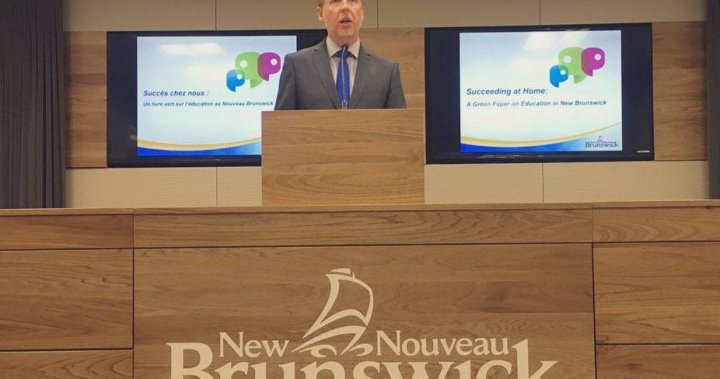
New Brunswick learners are preparing to go to on the internet understanding for at the very least two weeks, as COVID-19 scenarios go on to surge in the province.
Instruction Minister Dominic Cardy built the announcement on Friday.
At first, students were being to return to the classroom on Jan. 10, but with rising COVID-19 scenario counts and Omicron staying highly transmissible, the ministry transformed system.
“We have been seeking ahead to welcoming learners back to in-human being finding out in our province’s K to 12 colleges on Jan. 10. Regretably, the problem has developed and instances have modified,” said Dominic Cardy on Dec. 31.
“In light of the recent scenario with the Omicron variant, learners will discover from property, beginning on Jan. 11 right up until at minimum Friday, Jan. 21, and this decision will be re-evaluated on the week of Jan. 17.”
Tale carries on below advertisement
Go through much more:
COVID-19: N.B. leading checks good, students returning to on the web learning
Cardy has been clear in earlier interviews that shifting to on the internet mastering is not perfect since of the implications it has for college student psychological health and access to means.
Trending Tales


 CDC considering COVID-19 take a look at necessity for asymptomatic Us residents: Fauci


 Ontario considers delaying return to in-class discovering for 2 weeks amid COVID-19 spike
“This will make an influence on our at-chance and vulnerable pupils so we will be functioning with colleges to search at what supports we may well be equipped to deliver, so impacted pupils and families will be delivered with far more information up coming week,” he mentioned.
Given that early September, 193 educational facilities have been impacted by COVID-19. There have been 897 instances connected to educational facilities.
Browse much more:
P.E.I. logs 137 COVID-19 instances above two days, full infections triple in two weeks
Cardy inspired college students who were being presented immediate tests kits to reserve them while a again-to-university day is identified.
If you’re symptomatic, Cardy explained, save them.
The kits have been in significant desire. Well being Minister Dorothy Shephard introduced on Friday that much more kits would be sent to the province in the coming weeks.
“Please hold off on applying all those kits unless you turn out to be symptomatic until finally we have a confirmed return to faculty date. I take pleasure in everyone has people kits. Keep them heat, keep them secure at residence, you should really don’t use people college kits right until we have a confirmed back to faculty day for in-human being understanding,” Cardy said.






/cloudfront-us-east-1.images.arcpublishing.com/opb/C67KL5QFBVFSTBMTDPGPLEBRYQ.jpg "Oregon education, health officials warn of ‘rapid’ COVID-19 transmission in school activities")